Anna Akhmatova, née Gorenko, is best known for two poems (William T. Vollmann)

Anna Akhmatova, née Gorenko, is best known for two poems, first and foremost the nasty “Requiem,” which attacks the “organs” of state security, and incidentally slanders our prison system. Shostakovich was among that literary effort’s admirers; I wish I had enough space to tell you a few things about that cocksucker. (On the other hand, he did make us laugh from time to time; I don’t mind telling you that my job has its compensations. In 1953 Akhmatova was trying to impress him with some drivel she’d written about his Seventh Symphony, and he thanked her in his usual insincere fashion, then went to the Hotel Sovietskaya and said to his then mistress, G. I. Ustvolskaya, ingenuously assuming the walls don’t have ears: Basically, I can’t bear having poetry written about my music.) Our line on that so-called “work of art” was this: Since she had the good sense not to make a cause out of it, why not let her live out her pathetic little life? We’d already isolated her. Shooting her might have lost us hard currency in the West. Since “Requiem” accuses us, and we already know ourselves, it’s of zero investigative interest.

That leaves the “Poem Without a Hero,” whose publication I for my part have always welcomed. Do you remember when Hitler staged that exhibition of degenerate art? Don’t get me wrong; every time I see a German I want to string him up by the balls; nonetheless, I’m man enough to say this straight: Hitler wasn’t incorrect in that instance. Now, “Poem Without a Hero” is as degenerate as anything the Nazis banned. It portrays the so-called “life” of a clique of a parasites and intellectuals in Leningrad before our Revolution. This was the Symbolist epoch, whose atmosphere N. Berdayev aptly characterized as the putrefied air of a hothouse. My children even studied it in school (I had the teacher arrested). To me the main interest of the poem is this: All the characters are real, in which case have we identified all those bastards and sent them where they belong?

From William Vollmann’s novel Euorpe Central.

You can read “Requiem” here and “Poem without a Hero” here.

Connect the dots

velvets-connect

Trompe l’oeil with Studio Wall and Vanitas Still Life — Cornelius Norbertus Gijsbrechts

Books Acquired, Some Time in April, 2014

Got way way behind on this feature of the blog this month. I don’t even know if readers like this feature, this “Books Acquired” thing. It’s mostly been a way to give some kind of press for unsolicited review copies, as well as books I buy compulsively.

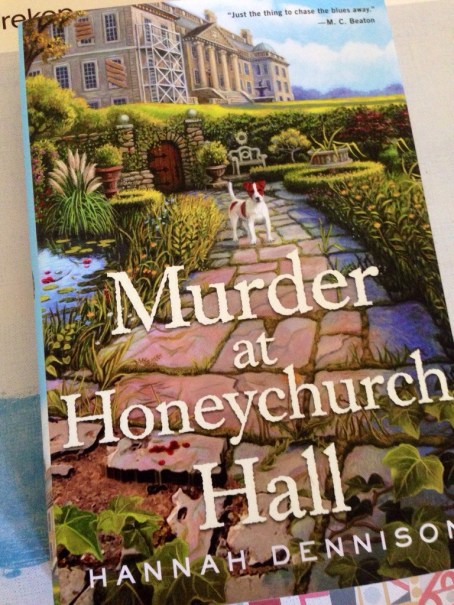
Anyway: I’m not too into the cozy mystery thing, but I love this cover for some reason. Just makes me laugh:

20140424-144637.jpg

From the Kirkus review of Hannah Dennison’s Murder at Honeychurch Hall:

Kat Stanford quit her job as star of the reality TV show Fakes & Treasures, hoping to find a quiet place to open an antiques store with her mother, Iris. She wasn’t counting on Iris’ impetuous decision to buy a carriage house from the dowager Countess of Grenville, mother of the owner of Honeychurch Hall. Arriving in Little Dipperton, Devon, to help her mother settle into what sounded like a picturesque cottage, Kat finds Iris living instead in a dilapidated building with holes in the floors; antiquated fixtures; Kat’s father’s ashes in a Tupperware container; and aggressively spiteful neighbors, Eric Pugsley and his wife, the leather-clad housekeeper. Iris insists they’re trying to drive her out of the carriage house, and Kat isn’t sure that would be so bad, especially after the Honeychurch nanny, who warned her about the place, disappears. Worse yet, a conversation Kat overhears between Eric and the Earl of Grenville makes Iris’ suspicions sound uncomfortably plausible. The earl’s first wife died from what were supposedly natural causes but possibly weren’t, a 20-year-old robbery has never been solved, and mystery surrounds a pair of toy bears, not to mention the odd ghost. Kat’s even more shocked to discover that Iris has a secret identity and a closer connection to Honeychurch Hall than her daughter imagined. When she stumbles on a body in a hidden grotto, the only element missing from the well-stuffed plot is romance—a deficiency the local detective inspector just might remedy.

Continue reading “Books Acquired, Some Time in April, 2014”

Book of the Sea — David Burliuk