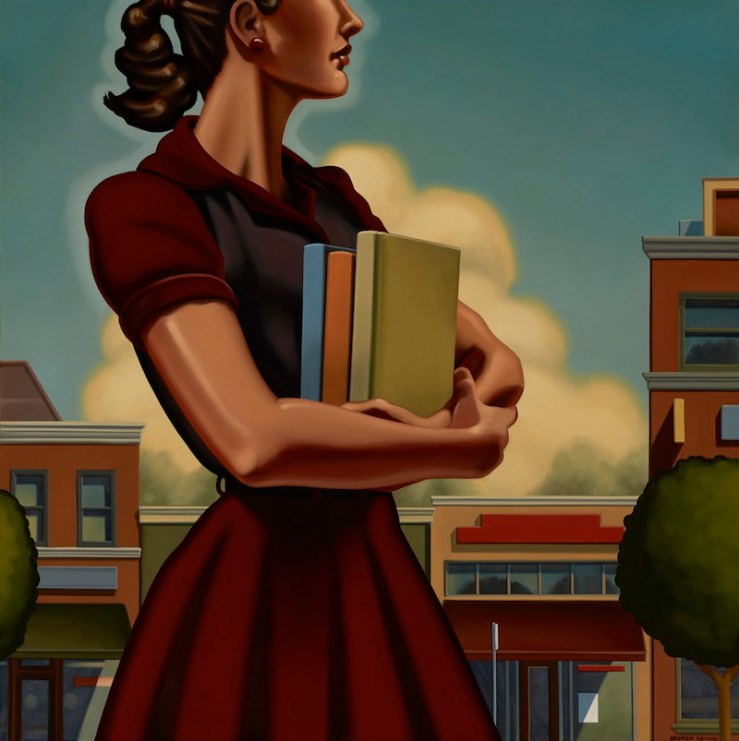
So he lent her books. After all, one of life’s best pleasures is reading a book of perfect beauty; more pleasurable still is rereading that book; most pleasurable of all is lending it to the person one loves: Now she is reading or has just read the scene with the mirrors; she who is so lovely is drinking in that loveliness I’ve drunk.
Amidst the other grey, red, greenish, black and orange volumes of various heights, this white book with the black lettering was perfectly proportioned in every way, neither showy nor insignificant. It was one of his favorite books (we can’t say his favorite since his life wasn’t over yet). He mentioned it, and she was willing to accept it; she was that kind, to read the book which he loved.
At the moment that it actually passed from his hand to hers they were sitting across from each other in one of the three or four restaurants where they usually met; and she, having gazed into his face with her usual richly intelligent seriousness, studied the book she now held with the same air of happy possession which he would have hoped to find had she been looking over his body before making love with him, which she would never, ever do no matter how long they both lived, a fact which made him want to utter a sound much softer and more leaden than any scream; and then, sitting within touching distance of her beautiful hands which he could not touch, he watched her open the book to the title page with its half-calligraphic brush-rendering by an unknown artist of a Buddhist pongmalai garland, probably of jasmine flowers, which was draped across a woman’s naked thigh. This was the most intimate moment that he and she would ever have (unless of course his one percent became a hundred, and she accepted him forever). He would not be at her side when she began to actually read the book; but from their frequent conversations he thought he could keep abreast of where she’d arrived each day. She’d promised to begin it that very night, when she was home with the other man, which meant that she would at least cross the frontier of the half-title page, followed by the dramatic double plant-stalks (connected by a leaf ), of the initial letter E. And now she saw before her those wide white margins and those generous white lines-between-the-lines which encouraged every word to preen itself like the treasure that it truly was.
I should mention that this beautiful volume, which was such a pleasure to hold, began its tale with a dazzling abruptness, as if the reader had just emerged from a dark tunnel into another world, a perfect world whose ground was a hot white plain of salt upon which the words lived their eternal lives.
I need say nothing about the plot, whose involutions (it’s a tale of obsessive love) progressed like the nested terraces on a Buddha-studded tower which narrows perfectly into nothingness. Once I visited a certain wat in Bangkok where although the day was exhaustingly hot and bright I grew enthralled by the sensation of wandering on a high place somewhere in the mist, a plateau exploding with ornately weathered crags. There were many towers, just as in this world there are many perfect books.
From William T. Vollmann’s novel Europe Central.


 Biblioklept