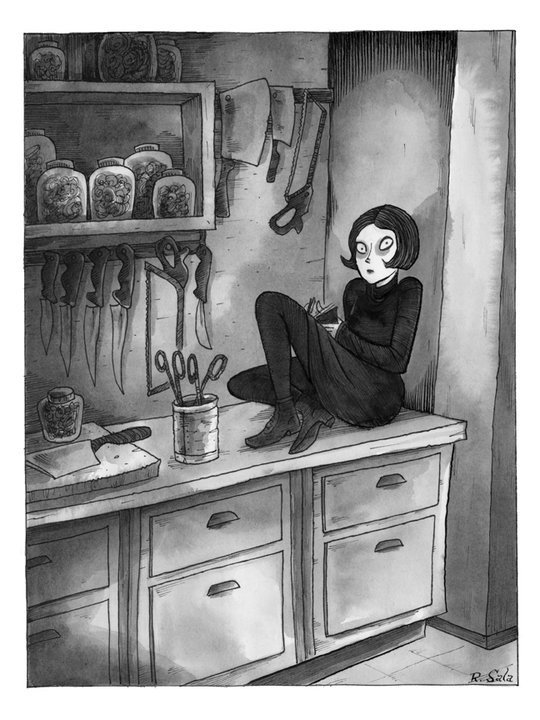
Girl Reading — Richard Sala

tumblr_njw104ES9h1r16qfco1_540

Because It’s So Damn Cold, Donald Barthelme’s Recipes for Fine Homemade Oxtail Soup and Fine Homemade Leek Soup

In his introduction to The Teachings of Don B, Thomas Pynchon praises Donald Barthelme’s soups:

Those recipes. That oxtail soup mix. That “burgoo,” with the frozen ducks in it? A notable moment in chef psychopathology, to be sure — yet such is Barthelme’s genius that even the most porkophobic or duck-intolerant among us is drooling, unashamed, by recipe’s end.

I don’t own The Teachings of Don B, but Pynchon’s description (which I found while looking for something entirely different) piqued my interest (first and foremost: was the recipe even a real thing?). Anyway: Via Maude Newton, via Overnight to Many Distant Cities, and then an additional Google search to The Purest of Treats:

FINE HOMEMADE OXTAIL SOUP

Take Knorr Oxtail Soupmix, decant into same any leftover meat (sliced or diced) from the old refrigerator. Follow above strategies to the letter. The result will make you happy. Knorr’s Oxtail is also good as a basic gravy maker and constituent of a fine fake cassoulet about which we can talk at another time. Knorr is a very good Swiss outfit whose products can be found in both major and minor cities. The point here is not to be afraid of the potential soup but to approach it with the attitude that you know what’s best for it. And you do. The rawness of the vegetables refreshes the civilization of the Soupmixes. And there are opportunities for mercy–if your ox does not wish to part with his tail, for example, to dress up your fine Oxtail Soup, you can use commercial products from our great American supermarkets, which will be almost as good.

And if you’re into Lenten observation:

FINE HOMEMADE LEEK SOUP

Take one package Knorr Leek Soupmix. Prepare as directed. Take two live leeks. Chop leeks into quarter-inch rounds. Throw into Soupmix. Throw in ½ cup Tribuno Dry Vermouth. Throw in chopped parsley. Throw in some amount of salt and a heavy bit of freshly ground pepper. Eat with good-quality French bread, dipped repeatedly in soup.

(See also: Gordon Lish’s recipe for chicken soup).

How to represent Night (Leonardo da Vinci)

That which is entirely devoid of light is all darkness; as the night is like this and you wish to represent a night subject, represent a great fire, so that the object which is nearest to the fire may be tinged with its colour, since the object which is nearest the fire will participate most in its nature. And as you will make the fire red, all the objects which it illumines must be red also, and those which are farther off from the fire will be dyed to a greater extent by the dark colour of night. The figures which are between you and the fire appear dark from the obscurity of the night, not from the glow of the firelight, and those which are at the side are half dark and half ruddy, and those which are visible beyond the edge of the flames will be altogether lighted up by the red glow against a black background. As to their action, make those which are near shield themselves with their hands and cloaks against the intense heat with averted faces as though about to flee; with regard to those who are farther off, represent them chiefly in the act of raising their hands to their eyes, dazzled by the intense glare.

From Baring’s translation of Leonardo’s notebooks.

Wunderkammer — Santiago Caruso

WUNDERKAMMER

The Hook and the Haymaker (Book acquired, 2.12.2015)

IMG_5102

Jared Yates Sexton’s The Hook and the Haymaker is new from Split Lip Press. Dug his last joint, An End to All Things and looking forward to getting into this one. Blurb from his site:

In 2012 Atticus Books released An End To All Things, Jared Yates Sexton’s acclaimed debut collection of stories. Called “invigorating” and “shades of Barry Hannah, Raymond Carver, and Breece D’J Pancake,” it was lauded byThe Portland Book Review as “the beginning of a long literary career.” Here, his next installment of stories, The Hook and The Haymaker, twenty-three award-winning pieces that have appeared in The Southern Humanities Review, Night Train, Verdad, PANK, Midwestern Gothic, among other prominent magazines and publications from around the country.

This book picks up right where Sexton’s debut left off with hard-hitting, gritty glimpses into an America that too-often goes unseen. Set in sweat-saturated sparring rings, the backrooms of gas station speakeasies, and the kitchens of the houses down the street, witness here the untold tales of the losers and the should’ve-beens, the dreamers and the hustlers, all of them just spoiling for their turn at glory or the inevitable one-two punch that puts them down for good.

Eva Cristina — Ernst Fuchs

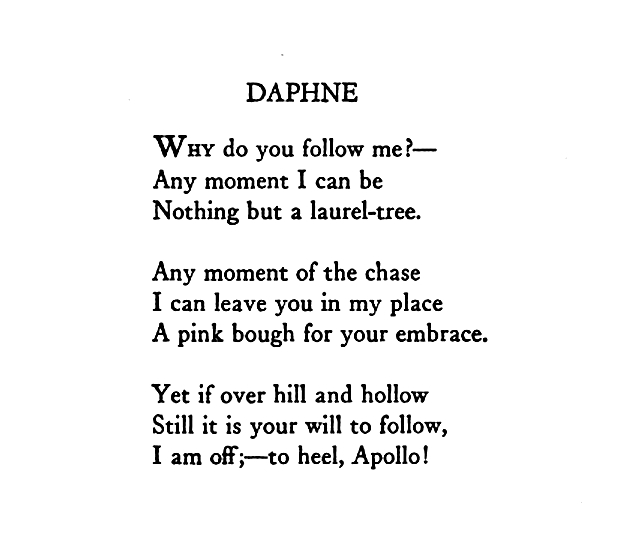
“Daphne” — Edna St. Vincent Millay

daphne

“All art constantly aspires towards the condition of la la la”