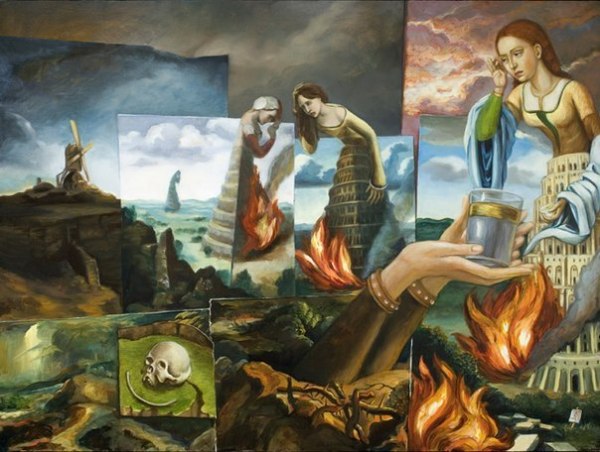
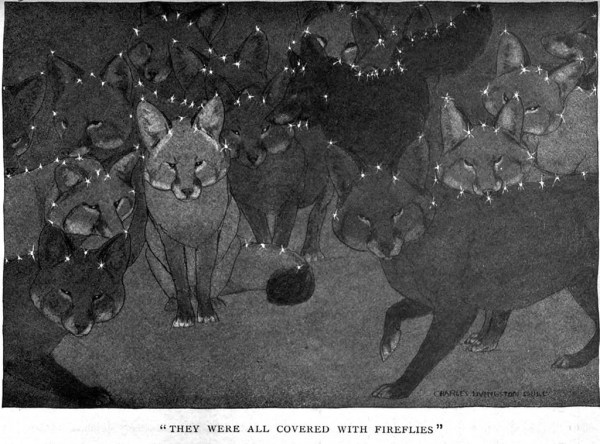
They Were All Covered with Fireflies — Charles Livingston Bull

tumblr_ll5pp8DLJk1qb7dheo1_1280

Reading/Have Read/Should Write About

IMG_7603

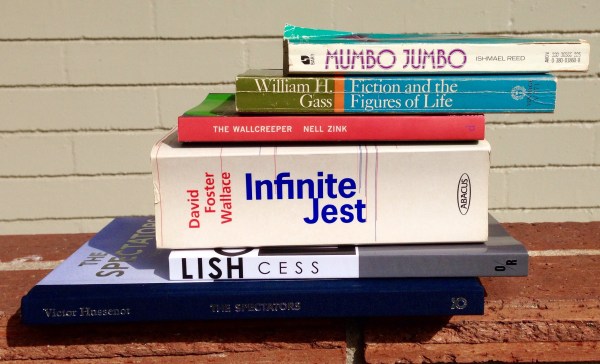
From top to bottom:

Mumbo Jumbo, Ishmael Reed

Last summer, I read Alasdair Gray’s novel Lanark and never mustered a review (Florida heat; Fourth of July fireworks; booze; other excuses). I’ve thought about Lanark all the time though. I’m afraid Mumbo Jumbo is gonna fall in the same slot as Lanark—too much to handle in one read. I need to go back and reread Mumbo Jumbo—just fantastic stuff—conspiracy theories, hoodoo, music, art theft—I owe it more than I seem to be able to register here.

Fiction and the Figures of Life, William H. Gass

So I read a handful of essays in Gass’s earliest essay collection interspersed with Infinite Jest, and I actually did write a bit about one of them here, in conjunction with IJ. Perfect sentences. (Gass’s sentences. Not mine). I wisely shelved the thing (Gass’s “review” of a Donald Barthelme collection almost paralyzed me), leaving more pieces to return to later.

The Wallcreeper, Nell Zink

I started Zink’s first novel The Wallcreeper this afternoon and only put it down when I had to go pick my kids up from day camp. Then I picked it up again. I just put it down again, at a break, of sorts, on page 77, to write this. Every sentence makes me want to read the next sentence (“I felt almost nostalgic toward socially acceptable horrors with larger meanings related to reproduction,” our narrator quips; a bit later: “My life was like falling off a log comfortably located somewhere light-years above the earth”). It’s about this young married couple living in Bern, Switzerland—also sex, birdwatching, music, etc. I was kinda worried that any novel I picked up after Infinite Jest (see below) might suffer, but nah. The Wallcreeper is fantastic so far.

Infinite Jest, David Foster Wallace

Okay, so I mustered a few riffs on rereading Infinite Jest, including a thing about the first 299 pages and a thing for first-time readers—but I finished the novel yesterday, and this is how I felt:

Twitter was the easiest way to try to bottle the feeling of finishing the novel, which is a feeling that I wanted to bottle because didn’t record the feeling of finishing IJ the first time, back in 2001. But I remember finishing it, very, very late at night/early in the morning, and going back through it, rereading that first chapter, trying to figure out What Happened. So what I mean is I felt enthusiasm and energy—it was the opposite of the reread, which was deflationary, I suppose—richer and sadder. And I hate to write this, but it’s impossible not to reread Infinite Jest through the lens of Wallace’s suicide. Just too many suicides in the novel…and then this late passage, from Hal’s narration (elisions and emphasis mine):

…the old specimen’s horrified face as the boy sobs into the chartreuse satin and shrieks ‘Murderer! Murderer!’ over and over, so that almost a third of Accomplice!’s total length is devoted to the racked repetition of this word — way, way longer than is needed for the audience to absorb the twist and all its possible implications and meanings. This was just the sort of issue Mario and I argued about. As I see it, even though the cartridge’s end has both characters emoting out of every pore, Accomplice!’sessential project remains abstract and self-reflexive; we end up feeling and thinking not about the characters but about the cartridge itself. By the time the final repetitive image darkens to a silhouette and the credits roll against it and the old man’s face stops spasming in horror and the boy shuts up, the cartridge’s real tension becomes the question: Did Himself subject us to 500 seconds of the repeated cry ‘Murderer!’ for some reason, i.e. is the puzzlement and then boredom and then impatience and then excruciation and then near-rage aroused in the film’s audience by the static repetitive final 1⁄3 of the film aroused for some theoretical-aesthetic end, or is Himself simply an amazingly shitty editor of his own stuff?

It was only after Himself’s death that critics and theorists started to treat this question as potentially important. A woman at U. Cal–Irvine had earned tenure with an essay arguing that the reason-versus-no-reason debate about what was unentertaining in Himself’s work illuminated the central conundra of millennial après-garde film, most of which, in the teleputer age of home-only entertainment, involved the question why so much aesthetically ambitious film was so boring and why so much shitty reductive commercial entertainment was so much fun. The essay was turgid to the point of being unreadable, besides using reference as a verb and pluralizing conundrum as conundra.

From my horizontal position on the bedroom floor…

There’s hero Hal horizontal, psychic parallel to Don Gately, the hero of stasis, to borrow Hal’s own term…

I’ll try to muster more.

Cess, Gordon Lish

AKA Gordon Lish does whatever the fuck he wants. I read this in one alarmed sitting, and I’m not sure if I read it “correctly,” whatever that means.

The Spectators,Victor Hussenot

Another beautiful book from Nobrow—not a graphic novel, but something closer to a colorful illustrated tone poem, a meditation, a feeling. Excellent review at Loser City, which I made the mistake of reading before I composed my own.
The Manufacturing of Tears — Carrie Ann Baade

VRO69LKBMGU

“This Compost” — Walt Whitman

“This Compost”

by

Walt Whitman

1

Something startles me where I thought I was safest,
I withdraw from the still woods I loved,
I will not go now on the pastures to walk,
I will not strip the clothes from my body to meet my lover the sea,
I will not touch my flesh to the earth as to other flesh to renew me.

O how can it be that the ground itself does not sicken?
How can you be alive you growths of spring?
How can you furnish health you blood of herbs, roots, orchards, grain?
Are they not continually putting distemper’d corpses within you?
Is not every continent work’d over and over with sour dead?

Where have you disposed of their carcasses?
Those drunkards and gluttons of so many generations?
Where have you drawn off all the foul liquid and meat?
I do not see any of it upon you to-day, or perhaps I am deceiv’d,
I will run a furrow with my plough, I will press my spade through the sod and turn it up underneath,
I am sure I shall expose some of the foul meat.

2

Behold this compost! behold it well!
Perhaps every mite has once form’d part of a sick person—yet behold!
The grass of spring covers the prairies,
The bean bursts noiselessly through the mould in the garden,
The delicate spear of the onion pierces upward,
The apple-buds cluster together on the apple-branches,
The resurrection of the wheat appears with pale visage out of its graves,
The tinge awakes over the willow-tree and the mulberry-tree,
The he-birds carol mornings and evenings while the she-birds sit on their nests,
The young of poultry break through the hatch’d eggs,
The new-born of animals appear, the calf is dropt from the cow, the colt from the mare,
Out of its little hill faithfully rise the potato’s dark green leaves,
Out of its hill rises the yellow maize-stalk, the lilacs bloom in the dooryards,
The summer growth is innocent and disdainful above all those strata of sour dead.

What chemistry!
That the winds are really not infectious,
That this is no cheat, this transparent green-wash of the sea which is so amorous after me,
That it is safe to allow it to lick my naked body all over with its tongues,
That it will not endanger me with the fevers that have deposited themselves in it,
That all is clean forever and forever,
That the cool drink from the well tastes so good,
That blackberries are so flavorous and juicy,
That the fruits of the apple-orchard and the orange-orchard, that melons, grapes, peaches, plums, will
none of them poison me,
That when I recline on the grass I do not catch any disease,
Though probably every spear of grass rises out of what was once a catching disease.

Now I am terrified at the Earth, it is that calm and patient,
It grows such sweet things out of such corruptions,
It turns harmless and stainless on its axis, with such endless successions of diseas’d corpses,
It distills such exquisite winds out of such infused fetor,
It renews with such unwitting looks its prodigal, annual, sumptuous crops,
It gives such divine materials to men, and accepts such leavings from them at last.

“The Hungry Stones” — Rabindranath Tagore

“The Hungry Stones”

by

Rabindranath Tagore


My kinsman and myself were returning to Calcutta from our Puja trip when we met the man in a train. From his dress and bearing we took him at first for an up-country Mahomedan, but we were puzzled as we heard him talk. He discoursed upon all subjects so confidently that you might think the Disposer of All Things consulted him at all times in all that He did. Hitherto we had been perfectly happy, as we did not know that secret and unheard-of forces were at work, that the Russians had advanced close to us, that the English had deep and secret policies, that confusion among the native chiefs had come to a head. But our newly-acquired friend said with a sly smile: “There happen more things in heaven and earth, Horatio, than are reported in your newspapers.” As we had never stirred out of our homes before, the demeanour of the man struck us dumb with wonder. Be the topic ever so trivial, he would quote science, or comment on the Vedas, or repeat quatrains from some Persian poet; and as we had no pretence to a knowledge of science or the Vedas or Persian, our admiration for him went on increasing, and my kinsman, a theosophist, was firmly convinced that our fellow-passenger must have been supernaturally inspired by some strange “magnetism” or “occult power,” by an “astral body” or something of that kind. He listened to the tritest saying that fell from the lips of our extraordinary companion with devotional rapture, and secretly took down notes of his conversation. I fancy that the extraordinary man saw this, and was a little pleased with it.

When the train reached the junction, we assembled in the waiting room for the connection. It was then 10 P.M., and as the train, we heard, was likely to be very late, owing to something wrong in the lines, I spread my bed on the table and was about to lie down for a comfortable doze, when the extraordinary person deliberately set about spinning the following yarn. Of course, I could get no sleep that night.

When, owing to a disagreement about some questions of administrative policy, I threw up my post at Junagarh, and entered the service of the Nizam of Hydria, they appointed me at once, as a strong young man, collector of cotton duties at Barich.

Barich is a lovely place. The Susta “chatters over stony ways and babbles on the pebbles,” tripping, like a skilful dancing girl, in through the woods below the lonely hills. A flight of 150 steps rises from the river, and above that flight, on the river’s brim and at the foot of the hills, there stands a solitary marble palace. Around it there is no habitation of man—the village and the cotton mart of Barich being far off. Continue reading ““The Hungry Stones” — Rabindranath Tagore”