Ratner’s Star | On Uncut Gems

uncut_gems_0174939

[Ed. note: Biblioklept originally ran this review in January, 2020 and is posting it again today as Uncut Gems is now streaming in the U.S. on Netflix.]

Frenetic, chaotic, and unceasingly energetic, the Safdie brothers’ 2019 film Uncut Gems plays out like a two-hour panic attack. Uncut Gems opens in the turbulent aftermath of a mining accident. An Ethiopian mine worker is borne up by his frenzied fellows, his leg a raw mangled bloody mess. The Ethiopian workers’ voices mix into the Chinese mine operators’ attempts to calm the situation. This initial cacophony signals the babble and buzz that will continue through the rest of the film, and the camera’s lingering on the destroyed leg signals the violent cost that underwrites the material splendor at the heart of Uncut Gems.

Two Ethiopian miners take a gamble and use the chaos as an opportunity to sneak away, back into the mine to make off with a rare black opal, the titular uncut gem. One of the miners peers into the gem, and the camera follows his gaze. We are taken into a kaleidoscope of shifting colors as Daniel Lopatin’s beautiful synth score kicks in. The camera swirls through the gem and, in an opening sequence that rivals Gaspar Noé’s Enter the Void, eventually enters the colon of our hero, Howard Ratner.

A title card informs us it is two years later. It is 2012 in New York City and Howard Ratner is getting a colonoscopy. There is probably some metaphor here—the aesthetic journey from the gem’s dazzle of color to the interior glistening-chewing-gum-pink flesh of Howard’s colon—but I’ll avoid remarking further upon it.

Here is the film’s premise: Howard owns and runs a jewelry store in the Diamond District. His associate Demany brings rappers and athletes to him to buy unique, high-end pieces. He is flush with cash all the time, but is also severely indebted to a loan shark named Arno (among other folks). However, his debts don’t stop him from continuing to place bets. He is also in the middle of an affair with one of his employees, Julia, whom he keeps in his Manhattan apartment, barely-concealed from his wife and children in Long Island.
uncut-garnett-sandler-1576518581

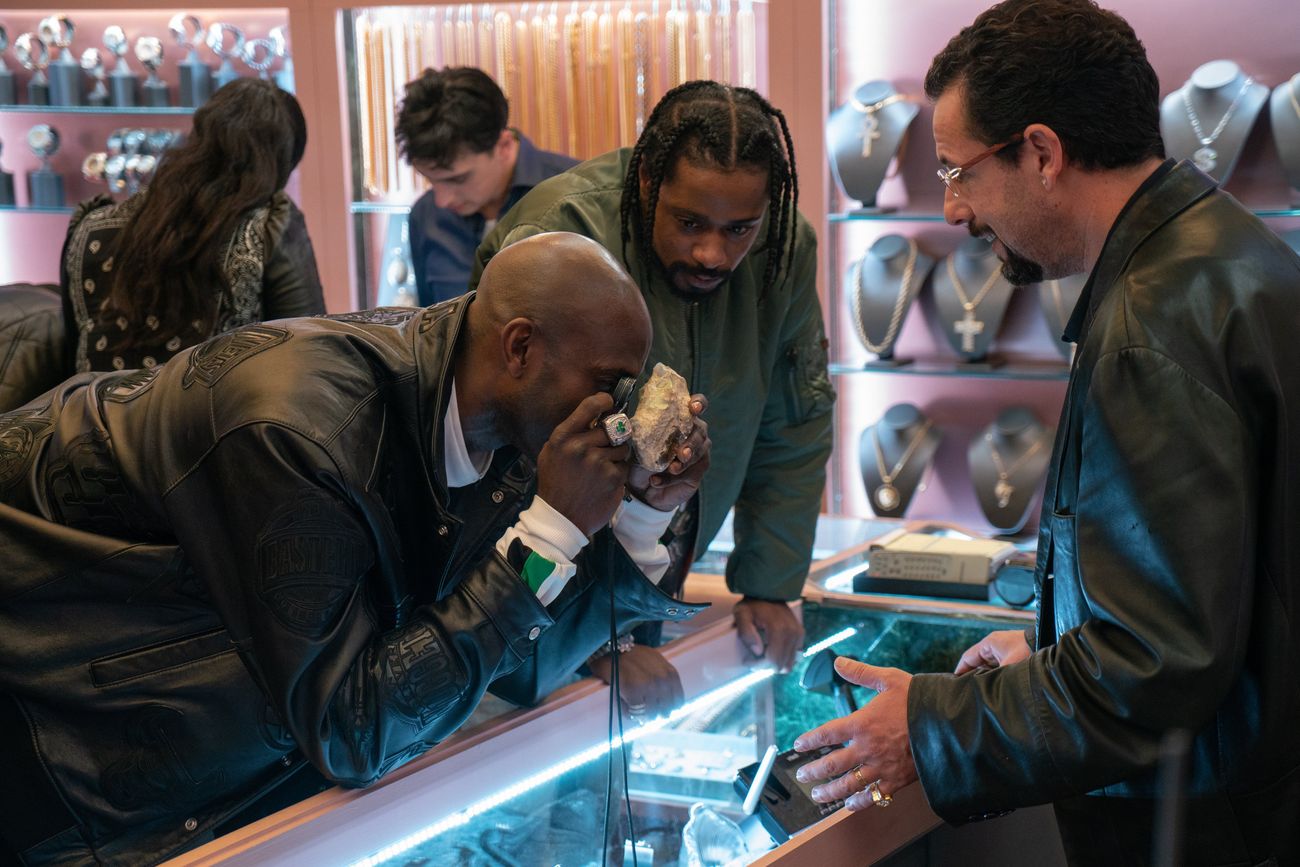
Three things happen on the day we meet Howard: Arno’s henchmen come to prove good on their threats of violence towards him if he does not pay back his loans; Demany brings Boston Celtics power forward Kevin Garnett to Howard’s shop; and Howard receives the titular uncut black opal, which he plans to sell at auction for at least a million dollars. Seeking to impress Kevin Garnett (“KG!”), the jeweler shows off his opal, Ratner’s star. In one of the film’s most extraordinary visual sequences, KG gazes into the opal and undergoes a seismic epiphany. He demands to buy the gem, but Howard refuses—he needs the money from the auction to get clean of debt. However, Howard allows KG to borrow the gem for the night, taking Garnett’s 2008 NBA Championship ring as collateral for its return. KG is convinced that the gem will lead to his success in that night’s Eastern Conference Semifinals game against the Philadelphia ’76ers (it does).

From this early point in the film Howard goes on to make a series of increasingly-nerve-wracking decisions against the backdrop of his loan shark’s enforcers’ increasingly-violent promises of retribution. I will not spoil any more of the plot—my “premise” paragraph seems too long as it is—I’ll simply say that there were moments that I (and other audience members) audibly gasped (in shock, in exasperation, in frustrated disbelief) at Howard’s choices.

Uncut Gems never really lets up. There are a few moments of respite as well as moments of comedy, but they mostly serve to suspend the anxiety the film creates, not release it. Uncut Gems is a horror film posing as a crime thriller, an anxiety film equal to Aronofsky’s mother! or Polanski’s Repulsion. The Safdies conjure a hectic, bustling world in Uncut Gems, a world of babble and noise and beauty and ugliness. Characters crowd the frames, their voices colliding in a way reminiscent of the films of Altman, Cassavetes, or early Scorsese.

Under and through the noise of voices in Uncut Gems floats Daniel Lopatin’s wonderful score. Waves of synths swing between between evocations of romance and horror; menacing swells and whimsical melodies, simultaneously busy and calming, cascade over the film. Lopatin, better known as the electronic artist Oneohtrix Point Never, is a highlight of this film.

Another highlight of Uncut Gems is Darius Khondji’s cinematography. The saturated shots are reminiscent of his work on Wong Kar-Wai’s under-rated 2007 film My Blueberry Nights (as well as his work the same year on Haneke’s equally-anxiety-producing black comedy/horror Funny Games). Khondji conjures a candy-colored Manhattan, lush and opulent. The painterly frames are seductive but also dangerous, recalling the neon-noir of films by Gaspar Noé and Nicolas Winding Refn.

And of course the acting. I have spent close to 800 words not pointing out that this is an Adam Sandler film. Sandler inhabits his role as Howard Ratner with a vibrating energy that is hard to capture in words. It’s hard to imagine any one else playing the part. Sandler’s Howard is a degenerate gambler, addicted to the thrills of his own confidence games, a trickster blowing up his life in real time. He’s in love with his own chaos, and it’s hard not to root for him, even as he destroys everything around him.

Kevin Garnett is fantastic as himself. His eyes are especially expressive, and his screen presence is utterly natural. His final scene with Sandler’s Howard is a highlight of the film, as he seems to deliver any sane person’s remarks to the gambling addict. Lakieth Stanfield is also excellent in the film as Demany, Howard’s procurer. He both balances and matches Howard’s energetic chaos, even if he can’t ground his erstwhile partner. Eric Bogosian brings ballast to the role of Arno, Howard’s loan shark, as does Judd Hirsch, playing his father-in-law. Idina Menzel plays Howard’s (soon-to-be-ex-) wife with an unflinching meanness that the character deserves. Newcomer Julia Fox is a standout as Julia, Howard’s mistress. She enables Howard, but in some ways she’s also the hero of the film.

Uncut Gems is a very good film and I was very relieved when it was over. The Safdie brothers have created something that sustains a feeling that many of us take SSRIs to avoid. “Wow, I really hated that,” the young woman next to me remarked to her date as the closing credits began. I can understand that reaction. Uncut Gems will not be entertaining for most folks, but I thought it was great. Its initial evocations of worldly violence as the cost of worldly pleasures are answered in its final moments. Catch it in the theater if you can.
The Complete Short Stories of J.G. Ballard (Fourth Riff: Stories of 1962)

jgb_complete_ss400

PREVIOUSLY:

Introductions + stories 1956-1959

Stories of 1960

Stories of 1961

IN THIS RIFF:

Nine stories published in 1962:

“The Insane Ones”

“The Garden of Time”

“The Thousand Dreams of Stellavista”

“Thirteen to Centaurus”

“Passport to Eternity”

“The Cage of Sand”

“The Watch Towers”

“The Singing Statues”

“Man on the 99th Floor”

“The Insane Ones” (1962)

Psychology, and particularly subliminal psychology, remained a major theme throughout Ballard’s writing career. “The Insane Ones” is a thought-experiment that examines what might happen if libertarianism were taken to its most extreme:

The Mental Freedom legislation enacted ten years earlier by the ultraconservative UW government had banned the profession outright and enshrined the individual’s freedom to be insane if he wanted to, provided he paid the full civil consequences for any infringements of the law. That was the catch, the hidden object of the MF laws. What had begun as a popular reaction against ‘subliminal living’ and the uncontrolled extension of techniques of mass manipulation for political and economic ends had quickly developed into a systematic attack on the psychological sciences. Overpermissive courts of law with their condoning of delinquency, pseudo–enlightened penal reformers, ‘Victims of society’, the psychologist and his patient all came under fierce attack. Discharging their self–hate and anxiety onto a convenient scapegoat, the new rulers, and the great majority electing them, outlawed all forms of psychic control, from the innocent market survey to lobotomy. The mentally ill were on their own, spared pity and consideration, made to pay to the hilt for their failings. The sacred cow of the community was the psychotic, free to wander where he wanted, drooling on the doorsteps, sleeping on sidewalks, and woe betide anyone who tried to help him.

“The Insane Ones” isn’t a particularly good story—as is the case with many of the tales in The Complete Stories, it’s mostly an excuse to tease out a speculative notion—but its conceit of a lack of adequate health care set against the backdrop of reactionary politics seems particularly germane today. 

“The Garden of Time” (1962)

“The Garden of Time” is an oddity in Ballard’s oeuvre. Most of his short stories take cues from Edgar Allan Poe, but “The Garden of Time,” a direct allegory, is pure-Hawthorne territory, a dark fairy tale with fantasy tropes unusual for Ballard. Count Axel and his darling wife live in a perfect Edenic space that they maintain by picking flowers that “freeze” time. At the periphery, a mechanized mob approaches:

At first glance, the long ranks seemed to be progressing in orderly lines, but on closer inspection, it was apparent that, like the obscured detail of a Goya landscape, the army was composed of a vast throng of people, men and women, interspersed with a few soldiers in ragged uniforms, pressing forward in a disorganized tide. Some laboured under heavy loads suspended from crude yokes around their necks, others struggled with cumbersome wooden carts, their hands wrenching at the wheel spokes, a few trudged on alone, but all moved on at the same pace, bowed backs illuminated in the fleeting sun.

I’m not sure how to read the tale—it seems that Ballard identifies the horde, the mob, as a dumb, dim force of history, a consumer society that will destroy the last vestiges of High Culture embodied by the graceful Count and his wife, the aristocrats who understand Truth and Beauty and Art &c. I think there’s a streak of conservatism here, a tendency that we might not immediately think of when we think of Ballard the futurist.

 “The Thousand Dreams of Stellavista” (1962)

Another Vermilion Sands story, “Stellavista” takes on architecture. This is basically a haunted house story; the Ballardian trick here is the psychotropic house, dwellings that echo “every shift of mood and position of the occupants.” Young couple buys house, house is haunted, etc. The conceit is interesting, but again, Ballard’s not particularly inclined to write it in anything outside of a standard pulp fiction (or doesn’t seem to know how to yet).

Ballard’s treatment of his female characters is what I find most interesting here. As always, they seem to be divided into just a few classes: The wife, an unimaginative nag; the mysterious (and impossible to understand) ingenue; the mad, abandoned old woman (shades of Miss Havisham); and the abject, consuming Villain-Woman. Ballard often combines the last three types, but they are always set in opposition to the housewife. More on this in a moment.

“Thirteen to Centaurus” (1962)

“Thirteen to Centaurus” belongs in what I’ve been calling The Essential Short Stories of J.G. Ballard, a collection of the best stuff here. Each Ballard story is essentially a trick or a thought experiment—the tale is just a delivery system, a frame. Ballard here employs a metaframe; sure, the story is still composed in the tropes and language of pulp fiction, but Ballard shows signs of breaking out. In some ways, “Thirteen to Centaurus” is a rewrite of “Manhole 69” (which I also suggested is Essential). I haven’t described the plot and won’t—I think the story is probably better read without preview or explication.

“Passport to Eternity” (1962)

“Passport to Eternity” highlights Ballard’s greatest imaginative failure. This is a guy who can conceive of every kind of fantasy trip—extraterrestrial adventures, private-war-as-vacation, space safari (the occasion for the story here is a list of surreal vacations; the story would read much, much better as just that list). Yes, Ballard can conceive of any kind of future, except one where a woman is something other than a house wife:

For several centuries now the managerial and technocratic elite had been so preoccupied with the work of government that they relied on the Templars of Aphrodite not merely to guard their wives from any marauding suitors but also to keep them amused and contented. By definition, of course, their relationship was platonic, a pleasant revival of the old chivalrous ideals…

Even if Ballard is poking ironic fun here (and I don’t think that’s the case), his framing is aggressively chauvinistic; not only does the “managerial and technocratic elite” appear to exclude women, the underlying anxiety of cuckoldry manifests in a social structure that must manage (and contain) women’s passions and sexualities. There’s something aggressively misogynistic here, a streak that finds its twin in Ballard’s abjectification of women elsewhere in the stories (I wrote above that he only conceives women as house wives—not quite true—they can also be consuming monsters in the Ballardverse).

“The Cage of Sand” (1962)

Astronauts. Ecology. Etc. Pass.

“The Watch-Towers” (1962)

“The Watch Towers” is basically an extended riff on how churches institutionalize power and regulate behavior. Ballard’s trick here is to elide or omit any language that would directly evoke religion or spirituality though. The story also gets its power comes from its bare simplicity, its lack of ornamentation—one can sense Ballard’s restraint here. The story would likely be more successful stripped even further—something closer to Shirley Jackson’s “The Lottery,” which it echoes. There are also shades here of a particularly English brand of hauntology—The Prisoner and The Wicker Man come to mind.

 “The Singing Statues” (1962)

“The Singing Statues” feels like a rewrite of several of Ballard’s Vermilion Sands stories. I suppose collected together in their own volume, the Vermilion Sands tales might read like a novel-in-stories, a work through of central themes, images, and ideas—but dispersed in The Collected Stories they get swallowed. They read like repetitions. Stale.

“Man on the 99th Floor” (1962)

Ballard handles subliminal suggestion much better in the next tale, “The Subliminal Man.” So I’ll take a pass on this one in anticipation of one of Ballard’s best.

[Ed. note: Biblioklept originally ran a series of posts on The Complete Short Stories of J.G. Ballard between October 2013 and March 2014.]