Riddley Walker–Russell Hoban

I never gave Riddley Walker back to Patrick Tilford (aka TLFRD). A few years ago I loaned it to a student who never returned it. Said student never returned Dune, or The Left Hand of Darkness, or several Jules Verne novels either. Doesn’t matter, I know that he read them.

This book is a favorite. Russell Hoban’s coming-of-age story takes place in a future that has regressed to the iron age due to a catastrophic war. Hoban writes in his own language, a mutated English, full of fragments of the 20th century.

I couldn’t find an image of the edition I stole/lost. This edtion from 2000 features an introduction by Will Self, whose latest book, The Book of Dave, apparently was directly influenced by Riddley Walker. Will Self’s book Great Apes deeply, deeply disturbed me. Nothing repulses me more than images of chimpanzees dressed as humans; Great Apes is the literary equivalent.

Great Apes was an airport bookstore buy; I suppose at some point on this blog I will address the “airport bookstore buy.”

Tim Hecker — Harmony in Ultraviolet

Yes yes yes. I know I know I know. It’s not a book. It’s an album of music. But see now so and yes–it’s just so beautiful. It’s the best “reading music” I’ve come across in a long time. And, in keeping with the theme of this blog, I did obtain it by extra-legal means (it comes out Oct 16, so go buy it from your local record store!)

KR102

Harmony in Ultraviolet is Hecker’s third or fourth album, depending on how you want to count his EPs and sundries. This music might be described as “ambient,” although I’m not sure I like that term. Harmony‘s tracks seem to contain impossible oppositions; they hover and sink, they pulsate but are static, they are digital-ice and analog-heat, they express the abstract in a concrete mode. Why write about it here? Well, really, I just love an album that lends itself to reading, and Hecker’s new disc is fantastic to read to. 

James Weldon Johnson — Part II

In 1912, James Weldon Johnson anonymously published The Autobiography of an Ex-Colored Man. It was later republished under Johnson’s name in 1927, at the acme of the Harlem Renaissance.

The Autobiography of an Ex-Colored Man strikes me as a thoroughly postmodern move. This fictional novel is presented as the true life story of a talented man who chooses to “pass” as white so that he might have greater–or at least equal–access to opportunity in America. Autobiography is a fictional novel “passing” as another genre, autobiography. This mirroring wasn’t intended as just a fancy rhetorical device–it was a subversive, incendiary gesture on JWJ’s part, meant to question the mores of white America. In fact, after it’s initial publication, several reviews were written suggesting that the book was a hoax, the premise of these reviews being that a black man could never pass as a white man–let alone marry a white woman and become a landowner of some importance.

Ultimately, the voice in Autobiography problematizes all easy readings. The ex-colored man is a bona fide narcissist with an almost preternatural ability to succeed at everything he attempts–except of course when he is thwarted by racist social norms. The reader seems most encouraged to sympathize with the narrator at these times, when the ex-colored man’s natural and cultivated abilities are confronted or ousted by the dominant system. At other times, the narrator condescends working class blacks he terms “inferior”; he also frequently wishes to sanitize “primitive” forms of black art, such as spirituals and ragtime music, by recasting them in a classical, canonical mode. The ex-colored man clearly feels frustration that the acumen of his genius is constantly delimited by his color, but this frustration sometimes seems aimed at his fellow blacks.

All of this makes for a challenging but brisk and enjoyable read. Paired with JWJ’s real autobiography, Along This Way, a savvy reader can come up with all kinds of ironic, postmodern readings. Or straightforward readings. Or whatever. Read it yourself.

James Weldon Johnson — Part I

Everything in Jacksonville, Florida should be named after native son James Weldon Johnson.


Well, maybe not everything–that could get confusing. But as it stands, the only thing we Jacksonvillians have bearing that great man’s name is a middle school, and an obscure plaque somewhere downtown–which is great. People love plaques.

James Weldon Johnson Middle School feeds Stanton College Preparatory School, an excellent school that JWJ served as principal of from 1894 to 1902. In the interest of full disclosure, I should point out that I’m a proud graduate of the Stanton School (go Blue Devils!). Under JWJ’s plan, Stanton became the first black high school in Florida. In his autobiography, Along This Way, JWJ discloses the genius of his plans for educational reform: he simply asked the eighth grade class to come back again, partitioned off some rooms, and based the new high school program on the curriculum of his alma mater Atlanta University (now known as Clark). The real genius of this is that he didn’t bother to ask the all-white board of education, who undoubtedly would’ve found some way to say “no.” He just did it, and then let the board come see what he had done. Brilliant.

Why isn’t there a single prominent statue of JWJ in Jacksonville? Or a library named after him? Or even a street? It seems to me that the average Jacksonvillian simply isn’t aware of JWJ, or has only a passing knowledge of who he was, not realizing that he was born and raised here.

So:

1. I will continue writing about James Weldon Johnson on this blog.

2. I challenge every Jacksonvillian to read a book by James Weldon Johnson.

 3. Maybe if we read his books, we’ll come to feel his genius, celebrate the fact that he is from our hometown, and honor him appropriately.

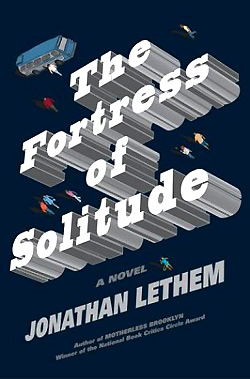
The Fortress of Solitude — Jonathan Lethem

Jonathan Lethem’s The Fortress of Solitude deserved the rave reviews it got back in 2003 when it first came out. I think it was a review in The Believer (although I’m pretty sure it wasn’t in Nick Hornby’s sometimes-entertaining “Stuff I’ve Been Reading” column) that prompted me to order a used copy via Amazon. I loved this book so much that of course I offered it up to Ricotta Parks, who apparently doesn’t read anything longer than a soup label anymore. Never fear, RP, I procured a nice cheap copy at the local B&N yesterday afternoon.

This book has it all: two main characters named after music legends, a magic ring, numerous Brian Eno references, gentrification, a Stan Brakhage-like filmmaker, 1970s Marvel comic books, confused sex, Brooklyn’s pre-hiphop hiphop culture, and a pretty cool Beatles archetype theory. Here is the Beatles archetype theory:

“‘Everything naturally forms into a Beatles, people can’t help it.’

‘Say the types again.’

‘Responsible-parent genius-parent genius-child clown-child.’

‘Okay, do Star Wars.’

‘Luke Paul, Han Solo John, Chewbacca George, the robots Ringo.'”

Biblioklept’s turn: Cheney Paul, Rove John, Condi Rice George, Bush Ringo.