Binocular Aesthetic

Sade Is Constantly Bookkeeping: Classes of Subjects, Orgasms, Victims

From Roland Barthes’ “Life of Sade,” a short biography of The Marquis de Sade. Translated from the French by Richard Miller.  Read the entire essay at Supervert (or here over the next few days, parceled out over 22 sections)—

12. In certain of the letters he received or wrote at Vincennes or in the Bastille, Sade discerned or inserted number utterances which he called signals. These signals helped him to imagine or even to read (supposing they were put there intentionally by his correspondent and had escaped the censor) the number of days between receipt and a visit from his wife, an authorization for outdoor recreation, or his freedom; these signals are for the most part malevolent (“The number system is working against me…”). The mania for numbers can be read at various levels; first, neurotic defense: in his fiction, Sade is constantly bookkeeping: classes of subjects, orgasms, victims, and, above all, like Ignatius Loyola, in a purely obsessive twist, he accounts for his own oversights, his errors in numbering; further, number, when it deranges a rational system (we may rather say made purposely to derange it), has the power to produce a surrealistic shock: “On the 18th at 9, the clock chimed 26 times,” Sade notes in his Journal; finally, number is the triumphant path of access to the signifier (here as a pun involving the similarity of pronunciation, in French, of the past tense of “to come,” vint, and the number “twenty,” vingt): (“The other day, because we needed a 24, a flunkey pretending to be M. le Noir [a police officer], and so that I might write to Monsieur Le Noir, came at 4 (vint le 4), thus 24 (vingtquatre).” Numeration is the beginning of writing, its liberating positioning: a connection apparently censured in the history of ideography, if we are to believe J.-L. Schefer’s current work on hieroglyphics and cuneiform: the phonological theory of language (Jakobson) unduly separates the linguist from writing; calculation will bring him closer.

The List of Sade’s Detentions

From Roland Barthes’ “Life of Sade,” a short biography of The Marquis de Sade. Translated from the French by Richard Miller.  Read the entire essay at Supervert (or here over the next few days, parceled out over 22 sections)—

11. The list of Sade’s detentions began in 1763 (he was twenty-three) and ended with his death in 1814. This almost uninterrupted imprisonment covers all the later years of the Ancien Régime, the revolutionary crisis and the Empire, in short, it straddles the vast change accomplished by modern France. Whence it is easy to accuse, behind the various regimes that detained the Marquis, a higher entity, an unalterable source of repression (government or state) which encountered in Sade a symmetrical essence of Immorality and subversion: Sade is like the exemplary hero of an eternal conflict: had they been less blind (but then, they were bourgeois, were they not?), Michelet and Hugo could have celebrated in him the fate of a martyr for liberty. Counter to this facile image, we must remember that Sade’s detentions were historical, they derived their meaning from contemporary History, and since this History was precisely that of social change, there were in Sade’s imprisonment at least two successive and different determinations and, to speak generically, two prisons. The first (Vincennes, the Bastille, until Sade’s liberation by the dawning Revolution) was not a fact of Law. Although Sade had been judged and condemned to death by the Aix Parlement for sodomy (the Marseilles affair), although he was arrested in 1777 in the Rue Jacob after years of flight and more or less clandestine returns to La Coste, it was under the action of a lettre de cachet (issued by the king at the instigation of the Lady President of Montreuil); the accusation of sodomy lifted and the judgment overturned, he nonetheless went back to prison, since the lettre de cachet, independent of the court decree, continued in effect; and if he was liberated, it was because the Constituent Assembly abolished the lettre de cachet in 1790; thus it is easy to understand that Sade’s first imprisonment had no penal or moral significance whatsoever; it was aimed essentially at preserving the honor of the Sade-Montreuil family from the Marquis’s escapades; Sade was regarded as a libertine who was being “contained,” and as a familial essence that was being saved; the context of this first imprisonment is a feudal one: the race commands, not morality; the king, dispenser of the lettre de cachet, is here merely the agent of the people. Sade’s second imprisonment (from 1801 to his death: at Sainte-Pélagie, Bicêtre, and Charenton) is another matter; the Family has disappeared, the bourgeois State rules, it is this (and not a prudent mother-in-law) which has imprisoned Sade (although with no more of a trial than in the first instance) for having written his infamous books. There is a confusion (under which we are still laboring) established between morality and politics. This began with the Revolutionary Tribunal (whose always fatal sanction is familiar), which included as enemies of the people “individuals fostering moral depravity”; it continued in Jacobin discourse (“He brags,” Sade’s comrades in Piques said, “of having been shut up in the Bastille during the Ancien Régime so as to appear patriotic, whereas had he not been from the ‘noble’ caste, he would have been meted another kind of exemplary punishment”; in other words, bourgeois equality had already, retroactively, made him an immoral criminal); then in Republican discourse (“Justine,” a journalist said in 1799, “is a work as dangerous as the royalist newspaper Le Nécessaire, because if republics are founded on courage, they are upheld by morality; destruction of the latter always leads to the destruction of empires”); and finally, after Sade’s death, in bourgeois discourse (Royer-Collard, Jules Janin, etc.). Sade’s second prison (where he remains today, since his books are not freely sold in France) is no longer due to a family protecting itself, but to the apparatus of an entire State (justice, teaching, the press, criticism), which — in the Church’s default — censors morality and controls literary production. Sade’s first detention was segregative (cynical); the second was (is still) penal, moral; the first arose out of a practice, the second out of an ideology; this is proved by the fact that in imprisoning Sade the second time, it was necessary to mobilize a subject philosophy based totally on norm and deviation: for having written his books, Sade was shut up as a madman.

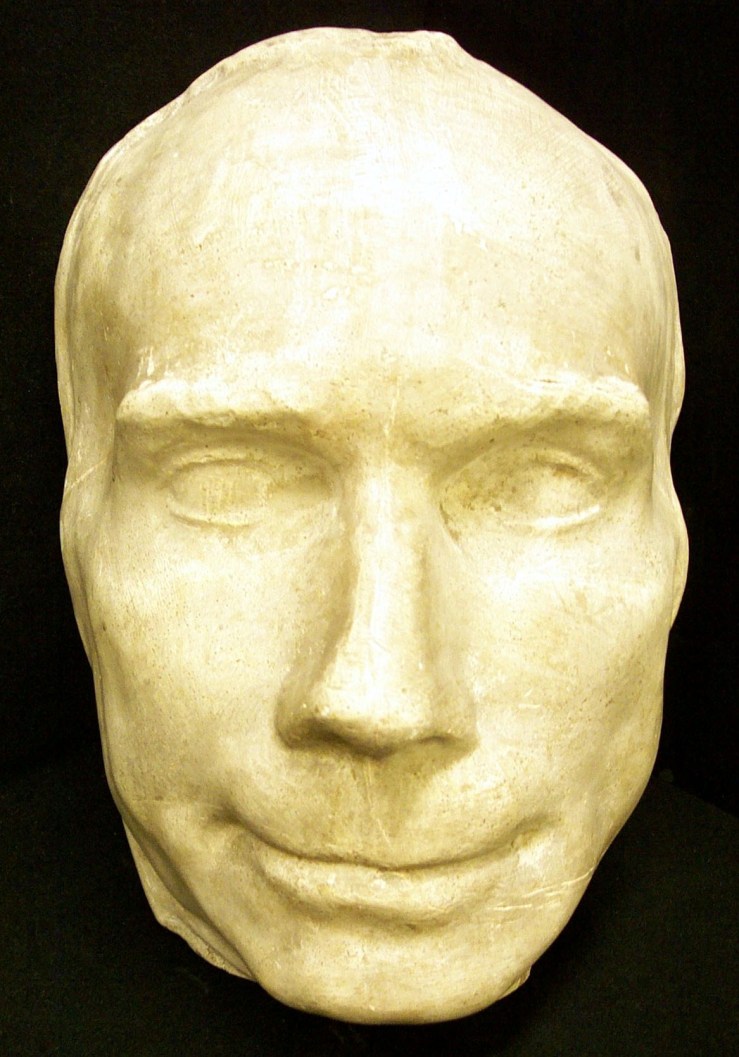
Henry Clay’s Death Mask

Sadean Secretaries, For Writing and For Debauchery

From Roland Barthes’ “Life of Sade,” a short biography of The Marquis de Sade. Translated from the French by Richard Miller.  Read the entire essay at Supervert (or here over the next few days, parceled out over 22 sections)—

10. Sade had several young secretaries (Reillanne, young Malatié or Lamalatié, Rolland, Lefèvre, of whom he was jealous and whose portrait he pierced with a penknife), they are part of the Sadian game insofar as they are simultaneously servants for writing and for debauchery.

In One Breath — The Making of Russian Ark

In One Breath is a documentary about the making of Aleksandr Sokurov’s 2002 film Russian Ark, one of the dreamiest, most sublime movies I’ve ever experienced. The entirety of  Russian Ark unfolds in one continuous take, with not a single cut in its 99 minutes (even though there are ballroom dance scenes and orchestras and other massive set pieces). Stunning stuff.

Continue reading “In One Breath — The Making of Russian Ark”

Tear Vases, Seven Sponges, A Neapolitan Knife, A Military Almanac, A Rhyming Dictionary . . .

From Roland Barthes’ “Life of Sade,” a short biography of The Marquis de Sade. Translated from the French by Richard Miller. Read the entire essay at Supervert (or here over the next few days, parceled out over 22 sections)—

9. Returning to France from Italy, Sade has sent from Naples to La Coste two large cases; the second, weighing six quintals, travels on the boat Aimable Marie; it contains: “marbles, stones, a vase or amphora for storing Greek wines with resin, antique lamps, tear vases, all à la Greek and Roman, medals, idols, raw and worked stones from Vesuvius, a fine sepulchral urn intact, Etruscan vases, medals, a sculptured piece in serpentine, a bit of nitrate solfatara, seven sponges, a collection of shells, a tiny hermaphrodite and a vase of flowers . . . a marble dish decorated with singularly lifelike fruits of all varieties, chests of drawers of Vesuvian marble, a Saracen buccherini or cup, a Neapolitan knife, used clothing and prints. . . Proofs of Religion, a treatise on the existence of God . . . The Rejected Tithe, an almanac of plays, The Gallant Saxon, a military almanac, Mme de Pompadour’s letters . . . a rhyming dictionary” (LéLy, i, 568). This variety of wares is in every way worthy of Bouvard and Pécuchet: we lack only a few ellipses, a few asyndeta, to read here a bit of Flaubertian bravura. The Marquis, however, did not write this inventory; yet he is the one who amassed this collection, whose heteroclite cultural nature is derisory in relation to culture itself. Dual proof: of the baroque energy of which Sade was capable, and of the writing energy he put into his acts.

Book Acquired, 9.2.11

20110902-032920.jpg

Today in the mail: Ali Smith’s There but for the. Publisher’s description—

At a dinner party in the posh London suburb of Greenwich, Miles Garth suddenly leaves the table midway through the meal, locks himself in an upstairs room, and refuses to leave. An eclectic group of neighbors and friends slowly gathers around the house, and Miles’s story is told from the points of view of four of them: Anna, a woman in her forties; Mark, a man in his sixties; May, a woman in her eighties; and a ten-year-old named Brooke. The thing is, none of these people knows Miles more than slightly. How much is it possible for us to know about a stranger? And what are the consequences of even the most casual, fleeting moments we share every day with one another?

Sade’s Parallel Duplications

From Roland Barthes’ “Life of Sade,” a short biography of The Marquis de Sade. Translated from the French by Richard Miller.  Read the entire essay at Supervert (or here over the next few days, parceled out over 22 sections)—

8. We need only read the Marquis’s biography after having read his work to be convinced that he has put part of his work into his life — and not the opposite, as so-called literary science would have us believe. The “scandals” of Sade’s life are not “models” of analogous situations drawn from his books. Real scenes and fantasized scenes are not directly related; all are no more than parallel duplications, more or less powerful (stronger in the work than in life), of a scene that is absent, unfigured, but not inarticulated, whose site of infiguration and articulation can only be writing: Sade’s work and his life traverse this writing area on an equal footing.

Derrida Talks About the Myth of Echo and Narcissus

Wherever He Goes, He Provokes the Terrified Dismay of the Guardians of Order

From Roland Barthes’ “Life of Sade,” a short biography of The Marquis de Sade. Translated from the French by Richard Miller.  Read the entire essay at Supervert (or here over the next few days, parceled out over 22 sections)—

7. The Lady President of Montreuil was objectively responsible for her son-in-law’s persecutions during the entire first years of his life (perhaps she loved him? One day, someone told the Marquise that the Lady President “loved M. de Sade to distraction”). The impression we have of her character, however, is one of continual fear: fear of scandal, of “difficulties.” Sade seems to have been a triumphant, troublesome victim; like a spoiled child, he is continually “teasing” (teasing is a sadistic passion) his respectable and conformist relations; wherever he goes, he provokes the terrified dismay of the guardians of order: everyone responsible for his confinement at the fort of Miolans (the King of Sardinia, the minister, the ambassador, the governor) is obsessed by the possibility of his escape — which does not fail to occur. The couple he forms with his persecutors is an aesthetic one: it is the malicious spectacle of a lively, elegant animal, both obsessed and inventive, mobile and tenacious, continually escaping and continually returning to the same area, while the giant mannequins, stiff, timorous, pompous, quite simply attempt to contain him (not punish him: this will only come later).

Household Sadism

From Roland Barthes’ “Life of Sade,” a short biography of The Marquis de Sade. Translated from the French by Richard Miller.  Read the entire essay at Supervert (or here over the next few days, parceled out over 22 sections)—

6. Household Sadism: at Marseilles, Sade wants Marianne Lavergne to whip him with a parchment beater with bent pins which he takes from his pocket. The girl quails before so exclusively functional an object (like a surgical instrument), and Sade orders the maidservant to bring a heather broom; this utensil is more familiar to Marianne and she has no hesitation in employing it to strike Sade across the buttocks.

Read the Opening Paragraphs of Denis Johnson’s Forthcoming Novella Train Dreams

The opening paragraphs of Denis Johnson’s forthcoming novella Train Dreams (via)—

In the summer of 1917 Robert Grainier took part in an attempt on the life of a Chinese laborer caught, or anyway accused of, stealing from the company stores of the Spokane International Railway in the Idaho Panhandle.

Three of the railroad gang put the thief under restraint and dragged him up the long bank toward the bridge under construction fifty feet above the MoyeaRiver. A rapid singsong streamed from the Chinaman voluminously. He shipped and twisted like a weasel in a sack, lashing backward with his one free fist at the man lugging him by the neck. As this group passed him, Grainier, seeing them in some distress, lent assistance and found himself holding one of the culprit’s bare feet. The man facing him, Mr. Sears, of Spokane International’smanagement, held the prisoner almost uselessly by the armpit and was the only one of them, besides the incomprehensible Chinaman, to talk during the hardest part of their labors: “Boys, I’m damned if we ever see the top of this heap!” Then we’re hauling him all the way? was the question Grainier wished to ask, but he thought it better to save his breath for the struggle. Sears laughed once, his face pale with fatigue and horror. They all went down in the dust and got righted, went down again, the Chinaman speaking in tongues and terrifying the four of them to the point that whatever they may have had in mind at the outset, he was a deader now. Nothing would do but to toss him off the trestle.

They came abreast of the others, a gang of a dozen men pausing in the sun to lean on their tools and wipe at sweat and watch this thing. Grainier held on convulsively to the Chinaman’s horny foot, wondering at himself, and the man with the other foot let loose and sat down gasping in the dirt and got himself kicked in the eye before Grainier took charge of the free-flailing limb. “It was just for fun. For fun,” the man sitting in the dirt said, and to his confederate there he said, “Come on, Jel Toomis, let’s give it up.” “I can’t let loose,” this Mr. Toomis said, “I’m the one’s got him by the neck!” and laughed with a gust of confusion passing across his features. “Well, I’ve got him!” Grainier said, catching both the little demon’s feet tighter in his embrace. “I’ve got the bastard, and I’m your man!”

The party of executioners got to the midst of the last completed span, sixty feet above the rapids, and made every effort to toss the Chinaman over. But he bested them by clinging to their arms and legs, weeping his gibberish, until suddenly he let go and grabbed the beam beneath him with one hand. He kicked free of his captors easily, as they were trying to shed themselves of him anyway, and went over the side, dangling over the gorge and making hand-over-hand out over the river on the skeleton form of the next span. Mr. Toomis’s companion rushed over now, balancing on a beam, kicking at the fellow’s fingers. The Chinaman dropped from beam to beam like a circus artist downward along the crosshatch structure. A couple of the work gang cheered his escape, while others, though not quite certain why he was being chased, shouted that the villain ought to be stopped. Mr. Sears removed from the holster on his belt a large old four-shot black-powder revolver and took his four, to no effect. By then the Chinaman had vanished.

A Somewhat Disturbing, Probably NSFW Clip from the Film Marquis

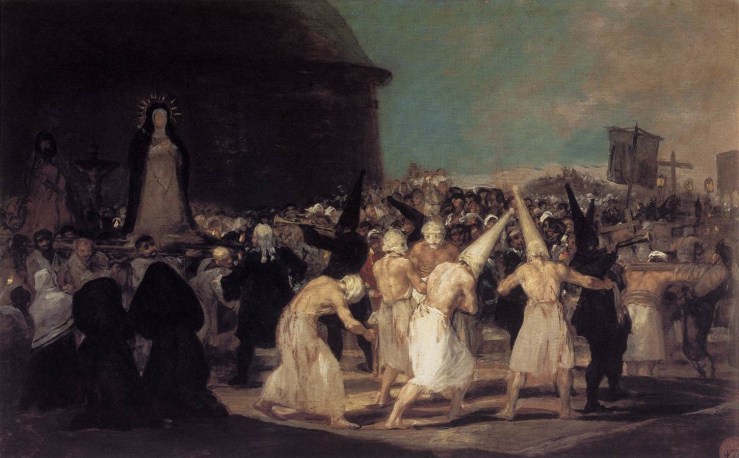
A Procession of Flagellants — Goya

Section 5, “Life of Sade” — Roland Barthes’ Short Biography of The Marquis de Sade

From Roland Barthes’ “Life of Sade,” a short biography of The Marquis de Sade. Translated from the French by Richard Miller.  Read the entire essay at Supervert. (or here over the next few days, parceled out over 22 sections)—

5. Sade likes theater costumes (forms which make the role); he wore them in his own daily life. When whipping Rose Keller, he disguises himself as a flogger (sleeveless vest over a naked torso; kerchief around the head as is worn by young Japanese cooks as they swiftly cut up live eels); later on, he prescribes for his wife the mourning costume she must wear for visiting a captive, unhappy husband: Dress as dark in color as possible, the bosom covered, “a large, very large bonnet without the hair it covers being dressed in any way, merely combed, a chignon, no braids.”

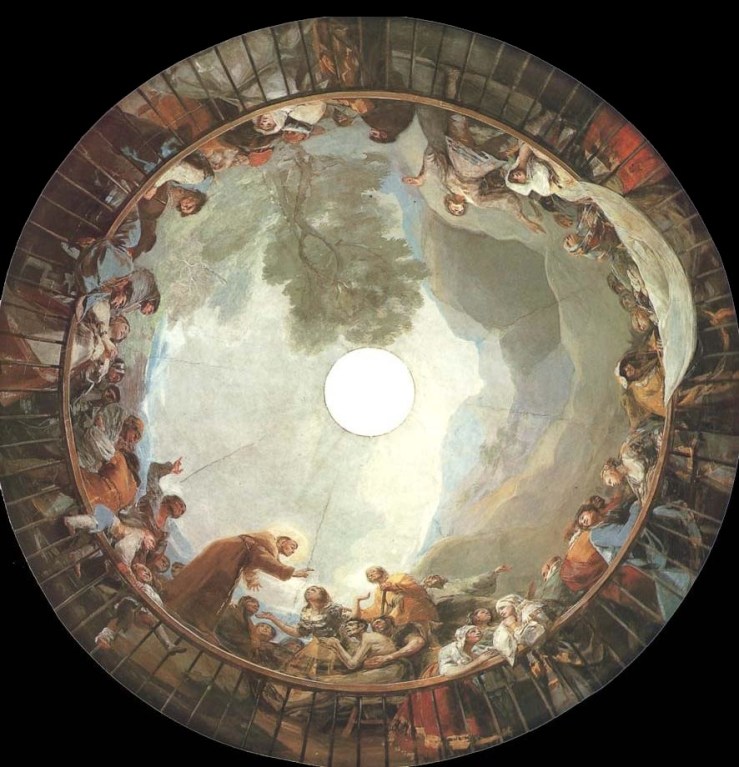
The Miracle of St. Anthony — Goya