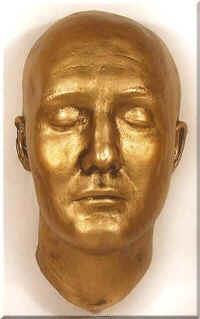
George Reeves’s Death Mask

Jim Jarmusch and Martin Scorsese Talk About Scorsese’s Mom

David Foster Wallace on the Economy of Comfort

Books Acquired, 8.11.11

20110811-035304.jpg

Went to my favorite used bookstore today. Picked up Nicholson Baker’s Room Temperature to see what all the fuss is about (although I don’t think it’s one of his works of “erotica”). Anyway, it’s slim — 116 pages — so I’m sure it’ll find a place near the top of the stack.

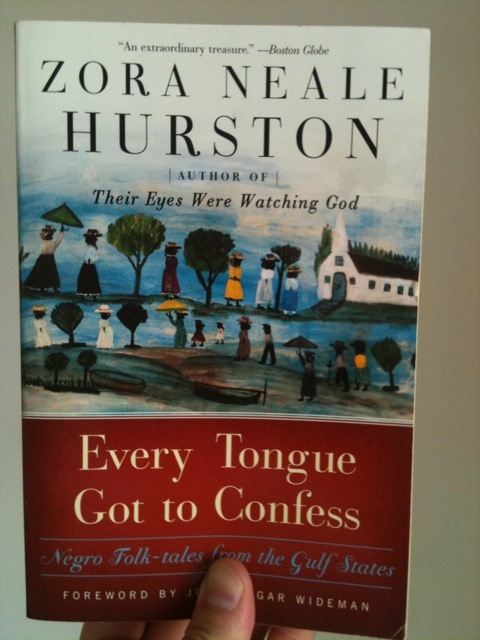
20110811-035343.jpg

I’m pretty sure that some of the folktales in this collection from Zora Neale Hurston are probably redundant in my library—I mean, I know I’ve got another collection of her folklore somewhere. But this one seems much bigger—and it has a great appendix. Look forward to a tall tale or two (or don’t; shit, I don’t care).

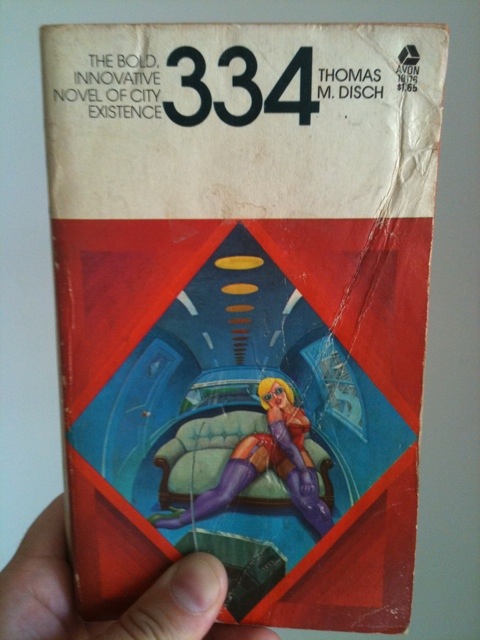
20110811-035332.jpg

Back when I taught high school English, one of my favorite students “borrowed” (and never returned) my copy of Dune. Then he did the same with my copy of Riddley Walker (which, to be fair, I had stolen from a dear friend). Then he took Camp Concentration. I thought I’d replaced it, but when I looked for it the other day, I couldn’t find it. Anyway, this Caroll & Graf edition has a cool cover. I also picked up 334 on a reader recommendation (I was scolded for putting Camp Concentration on this list instead of some other Disch titles. Mea culpa). Anyway, I dig this pop art cover; I also think this is a first printing—-

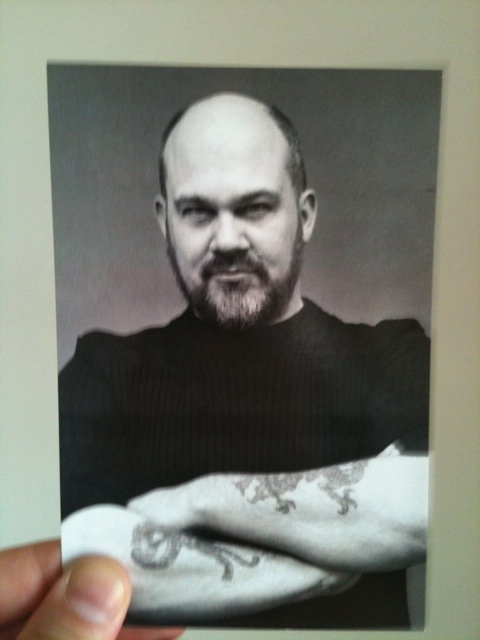
20110811-040121.jpg

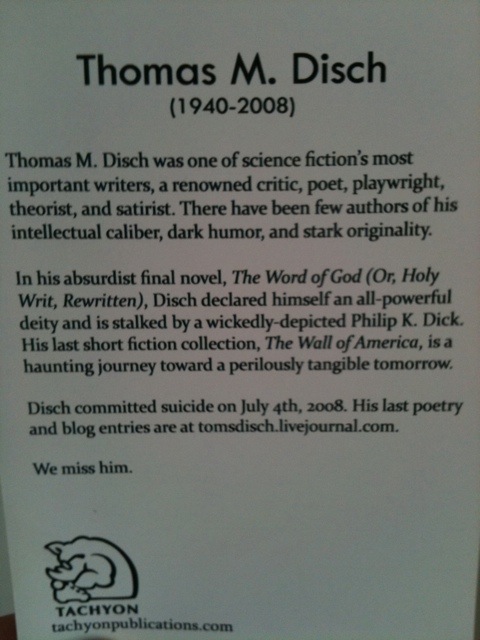
Underneath (but not in) the 334 was this Thom Disch postcard. A fortuitous bookmark!

20110811-035522.jpg

20110811-035534.jpg


Wells Tower, Garbage Man

Over at The Paris Review Daily, Chris Flynn asked a few authors to discuss odd jobs they’d held, including Biblioklept fave Wells Tower, who worked briefly as a garbage man. He also slang marijuana for a while, but that’s not in the anecdote. Anyway, we love Tower’s short story collection Everything Ravaged, Everything Burned (review here) and hope he’ll put out a novel soon. Here’s his trash story—

When I was nineteen, I worked briefly as a garbage man. My boss’s name was Puddn’. He was a vast, sunbaked person with such a pronounced Southern accent that I couldn’t understand much of what he said. The job’s oppressions were what you’d expect: maggots, smells made worse by the summer heat. By the end of each day, I hated everyone who owned a garbage can. I did not hate Puddn’, though, who made many gifts to me of the wonders he found in the trash: penknives, silver cutlery, old watches, some of which I keep with me still.

Book Acquired, 8.10.11

20110810-042316.jpg

I don’t know if this one actually counts; Atomic Ranch is a book my wife ordered (not that my wife doesn’t count). But I’ve started to (at least try to) document all the books that come into the house, so, yeah, here’s Atomic Ranch, which is about 1950s ranch homes, which I guess my wife bought because we bought such a home earlier this year.

All Four Twilight Books in One Short Webcomic

Twilight Comic by Lucy Knisley

Thanks to Lucy Knisley, you never have to read the Twilight series.


“Hibachi” — J. Robert Lennon/Benk

From the latest Electric Literature

For our new Single Sentence Animation, J. Robert Lennon has chosen a sentence from his story “Hibachi” that depicts a turning point in Phillip and Evangeline’s marriage: the night she reveals she is one furious Hibachi master.

The sentence: “And then, with a motion so swift and subtle it was hard to be certain that it had happened, she pulled a wooden match from a pocket, scraped it against the exhaust hood, and set the onion alight. ”

Single Sentence Animations are creative collaborations. The writer selects a favorite sentence from his or her work and the animator creates a short film in response.

Animation and sound by Benk.

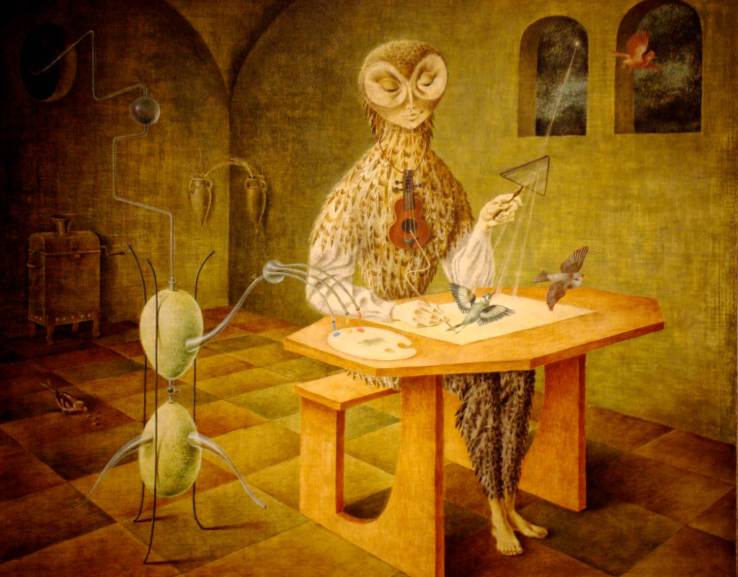
Creation of the Birds — Remedios Varo

F. Scott Fitzgerald’s College Slang, Including Some Amorous Vocabulary

Even more from F. Scott Fitzgerald’s Notebooks

Slang (collegiate)

A Jeep……………….Orchid Consumer

Floating……………….Long Dress

Drag……………….Main Street

Jelly……………….Small Date

Joe College……………….Collegiate

A drip……………….Bird<

” of the pt. water……………….Bird

Clapping……………….Cutting in.

Trucking……………….Walking like that.

Smooch)

Perch)                                    Necking

Pitch and Fling Woo)

Book Acquired, 8.09.11

20110809-033704.jpg

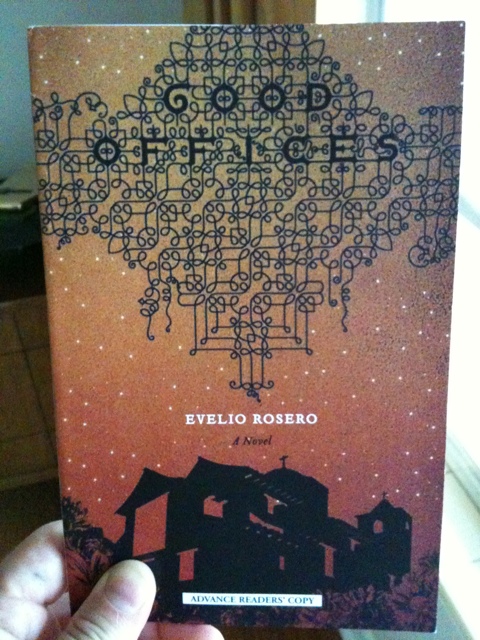
The good people at New Directions were kind enough to send me a copy of Colombian author Evelio Rosero’s novel, Good Offices, a satire of the Catholic Church in Latin  America with a hunchback for a hero. I am intrigued. Anne McClean translates. Review forthcoming.

“Notes of Childhood” — F. Scott Fitzgerald

More from F. Scott Fitzgerald’s Notebooks. Apparently young Scottie was into Hume against Lock [sic]—

Notes of Childhood:

Make a noise like a hoop and roll away
She’s neat ha ha
Grandfather’s whiskers
Aha, she laughed
Annex rough house
Hume against Lock
Changing Voice
Snow
Hot dogs
Hair oily and pumps from notes
Miss Sweet’s school
Folwell Paulson
Each Bath
Writing in class
Debates
It’s one thing to call a man
Story of dirty shirt
Trick show lemonade stand

Groucho Marx on Charlie Chaplin

The Island — Walton Ford

Terry Gilliam’s DIY Animation Show

Luis Buñuel Discusses Salvador Dali and Making Un Chien Andalou

“Ernest Taking Me to That Bum Restaurant” and Other References to Hemingway in F. Scott Fitzgerald’s Notebooks

F. Scott Fitzgerald’s Notebooks are crammed with little sketches, scenes, observations, and, uh, notes (obviously). Although they are brief, his notes on Ernest Hemingway reveal much about Fitzgerald’s agon with Papa.

Ernest—until we began trying to walk over each other with cleats.

Snubs—Gen. Mannsul, Telulah phone, Hotel O’Con­nor, Ada Farewell, Toulman party, Barrymore, Tal­madge, and M. Davies. Emily Davies, Tommy H. meeting and bottle, Frank Ritz and Derby, Univ. Chicago, Vallambrosa and yacht, Condon, Gerald in Paris, Ernest apartment.

Day with a busy man. Combine the day of Ernest’s pictures, the man of genius episode,

As to Ernest as a boy—reckless, adventurous, etc. Yet it is undeniable that the dark was peopled for him. His bravery and acquired characteristics.

Nevertheless value of Ernest’s feeling about the pure heart when writing—in other words the comparatively pure heart, the “house in order.”

That Willa Cather’s poem shall stand at beginning of Mediaval and that it shall be the story of Ernest.

Just as Stendahl’s portrait of a Byronic man made Le Rouge et Noir so couldn’t my portrait of Ernest as Phillipe make the real modern man.

Didn’t Hemmingway say this in effect:  If Tom Wolfe ever learns to separate what he gets from books from what he gets from life he will be an original. All you can get from books is rhythm and technique. He’s half-grown artistically—this is truer than what Ernest said about him. But when I’ve criticized him (several times in talk) I’ve felt bad afterwards. Putting sharp weapons in the hands of his inferiors.

Ernest Hemingway, while careful to avoid cliches in his work, fairly revels in them in his private life, his favorite being Parbleu (“So what?”) French, and “Yes, We Have No Bananas.” Contrary to popular opinion he is not as tall as Thomas Wolfe, standing only six feet five in his health belt. He is naturally clumsy with his body, but shooting from a blind or from adequate cover, makes a fine figure of a man. We are happy to announce that his work will appear in future exclusively on United States postage stamps.

Parallel of Ernest’s and French conversation as opposed to Gerald and me and U.S.A. emotional bankruptcy.

Do you know what your affair was founded on? On sorrow. You got sorry for each other. (Did Ernest borrow this one?)

Very strong personalities must confine themselves in mutual conversation to very gentle subjects. Everything eventually transpired—but if they start at a high pitch as at the last meeting of Ernest, Bunny and me their meeting is spoiled. It does not matter who sets the theme or what it is.

Ernest taking me to that bum restaurant. Change of station implied.

Ernest would always give a helping hand to a man on a ledge a little higher up.

Ernest Hemingway and Ernest Lubitsch—Dotty “We’re all shits.”

I talk with the authority of failure—Ernest with the authority of success. We could never sit across the table again.

People like Ernest and me were very sensitive once and saw so much that it agonized us to give pain. People like Ernest and me love to make people very happy, caring desperately about their happiness. And then people like Ernest and me had reactions and punished people for being stupid, etc., etc. People like Ernest and me————

Tom Fast’s story of Ernest.

Ernest and “Farewell to Arms”—producer story.

An inferiority complex comes simply from not feeling you’re doing the best you can—Ernest’s “drink” was simply a form of this.

It [For Whom the Bell Tolls] is so to speak Ernest’s ’Tale of Two Cities’ though the comparison isn’t apt. I mean it is a thoroughly superficial book which has all the profundity of Rebecca.

I want to write scenes that are frightening and inimitable. I don’t want to be as intelligible to my contemporaries as Ernest who as Gertrude Stein said, is bound for the Museums. I am sure I am far enough ahead to have some small immortality if I can keep well.

But there was one consolation:  They could never use any of Mr. Hemingway’s four letter words, because that was for fourth class and fourth class has been abolished—
(The first class was allowed to cheat a little on the matter.)
But on the other hand they could never use any two letter words like NO. They had to use three letter words like YES!

Bald Hemingway characters.