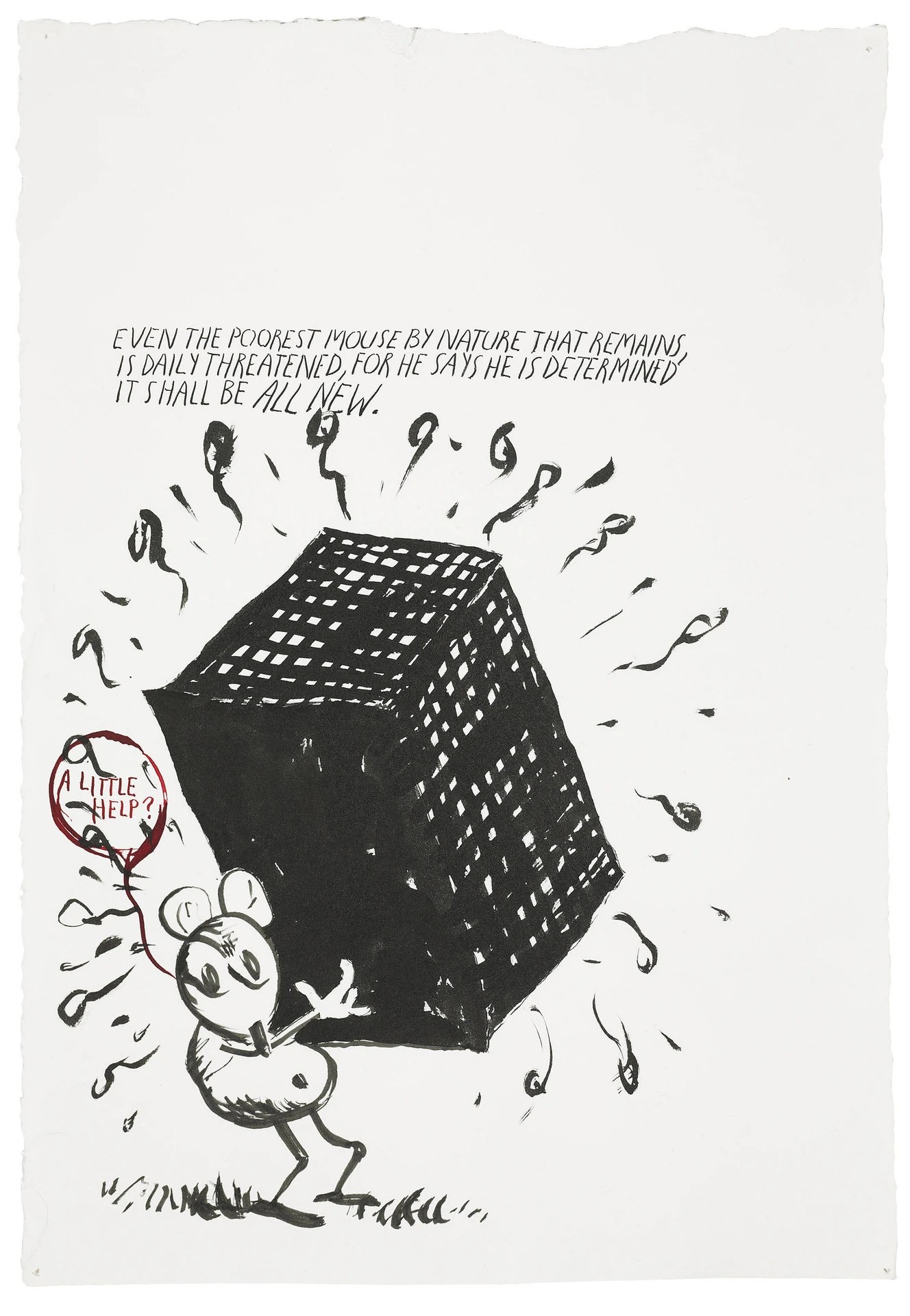
A page from “The Highway,” collected in Compulsive Comics, 2018 by Eric Haven.

A page from “The Highway,” collected in Compulsive Comics, 2018 by Eric Haven.
There were reactions. Some people found the balloon “interesting.” As a response this seemed inadequate to the immensity of the balloon, the suddenness of its appearance over the city, on the other hand, in the absence of hysteria or other societally induced anxiety, it must be judged a calm, “mature” one. There was a certain amount of initial argumentation about the “meaning” of the balloon, this subsided, because we have learned not to insist on meanings, and they are rarely even looked for now, except in cases involving the simplest, safest phenomena. It was agreed that since the meaning of the balloon could never be known absolutely, extended discussion was pointless, or at least less purposeful than the activities of those who, for example, hung green and blue paper lanterns from the warm gray underside, in certain streets, or seized the occasion to write messages on the surface, announcing their availability for the performance of unnatural acts, or the availability of acquaintances.
Daring children jumped, especially at those points where the balloon hovered close to a building, so that the gap between balloon and building was a matter of a few inches, or points where the balloon actually made contact, exerting an ever-so-slight pressure against the side of a building, so that balloon and building seemed a unity. The upper surface was so structured that a “landscape” was presented, small valleys as well as slight knolls, or mounds, once atop the balloon, a stroll was possible, or even a trip, from one place to another. There was pleasure in being able to run down an incline, then up the opposing slope, both gently graded, or in making a leap from one side to the other. Bouncing was possible, because of the pneumaticity of the surface, and even falling, if that was your wish. That all these varied motions, as well as others, were within one’s possibilities, in experiencing the “up” side of the balloon, was extremely exciting for children, accustomed to the city’s flat, hard skin. But the purpose of the balloon was not to amuse children.

February, 1938 by Evelyn Dunbar (1906-1960)

—The Crossing is one of McCarthy’s best novels, up there with Suttree and Blood Meridian, and possibly The Passenger. It might seem baggy, but its fatty prose is generous. I’m amazed that it did not have as much of an impact on me a decade and a half ago as it did in the first month of 2023, but I’m glad I went back to it and met its myriad messages when I needed them.
Very highly recommended. If you’re interested in McCarthy but don’t know where to start, The Crossing might be a great place.

The Inheritors, 2022 by Salman Toor (b. 1983)

Hare, 1967 by Elisabeth Frink (1930-1993)

Suma, 1982 by Cy Twombly (1928-2011)

Helen at the Scaean Gate, c. 1880s by Gustave Moreau (1826–1898)
You can read the full text of Vladimir Sorokin’s beautiful, abject, horrifying very long short story “Nastya” at The Baffler.
The novella-length piece swirls between fairy tale magic and Sadean cruelty. It is probably best if you consume “Nastya” on an empty stomach—like his novel Their Four Hearts, “Nastya” is reminiscent of Pasolini’s horrifying masterpiece Salò, or the 120 Days of Sodom. And like Their Four Hearts, this story is translated by Max Lawton, who vividly conveys the dream-nightmare-reality energy of Sorokin’s prose.
“Nastya” is from the collection Red Pyramid, which will publish in Lawton’s English-language translation early next year. (You can read the title story here.)
Here are the opening paragraphs of “Nastya”—
A GRAYISH-BLUE LULL BEFORE DAWN, a slow boat on the heavy mirror of Denezh Lake, emerald caverns in the juniper bushes creeping menacingly toward the white wash of the alpine waters.
Nastya turned the brass knob of the door to the balcony and pushed it open. The thick, reeded glass swam to the right, splintering the landscape with its parallel flutes and mercilessly dividing the little boat into twelve pieces. A damp avalanche of morning air flowed through the open door, embraced her, and shamelessly flew up into her nightgown.
Nastya inhaled greedily through her nose and walked out onto the balcony.
Her warm feet recognized the cool wood, and its boards creaked gratefully. Nastya lay her hands upon the peeling paint of the railing, tears came to her eyes as she took in the motionless world: the left and right wings of the manor, the garden’s milky green, the severity of the linden grove, the sugar-cube church on the hill, the willow branches lying on the ground, the stacks of mown grass.
Nastya rolled her wide, thin shoulders, let down her hair, and stretched out with a moan, listening to her vertebrae crack as her body woke up.
And here is a sentence from later in the story that made me laugh out loud:
“Don’t dare overcook my daughter!”
Great fucked up stuff.