50 Great Guitarists, All Better Than Slash (In No Particular Order)–Part III

11. John Fahey
In the late nineties, indie rock kids–myself included–started embracing sounds that expanded beyond four white guys playing drums, bass, and guitar. Bands like Tortoise and The Sea and Cake bridged the way to the avant garde stylings of Gastr del Sol and Oval, opening up whole new sound-worlds to young ears. Gastr del Sol’s stunning 1996 record Upgrade and Afterlife featured a cover of Fahey’s “Dry Bones in the Valley” as the most beautiful closing statement imaginable. A whole new generation of listeners were introduced to cult fave Fahey’s cryptic finger-picking style via Gastr’s Jim O’Rourke, along with Table of the Elements records who released Fahey’s Womblife in 1997. Today, followers of Fahey’s sound include Six Organs of Admittance, Jack Rose, Glenn Jones, and James Blackshaw, among many others. Great stuff, all around.

12. Jimi Hendrix

Hendrix is as great as everyone thinks he is.

13. Brian Jones

Brian Jones is often credited as the “second guitarist” for the Rolling Stones, and relegated to a space under the shadow of Keith Richards. He’s more infamous than famous, remembered as the wild man of the Stones who helped define their renegade image. However, Brian Jones was a multi-instrumentalist whose passion for different styles of music from around the world helped infuse the basic rocknroll of the early Stones with a certain eclectic punch. And although his early drowning death (like Dennis Wilson) in 1969 (before Jimi Hendrix, Jim Morrison, Janis Joplin) is tragic on some levels (like Keith Moon), it may have preserved him from turning into what the Rolling Stones are today–a decrepit zombie joke that can no longer reasonably retire, already having permanently damaged any patina of mythos to their legacy.

14. Pete Townshend

What Pete Townshend lacked in technical dazzle he more than made up for in bombast, his raw energy and indelicacy summed up best in his propensity to smash his guitars and stab his amps. His work with synthesizers pioneered whole new territories and genres of music, and his penchant for arranging narrative song-suites proved a profound influence on my favorite band, The Fiery Furnaces.

This is one of my favorite things ever:

15. Phil Manzanera

Besides being a founding member of Roxy Music, Manzanera released a series of excellent solo albums of strange new wave music in the late seventies, continuing to work with Brian Eno, as well as guys like Robert Wyatt and John Wetton. Diamond Head is a favorite of mine.

50 Great Guitarists, All Better Than Slash (In No Particular Order)–Part I

Welcome to yet another ongoing Biblioklept series which may or may not ever end in your lifetime (and no, we haven’t given up on the Alphabet Soup thing). These axe-masters will come in random order–don’t confuse the numbers I give them with rankings. There’s only one tier of hierarchy here–all of these guitar players are superior to Slash, he of Snake Pit fame.

1. Robert Fripp

Fripp is the guitarist who best epitomizes the spirit of this list: he has consistently evolved over his 40+ years in King Crimson, he combines his masterful playing with a keen ear for control, and he’s a true innovator to his instrument. Watch the man demonstrate his patented Frippertronics below.

2. Nels Cline

This guy is fucking amazing, whether he’s channeling John Coltrane:

lending a virtuoso lead to Wilco:

or just kicking it experimental:

3. Sonny Sharrock

Sonny Sharrock’s 1991 album Ask the Ages is absolutely perfect. Possibly the most under-appreciated guitarist in history.

Sonny jams with Last Exit:

4. Neil Young

Neil Young gets more mileage out of a one-note solo on “Cinnamon Girl” than most wankers achieve on the whole fretboard. Neil Young was willing to go beyond the standard rock stuff (which he excelled at of course) and challenge his listeners with experimental albums like Trans and Arc. And for the record, Harvest is the most perfect Sunday-morning album ever committed to vinyl.

From the Rust Never Sleeps tour:

5. Steve Cropper

Cropper’s subtle and steady rhythm helped define the Stax sound. He was never showy, and in his production and songwriting as well as his playing he knew how to highlight the song, not his own guitar. If he’d only done “(Sittin’ on the) Dock of the Bay” with Otis Redding he’d still be on this list; as it is you can hear him on literally hundreds of hit recordings. And we’ll agree to forgive him for the Blues Brothers, okay?

Steve Cropper playing with Booker T & The MGs:

Leaking Most Interesting Colors

aniive_pre_1.jpg

We here at Biblioklept, Inc. couldn’t be more stoked for Strawberry Jam. We all know that strawberry jam is delicious on crumpets (and if you don’t know the tasty delights of jam-on-crumpets, I suggest you indulge yourself posthaste) and Animal Collective’s new record Strawberry Jam, set to drop sometime in September on their new label Domino, will no doubt prove delicious to the ears–the perfect aural jelly for beach blanket parties and midsummer night campfires. Animal Collective’s Sung Tongs and Feels were instant classics of the oughties, and Panda Bear’s sumptuous solo album Person Pitch has provided the sing-along soundtrack for both spring and summer around the Biblioklept offices. Seriously, I’ve never heard an album as sing-allongable as Person Pitch. We love it love it love it &c.

Anyway, studio versions of Strawberry Jam‘s first three tracks (I’m basing the idea that these are the first three tracks on the album based on this track list) have been popping up here and there in the last week. These new tracks preserve the psycho-circus-carnival feel that defines the Animal Collective sound, with the creepy darkness and noise of previous albums like Here Comes the Indian seemingly absent (despite lyrics about Jack the Ripper in “Unsolved Mysteries”). We like “Chores” the best so far–but what do you think? Mp3s below–

“Peacebone”

“Unsolved Mysteries”

“Chores”

Hypothetical Sentiments, Bodacious Birthdays, and Friendly Links

If this was the type of blog where I wrote about my personal life, the type of blog where I bared my naked soul to the keen scrutiny of all the world (wide web), the type of blog where I tried to express the ineffable internal in so many 0s and 1s–; if this were that type of blog, I might start this post with a litany of clichés and truisms about how the birth of my daughter Zoe this Sunday, 3 June, was easily the bestest, most significant thing to ever happen to me; how the birth of my daughter made me the happiest man in the etc., how beautiful and alert and cute and adorable etc., life-changing and dramatic, etc.; I might even post a sugary photo of her like this one–

–to justify all these wild claims.

But of course, this is all hypothetical; this is not a blog about how happy I am with our new addition, or how great my wife is at being a mother, or how lovely our little Zoe is–this is a blog about books and pop culture. So maybe I should link Zoe’s birthday, 3 June, with some famous people also born on that day: these include beat poet Allen Ginsberg, exiled dancer Josephine Baker, and game show host/CIA assassin (?) Chuck Barris. Zoe wasn’t the only person to have a birthday in the Biblioklept clan this week–I switched a digit just yesterday. Famous people who were also born on 7 June include libertine painter Paul Gaugin, American poet Gwendolyn Brooks, professional drunk Dean Martin, and Florida writer Harry Crews, whose novel a Feast of Snakes, out-Bukowskis Bukowski. But by far the coolest person to be born on 7 June (sorry Mr. Martin) is Prince (I’m not going to wiki-link to Prince. If you want to know about Prince, go buy Purple Rain, or Sign ‘O’ the Times, or 1999, or Diamonds and Pearls. Also, if you know-not the glory of Prince, hang your sorry head in shame (philistine)). On my birthday, I always wonder: “What is Prince doing for his birthday? Is he having a great time? I bet he’s doing some really awesome stuff!” It makes me happy. What can I say.

I guess some of my friends knew that I’d be tuckered out from the week’s excitement, so they sent me plenty of cool links, kind of doing my blog-job for me. Check it out:

–Watch the first episode of The Flight of the Conchords when you have a spare half hour. If you don’t find this hilarious, there is probably something wrong with your soul (thanks to Damon for the link)

–Treat yourself to an awesome mix tape, courtesy of Speck. My favorite track: “The Return” by Antares (those who don’t love spaced-out psychedelic prog jamz need not apply)

–Listen to this BBC Radio 4 story on Roger Linn, inventor of the drum machine

–Watch this presentation on Photosynth. Absolutely amazing (thanks to Mike for the links)

–Watch this preview of the upcoming Persepolis movie; then check out my review of the book (thanks to Nick for the link)

Apples to Apples

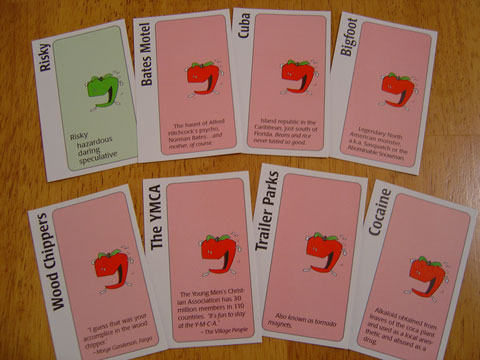
Apples to Apples is the best game I’ve played in years. It’s pretty basic: each player gets seven NOUN cards. The nouns cover a range of people, places, and things–everything from Frank Sinatra to Skiing to Wall Street to Bananas. Each round, a new player plays the judge. The judge sets out an ADJECTIVE card–something like Classy or Wise or Extravagant or Basic or Feminine, etc. Then, each player has to throw out (face down) the NOUN card that they think best fits the adjective in play. Each time the judge picks your card as the winner, you set it aside as a point. The player with the most points wins (duh).

apples-example-small.jpg

This game stimulates plenty of conversation; you can play it with friends for hours without noticing how much time has passed by. It also goes great when paired with beer or wine (but watch out that no one you’re playing with gets upset and knocks the wine bottle over and curses everyone, which may happen in some cases). Highly recommended.

Millionaire’s Maakies

Cartoon Network’s Adult Swim lineup is pretty much hit or miss. Despite great shows like Home Movies and Moral Orel, they still produce garbage like Aqua Teen Hunger Force (their worst crime of course is their culpability in getting Family Guy back on the air). Luckily, this “throw something up and see if it sticks” approach to TV programming allows for all sorts of weird visual shenanigans to take place on your TV screen that usually wouldn’t air on basic cable. In a fit of insomnia a few nights ago I caught some of Tony Millionaire’s series of shorts, Maakies. Odd/possibly disturbing/very funny. Enjoy (or not, you mirthless maggot!)

Follow Through

Feist on Leno, 5.8.07.

The New Feminism

Yay! Girl power!

Read this hilarious article from The Onion, “Women Now Empowered By Everything A Woman Ever Does.” It neatly sums up all of my feelings on the current national/pop cultural understanding of what feminism is in America today.

Every time a discussion of feminism comes up in any of my graduate courses, I always manage to come off like a caveman jerk as I try to explain how I think that the term “feminism”–much like “punk”–has been completely co-opted by mainstream patriarchal commercial culture, and thus etiolated of life, its original power sucked dry. There is of course an easy solution for this, which involves a re-appraisal of feminist objectives and a general re-education of young girls and boys (okay, easy in theory, not in practice). The concern  in academia with gender studies over the past two decades has done a remarkable job of re-framing the problematics of identity, sexuality, culture, etc. beyond just “women’s issues,” but the trickle-down of second-wave feminism seems to be, well, diluted at best and completely misunderstood at worst . And as recent attacks on Roe v Wade show, these aren’t battles that were neatly finished thirty years ago–there is still much at stake today. Get empowered, yo.

math.jpg

Noam Chomsky, Intellectual Elitism, Po-Mo Gibberish, More Attacks on Deconstruction, and Bad Writing Revisited

While doing some background research for an upcoming Graduate Symposium I’ll be participating in later this month (more on that in the future), I somehow stumbled upon this post from Noam Chomsky in which the famous linguist/activist attacks post-modernism and its heroes. In this email/posting Chomsky criticizes what he views as “a huge explosion of self- and mutual-admiration among those who propound what they call “theory” and “philosophy,”” as little beyond “pseudo-scientific posturing.” Immediately, my thoughts jumped to the discussion of the Sokal Hoax I posted a few weeks back. Chomsky continues his affront to post-structuralism, arguing, much like Sokal, that the major figures of this movement–Derrida, Lacan, Foucault, Kristeva, etc.–obfuscate their arguments with an incoherent vocabulary rife with misused and misapplied scientific terminology. Chomsky on Derrida:

“So take Derrida, one of the grand old men. I thought I ought to at least be able to understand his Grammatology, so tried to read it. I could make out some of it, for example, the critical analysis of classical texts that I knew very well and had written about years before. I found the scholarship appalling, based on pathetic misreading; and the argument, such as it was, failed to come close to the kinds of standards I’ve been familiar with since virtually childhood. Well, maybe I missed something: could be, but suspicions remain […]”

Ouch!

But Chomsky’s not done yet:

“Some of the people in these cults (which is what they look like to me) I’ve met: Foucault (we even have a several-hour discussion, which is in print, and spent quite a few hours in very pleasant conversation, on real issues, and using language that was perfectly comprehensible — he speaking French, me English); Lacan (who I met several times and considered an amusing and perfectly self-conscious charlatan, though his earlier work, pre-cult, was sensible and I’ve discussed it in print); Kristeva (who I met only briefly during the period when she was a fervent Maoist); and others. Many of them I haven’t met, because I am very remote from from these circles, by choice, preferring quite different and far broader ones […] I’ve dipped into what they write out of curiosity, but not very far, for reasons already mentioned: what I find is extremely pretentious, but on examination, a lot of it is simply illiterate, based on extraordinary misreading of texts that I know well (sometimes, that I have written), argument that is appalling in its casual lack of elementary self-criticism, lots of statements that are trivial (though dressed up in complicated verbiage) or false; and a good deal of plain gibberish.”

Illiterate gibberish? Charlatan? Cults ? (This is a really common charge leveled at psychoanalysis in particular, and when one considers that both the work of Freud and Lacan was carried on by their respective daughters, there may be some validity to the claim. Still…)

Double-ouch!

Two things:

First, as a linguist, Chomsky is searching for an underlying, “universal grammar” or deep structure, a core pattern that underpins/organizes/generates all human languages. In this sense, Chomsky is searching for an ideal, a foundation. This method is in direct opposition to deconstruction, which as I understand it, seeks to decenter and disrupt all metaphysical anchors. I will never forget the class in transformational syntax I took at the University of Florida with Mohammed Mohammed (or MoMo, as we affectionately were permitted to call him). The class was a split grad/undergrad section, and MoMo scared away all of the undergrads in the first session, with the exception of myself and another student. After that point, he was always very kind to us (the undergrads) and cruel to the grads. MoMo was a Palestinian; he identified as a Jordanian refugee. He was a devout Chomskyian (cultishly so, perhaps). Derrida spoke at UF while I was in this class. I didn’t really understand what Derrida’s lecture was about, but it was very long and his English accent wasn’t so great. The next day in class, MoMo savaged Derrida for the entirety of the period on points both specific and general, most of it over our heads. It was a true rant, one of the best I’ve ever witnessed, culminating in (and I quote): “He’s full of shit!”

So Derrida certainly provoked MoMo, a strict Chomskyian–and why not? If you spend your academic career and your adult life searching for something that another person says you could never find, wouldn’t you be upset? (I believe that more than anything MoMo was upset over Derrida’s reception at UF, which was rock-starish to say the least). For MoMo, Derrida was a phony, a pied-piper misleading the children from the real issues.

Which brings me to point two–Chomsky is primarily a political figure, and really a pragmatist at heart. The core of his argument is not so much that po-mo writing is high-falutin’ nonsense, but rather that it ultimately serves no practical purpose. Here is where I would strongly disagree. The people that Chomsky attacks and their followers are re-evaluating the canon and the very notion of received wisdom. Chomsky attacks them for “misreading the classics”–but just what are the classics, and whose value systems created the notion that the classics were indeed “classic”? If Derrida & co. appear to “misread,” it is because they seek to recover the marginalized knowledge that has been buried under a sediment of givens as “truth.” Yes, the post-modern movement might have elitist tendencies, and yes, the subjects and themes of their work might not have much to do on the surface with the plight of a refugee (cf. MoMo in Jordan in 1948)…but the goal is actually in line with Chomsky’s goal–to make people question the powers that structure their lives.

I do agree, as I’ve said before, that post-modern writing often comes off as so-much sophistry and hogwash (I admit to plenty of this myself), that in some sense it relies too heavily on a coded vocabulary that seems unaccessible to the untrained eye, and that all too often an air of self-congratulation, an atmosphere of winks and nods replaces an environment of real thinking and debate. But my real take is this: any philosophy that could shake MoMo into discomposure is good. MoMo is a brilliant man and his class was fascinating, but to have seen him that day–his feathers so ruffled, his foundations tested–so infuriated over ideas–that was a beautiful thing. Right then, I knew there must be something to Derrida, something I wanted to figure out. And that’s what the best of these writers do–they infuriate us by provoking the truths that we are so sure that we hold in ourselves. They destabilize our safe spaces. They don’t allow for easy answers; they rebuke tradition. And if this approach falls into the norm in academia, becomes lazy and sedimentary, undoubtedly someone will come along and call “bullshit” on it, thus reigniting debate, questions, language. Nietzsche speaks of language as a series of hardened metaphors, language as petrified lava, sedimentary givens. This is the goal of deconstruction: to get that lava flowing again.


 

Don’t Ban Books

I rarely write about “local” events (although “local” blogs are my favorite), but circumstances provoke me tonight. According to Jacksonville’s own Citadel of Truth, First Coast News, Eddie de Oliveira’s novel Lucky is under review by Duval County Public Schools (my Esteemed Employer, I add in the interest of full disclosure). A parent has complained that the book contains “questionable” material and should be banned from the school library. Aparently even in the late oughties the theme of a sexually-confused teenager is “questionable.” According to the (short) report, the parent was particularly offended by “gay themes” and the words “swinger’s party.” The story was barely a blip in the background as the wife and I prepared fresh pesto, so I didn’t catch what particular school said parent’s spawn attends [ed. note–I found out Tuesday morning that the school is none other than LaVilla School of the Arts (emphasis mine)–Jiminy Cricket, what’s up when it’s the art school parents attacking books!] but even if it is an elementary school (which it probably isn’t, not that that matters), banning books from our public school system is regressive at best, and ultimately an abasement of knowledge and intellect. In the past, DCPS has restricted and/or banned The Autobiography of Malcolm X, Catcher in the Rye, Of Mice and Men and at least a dozen more books (I haven’t been able to locate a complete list as of now). Of course, every year many books are challenged (the Harry Potter series springs immediately to mind, and Judy Blume has always caused problems for uptight parents who don’t want to talk honestly with their kids) and as an English teacher I’ve dealt with this in my own classroom, from both parents and administration (an administrator advised [i.e. told] me not to have my students read The Adventures of Huckleberry Finn; another time an administrator was shocked by the diction of Zora Neale Hurston’s classic Their Eyes Were Watching God). This particular mother’s concern is the “questionable” nature of the Lucky‘s themes which might cause readers to uhm, you know, question stuff. If super-mom doesn’t want her kid to read so-and-so, that’s fine with me (and what a great, attentive parent to be all up in the grill of said child’s reading material. Seriously. We (educationeers) really encourage reading with your kids. For real)–but why attempt to ban the book? Why can’t the rest of us make these decisions for ourselves? I could go and on, but I think that my readers don’t need convincing (if you need convincing that banning books is an anti-progress gesture indicative of a caveman mentality, email me at biblioklept.ed@gmail.com). Let’s not add to Jax’s reputation as a bastion of provincial attitudes (particularly in light of recent vagina-controversies): if necessary, we must fight for this book, and every other book’s, place on the library shelf.

For a list of the 100 Most Frequently Challenged Books, go here.

Merry Christmas

We here at The Biblioklept wish all of our dear readers a very merry Christmas. As our special gift to you, enjoy this fine performance by the late, great James Brown.

Praise Yaweh

This is what the holy holidays are all about: praising the lord, keeping the faith, practicing good works, and dancing to sweet tunes, all set to special effects that would make the “When Doves Cry” video blush (if a music video could indeed blush).

Watch Rev. Alecia groove the transcendental with crazy neck moves and wicked jazz hands–without even having to get out of her swivel chair! Thanks to Mike Gersten for the vid.

Mary Timony-Hapi Holidaze

What is Christmas without creepy pagan vampire rock and arbitrary misspellings? Enjoy “Hapi Holidaze” by The Mary Timony Band.

Download “Hapi Holidaze” (mp3)
from “Kill Rock Stars Winter Holiday Album”
Various Artists
Kill Rock Stars