“And there were shepherds living out in the fields nearby, keeping watch of their flocks at night. An angel of the Lord appeared to them, and the glory of the Lord shone around them, and they were terrified. But the angel said to them, ‘Do not be afraid. I bring you good news of great joy that will for all the people. Today in the town of David a Savior has been born to you; he is Christ the Lord'” — Luke 2:8-11
John Leonard, a widely influential and enduringly visible cultural critic known for the breadth of his knowledge, the depth of his inquiries and the lavish passion of his prose, died on Wednesday in Manhattan. He was 69 and lived in Manhattan. . . .
As a critic, Mr. Leonard was far less interested in saying yea or nay about a work of art than he was in scrutinizing the who, the what and the why of it. His writing opened a window onto the contemporary American scene, examining a book or film or television show as it was shaped by the cultural winds of the day.
Amid the thicket of book galleys he received each week, Mr. Leonard often spied glimmers that other critics had not yet noticed. He was known as an early champion of a string of writers who are now household names, among them Mary Gordon, Maxine Hong Kingston and the Nobel Prize winners Toni Morrison and Gabriel García Márquez.
Mr. Leonard’s prose was known not only for its erudition, but also for its sheer revelry in the sounds and sentences of English. Stylistic hallmarks included wit, wordplay, a carefully constructed acerbity and a syntax so unabashedly baroque that some readers found it overwhelming. The comma seemed to have been invented expressly for him.
I’ve subscribed to Harper’s for about a decade now, and in that time John Leonard’s “New Books” column has been not only one of my favorite features of the magazine, but also an inspirational guide on how to review a book. Leonard knew how to show why a book mattered; he also knew how to capture the essence of not just the plot but the author’s style in just a few short lines–something that’s really, really tough to do. I read one of Leonard’s last reviews, a write up of Toni Morrison’s latest A Mercy in this month’s Harper’s, just last Monday to a group of my high school students who were interested in Morrison’s work. The review made one of them say: “I want to read that book.” I think there is no higher compliment for any critic. John Leonard will be missed.
So let’s just say we’re too anxious around here to run a proper book review, okay? I promise to have reviews of new books up after Election Day. In the meantime–
It leaked a few weeks ago, but it was nice to see Homer Simpson endorse Obama on this year’s Treehouse of Horror episode–
(The best part of the episode was the Mad Men parody, though).
Speaking of election humor, Sarah Palin continues to be a comedy goldmine. How could she be so readily duped by a French Canadian pretending to be President Sarkozy? She’s fucking stupid, that’s how. I’m reminded of her appearance on SNL a few weeks ago–unjustifiably lauded–where she smirked along as if she were actually in on the joke, and not being simply mocked.
Speaking of ignorance and ugliness, the aughties in America have been culturally and politically awful. Beginning with the one-two punch of the 2000 election debacle and the nightmare of the 9/11 attacks, this past decade has been an embarrassing series of disastrous blunders for the United States government, coupled with a spike in civic apathy at home. The results: our stock has fallen in the rest of the world’s eyes and a large portion of Americans have found solace and even pride in ignorance and xenophobia (what else could explain the ascendancy of an ignoramus like Palin?)
And for all the great things that I’ve experienced in my personal life this past decade (marriage, fatherhood), the idea of another decade like the aughties–selfish and cruel and ignorant–seems miserable. The Bush administration–and the American people who supported them–has been working hard to usher in a New Dark Age. Yet in the past few days I’ve seen some of my cynicism fall away, as I see friends and acquaintances and complete strangers excited about the prospect of change for this country. Watching Obama in Cleveland tonight, I found myself moved and excited and hopeful, not just for Tuesday, or for a new President in January, but for a whole new spirit in this country, one that embraces progressive ideals and puts them into action.
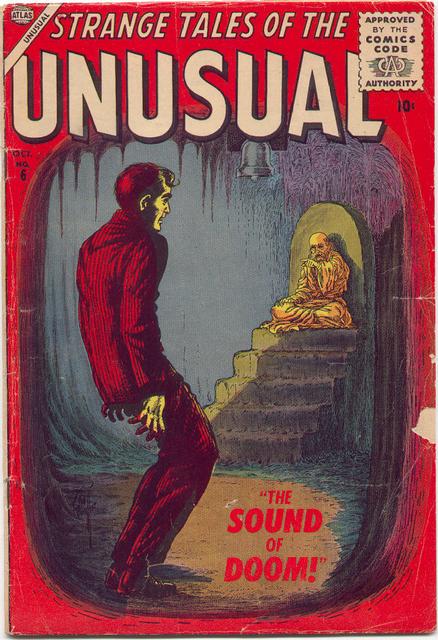
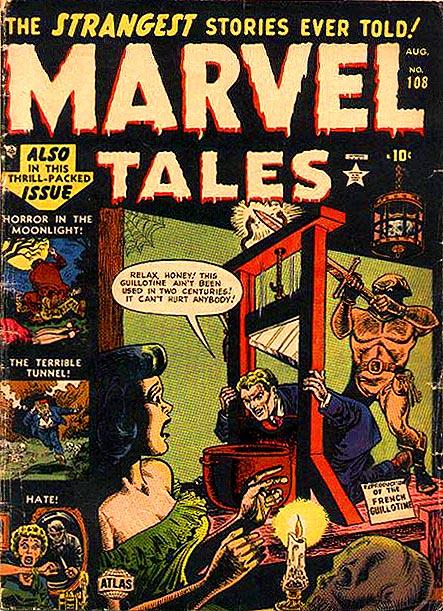
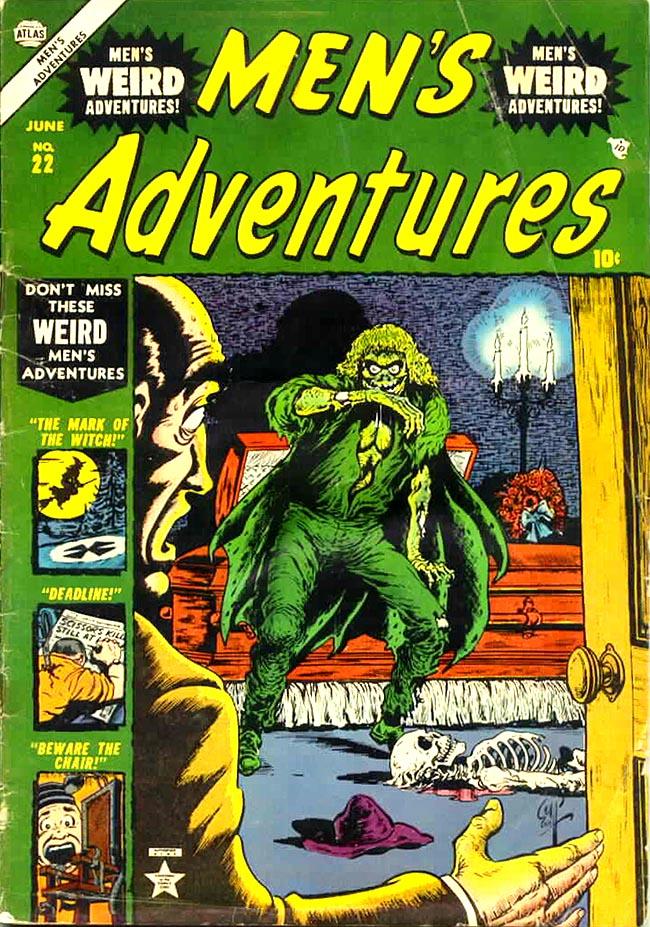
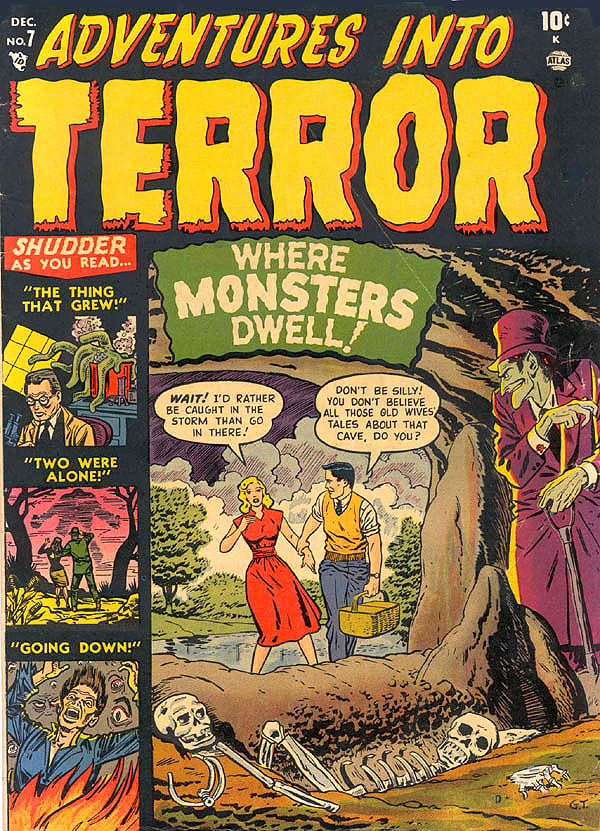
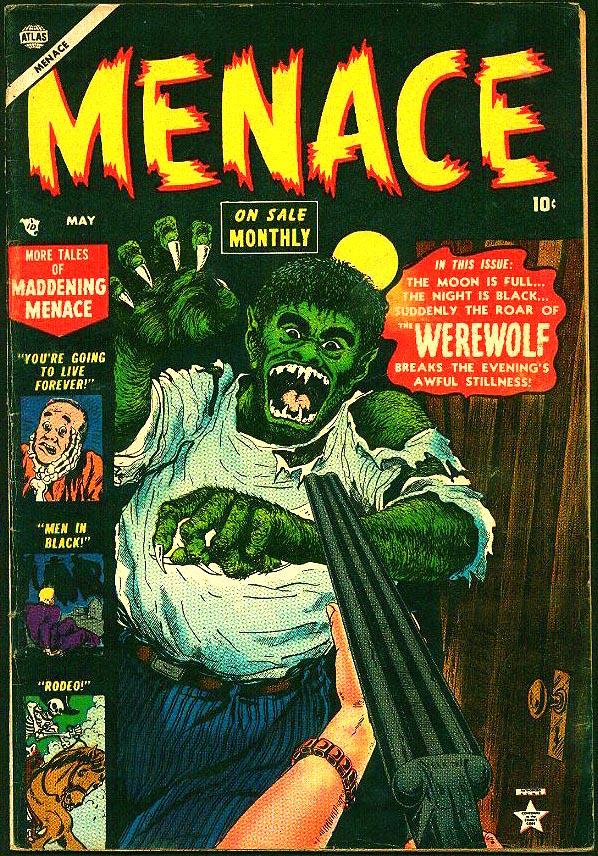
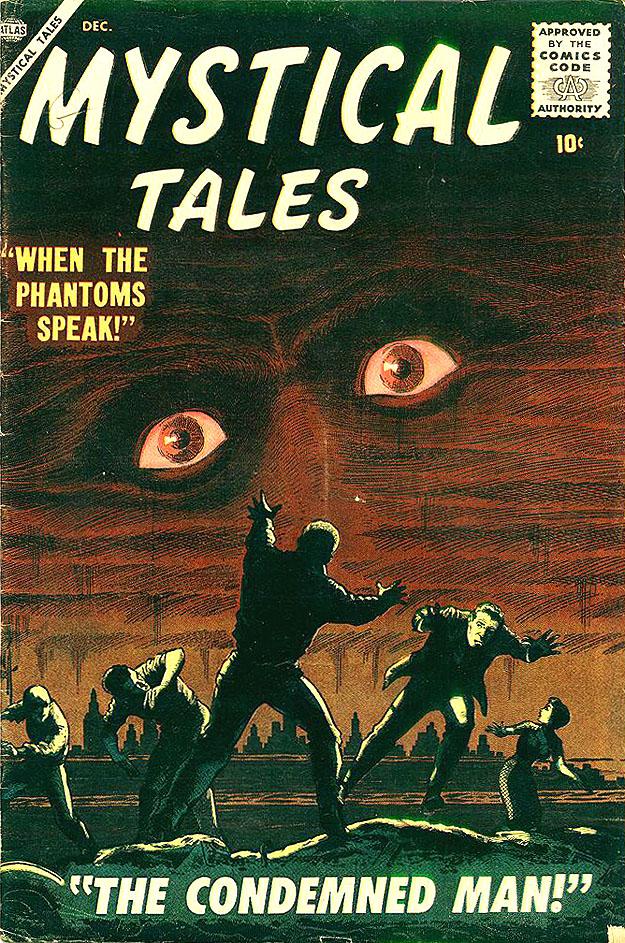
Let’s kick off Halloween week right by analyzing some old horror comic book covers from the 1950s.
I love this one: the jagged posture, the bloody reds, the weird mystic guy. And what can beat a title as redundant as Strange Tales of the Unusual?
Of course, all of these titles are strange, except when they’re weird or uncanny or unusual. Or mystical. But honestly, what’s so strange about putting your head in an old guillotine? I mean, seriously, relax. Who hasn’t put their neck on the chopping block like this. Literally, that is. (I love the bottom corner panel that just says “HATE!” incidentally).
Let me be clear on this: I am a man. Further, I am a manly man. Therefore, I require–no, demand–only men’s adventures. Further, I require my adventures to be weird. And not just slightly weird. I need creepy-green-gay-zombie weird. I need mark-of-the-witch weird. Newspaper-oriented-murder weird. Chair weird!
This comic is a clear forerunner of all those eighties slasher films that warned against teenage sex. Look at all the sexual anxiety here: “THE THING THAT GREW!”? “TWO WERE ALONE!”? “GOING DOWN!”? Jeez! Or, alternately, I am a pervert who sees sex everywhere. But seriously, don’t go into caves, kids.
My grandpa always taught me that the only thing more maddeningly menacing than a werewolf is a green werewolf.
Nothing snarky to say about this one: it’s beautiful. But really, I love them all.
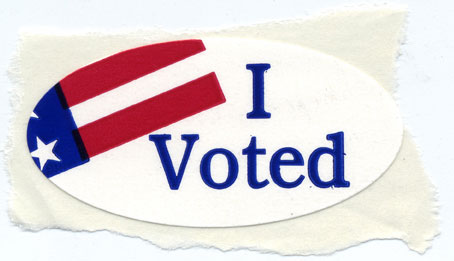
I voted last Thursday. It was easy. I had to go pick up my daughter from daycare, and an early voting location happened to be right on the way. I left half an hour early just in case, and then drove the 1.1 miles to the Murray Hill Library. I returned three audio books (I know you’re dying to know: Don DeLillo’s The Body Artist, Margaret Atwood’s Moral Disorder, and Michael Chabon’s The Amazing Adventures of Kavalier and Clay) and then stood in a line five-people deep where I waited all of 120 seconds before entering the voting area. There, I handed over my driver license and voter registration card, confirmed my address, and waited about 45 seconds for my ballot. The woman in front of me was living at an address different from the one on her ID, but she was able to vote anyway. Easy. I overheard the process involved (she had to fill out some form) while I waited about a minute to go to a booth. Then I went to the booth and voted for Obama (I didn’t even look wistfully at Nader’s name, I swear!). I voted on some other stuff too, but the only other thing I cared about quite a bit was Florida’s proposed Amendment 2, another American Taliban scheme to define marriage. I voted “no,” of course. The whole process, including driving, took less than 20 minutes (I should mention that I had my sample ballot with me, which is a time saver of course).
Some folks I know personally have worried about early voting–will their vote be counted?–and after debacles in 2000 and 2004, who can blame them for these anxieties? However, Florida voters can go to the Florida Division of Elections website to check the early voting and absentee ballot reports. I went there, clicked on my county’s updated report, downloaded a .txt file and found my name, as well as my wife’s, and the respective times we voted. Done. I know–and have a record–that my vote will be counted. Simple. Now, go vote–you never know what surprise might pop up on November 4th.
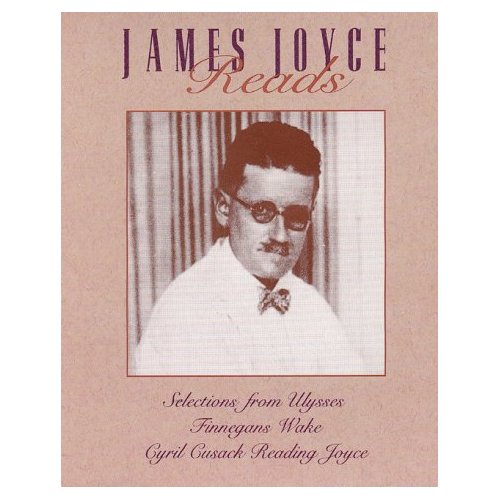
Check out these mp3s of James Joyce reading selections from his novels (that word, “novel,” it doesn’t seem right…) Ulysses and Finnegans Wake. Lovely lilting rhythm. Mostly, it’s just cool to hear his voice. From the original liner notes by Sylvia Beach to the 1924 album (courtesy The Modern World):
In 1924 I went to the office of His Master’s Voice in Paris to ask them if they would record a reading by James Joyce from ULYSSES. But they would agree only if it were done at my expense. The record would not have their label on it, nor would it be listed in their catalogue. I accepted the terms: thirty copies of the recording to be paid for on delivery.
Joyce himself was anxious to have this recording made. He had made up his mind, he told me, that this would be his only reading from ULYSSES. Recording was done in a rather primitive manner in those days. All the same, I think the ULYSSES recording is a wonderful performance. I never hear it without being deeply moved.
Conservative Republicans seem to be having an awfully tough time with their vocabulary lately. They keep misusing words, poor old dears. In particular, these confused politicos keep using words that have traditionally had a positive connotation in a pejorative sense. Therefore, we present a little gloss that might help them with their sorry diction.
1. Liberal
“c.1375, from O.Fr. liberal “befitting free men, noble, generous,” from L. liberalis “noble, generous,” lit. “pertaining to a free man,” from liber “free,” from PIE base *leudheros (cf. Gk. eleutheros “free”), probably originally ‘belonging to the people'” (Online Etymological Dictionary)
From the Indo-European root “leudh,” meaning “grow, rise,” as in progressive (Joseph T. Shipley, The Origins of English Words)
2. Elite
“1823, from Fr. élite “selection, choice,” from O.Fr. fem. pp. of elire, elisre “pick out, choose,” from L. eligere “choose” (see election). Borrowed in M.E. as “chosen person,” esp. a bishop-elect, died out c.1450, re-introduced by Byron’s “Don Juan.” (Online Etymological Dictionary)
“1a singular or plural in construction:the choice part. 1b singular or plural in construction:the best of a class” (Merriam-Webster)
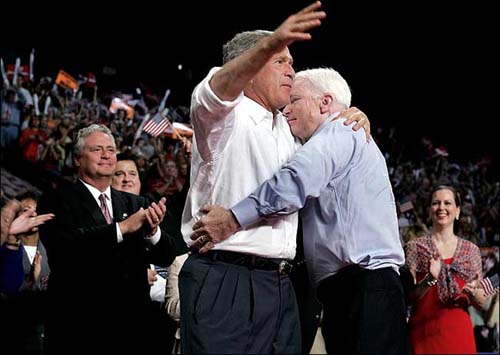
A Tender Hug Betwixt Mavericks
3. Maverick
“1867, “calf or yearling found without an owner’s brand,” in allusion to Samuel A. Maverick (1803-70), Texas cattle owner who was negligent in branding his calves. Sense of “individualist, unconventional person” is first recorded 1886, via notion of ‘masterless.'” (Online Etymological Dictionary)
Samuel A. Maverick refused to brand his cattle, ostensibly claiming that the practice was cruel. However, by not branding his cattle, he was able to claim any stray cows as his own property. What a devious genius! How’s that for laissez-fair?
Clearly, a maverick would never let himself be branded with someone else’s label. He’d cut his own path, forge his own trail, create his own hackneyed metaphor, and not, f’r’instance, vote with the President 95% of the time.
4. Conservative
“Conservative,n. A statesman who is enamored of existing evils, as distinguished from the Liberal, who wishes to replace them with others.” ( Ambrose Bierce, Devil’s Dictionary)
5. Change
“From the Indo-European root “(s)kamb: bend, change; exchange, barter . . . Fr, change, exchange. Gc, change, changeable, unchanging, etc. . . . This root is related to camp, campus, campaign, etc.” (Joseph T. Shipley, The Origins of English Words)
Synonyms for “change” include: modification, variation, transformation, revolution, conversion, adjustment, amendment, difference, and alteration.
When used in politics, the word connotes a dramatic shift in ideology from the previous regime to its successors (e.g. “The idea that a new set of Republicans would be a change from the old set was both a paradox and a misuse of language”)
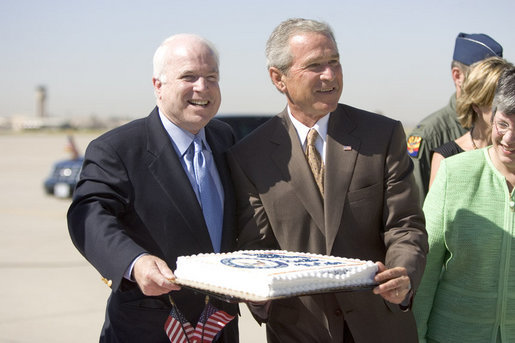
Let Them Eat Cake! W and Mav McCain Enjoy A Tasty Treat as Katrina Drowns New Orleans
I teach at an inner-city school, and I’ve witnessed first hand just how awful NCLB has been: it basically aims to make zombies out of kids. Here’s a personal anecdote that best sums up how NCLB’s rigid testing processes work to attack the fostering of free thought: I was administering an FCAT practice test, and a young lady of about 15 years or so raised her hand for my assistance. Her problem was that the answer box for a short response question was far too small to accommodate her answer (her handwriting was also large). We are teaching kids to literally “think inside the box”; we are also mandating that there is always only “one right” answer to problems, which is plainly false.
Please take a few seconds to sign the online petition to abolish this heinous crime against our young people.
Claim: Annual standardized testing is the key to bringing school improvement and accountability to all schools. “For too long,” says the Department of Education, “America’s education system has not been accountable for results, and too many children have been locked in underachieving schools and left behind. … Testing will raise expectations for all students and ensure that no child slips through the cracks.”
Reality: A huge increase in federally mandated testing will not provide the services and strategies our schools and students need to improve. Most states and local districts have dramatically increased the use of standardized tests over the past two decades, but this did not solve the problems of poor schools. Some estimate that the new federal law will require states to give more than 200 additional tests at a cost of more than $7 billion.
Many studies show that standardized testing does not lead to lasting increases in student achievement and may in fact reduce it. Researchers at Arizona State University recently completed the largest study ever done on the issue. They concluded that “rigorous testing that decides whether students graduate, teachers win bonuses and schools are shuttered, an approach already in place in more than half the nation, does little to improve achievement and may actually worsen academic performance and dropout rates.” (New York Times, 12/28/02)
Yesterday, the discussion on my post last week on the rhetoric of environmentalism got a little heated. I was accused in the comments thread of proposing two conflicting ideas. I don’t think that’s true, and I’m not going to go back to the post and nitpick over my own rhetoric; I’ll let it stand on its own. Oddly enough though, last night I read novelist Wendell Berry’s essay “Faustian Economics” in the latest issue of Harper’s. Berry’s piece is simply beautiful and beautifully simple, and certainly the best essay I’ve read in a number of years. He discusses our propensity toward the illusion that we are “limitless animals,” reveals the etymological connection between free and friend, points out that we are in an “economy of community destruction” (not all of us unwittingly), and proposes that, “in confronting the phenomenon of “peak oil,” we are really confronting the end of our customary delusion of “more.”” For Berry, this is a good thing. Again, the essay is awfully compelling, and he makes a much more solid case for what I was trying to say in my previous post: existence costs.
Berry’s introduction:
The general reaction to the apparent end of the era of cheap fossil fuel, as to other readily forseeable curtailments, has been to delay any sort of reckoning. The strategies of delay have been a sort of willed oblivion, or visions of large profits to the manufacturers of such “biofuels” as ethanol from corn or switchgrass, or the familiar unscientific faith that “science will find an answer.” The dominant response, in short, is a dogged belief that what we call the American Way of Life will prove somehow indestructible. We will keep on consuming, spending, wasting, and driving, as before, at any cost to anything and everybody but ourselves.
This belief was always indefensible–the real names of global warming are Waste and Greed–and by now it is manifestly foolish. But foolishness on this scale looks disturbingly like a sort of national insanity. We seem to have come to a collective delusion of grandeur, insisting that all of us are “free” to be as conspicuously greedy and wasteful as the most corrupt of kings and queens. (Perhaps by devoting more and more of our already abused cropland to fuel production we will at last cure ourselves of obesity and become fashionably skeletal, hungry, but–thank God!–still driving.
Witold Rybczynski’s “Borrowed Time,” an interesting photo-essay published at Slate today, considers the architecture, purpose, and meaning of libraries in the “”digital world” of Google, Wikipedia, and Kindle.” Rybczynski’s essay is typical Slate writing–it picks at its topic a little bit, rifles through a few examples, and ends with an empty platitude.
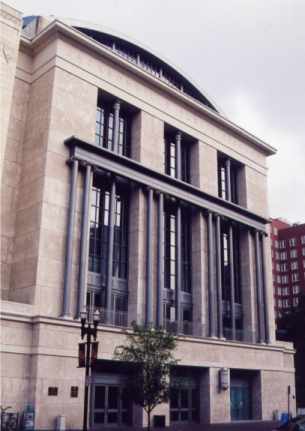
The article cites Jacksonville’s own new downtown branch among several examples of a new direction in library building, arguing that the “library building boom of the last two decades is closely tied to efforts to rejuvenate downtowns. Cities can’t re-create the department stores, movie palaces, and manufacturing lofts that once made downtowns the vital centers of American metropolitan life, so they build convention centers, ballparks, museums, and concert halls instead.” Rybczynski concedes that “Retro ballparks have enjoyed success with the public,” but insists that the days of “library-as-monument” are over. Instead, he sees the library of the future as more of a social meeting place, a community center with internet access, coffee shops, and magazines–with less and less room for books.
Jacksonville’s new Main Library (Downtown)
Although the trend that Rybczynski points out does evince a change in both the architecture and organization of the library–a trend that does reflect (relatively) recent changes in technology–I just don’t see the library losing its monumental status. Rather, I think that 21st-century notions, concepts, and constructions of what exactly a society should monumentalize, and how that culture should monumentalize whatever it decides it should monumentalize (whether it’s a sports arena, a church, a library, or a shopping mall) are changing. The purpose of a library–extending all the way back to the Library at Alexandria–is akin to (and yet, of course, different from) the purposes of churches and art and science museums: libraries serve as a nexus of a culture’s collected knowledge, and as a point of access to that knowledge. This is why the concept of a public library is extremely important, indeed vital, to a free and democratic society. Just because greater access to technology holds the possibility of displacing books does not mean that books will disappear forever and that museums will have to suddenly become glorified Starbucks. Change is normal, and a library that fails to reflect the zeitgeist of its age would cease to become a library (it would be a history museum). And yet the core mission of public libraries will (and should) remain as long as people endeavor to enter the epochs-old conversation that is human culture.
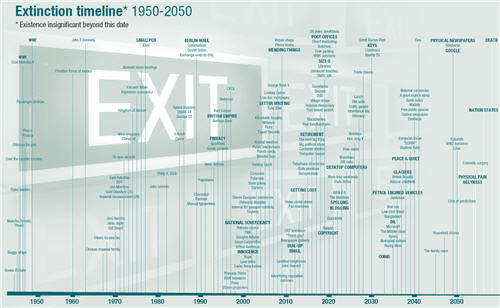
Improbably, Rybczynski cites the “Extinction Timeline” created last year by What’s Next and Future Exploration Network as evidence that the library will certainly disappear (in 2019). While this type of thinking is fun–and I certainly get a kick out of the “Extinction Timeline”–it belongs to the realm of science fiction, not cultural criticism. Although much of what the Extinction Timeline predicts will almost certainly come about (how much longer can printed telephone directories last?) I suspect that more than half of it is tongue-in-cheek. Will “Childhood” really disappear in 2030? Will “Sit down breakfasts” become insignificant? Can “Natural Childbirth” really go away by 2038? If these guys are serious, this is teleological thinking at its worst. But perhaps I’m ludicrously old fashioned. After all, I still think that “Mending Things” (“Existence insignificant” as of 2009) is both important and worthwhile, and, in a more abstract sense, both healthy and good for people. And I’ll be mending things in 2009.
If our libraries need to be mended, or amended, rather, let’s change them in ways that suitably monumentalize and grant access to our culture. I think that the Jacksonville library alluded to in Rybczynski’s article monumentalizes the best aspects of human culture and technology, and is more than just, as Rybczynski suggests, an “urban hangout” or mere “arbiter of information.” And even if, like the Seattle Public Library, the Jacksonville Public Library is full of “street people” (Rybczynski’s contemptuous term), significantly, it is, as its stairwell mural proudly declares, “OPEN TO ALL”–a monument to democratic and egalitarian access to information.
Kevin Shields claims that a “new” My Bloody Valentine record will come out this year. Hold your breath. Anyway. Kevin Shields. Loveless. Yeah, that was really good. “If They Move, Kill ‘Em (MBV Arkestra),” I like that too. MBV–never really made a good video.
Don’t start with me. I know Peter Hook played bass. Bass is a guitar, right? I love New Order. Who can deny Peter Hook’s iconic bass leads. Sure, Bernard Sumner had that jangly thing down, but, c’mon, “Ceremony”? “Disorder”? “Temptation”? “Blue Monday”? “Perfect Kiss”? “Love Vigilantes”? Give me a break, those are perfect songs, and you know it’s because of Hook’s sweet lines. Shit, even “Regret” is awesome. Peter Hook is too good. Sumner looks kind of like Thomas Lennon playing Lt. Dangle in this vid:
Polvo never got their due. Maybe they’ll get a renaissance one day. They were the loudest band I’ve ever seen (they permanently damaged my hearing). They were one of the first bands I listened to where I said “What the fuck is this?” Great stuff, bendy electric. Chewy churny. I saw them cover “Fly Like an Eagle” at Merge Record’s fifth anniversary party. Ash Bowie played what looked like a little SK1. He kicked a stool at the girls from Tsunami, who were filming the show.
I found this on the floor of my classroom; I’m assuming it’s a student’s response to a prompt given by the social studies teacher who has my classroom while I’m on my planning period. I don’t know the student. What follows is the student’s response, verbatim:
“I think the US should blow up Iraq because Iraq is hating on the US and they would do whatever it takes to blow up us and we all are beefin.”
Clearly, this kid is savvy enough to work for the Bush administration.
I came of age (as the hackneyed phrase goes) in the nineties, a magical time when the Chicago Bulls ruled the world and Michael Jordan was the king of the universe. As a young kid, I didn’t really care about sports: I wasn’t very good at them and I didn’t really grow up in America, so my exposure and interest were limited on two fronts. But by 1991, my family had moved back to the States and I was suddenly aware of something very, very cool: there were these guys, the Bulls, who played like the best orchestra in the world. They were all awesome individually–Michael Jordan was basically God in Nikes, and there was this guy Scottie Pippen who was a star in his own right–but they also played as a real team. By the time the Bulls were going for their “threepeat” in the ’92 NBA season I–and just about every other kid in America–loved the Bulls. I didn’t really even care about basketball, to be honest–I liked it all right I guess, but what I really loved was to watch Jordan play. By the time I was headed to college, the Bulls were finishing up their second “threepeat,” and I knew for certain that I didn’t really care about basketball at all–just the Bulls and Jordan. I also knew that this was somehow lame or shameful, and it was also kind of sad. I only cared about seeing something really, really good. But who could blame me–especially after Jordan decided to come back after giving minor league baseball a shot, especially after game five of the ’97 championship, when Jordan, running a fever of over one hundred degrees, scored 38 points including a game-deciding three-pointer in the last minute. That’s pure magic; that’s divine spirit channeled. But why am I going on about this? You were probably there too, and if you weren’t, you know the mythology.
The point is that we love winners in America. We love to see someone excel at something, to do something better than anyone else, and do it harder, faster, longer, more, more, more. We don’t just want excellence, we want spectacular excellence (and conversely, devastating, soul-crushing failure). And we want excellence we can measure: points made, times beaten, wins racked up, championship victories accrued. We want to know for sure who won: we don’t like ties (soccer will never really take off in America). We want objective evidence to point to, so we can say plainly what is good and what is great and what is excellent and what is not: see, the numbers are right there.
This need for winners is, of course, not confined to the world of sports. Americans now seem to want to know who the winners in education are: they want test scores and school grades that objectively determine what a student knows or does not know. But the ability to think critically, rationally, logically, and creatively cannot truly be determined objectively. Education isn’t a basketball game, with points, and winners, and losers. When a basketball team is good, we know that they’re good because there is a system of rules that make the game a game (without the rules, there is no game). However, education is not a game, and treating it as such is unfair to young people in schools.
I am not making an argument that all kinds of testing be done away with, or that objective testing can’t provide a clear idea of the strengths and weaknesses of students and schools. The right kind of tests help assess deficiencies that can then be remedied. However, America is doing little right now to educate their children. Our educational model in this country goes back to the Industrial Revolution; we are behind the rest of the world in science education; we have abandoned the idea of teaching civic responsibility and bought in to the myth that to be American is to be a cannibal capitalist. There is clearly a gap between public expectations of public education and public support of public education. I don’t think that the average American comprehends the genuine literacy crisis that this country is faced with right now, but it’s real, it’s happening, and the results will be objectively measurable in the ever-growing gap between the rich and the poor in this country.
I’m on a rant now; sorry. I’ll try to be clearer: standardized tests like the Florida Comprehensive Assessment Test (FCAT) are a big waste of taxpayer money. They prove nothing and divert resources–money and educators’ time and energy–away from meaningful instruction and real learning. I’m not arguing that the test is too difficult–it’s not, and you certainly should be able to master such material in order to graduate high school–but the amount of stock the state has put into this test is ridiculous. It delimits creative and complex thought, limiting students to bubbling answers without recourse to explanation or rationale. Even the written response sections don’ t allow for real analytical assessment–students must literally think inside a tiny little box, and if their answer goes outside of the box, it will not be considered for grading. We need to abandon these types of tests and replace them with a meaningful, real-world based curriculum. We need to teach kids word processing, website design, standard office programs. Institute new hands-on science programs. Bring back shop, home ec, etc. But that’s not what’s happening: instead of curricula based on real-world needs, Florida continues to ask for objective data in place of real thinking, test scores instead of laboratories and practicums.
We all knew that Michael Jordan was great; we didn’t need the scoreboard to tell us. We didn’t need the MVP awards and National Championships and thousands of points he made to tell us. You could see it in his jump, in his tongue, in his eyes. It came out of the TV and you could feel it. MJ’s excellence was truly excellent because it transcended objective data: even a nerd like me could recognize it and honor it and hope to reach something close to it in some unknown way. We loved MJ because he represented an unquantifiable, nearly ineffable excellence; I believe that this excellence has a potential analog in the mind of any student in this country. But when we get hung up on things like points, scores, and grades, we not only send the wrong message, we also squander and misspend that potential.








 Biblioklept