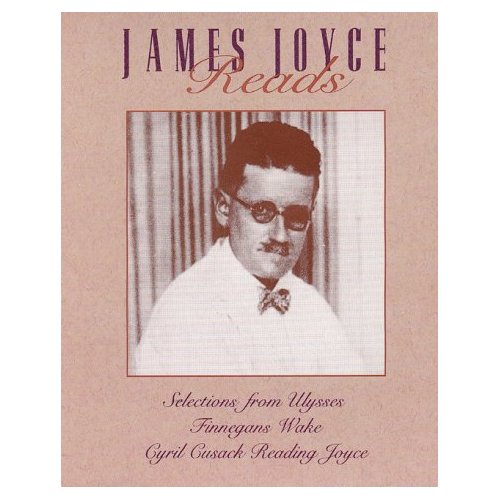
Check out these mp3s of James Joyce reading selections from his novels (that word, “novel,” it doesn’t seem right…) Ulysses and Finnegans Wake. Lovely lilting rhythm. Mostly, it’s just cool to hear his voice. From the original liner notes by Sylvia Beach to the 1924 album (courtesy The Modern World):
In 1924 I went to the office of His Master’s Voice in Paris to ask them if they would record a reading by James Joyce from ULYSSES. But they would agree only if it were done at my expense. The record would not have their label on it, nor would it be listed in their catalogue. I accepted the terms: thirty copies of the recording to be paid for on delivery.
Joyce himself was anxious to have this recording made. He had made up his mind, he told me, that this would be his only reading from ULYSSES. Recording was done in a rather primitive manner in those days. All the same, I think the ULYSSES recording is a wonderful performance. I never hear it without being deeply moved.
Conservative Republicans seem to be having an awfully tough time with their vocabulary lately. They keep misusing words, poor old dears. In particular, these confused politicos keep using words that have traditionally had a positive connotation in a pejorative sense. Therefore, we present a little gloss that might help them with their sorry diction.
1. Liberal
“c.1375, from O.Fr. liberal “befitting free men, noble, generous,” from L. liberalis “noble, generous,” lit. “pertaining to a free man,” from liber “free,” from PIE base *leudheros (cf. Gk. eleutheros “free”), probably originally ‘belonging to the people'” (Online Etymological Dictionary)
From the Indo-European root “leudh,” meaning “grow, rise,” as in progressive (Joseph T. Shipley, The Origins of English Words)
2. Elite
“1823, from Fr. élite “selection, choice,” from O.Fr. fem. pp. of elire, elisre “pick out, choose,” from L. eligere “choose” (see election). Borrowed in M.E. as “chosen person,” esp. a bishop-elect, died out c.1450, re-introduced by Byron’s “Don Juan.” (Online Etymological Dictionary)
“1a singular or plural in construction:the choice part. 1b singular or plural in construction:the best of a class” (Merriam-Webster)
A Tender Hug Betwixt Mavericks
3. Maverick
“1867, “calf or yearling found without an owner’s brand,” in allusion to Samuel A. Maverick (1803-70), Texas cattle owner who was negligent in branding his calves. Sense of “individualist, unconventional person” is first recorded 1886, via notion of ‘masterless.'” (Online Etymological Dictionary)
Samuel A. Maverick refused to brand his cattle, ostensibly claiming that the practice was cruel. However, by not branding his cattle, he was able to claim any stray cows as his own property. What a devious genius! How’s that for laissez-fair?
Clearly, a maverick would never let himself be branded with someone else’s label. He’d cut his own path, forge his own trail, create his own hackneyed metaphor, and not, f’r’instance, vote with the President 95% of the time.
4. Conservative
“Conservative,n. A statesman who is enamored of existing evils, as distinguished from the Liberal, who wishes to replace them with others.” ( Ambrose Bierce, Devil’s Dictionary)
5. Change
“From the Indo-European root “(s)kamb: bend, change; exchange, barter . . . Fr, change, exchange. Gc, change, changeable, unchanging, etc. . . . This root is related to camp, campus, campaign, etc.” (Joseph T. Shipley, The Origins of English Words)
Synonyms for “change” include: modification, variation, transformation, revolution, conversion, adjustment, amendment, difference, and alteration.
When used in politics, the word connotes a dramatic shift in ideology from the previous regime to its successors (e.g. “The idea that a new set of Republicans would be a change from the old set was both a paradox and a misuse of language”)
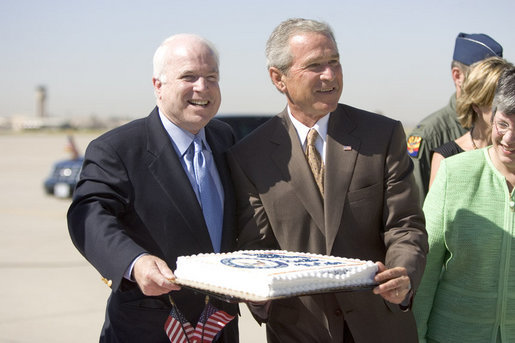
Let Them Eat Cake! W and Mav McCain Enjoy A Tasty Treat as Katrina Drowns New Orleans
I teach at an inner-city school, and I’ve witnessed first hand just how awful NCLB has been: it basically aims to make zombies out of kids. Here’s a personal anecdote that best sums up how NCLB’s rigid testing processes work to attack the fostering of free thought: I was administering an FCAT practice test, and a young lady of about 15 years or so raised her hand for my assistance. Her problem was that the answer box for a short response question was far too small to accommodate her answer (her handwriting was also large). We are teaching kids to literally “think inside the box”; we are also mandating that there is always only “one right” answer to problems, which is plainly false.
Please take a few seconds to sign the online petition to abolish this heinous crime against our young people.
Claim: Annual standardized testing is the key to bringing school improvement and accountability to all schools. “For too long,” says the Department of Education, “America’s education system has not been accountable for results, and too many children have been locked in underachieving schools and left behind. … Testing will raise expectations for all students and ensure that no child slips through the cracks.”
Reality: A huge increase in federally mandated testing will not provide the services and strategies our schools and students need to improve. Most states and local districts have dramatically increased the use of standardized tests over the past two decades, but this did not solve the problems of poor schools. Some estimate that the new federal law will require states to give more than 200 additional tests at a cost of more than $7 billion.
Many studies show that standardized testing does not lead to lasting increases in student achievement and may in fact reduce it. Researchers at Arizona State University recently completed the largest study ever done on the issue. They concluded that “rigorous testing that decides whether students graduate, teachers win bonuses and schools are shuttered, an approach already in place in more than half the nation, does little to improve achievement and may actually worsen academic performance and dropout rates.” (New York Times, 12/28/02)
Yesterday, the discussion on my post last week on the rhetoric of environmentalism got a little heated. I was accused in the comments thread of proposing two conflicting ideas. I don’t think that’s true, and I’m not going to go back to the post and nitpick over my own rhetoric; I’ll let it stand on its own. Oddly enough though, last night I read novelist Wendell Berry’s essay “Faustian Economics” in the latest issue of Harper’s. Berry’s piece is simply beautiful and beautifully simple, and certainly the best essay I’ve read in a number of years. He discusses our propensity toward the illusion that we are “limitless animals,” reveals the etymological connection between free and friend, points out that we are in an “economy of community destruction” (not all of us unwittingly), and proposes that, “in confronting the phenomenon of “peak oil,” we are really confronting the end of our customary delusion of “more.”” For Berry, this is a good thing. Again, the essay is awfully compelling, and he makes a much more solid case for what I was trying to say in my previous post: existence costs.
Berry’s introduction:
The general reaction to the apparent end of the era of cheap fossil fuel, as to other readily forseeable curtailments, has been to delay any sort of reckoning. The strategies of delay have been a sort of willed oblivion, or visions of large profits to the manufacturers of such “biofuels” as ethanol from corn or switchgrass, or the familiar unscientific faith that “science will find an answer.” The dominant response, in short, is a dogged belief that what we call the American Way of Life will prove somehow indestructible. We will keep on consuming, spending, wasting, and driving, as before, at any cost to anything and everybody but ourselves.
This belief was always indefensible–the real names of global warming are Waste and Greed–and by now it is manifestly foolish. But foolishness on this scale looks disturbingly like a sort of national insanity. We seem to have come to a collective delusion of grandeur, insisting that all of us are “free” to be as conspicuously greedy and wasteful as the most corrupt of kings and queens. (Perhaps by devoting more and more of our already abused cropland to fuel production we will at last cure ourselves of obesity and become fashionably skeletal, hungry, but–thank God!–still driving.
Witold Rybczynski’s “Borrowed Time,” an interesting photo-essay published at Slate today, considers the architecture, purpose, and meaning of libraries in the “”digital world” of Google, Wikipedia, and Kindle.” Rybczynski’s essay is typical Slate writing–it picks at its topic a little bit, rifles through a few examples, and ends with an empty platitude.
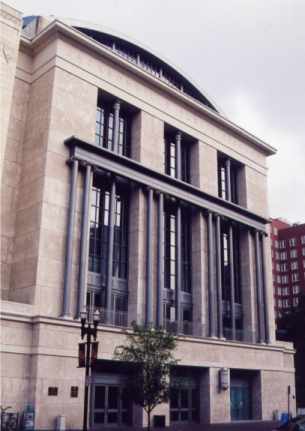
The article cites Jacksonville’s own new downtown branch among several examples of a new direction in library building, arguing that the “library building boom of the last two decades is closely tied to efforts to rejuvenate downtowns. Cities can’t re-create the department stores, movie palaces, and manufacturing lofts that once made downtowns the vital centers of American metropolitan life, so they build convention centers, ballparks, museums, and concert halls instead.” Rybczynski concedes that “Retro ballparks have enjoyed success with the public,” but insists that the days of “library-as-monument” are over. Instead, he sees the library of the future as more of a social meeting place, a community center with internet access, coffee shops, and magazines–with less and less room for books.
Jacksonville’s new Main Library (Downtown)
Although the trend that Rybczynski points out does evince a change in both the architecture and organization of the library–a trend that does reflect (relatively) recent changes in technology–I just don’t see the library losing its monumental status. Rather, I think that 21st-century notions, concepts, and constructions of what exactly a society should monumentalize, and how that culture should monumentalize whatever it decides it should monumentalize (whether it’s a sports arena, a church, a library, or a shopping mall) are changing. The purpose of a library–extending all the way back to the Library at Alexandria–is akin to (and yet, of course, different from) the purposes of churches and art and science museums: libraries serve as a nexus of a culture’s collected knowledge, and as a point of access to that knowledge. This is why the concept of a public library is extremely important, indeed vital, to a free and democratic society. Just because greater access to technology holds the possibility of displacing books does not mean that books will disappear forever and that museums will have to suddenly become glorified Starbucks. Change is normal, and a library that fails to reflect the zeitgeist of its age would cease to become a library (it would be a history museum). And yet the core mission of public libraries will (and should) remain as long as people endeavor to enter the epochs-old conversation that is human culture.
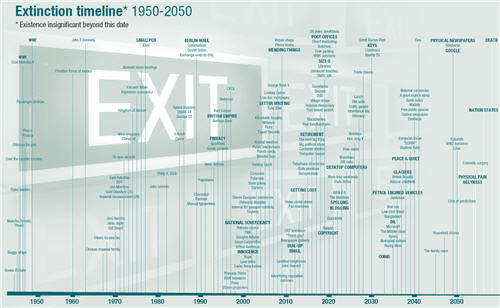
Improbably, Rybczynski cites the “Extinction Timeline” created last year by What’s Next and Future Exploration Network as evidence that the library will certainly disappear (in 2019). While this type of thinking is fun–and I certainly get a kick out of the “Extinction Timeline”–it belongs to the realm of science fiction, not cultural criticism. Although much of what the Extinction Timeline predicts will almost certainly come about (how much longer can printed telephone directories last?) I suspect that more than half of it is tongue-in-cheek. Will “Childhood” really disappear in 2030? Will “Sit down breakfasts” become insignificant? Can “Natural Childbirth” really go away by 2038? If these guys are serious, this is teleological thinking at its worst. But perhaps I’m ludicrously old fashioned. After all, I still think that “Mending Things” (“Existence insignificant” as of 2009) is both important and worthwhile, and, in a more abstract sense, both healthy and good for people. And I’ll be mending things in 2009.
If our libraries need to be mended, or amended, rather, let’s change them in ways that suitably monumentalize and grant access to our culture. I think that the Jacksonville library alluded to in Rybczynski’s article monumentalizes the best aspects of human culture and technology, and is more than just, as Rybczynski suggests, an “urban hangout” or mere “arbiter of information.” And even if, like the Seattle Public Library, the Jacksonville Public Library is full of “street people” (Rybczynski’s contemptuous term), significantly, it is, as its stairwell mural proudly declares, “OPEN TO ALL”–a monument to democratic and egalitarian access to information.
Kevin Shields claims that a “new” My Bloody Valentine record will come out this year. Hold your breath. Anyway. Kevin Shields. Loveless. Yeah, that was really good. “If They Move, Kill ‘Em (MBV Arkestra),” I like that too. MBV–never really made a good video.
Don’t start with me. I know Peter Hook played bass. Bass is a guitar, right? I love New Order. Who can deny Peter Hook’s iconic bass leads. Sure, Bernard Sumner had that jangly thing down, but, c’mon, “Ceremony”? “Disorder”? “Temptation”? “Blue Monday”? “Perfect Kiss”? “Love Vigilantes”? Give me a break, those are perfect songs, and you know it’s because of Hook’s sweet lines. Shit, even “Regret” is awesome. Peter Hook is too good. Sumner looks kind of like Thomas Lennon playing Lt. Dangle in this vid:
Polvo never got their due. Maybe they’ll get a renaissance one day. They were the loudest band I’ve ever seen (they permanently damaged my hearing). They were one of the first bands I listened to where I said “What the fuck is this?” Great stuff, bendy electric. Chewy churny. I saw them cover “Fly Like an Eagle” at Merge Record’s fifth anniversary party. Ash Bowie played what looked like a little SK1. He kicked a stool at the girls from Tsunami, who were filming the show.
I found this on the floor of my classroom; I’m assuming it’s a student’s response to a prompt given by the social studies teacher who has my classroom while I’m on my planning period. I don’t know the student. What follows is the student’s response, verbatim:
“I think the US should blow up Iraq because Iraq is hating on the US and they would do whatever it takes to blow up us and we all are beefin.”
Clearly, this kid is savvy enough to work for the Bush administration.
I came of age (as the hackneyed phrase goes) in the nineties, a magical time when the Chicago Bulls ruled the world and Michael Jordan was the king of the universe. As a young kid, I didn’t really care about sports: I wasn’t very good at them and I didn’t really grow up in America, so my exposure and interest were limited on two fronts. But by 1991, my family had moved back to the States and I was suddenly aware of something very, very cool: there were these guys, the Bulls, who played like the best orchestra in the world. They were all awesome individually–Michael Jordan was basically God in Nikes, and there was this guy Scottie Pippen who was a star in his own right–but they also played as a real team. By the time the Bulls were going for their “threepeat” in the ’92 NBA season I–and just about every other kid in America–loved the Bulls. I didn’t really even care about basketball, to be honest–I liked it all right I guess, but what I really loved was to watch Jordan play. By the time I was headed to college, the Bulls were finishing up their second “threepeat,” and I knew for certain that I didn’t really care about basketball at all–just the Bulls and Jordan. I also knew that this was somehow lame or shameful, and it was also kind of sad. I only cared about seeing something really, really good. But who could blame me–especially after Jordan decided to come back after giving minor league baseball a shot, especially after game five of the ’97 championship, when Jordan, running a fever of over one hundred degrees, scored 38 points including a game-deciding three-pointer in the last minute. That’s pure magic; that’s divine spirit channeled. But why am I going on about this? You were probably there too, and if you weren’t, you know the mythology.
The point is that we love winners in America. We love to see someone excel at something, to do something better than anyone else, and do it harder, faster, longer, more, more, more. We don’t just want excellence, we want spectacular excellence (and conversely, devastating, soul-crushing failure). And we want excellence we can measure: points made, times beaten, wins racked up, championship victories accrued. We want to know for sure who won: we don’t like ties (soccer will never really take off in America). We want objective evidence to point to, so we can say plainly what is good and what is great and what is excellent and what is not: see, the numbers are right there.
This need for winners is, of course, not confined to the world of sports. Americans now seem to want to know who the winners in education are: they want test scores and school grades that objectively determine what a student knows or does not know. But the ability to think critically, rationally, logically, and creatively cannot truly be determined objectively. Education isn’t a basketball game, with points, and winners, and losers. When a basketball team is good, we know that they’re good because there is a system of rules that make the game a game (without the rules, there is no game). However, education is not a game, and treating it as such is unfair to young people in schools.
I am not making an argument that all kinds of testing be done away with, or that objective testing can’t provide a clear idea of the strengths and weaknesses of students and schools. The right kind of tests help assess deficiencies that can then be remedied. However, America is doing little right now to educate their children. Our educational model in this country goes back to the Industrial Revolution; we are behind the rest of the world in science education; we have abandoned the idea of teaching civic responsibility and bought in to the myth that to be American is to be a cannibal capitalist. There is clearly a gap between public expectations of public education and public support of public education. I don’t think that the average American comprehends the genuine literacy crisis that this country is faced with right now, but it’s real, it’s happening, and the results will be objectively measurable in the ever-growing gap between the rich and the poor in this country.
I’m on a rant now; sorry. I’ll try to be clearer: standardized tests like the Florida Comprehensive Assessment Test (FCAT) are a big waste of taxpayer money. They prove nothing and divert resources–money and educators’ time and energy–away from meaningful instruction and real learning. I’m not arguing that the test is too difficult–it’s not, and you certainly should be able to master such material in order to graduate high school–but the amount of stock the state has put into this test is ridiculous. It delimits creative and complex thought, limiting students to bubbling answers without recourse to explanation or rationale. Even the written response sections don’ t allow for real analytical assessment–students must literally think inside a tiny little box, and if their answer goes outside of the box, it will not be considered for grading. We need to abandon these types of tests and replace them with a meaningful, real-world based curriculum. We need to teach kids word processing, website design, standard office programs. Institute new hands-on science programs. Bring back shop, home ec, etc. But that’s not what’s happening: instead of curricula based on real-world needs, Florida continues to ask for objective data in place of real thinking, test scores instead of laboratories and practicums.
We all knew that Michael Jordan was great; we didn’t need the scoreboard to tell us. We didn’t need the MVP awards and National Championships and thousands of points he made to tell us. You could see it in his jump, in his tongue, in his eyes. It came out of the TV and you could feel it. MJ’s excellence was truly excellent because it transcended objective data: even a nerd like me could recognize it and honor it and hope to reach something close to it in some unknown way. We loved MJ because he represented an unquantifiable, nearly ineffable excellence; I believe that this excellence has a potential analog in the mind of any student in this country. But when we get hung up on things like points, scores, and grades, we not only send the wrong message, we also squander and misspend that potential.
11. John Fahey
In the late nineties, indie rock kids–myself included–started embracing sounds that expanded beyond four white guys playing drums, bass, and guitar. Bands like Tortoise and The Sea and Cake bridged the way to the avant garde stylings of Gastr del Sol and Oval, opening up whole new sound-worlds to young ears. Gastr del Sol’s stunning 1996 record Upgrade and Afterlife featured a cover of Fahey’s “Dry Bones in the Valley” as the most beautiful closing statement imaginable. A whole new generation of listeners were introduced to cult fave Fahey’s cryptic finger-picking style via Gastr’s Jim O’Rourke, along with Table of the Elements records who released Fahey’s Womblife in 1997. Today, followers of Fahey’s sound include Six Organs of Admittance, Jack Rose, Glenn Jones, and James Blackshaw, among many others. Great stuff, all around.
Brian Jones is often credited as the “second guitarist” for the Rolling Stones, and relegated to a space under the shadow of Keith Richards. He’s more infamous than famous, remembered as the wild man of the Stones who helped define their renegade image. However, Brian Jones was a multi-instrumentalist whose passion for different styles of music from around the world helped infuse the basic rocknroll of the early Stones with a certain eclectic punch. And although his early drowning death (like Dennis Wilson) in 1969 (before Jimi Hendrix, Jim Morrison, Janis Joplin) is tragic on some levels (like Keith Moon), it may have preserved him from turning into what the Rolling Stones are today–a decrepit zombie joke that can no longer reasonably retire, already having permanently damaged any patina of mythos to their legacy.
14. Pete Townshend
What Pete Townshend lacked in technical dazzle he more than made up for in bombast, his raw energy and indelicacy summed up best in his propensity to smash his guitars and stab his amps. His work with synthesizers pioneered whole new territories and genres of music, and his penchant for arranging narrative song-suites proved a profound influence on my favorite band, The Fiery Furnaces.
This is one of my favorite things ever:
15. Phil Manzanera
Besides being a founding member of Roxy Music, Manzanera released a series of excellent solo albums of strange new wave music in the late seventies, continuing to work with Brian Eno, as well as guys like Robert Wyatt and John Wetton. Diamond Head is a favorite of mine.
Welcome to yet another ongoing Biblioklept series which may or may not ever end in your lifetime (and no, we haven’t given up on the Alphabet Soup thing). These axe-masters will come in random order–don’t confuse the numbers I give them with rankings. There’s only one tier of hierarchy here–all of these guitar players are superior to Slash, he of Snake Pit fame.
Fripp is the guitarist who best epitomizes the spirit of this list: he has consistently evolved over his 40+ years in King Crimson, he combines his masterful playing with a keen ear for control, and he’s a true innovator to his instrument. Watch the man demonstrate his patented Frippertronics below.
Neil Young gets more mileage out of a one-note solo on “Cinnamon Girl” than most wankers achieve on the whole fretboard. Neil Young was willing to go beyond the standard rock stuff (which he excelled at of course) and challenge his listeners with experimental albums like Trans and Arc. And for the record, Harvest is the most perfect Sunday-morning album ever committed to vinyl.
Cropper’s subtle and steady rhythm helped define the Stax sound. He was never showy, and in his production and songwriting as well as his playing he knew how to highlight the song, not his own guitar. If he’d only done “(Sittin’ on the) Dock of the Bay” with Otis Redding he’d still be on this list; as it is you can hear him on literally hundreds of hit recordings. And we’ll agree to forgive him for the Blues Brothers, okay?
We here at Biblioklept, Inc. couldn’t be more stoked for Strawberry Jam. We all know that strawberry jam is delicious on crumpets (and if you don’t know the tasty delights of jam-on-crumpets, I suggest you indulge yourself posthaste) and Animal Collective’s new record Strawberry Jam, set to drop sometime in September on their new label Domino, will no doubt prove delicious to the ears–the perfect aural jelly for beach blanket parties and midsummer night campfires. Animal Collective’s Sung Tongs and Feels were instant classics of the oughties, and Panda Bear’s sumptuous solo album Person Pitch has provided the sing-along soundtrack for both spring and summer around the Biblioklept offices. Seriously, I’ve never heard an album as sing-allongable as Person Pitch. We love it love it love it &c.
Anyway, studio versions of Strawberry Jam‘s first three tracks (I’m basing the idea that these are the first three tracks on the album based on this track list) have been popping up here and there in the last week. These new tracks preserve the psycho-circus-carnival feel that defines the Animal Collective sound, with the creepy darkness and noise of previous albums like Here Comes the Indian seemingly absent (despite lyrics about Jack the Ripper in “Unsolved Mysteries”). We like “Chores” the best so far–but what do you think? Mp3s below–
If this was the type of blog where I wrote about my personal life, the type of blog where I bared my naked soul to the keen scrutiny of all the world (wide web), the type of blog where I tried to express the ineffable internal in so many 0s and 1s–; if this were that type of blog, I might start this post with a litany of clichés and truisms about how the birth of my daughter Zoe this Sunday, 3 June, was easily the bestest, most significant thing to ever happen to me; how the birth of my daughter made me the happiest man in the etc., how beautiful and alert and cute and adorable etc., life-changing and dramatic, etc.; I might even post a sugary photo of her like this one–
–to justify all these wild claims.
But of course, this is all hypothetical; this is not a blog about how happy I am with our new addition, or how great my wife is at being a mother, or how lovely our little Zoe is–this is a blog about books and pop culture. So maybe I should link Zoe’s birthday, 3 June, with some famous people also born on that day: these include beat poet Allen Ginsberg, exiled dancer Josephine Baker, and game show host/CIA assassin (?) Chuck Barris. Zoe wasn’t the only person to have a birthday in the Biblioklept clan this week–I switched a digit just yesterday. Famous people who were also born on 7 June include libertine painter Paul Gaugin, American poet Gwendolyn Brooks, professional drunk Dean Martin, and Florida writer Harry Crews, whose novel a Feast of Snakes, out-Bukowskis Bukowski. But by far the coolest person to be born on 7 June (sorry Mr. Martin) is Prince (I’m not going to wiki-link to Prince. If you want to know about Prince, go buy Purple Rain, or Sign ‘O’ the Times, or 1999, or Diamonds and Pearls. Also, if you know-not the glory of Prince, hang your sorry head in shame (philistine)). On my birthday, I always wonder: “What is Prince doing for his birthday? Is he having a great time? I bet he’s doing some really awesome stuff!” It makes me happy. What can I say.
I guess some of my friends knew that I’d be tuckered out from the week’s excitement, so they sent me plenty of cool links, kind of doing my blog-job for me. Check it out:
–Watch the first episode of The Flight of the Conchords when you have a spare half hour. If you don’t find this hilarious, there is probably something wrong with your soul (thanks to Damon for the link)
–Treat yourself to an awesome mix tape, courtesy of Speck. My favorite track: “The Return” by Antares (those who don’t love spaced-out psychedelic prog jamz need not apply)
–Listen to this BBC Radio 4 story on Roger Linn, inventor of the drum machine
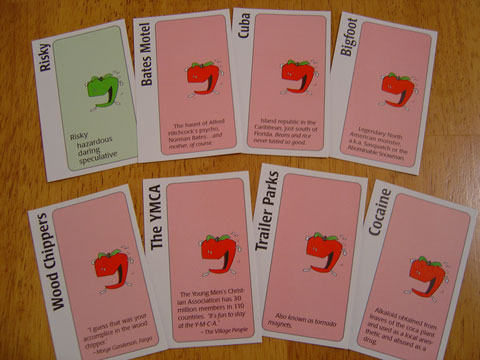
Apples to Apples is the best game I’ve played in years. It’s pretty basic: each player gets seven NOUN cards. The nouns cover a range of people, places, and things–everything from Frank Sinatra to Skiing to Wall Street to Bananas. Each round, a new player plays the judge. The judge sets out an ADJECTIVE card–something like Classy or Wise or Extravagant or Basic or Feminine, etc. Then, each player has to throw out (face down) the NOUN card that they think best fits the adjective in play. Each time the judge picks your card as the winner, you set it aside as a point. The player with the most points wins (duh).
This game stimulates plenty of conversation; you can play it with friends for hours without noticing how much time has passed by. It also goes great when paired with beer or wine (but watch out that no one you’re playing with gets upset and knocks the wine bottle over and curses everyone, which may happen in some cases). Highly recommended.
Cartoon Network’s Adult Swim lineup is pretty much hit or miss. Despite great shows like Home Movies and Moral Orel, they still produce garbage like Aqua Teen Hunger Force (their worst crime of course is their culpability in getting Family Guy back on the air). Luckily, this “throw something up and see if it sticks” approach to TV programming allows for all sorts of weird visual shenanigans to take place on your TV screen that usually wouldn’t air on basic cable. In a fit of insomnia a few nights ago I caught some of Tony Millionaire’s series of shorts, Maakies. Odd/possibly disturbing/very funny. Enjoy (or not, you mirthless maggot!)









 Biblioklept