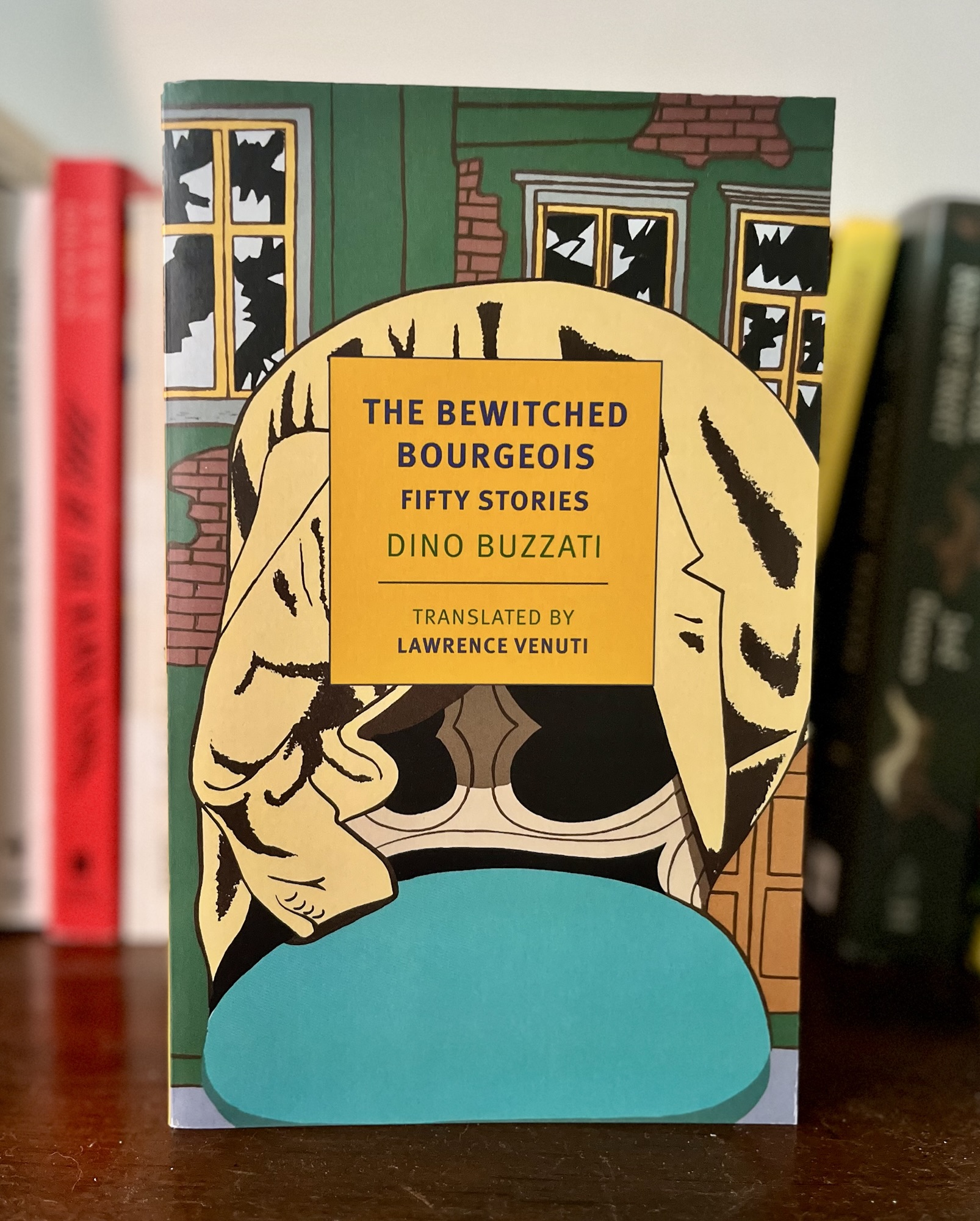
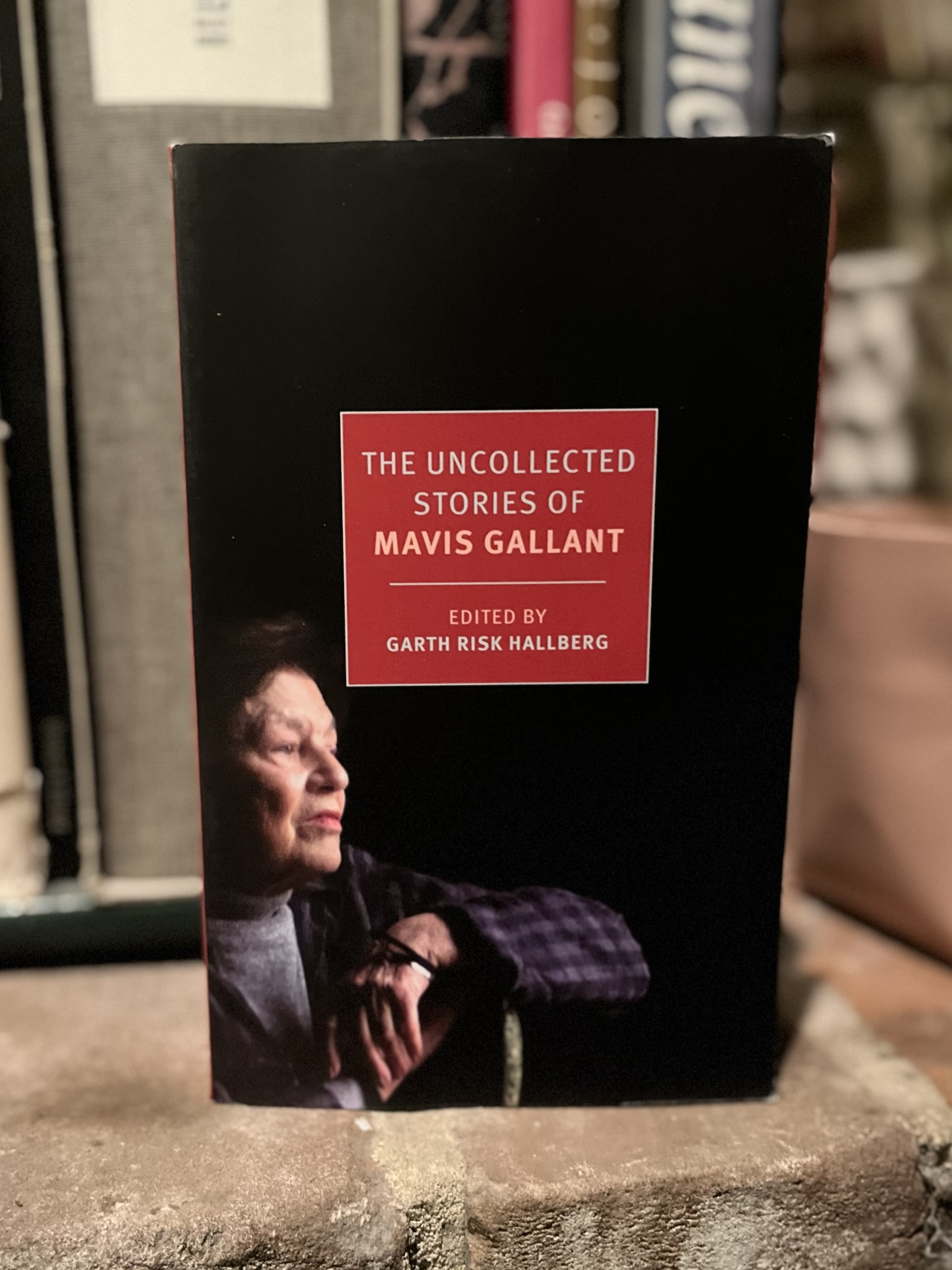
The Uncollected Stories of Mavis Gallant publishes later this month from NYRB. And oof is she a big boy! NYRB’s blurb:
Mavis Gallant’s extraordinary mastery of the short story remains insufficiently recognized. She may be the best writer of stories since the early-1950s prime of John Cheever, Eudora Welty, and Flannery O’Connor, and even in such august company, her work is sui generis. Gallant’s short fiction refines the art of the story even as it expands the boundaries of what a story can be. Above and beyond that, however, it constitutes a striking, almost avant-garde reduction. To read her is to discover something about the very nature of story: how for better or worse life is caught up in it, and how on the page that common predicament can come to life.
The Uncollected Stories of Mavis Gallant includes more than thirty stories never before gathered into one volume, including “The Accident” and “His Mother” and “An Autobiography” and “Dédé.” With the publication of this book, finally all of this modern master’s fiction will be in print.
I’m excited about this one. I loved the previous Antonio Di Benedetto novels I read, Zama (1956) and The Silentiary (1964), both also translated by Esther Allen. (I reviewed Zama here and The Silentiary here.)
The Suicides will publish in February 2025 from NYRB. Their blurb:
A stymied reporter in his early thirties embarks on an investigation of three unconnected suicides. All he has to go on are photos of the faces of the dead. Other suicides begin to proliferate, while a colleague in the archives sends him historical justifications of self-murder by thinkers of all sorts: Diogenes, David Hume, Emile Durkheim, Margaret Mead. His investigation becomes an obsession, and he finds himself ever more attracted to its subject as it proceeds.
The Suicides is the third volume of Antonio Di Benedetto’s Trilogy of Expectation, a touchstone for Roberto Bolaño and deemed “one of the culminating moments of twentieth-century fiction” by Juan José Saer. Following Zama (set during the eighteenth century) and The Silentiary (set during the 1950s), this final work takes place in a provincial city in the late 1960s, as Argentina plummets toward the “Dirty War.”
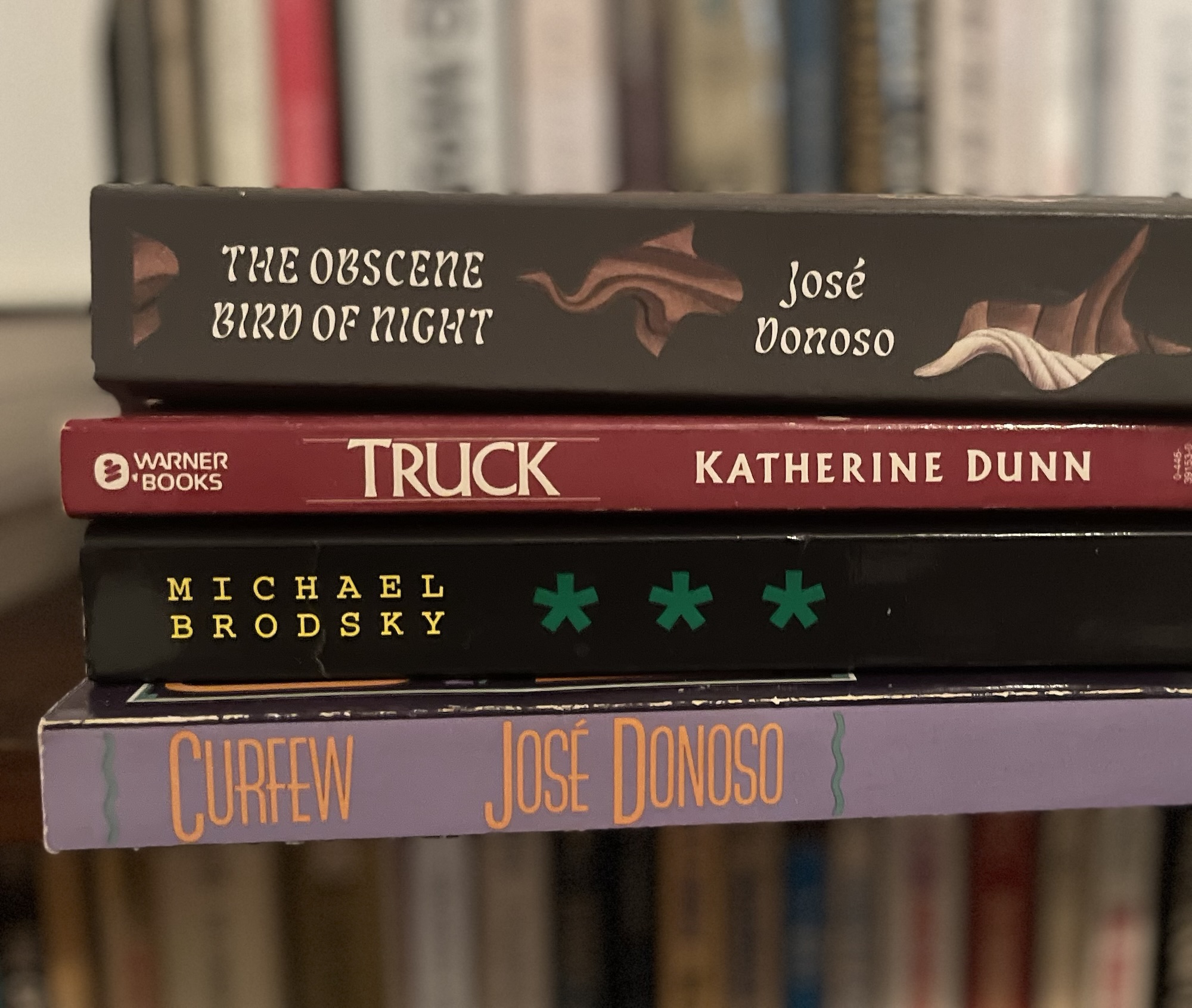
Picked up some books this weekend: Two from José Donoso: Megan McDowell’s “revision” of Hardie St. Martin and Leonard Mades’ translation of The Obscene Bird of Night, and Alfred MacAdam’s translation of Curfew: the first I had to order, the second was a lucky find. As was Michael Brodsky’s *** (send me a copy of Xman, someone), and Katherine Dunn’s Truck, which can twin with the copy of Attic I found this summer.
So I finally made some time to dig into Augusto Monterroso’s lone novel, 1978’s The Rest Is Silence (trans. Aaron Kerner). It’s hardly a conventional novel (and seems very much of a piece with the other novel I’m reading right now, Cuban author Guillermo Cabrera Infante’s 1967 novel Tres tristes tigres (in its 1971 translation as Three Trapped Tigers by Donald Gardner and Suzanne Jill Levine). Both novels eschew traditional novelistic forms—no central narrator, no conventional plot, per se, polyglossia given rein over a controlling and unifying voice. I read the first fifty or so pages of The Rest Is Silence and look forward to digging in deeper.
From Dustin Illingworth’s introduction
Augusto Monterroso’s The Rest Is Silence, a fictional Festschrife for a provincial Mexican Intellectual, teems with invented texts, imaginary writers, dubious footnotes, possible pseudonyms, and unreliable memories. The novel’s constituent parts reveal the social, culeural, and literary life of one Eduardo Torres, a writer and elder statesman of the fictional town of San Blas, Mexico, Its four sec-tions— grouped loosely into tributes, selected writings, aphorisms, and “impromptu collaborations” —make a case for compilation as a natural handmaiden to farce. The opening remarks from friends and family are largely hatchet jobs born of petty jealousy or long acquain-tance. The selections from Torres’s oeuvre—incredible misreadings, all-are bathetic, anodyne, lacking in sense, and almost invariably wrong. Yet the vivisection is marked by compassion as much as it is by savagery. Ferried by the risible figure of Torres, avatar of vanity and misjudgment, Monterroso smuggles a pocket autobiography within his deflation of Mexico’s literati. In the process, he forges one of the sublime fools of literature, a man whose commitment to delusion is itself a kind of glorious art.
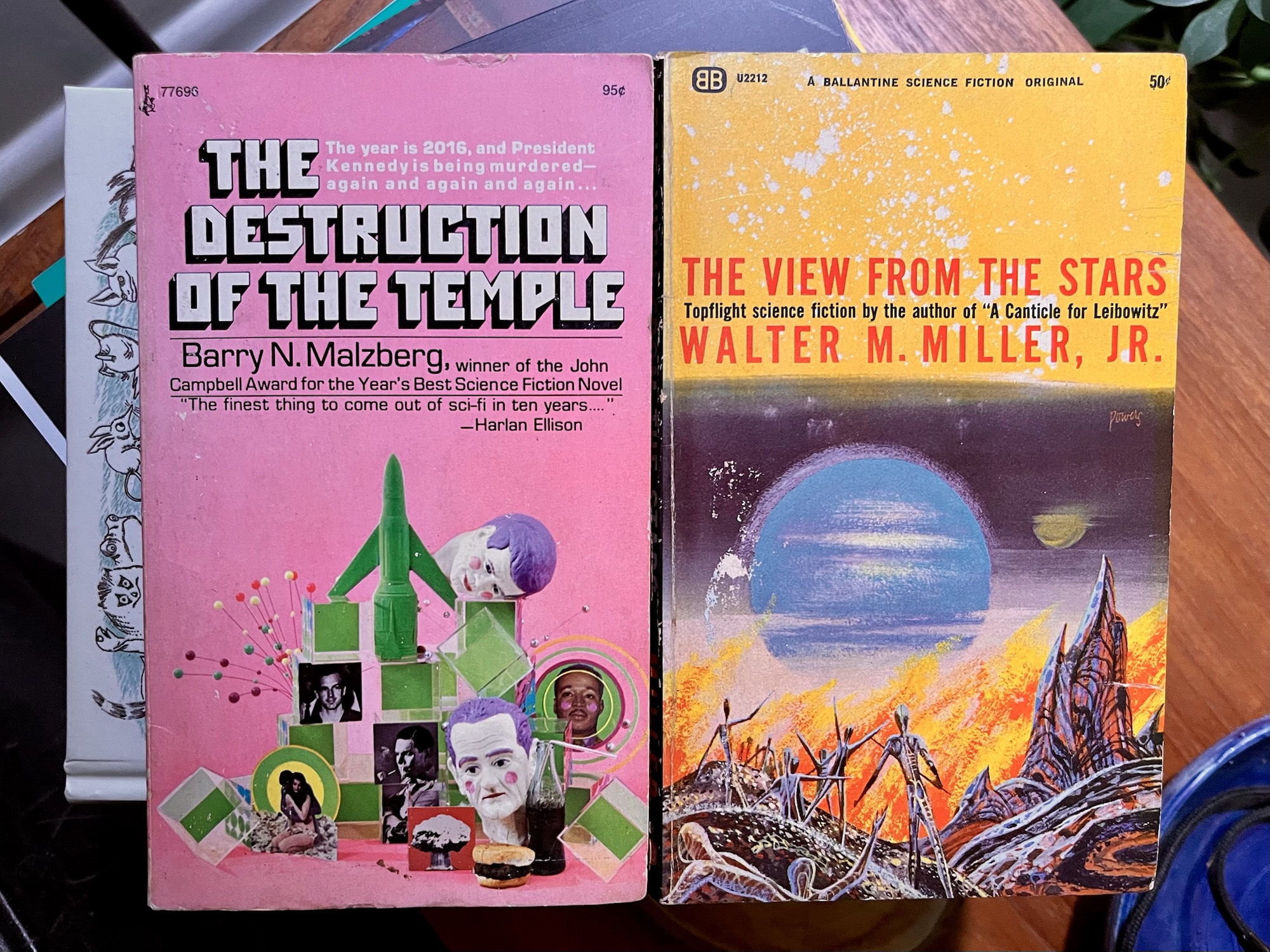
Bought some books today, mass-market paperbacks by Barry N. Malzberg and Walter M. Miller, Jr. I don’t need them and honestly my eyes are so bad by now that I probably couldn’t make it through one—I’ll have to find them online probably. But they were so cheap and such a cheap indulgence and so lovely as objects.
I’ve only ever come across two Walter M. Miller Jr. books: A Canticle for Leibowitz, a fantastic post-apocalyptic western theodicy, and its sequel, Saint Leibowitz and the Wild Horse Woman, which, for whatever reasons, I’ve chosen to abstain from reading. His 1965 novel The View from the Stars looks fairly generic but I picked it up anyway. I also picked up Barry N. Malzberg’s The Destruction of the Temple, simply because it looks so goofy. I listened to an audiobook of his 1975 novel Galaxies earlier this year. It wasn’t very good, but it was also fascinating, a metatextual mess dripping with anxiety about/against the “legit” lit of Barthelme, Barth, Pynchon, et al. I found pirated copies of two “erotic” novels he wrote under the pseudonym Gerrold Watkins, 1969’s Southern Comfort and 1970’s A Satyr’s Romance. Both were better than Galaxies, and not nearly as horny as, say, Robert Coover’s pornographies. Southern Comfort is actually a pretty good novel. (I mean it’s also, like, very deeply problematic in many ways, but those are the same ways that maybe makes it so more interesting than so-called “legit” so-called “literary” fiction.)
As a weird bit of chaotic (serendipity is not the right word) coincidence, The Destruction of the Temple features this blurb/description:
The year is 2016, and President Kennedy is being murdered – again and again and again. The director has come to the charred ruins of New York to re-enact a mad dream from the past – the assassination of President Kennedy.
JFK was assassinated 22 Nov. 1963, of course, sixty years ago today.
This is Friday—not today, I mean, this, this blog, is Friday, four or five days ago, depending on how you count such things. We were maybe fifteen or twenty minutes on the road heading northwest to Atlanta—my wife driving the first leg before we stopped for gas—when I checked social media again to see if Godspeed You! Black Emperor were still going to play that night. They were not. This information came via opener Low legend Alan Sparhawk, who had reported the past two nights’ shows canceled.
We headed north anyway. The kids had left school early; my daughter pointed out that she had already missed an AP Bio test and that she wasn’t going with me and the boy to the show anyway, she just wanted to go to Atlanta to hang out. Fair point, of course.
My son was bummed and I was bummed. I don’t know exactly how he came to Godspeed You! Black Emperor’s strange, hypnotic, droney anthems—via an algorithm, really—but a few years ago I heard him blasting Lift Your Skinny Fists Like Antennas to Heaven in his bedroom. I gave him my copy of their debut LP, F♯ A♯ ∞, which I’d bought from the band back in 1998 or 1999 when they opened for Low at a record story I was working at in Florida. They knocked our socks off. It seemed there were more Godspeeds Yous than audience members, and to be clear, the tiny record store was packed. It was a summer afternoon in Florida; very hot and very sunny, a throbbing miasma of sound across Hemming Park, now James Weldon Johnson Park, in beautiful ugly downtown Jacksonville.
(It was just such a night my friend Travis was arrested for skateboarding across Laura Street. Jayskating. (I don’t think it was the same night.))
After the show I bought their record. It had a pouch crammed with incidentals—flattened pennies, a Canadian stamp, some illustrated scraps. I think I listened to it a million times that summer. One of the guys in the band asked me where they could get some hash in Jacksonville. I suggested the Waffle House. Low played after; everyone sat down, exhausted from what Godspeed had required. It was lovely. Perfect day.
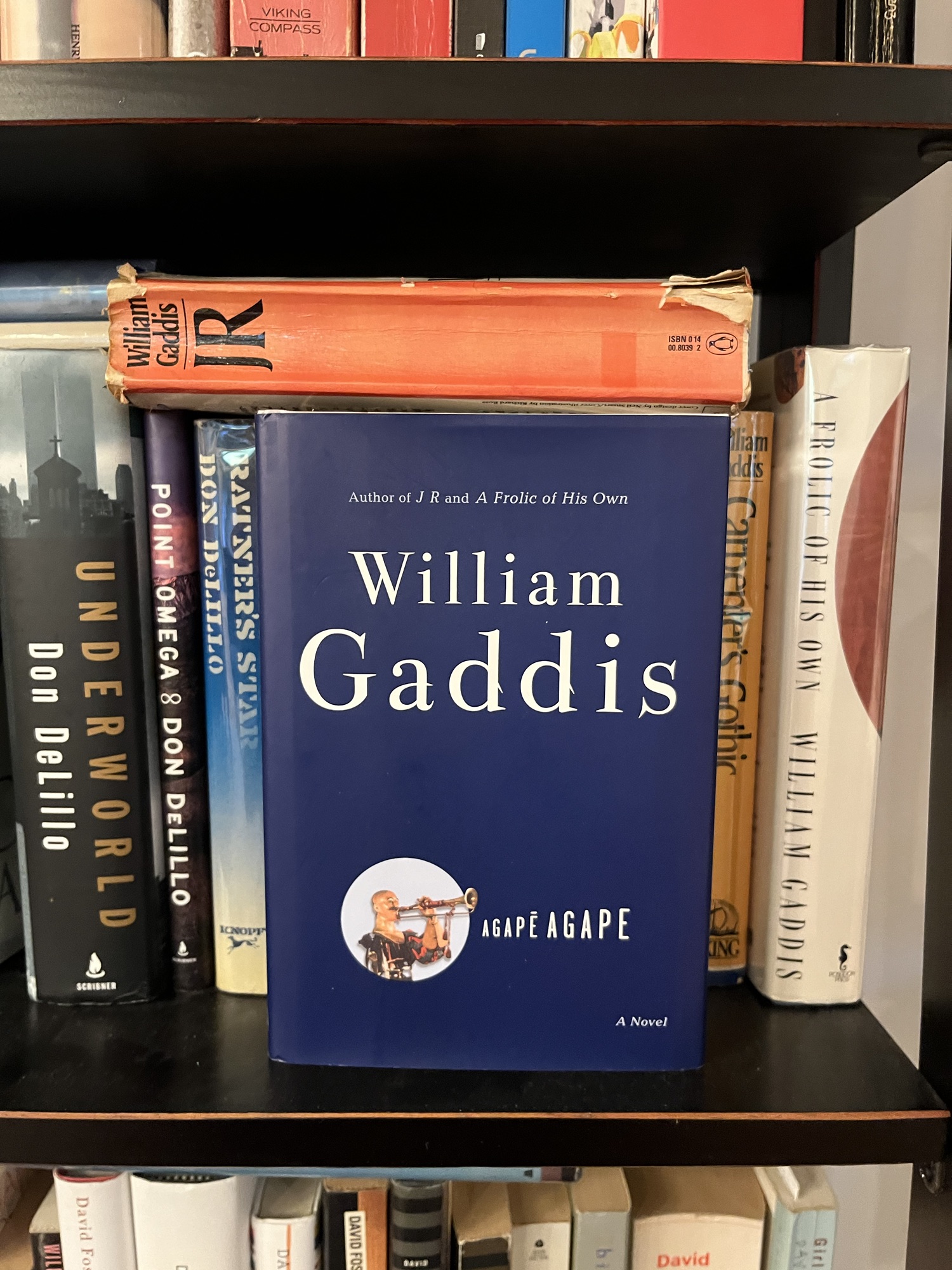
I had really wanted to experience my imaginative inversion of this concert this past weekend, but it didn’t emerge. I mean Alan Sparhawk, whose new record is so strange and daring and wonderful—I wanted to see that with my kid, who, he, my kid, wanted to see the ensemble Godspeed do their drone magic. I bought him an Aphex Twin record at Wax n’ Facts as a consolation prize, and he bought himself the first volume of Katsuhiro Otomo’s Akira at A Capella Books. I picked up a first edition hardback of William Gaddis’s last novel Agapē Agape.
And so well we made a weekend of it, browsing book stores and record stores and walking the Beltline. Love that city and my best wishes to GY!BE founding member, Efrim Menuck—I hate that we missed you on the tour but I hope that your health recovers. Thank you for making music my son and I love.
Got a review copy of Paul Valéry’s Monsieur Teste, a slim lil fellow from NYRB in translation by Charlotte Mandell. The back cover includes a blurb from William H. Gass—
Monsieur Teste is a monster, and is meant to be—an awesome, wholly individualized machine—yet in a sense he is also the sort of inhuman being Valéry aimed to become himself: a Narcissus of the best kind, a scientific observer of consciousness, a man untroubled by inroads of worldly trivia, who vacations in his head the way a Platonist finds his Florida in the realm of Forms.
What the fuck does Gass mean by “Florida” here? I really want to know.
This style of post, the book acquired post, is an established, which is to say tired, blog post format on this blog, Biblioklept, probably going back a decade now, born from a glut of review copies piling up, mostly unasked for but many asked for, books that stack up their own measures of guilt, unread, or then maybe read, months, years later—but the post style is ephemeral, yes, fluffy, sure, embarrassing even maybe. The form is stale; I apologize. I do think the Valéry book seems pretty cool.
I have a not-insubstantial stack of newly acquired new (and used books) stacked on the cherry side table by the black leather couch that I should have made book acquired posts about. These have piled up over the last few weeks. These are not interesting sentences (several of the books seem very interesting).
I am not going to find the new form I want here, am I?
When I was a freshman in high school, my then-girlfriend’s older brother gave me a mixtape that a girl had given him. He didn’t like anything on the mixtape; he liked Buddy Holly. I can’t remember why he gave me the tape—I think I saw it in his car and asked about it. But it ended up changing my life in some ways, as small giant things like songs or books or films can do when they come over you at the right time and place.
There were a few bands on the tape that I knew or had heard of, and even some I owned albums by, like the Cure and the Smiths. But for the most part, the tape opened a new aural world to me. I heard My Bloody Valentine, Big Star, Ride, the Cocteau Twins, and This Mortal Coil, among others, for the first time. There were also two songs by one band: Slowdive’s “When the Sun Hits” and “Dagger.”
(This particular blog post is no longer about acquiring a Valéry translation; it is about something else.)
Those songs are from Slowdive’s 1993 classic Souvlaki. I owned it on cassette. That cassette melted, just slightly, on the top of my 1985 Camry’s dashboard in like August of 1995. The tape was just warped enough not to fit into a cassette deck. I liked to imagine how it would sound. The next year, my lucky privileged ass found a used CD of Slowdive’s follow-up, Pygmallion on a school trip to London. Slowdive kinda sorta broke up after that.
I have always been a proponent of bands breaking up. I think a decade is long enough; get what you need done in five or six albums and move on. There are many many exceptions to this rule. But generally, I don’t think beloved bands—by which I means bands beloved by me—should keep going on too long. And if they break up, they should stay broken.
But I bought Slowdive’s 2017 reunion album Slowdive used at a St. Petersburg record store and listened to it again and again, amazed at how strong it was, how true to form. My kids liked it a lot. And then they put out a record last year, Everything Is Alive—I like that one too (not as good as the self titled one).
(There’s no point to any of this; I might’ve had some wine; I might just feel like writing.)
I guess if you’d told me back in ’95 or ’05 or even ’15 that I’d see a reunited Slowdive twice in one year I’d say that that sounded silly. (The ’15 version of me that had seen Dinosaur Jr.’s dinosaur act wouldn’t have been interested.) But we went out into the woods to see Slowdive this Sunday. They played the St. Augustine Amphitheatre to a large, strange, diverse crowd, out there in the Florida air. A band named Wisp, TikTok famous I’m told, opened, and they were pretty good. But Slowdive was perfect—better than back in May in Atlanta—echo and reverb ringing out into Anastasia State Park.
We stayed in a cheap motel off of AIA that night—another sign of my age. When I was younger, I could drive six hours, watch a band, and drive the six hours back without blinking. We are about 45 minutes from St. Augustine. It was a nice night out.
A younger version of me could’ve read the 80 pages of Paul Valéry’s Monsieur Teste in the time it took to twiddle my thumbs in this post and write a real (and likely bad) review to boot. Again, apologies. I’m getting old, a dinosaur act. But I can’t break up, not now.
Slowdive, St. Augustine Amphitheatre, 10 Nov. 2024
Simon Critchley’s Mysticism is new from NYRB. Their blurb:
Why mysticism? It has been called “experience in its most intense form,” and in his new book the philosopher Simon Critchley poses a simple question to the reader: Wouldn’t you like to taste this intensity? Wouldn’t you like to be lifted up and out of yourself into a sheer feeling of aliveness, both your life and those of the creatures that surround you? If so, it might be well worthwhile trying to learn what is meant by mysticism and how it can shift, elevate, and deepen the sense of our lives.
Mysticism is not primarily a theoretical issue. It’s not a question of religious belief but of felt experience and daily practice. A rough and ready definition of mysticism is that it is a way of systematically freeing yourself of your standard habits, your usual fancies and imaginings so as to see what is there and stand with what is there ecstatically. Mysticism is the practical possibility of the achievement of a fluid openness between thought and existence.
This is a book about trying to get outside oneself, to lose oneself, while knowing that the self is not something that can ever be fully lost. It is also a book about Julian of Norwich, Anne Carson, Annie Dillard, T.S. Eliot, and Nick Cave. It shows how listening to music can be secular worship. It is a book full of learning, puzzlement, pleasure, and wonder. It opens the door to mysticism not as something unworldly and unimaginable, but as a way of life.
Benamin Swett’s The Picture Not Taken is forthcoming from NYRB. Their blurb:
In The Picture Not Taken, the photographer and writer Benjamin Swett considers the intersections between photography, memory, the natural world, and the course of life in essays on subjects that include family snapshots, images of racial violence, the shape of abiding love, and the experience of unforseen and irremediable loss. In these beautifully written, deeply affecting pages, Swett moves with a wonderful improvisatory freedom among his chosen themes. The Picture Not Taken is a book of transfixing pieces that possesses the intensity and integrity and heft of the wholly new.
I ducked out of work maybe a little bit early on Friday and filled a brown paper bag with books at a Friends of the Library sale.
I picked up some hardback first editions of books I already own in cheaper formats–Lucia Berlin’s A Manual for Cleaning Women, Denis Johnson’s The Laughing Monsters, P.D. James’s The Children of Men, and Ben Marcus’s Leaving the Sea. I also got hardcover editions of Rachel Cusk’s Second Place, Amy Hempel’s Sing to It, Atticus Lish’s The War for Gloria, and Eugenio Corti’s The Red Horse.
I also grabbed some duplicates or alternate paperback editions of books I already own, including an academically-oriented edition of Gertrude Stein’s Three Lives, Italo Calvino’s If on a winter’s night a traveler, and William Faulkner’s Light in August. I gave the Calvino to my son; the Stein is for a colleague. I’ll give Light in August to a student. (I got the same edition of the Faulkner at the last Friends of the Library sale I went to; my son claimed it.) I’ll also probably offer the Bourdain memoir to a student. I’m pretty sure we have a copy of Kitchen Confidential somewhere around the house. I couldn’t pass up on the cheap mass-market copy of Melville’s White Jacket. I mean, just look at this cover—dude’s wearing a white jacket—
The book also bears a stamp claiming it originated (in a sense) at the old Melville Manse, Arrowhead:
I also couldn’t resist letting a paperback copy of Lucy Ellmann’s Ducks, Newburyport take up a lot of real estate in my paper grocery bag. The hype has died down enough for me to perhaps eventually sink into it. The edition of Alan & John Lomax’s American Ballads & Folk Songs is kinda beat up, but it’s got a lovely cover:
I was also attracted to this strange edition of Nikolai Gogol’s Dead Souls. It’s a 1987 hardback from the Soviet house Raduga Publishers, featuring a full-color portrait of Gogol and blue (?) page headings. The translation is by Christopher English and the book was printed in the U.S.S.R.—I’m not really sure who the intended audience was.
Albert Cullum’s The Geranium in the Window Sill Just Died But Teacher You Went Right Onwas another oddity I came across. Ostensibly a children’s book, The Geranium ultimately seems aimed at teachers. It features illustrations on every other page, each one by a different artist; many are remarkable, like this one by Stanley Mack–
There were a few titles, not pictured in the image at the top of this post, that I grabbed to cram into my bag simply because I had extra room at the end. I can usually offset the ten dollar bag fee by identifying a handful of pristine trade paperbacks that my local used bookstore will take for trade credit. So maybe I’m not, like, really offsetting the ten dollar fee so much as redirecting it toward obtaining more books.
There were plenty of titles at this particular sale that I would’ve crammed into the bag maybe ten or fifteen years ago—lots of books by Haruki Marukami, who has never been my guy, Jonathan Lethem (who I once really loved), Michael Chabon, Irvine Welsh, and even Chuck Palahniuk (there was a time when I was younger and had a broader range of friends that I could’ve given Palahniuk titles away easily). But I ended up imagining some younger person showing up to the sale, maybe today, Saturday, filling up a bag with titles that promised something beyond the YA formula stuff that makes up their current literary diet.
And if I imagined a younger person growing their library, I also imagined some of the older people whose collections had clearly ended up at the sale. Beyond the obvious airport thrillers and glut of titles by fiction factory Authors™, there were sets of strange, off-brand looking fantasy series in hardback, a seemingly-full run of Agatha Christie mysteries (also in hardback), Westerns no one will read again. Other people’s oddities ended up here; their children had no place for them, having subscribed to their own burdensome addictions.
I’ll have to give away all these books I’ve acquired at some point. But there’s joy in that too.
This is an interesting one: The Oceans of Cruelty: Twenty-Five Tales of a Corpse Spirit: A Retelling by Douglas Penick: I think I’ll just keep using the colon the way I use garlic: The book will be out in October, in time for Halloween: Here is publisher NYRB’s blurb: (No colons in their blurb):
One of the oldest books in the world, The Oceans of Cruelty is a sequence of twenty-five tales from India whose central theme is the dark power of storytelling. At the start, a young king falls into the hands of a wicked sorcerer, who orders him to find a vetala, or corpse spirit, to serve him; the young king must do as he is told, and soon enough he is also under the sway of the no less malevolent spirit. Like a bat, the spirit hangs from the branches of a tree, and the king is condemned to bear it on his back through a dark forest as it whispers a riddling story in his ear. These are tales of suicidal passion, clever deceit, patriarchal oppression, and narrow escapes from death, and as long as the king can resolve the problems they pose, his bondage continues; the vampiric creature goes on commanding his attention in the dark. Only when the king is out of answers will he at last be free, though when that comes to pass—well, that’s when the whole story takes a new turn.
Douglas Penick’s re-creation of this ancient work brings out all its humor and horror and vitality, as well its unmistakable relevance in a world of stories gone viral.
I finally came across a copy of Ron Loewinsohn’s 1983 novel Magnetic Field(s).
First three paragraphs, which I read a few minutes ago in a sweat:
Killing the animals was the hard part. “All you’ve got to do,” Jerome had told him, “is keep your cool. There isn’t anybody else’s cool you’ve got to keep, and there isn’t anybody else who will keep yours.” The first time it happened—he had already gone with Jerome five or six times—they were in this backyard when this little black dog (a Scottie?) started yapping up at them and he froze in the first moment and in the next felt his body want to move back over the fence, the way they’d come. But Jerome had simply reached down to pick up a brick that formed part of a kind of border around some flowers—it was all one smooth motion—and bashed in the dog’s head with one good one, and then gave it one more to make sure, the second one making an awful sound as it went into what was left of the dog’s head. There were just these four little legs attached to this furry black body, and where the head had been was just this turmoil of hair and blood and meat and one piece of jagged bone and one eye where it shouldn’t have been, not even not looking at anything, just there; and he looking down at it till Jerome touched him on the chest and then motioned toward the window with one jerk of his thumb.
The first time he’d had to do it himself, they had just stepped into this backyard at the end of the driveway and suddenly there was this big setter—just as surprised as they were. He started to feel himself wanting to turn back out of there, hearing the blood rushing in his ears and thinking he did not want to do this as he reached back, his hand closing around the cold shaft of the tire iron in his back pocket. Behind him Jerome had stopped. He reached out his left hand, offering “something” to the dog, which leaned forward to check it out at the same time that it began to pull its lips back away from its teeth. He brought the tire iron out and down in one sweeping arc into the animal’s head. It actually made a dent in the head and felt something, at first, like hitting a rolled-up rug, except that now there was this dog lying there with its different legs crumpled under it or sticking out in a way that nothing that was alive would lie that way. He just stood there a long moment, looking down at that furry body, hearing himself breathing and hearing the dog not.
Killing the animals was the hard part because they tended to get under his skin; they reminded him of him. Their bodies were complicatedly thick, so that hitting this skull was nothing at all like hitting a rolled-up rug, or a log, things that were solid, the same all the way through. They were made of all those layers of skin and bone and organs, all of which he thought of as easily bruised, especially the organs. They moved like him, they wanted things, they wanted, and they were scared and furious.
I have a big pile of books recently acquired that I haven’t made enough time to attend to; the most recent of these is Lutz Seiler’s Star 111, forthcoming in English translation by Tess Lewis from NYRB. Here’s their blurb:
Star 111 (the name of a popular East German transistor radio) begins with the world turned upside down. It is the fall of 1989. The communist government of the GDR is losing its grip on power. Carl Bischoff, a very young man, trained as a bricklayer, now a college student, is abruptly recalled by his parents to the small town in the middle of nowhere where he grew up. His hardworking unprotesting parents inform him, that with the border open, they intend to leave the country and check into a West German refugee camp. Will Carl to look after the house and take in the mail? They promise at some point to be in touch.
Deserted by his parents, Carl has no idea what to do. Then he packs the family car and heads to Berlin, where he joins a group of squatters led by a shepherd with a goat. Carl participates in the anarchic life of an anarchist commune, and keeps his distance too. He has all sorts of things to learn about himself and others. He is hungry for sex and love and sometimes simply hungry. He worries about his parents. He wants to be a poet.
Star 111 is a story about unforeseen ends and new beginnings, about different kinds of families, biological and improvised, and one innocent young aspiring poet in pursuit of experience at a moment in history when everything is about to change and nobody knows how. A tender, entrancing, and comic tale of youth and adventure, it is a book that looks back on the history of our time to ask the most fundamental of questions: what does it mean to lead a good life?
The last two weeks flew by. My kids went back to school this week; they are attending the same school for the first time since elementary school, high school,my own dear mother, that school, and I am relieved, if only temporarily from driving duties. We are making pizzas in an hour or two to celebrate the first Friday of their school year (we make pizzas every Friday as a nifty fridge clearing activity, but let’s not ruin the sparkle). My own semester starts the week after next and I realize that I need to do something more with my summers now that my children are so much older than they were when they were little children, when I was with them all summer, or if I wasn’t exactly right there with them I was hovering in the background.
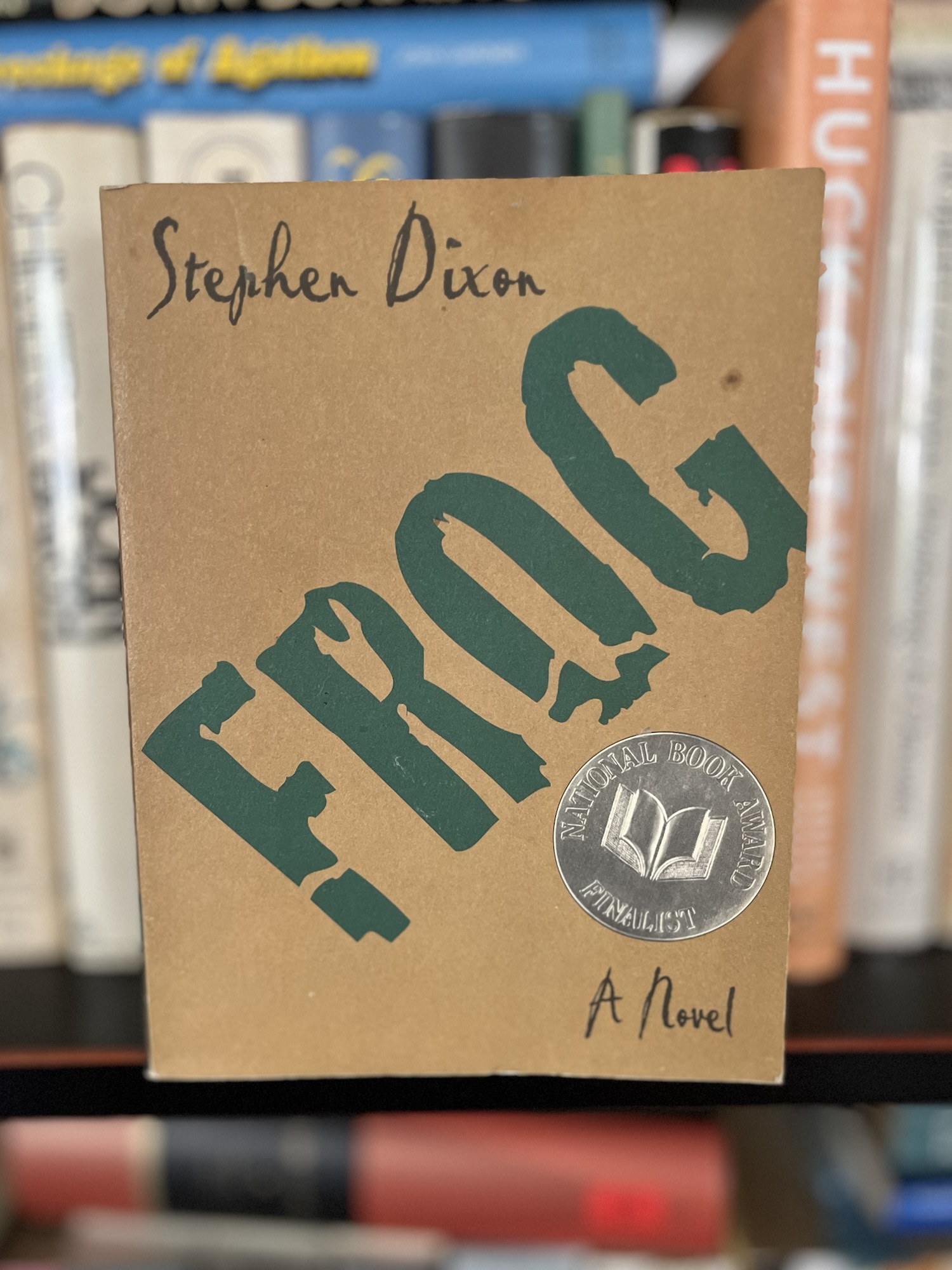
I am on track to read fewer novels, or books, or whatever, than I read in July of this year. I finished Mauro Javier Cárdenas’s third novel American Abductions and liked it very much, or liked the experience or feeling of reading it, whatever that means, and I owe it a proper review. In July I read Katherine Dunn’s debut novel Attic and loved it. I couldn’t find her 1971 follow-up Truck in any of the used bookstores I frequent, so I ended up listening to it on audiobook. Maybe it was the narrator’s narration but I found it disappointing, but I still appreciate its grime and its abjection and its picaresque energy. I also checked out some Stephen Dixon e-books from my library; I read a handful of fucked up stories (a piece called “The Intruder” was especially weird) before digging into his 1988 novel Garbage. I read the first half of Garbage last night and I don’t even know how to describe it—it’s sort of like wandering upon some forgotten gritty 1970s American exploitation film made by an insane but focused auteur. But it’s also very normal in a way I will not explain. It’s uncanny.
I purged about thirty paperbacks last week at my local used bookstore and ordered a copy of the latest Antoine Volodine novel, Gina M. Stamm’s translation of Mevlido’s Dreams. A recent reading of Volodine’s Radiant Terminus left me hungry for more of that sweet gross post-exotic flavor. I went to pick up the Volodine today and ended up with two hardbacks. I admit that the blurb on the back of Thomas Sullivan’s 1989 novel Born Burning sold me; it compared his previous novel to William Gaddis, John Barth, and Kurt Vonnegut. I also snapped up a first-edition hardback 1985 edition of William S. Burroughs’s novel Queer, which I fear was quite underpriced, although I don’t fear that too much. (All my sweet purged paperback credit is gone!)
I broke down and bought an inexpensive copy of Dinah Brooke’s 1976 novel Death Games from an internet vendor. I absolutely loved her 1973 novel Lord Jim at Home, which never got a U.S. release (until a year or two ago). Death Games did get a U.S. release—I guess because it involves the Vietnam War?—and was reviewed by Jane Larkin Crain in The New York Times. She wrote:
Pornographic brutality dominates this distasteful tale of carnage, corruption and colonialism in Indochina, starring young, beautiful, demented Elspeth Waterhouse, who pursues her impeccably detached tycoon of a father from Bangkok to Vientiane to Saigon, hungering after his recognition and love. Also featured are maimed and traumatized American war veteran who conducts an unlikely affair with Elspeth and Veronique, Waterhouse’s business associate and mistress, whose son is relegated to boarding school so that she may go globe‐trotting with her lover. . .
Death Games . . . largely dispenses with the mechanics of plot, pacing and characterization. In the course of a very short novel, scenes of debauchery, rape, murder, cannibalistic fantasy, suicide, bloodshed follow so quickly one upon the other, with so little sense or modulation…
I’m excited about this one. Charles Burns’s novel Final Cut is out in late September. I’ll have a review around that time. For now, here’s publisher Pantheon’s blurb:
As a child, Brian and his friend Jimmy would make sci-fi films in their yards, convincing their friends to star as victims of grisly murders, smearing lipstick on the “bodies” to simulate blood. Now a talented artist and aspiring filmmaker, Brian, along with Jimmy, Jimmy’s friend Tina, and Laurie—his reluctant muse—sets off to a remote cabin in the woods with an old 8 millimeter camera to make a true sci-fi horror movie, an homage to Brian’s favorite movie: Invasion of the Body Snatchers. But as Brian’s affections for Laurie go seemingly unreciprocated, Brian writes and draws himself into a fantasy where she is the girl of his dreams, his damsel in distress, and his savior wrapped into one. Rife with references to classic sci-fi and horror movies and filled with panels of stunning depictions of nature, film and the surreal, Burns blurs the line between Brian’s dreams and reality, imagination and perception. A master of the form at his finest, Final Cut is an astonishing look at what it means to truly express oneself through art.
At Reed, Dunn began work on “Attic,” her first novel, a fictionalization of a stint in a Kansas City jailhouse when she was eighteen and was arrested for trying to cash a fraudulent check.
In “Attic,” Dunn introduced an early version of the sinister magic realism she would later make famous in “Geek Love.” The book’s narrator, K. Dunn, describes a carrousel [sic] in which, to gain entry, young boys have to shoot arrows into their mothers’ vaginas and young girls have to throw hoops over their father’s erections. “If they don’t make it in four tries they can’t ride the merry-go-round so the Mommies spread their legs wider and wider and the Daddies sweat to rub up a good one.” But the book is largely a realist work in which Dunn emphasizes the trauma of her protagonist’s childhood. “Attic” is filled with potent flashbacks about K. Dunn’s mother shaming her, like this one: “. . . she looked at me very closely there and said you’ve been playing with yourself again haven’t you . . . and she said show me show me how you do it and I just lay there and she got angry and she said if a bitch dog did that they’d have to kill her . . . and I couldn’t help it I started to cry . . .” K. Dunn experiences some liberation in prison, where no one cares if she masturbates, but is thrust back into shame after she agrees to pleasure a male benefactor who helps get her out. Some of the book’s best parts read like a neurotic’s guide to prison life, in which Dunn uses what she learned from Thoreau to describe the vagaries of sharing a toilet with a cellmate. “I could piss over her piss but I can’t piss over her shit, much less shit over it and have them mix. It would be terrible if mine came out lighter or darker than hers—you could tell whose they were. Even worse if they were the same.”