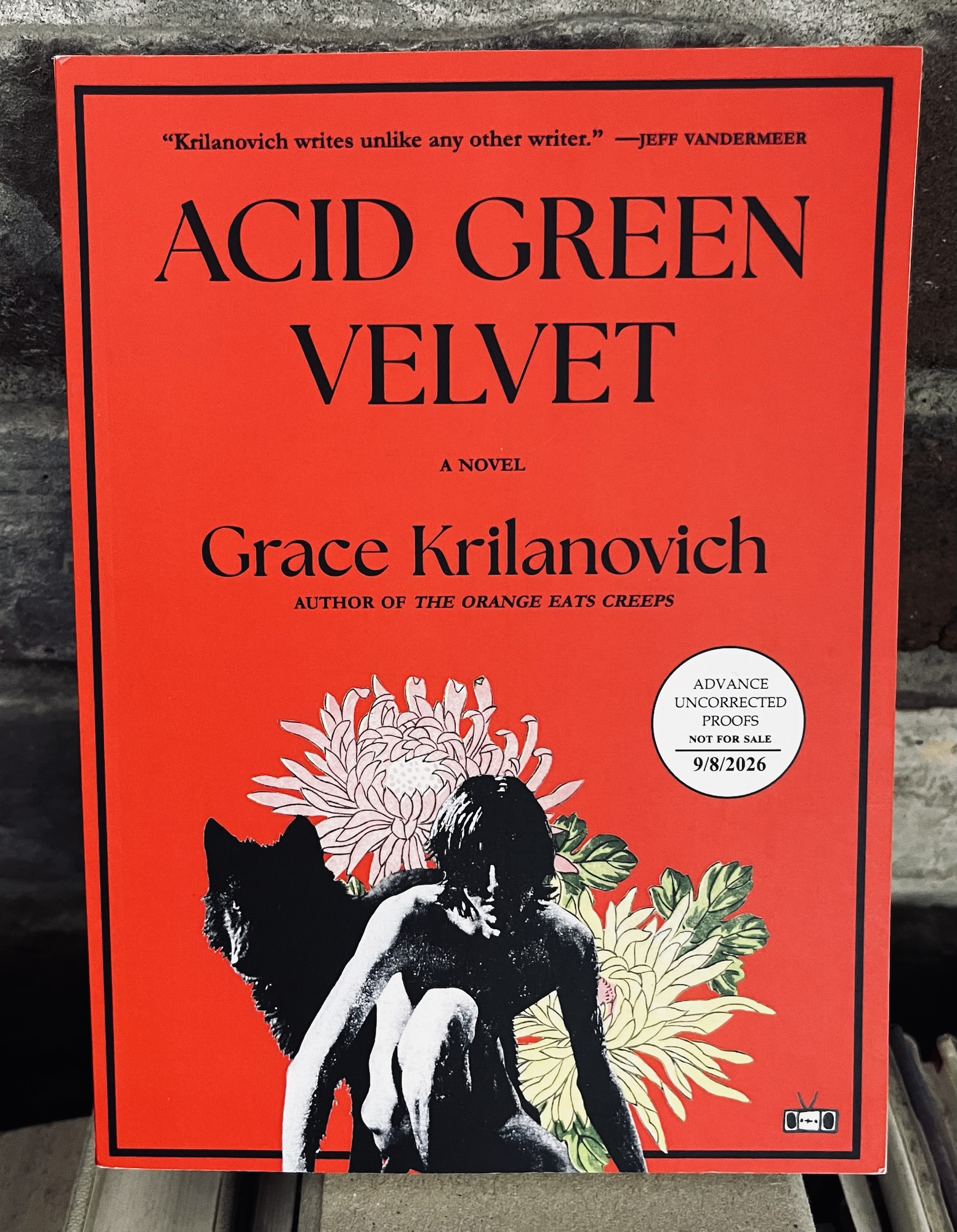
In Grace Krilanovich’s Acid Green Velvet, nearly everyone is trying to invent a new self. Tramps become philosophers, grifters become visionaries, labor organizers become prophets, mystics become entrepreneurs, and wealthy eccentrics attempt to turn private fantasies into reality. Set in a fictional California town called Anzar, the novel follows these competing acts of self-creation as they collide, overlap, and occasionally explode.
Anzar, located somewhere on California’s Central Coast, is a “site of cosmic conavergence,” a magnet for runaways, tricksters, radicals, opportunists, and dreamers of every stripe. It’s the end of the nineteenth century, a half-historical, half-mythic version of the Gilded Age out west. Tramps pour in by rail and establish hobo jungles on the edges of town. Labor organizers arrive with half-baked utopian schemes to challenge the wealthy families who rule Anzar with the aid of their Loganberries, Acid Green Velvet’s stand-in for the Pinkertons. In all this tumult, Anzar, “primed by the ancients for the arrival of newcomers to tap into its potential…await[s] its true founding.”
At the novel’s center is Paulette, daughter of the confidence man Rodney Eligon. Believing she and her companion Kenneth Greycroft have successfully murdered Rodney on a northern California beach, she remakes herself as the muse and would-be wife of the wealthy eccentric Johnny Hasley, retreating with him into the increasingly strange atmosphere of Hasley Manor. Kenneth follows her south to Anzar, where labor unrest, yegg culture, occult philosophies, and class conflict are transforming the city into a temporary social experiment. The complication, of course, is that Rodney survived. Acid Green Velvet keeps changing shape. It’s a Gothic romance and a class-struggle novel, a hobo epic and a horror story, a grifter western and a fever dream about California history. Old crimes, revolutionary schemes, buried family secrets, and competing ideas about freedom all end up tangled together in Anzar.
The easiest point of comparison is probably Steinbeck. We’ve got rail yards, strikes, flophouses, and the perpetual struggle between workers and owners. But the novel’s striking prose and weird energy often reminds me more of Pynchon, particularly Against the Day: anarchists, secret histories, wandering philosophers, failed utopian projects, and people living just outside official reality. The tramps of Acid Green Velvet think of themselves as “Night People, people unimpressed by hours.”
Krilanovich depicts tramp culture as an ever-regenerative series of performances. Paulette reinvents herself. Rodney reinvents himself. Tramps invent philosophies. Yeggs invent machines and conspiracies. Labor organizers invent futures. Mystics invent cosmologies. In Acid Green Velvet, American drifter culture plays like a form of outsider art. The recurring question is not who these people are, but how long they can sustain the characters they’ve created for themselves.
The prose is remarkable. Here’s Paulette trying to describe the city that forms around the tramp occupation:
The Main Stem was a pageant, a gathering of the tribes: vagrants as sailors, vagrants as concrete men, sandwich counter girls, fieldworkers, baby handlers, food tasters, range salesmen. Vagrants as sporting girls, stoat farmers, and rat trappers. A generation from now people would pretend to know what happened here, would insist on the idea that some authoritative entity was present. Digging up the bones of our community they would pretend to comprehend the story of alien ancestors, whose skeletons lay scattered in party positions in graves dug by drunkards and sleepwalkers.
That paragraph captures an enormous amount of what Acid Green Velvet is doing. Histories emerge from rumors and communities spring from accident. The notion of a governing authority is retrospective fantasy. The people making history usually look ridiculous while they’re making it.
Yegg is one of the novel’s bywords. In Krilanovich’s hands, the term expands into something grander than its traditional meaning of burglar. The yegg is the signal class of Anzar: the tinkerer, the schemer, the amateur engineer of reality itself. Krilanovich’s yeggs build machines, rig scams, spark riots, construct impossible social theories, and generally behave like avant-garde artists set loose in a hobo jungle. Anzar is for the yeggs: people taking apart the world in hopes that something better might emerge from the pieces. Or just taking.
The labor politics are similarly strange. The conflict between tramps, workers, Loganberries, businessmen, and civic authorities is never reduced to a simple ideological struggle because almost nobody in Acid Green Velvet possesses a stable political identity to begin with. The novel is obsessed with disguises and assumed identities. On the very first pages Paulette worries that Rodney may have seen her “without my mask”; later Kenneth is described “shedding his disguise” after the attempted murder, while Johnny drifts between aristocratic elegance and “an affected laborer costume.” Ideology itself begins to feel like another role available for temporary use. People drift in and out of movements with the same improvisational energy that drives their grifts, romances, and self-created mythologies.
If the yegg is the novel’s core social class, its central moral category is sloppiness. The charge appears everywhere. Characters call each other sloppy along with variations on the theme: obvious, transparent, careless, “not smart.” A sloppy person is not necessarily unintelligent; they simply fail to manage the performance. They reveal motive, let the mask slip, tip their hand. In the shadow economy of grifters, radicals, and self-appointed prophets, that failure is a mortal sin.
Paulette, Rodney, and sundry other characters operate with cool sharpness, surviving through control, concealment, and manipulation. Kenneth Greycroft, on the other hand, does not. Kenneth is perhaps the sloppiest person in the novel, “sloppy as hell, oblivious and obvious by turns,” as Johnny Hasley describes him.
Kenneth’s sloppiness makes him the novel’s emotional center. To call him the novel’s heart would work, but the stomach is an even more appropriate organ. Everything passes through him: longing, guilt, labor politics, grief, violence, fantasy, jealousy, and desire. He absorbs and digests; he hungers, loves too visibly, grieves too visibly.
Krilanovich repeatedly frames Kenneth as someone incapable of protecting himself through self-mythology:
He’d always insisted his eyes looked forward only, though the view was occluded by a beige, ambient suffering. He was effectively blind, grappling over a forbidden landscape. Innocent.
That final word, innocent, does an enormous amount of work. Kenneth is obsessive, self-pitying, sentimental, and often catastrophically wrong. Yet his transparency increasingly comes to look like a form of innocence when set beside the machinations of Rodney, old man Hasley, and especially Little Dennis, a diminutive trickster who inserts himself into Johnny’s life like a parasite in the novel’s final third.
Kenneth’s innocence should not be confused with virtue. He plans and attempts a murder; he stalks Paulette across California. He routinely mistakes obsession for devotion. But unlike many of the novel’s other characters, he never succeeds in sealing himself off from consequence. While characters like Rodney and Little Dennis attempt to bend reality to their own purposes, Kenneth remains trapped inside the ordinary human experiences of guilt, longing, jealousy, and grief.
Rich kid Johnny represents the opposite tendency. He responds to the chaos of Anzar by closing himself off. With the aid of Little Dennis’s potions and notions, Johnny insulates himself from history, politics, and even ordinary human contact by constructing a private world governed by his own aesthetic and philosophical obsessions:
“My dream is to run amok in a realm of my own creation,” he said. … “Now, Paulette, we both know the world outside is a dangerous place beset on all sides with evil. The less flesh exposed to the elements the better.”
That impulse gradually becomes the defining tragedy of his character. While Paulette continually reshapes herself in response to circumstance, Johnny attempts to build a reality in which circumstance can no longer reach him. Hasley Manor transforms into an increasingly elaborate fantasy space ruled by mysticism, ritual, occult systems, self-help philosophies, attendants, acolytes, and eventually outright delusion.
Paulette spends the novel trying to escape definition. Johnny increasingly tries to transform reality into a private dream. Kenneth follows both through the wreckage.
Alongside them stands Shelly, perhaps the novel’s most compelling foil for Paulette. Shelly is a charismatic organizer, opportunist, idealist, and manipulator whose search for collective liberation contrasts with Paulette’s determination to preserve her own autonomy. Paulette survives by slipping away from structures of power; Shelly tries to seize those structures and remake them. Her revolutionary community offers a genuine alternative to the fathers, lovers, employers, and wealthy eccentrics who otherwise determine the terms of women’s lives, but Krilanovich also shows how quickly a movement built around liberation can develop its own rules, hierarchies, and demands. Shelly doesn’t simply represent the answer to Paulette’s isolation. She exposes the problem of finding freedom without reproducing another system of control.
Krilanovich eventually pushes this question beyond self-invention and into history itself. Beneath the tramp occupations, labor unrest, yegg philosophies, and revolutionary dreams lies a history of erased women: imprisoned wives, missing mothers, hidden rooms, buried infants, and generations of suffering concealed beneath respectable wealth. Acid Green Velvet’s final third plays as a horrific Gothic excavation, with haunted Hasley Manor serving as an archive of disappearance.
I’ve barely begun to cover everything the novel contains. I have barely touched the dream sequences, occult cosmologies, supernatural horrors, bizarre visions and apparitions, hidden chambers, prophetic trances, haunted histories, and eruptions of genuine dread. Nor have I said much about the sheer density of Krilanovich’s invention. Every time Acid Green Velvet seems poised to settle into a labor novel, a Gothic romance, a grifter story, or a historical epic, it mutates into something stranger.
The title obliquely captures the novel’s paradoxical atmosphere: Acid Green Velvet is simultaneously lush and corrosive, beautiful and decaying, comic and horrifying. Krilanovich braids genres and images until Anzar pulses like a collective hallucination sustained by tramps, mystics, radicals, confidence artists, and dreamers talking one another into existence.
The pleasures of Acid Green Velvet lie in its language, its strangeness, and its astonishing capacity for surprise. Krilanovich has created a novel as unruly, excessive, and alive as the hobo kingdom at its center — excessive, exhausting, funny, grotesque, and frequently brilliant. Very highly recommended.