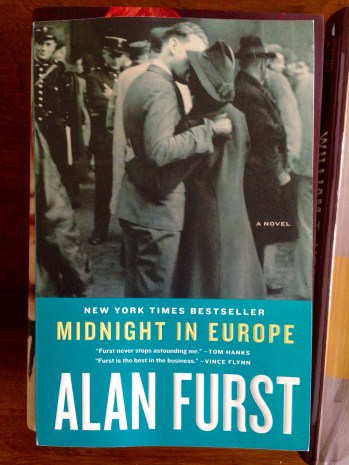
Midnight in Europe (Book acquired, some time in February 2015)

IMG_5139

Alan Furst’s Midnight in Europe is out next week in paperback from Random House. Their blurb:

Paris, 1938. As the shadow of war darkens Europe, democratic forces on the Continent struggle against fascism and communism, while in Spain the war has already begun. Alan Furst, whom Vince Flynn has called “the most talented espionage novelist of our generation,” now gives us a taut, suspenseful, romantic, and richly rendered novel of spies and secret operatives in Paris and New York, in Warsaw and Odessa, on the eve of World War II.

Cristián Ferrar, a brilliant and handsome Spanish émigré, is a lawyer in the Paris office of a prestigious international law firm. Ferrar is approached by the embassy of the Spanish Republic and asked to help a clandestine agency trying desperately to supply weapons to the Republic’s beleaguered army—an effort that puts his life at risk in the battle against fascism.

Joining Ferrar in this mission is a group of unlikely men and women: idealists and gangsters, arms traders and aristocrats and spies. From shady Paris nightclubs to white-shoe New York law firms, from brothels in Istanbul to the dockyards of Poland, Ferrar and his allies battle the secret agents of Hitler and Franco. And what allies they are: there’s Max de Lyon, a former arms merchant now hunted by the Gestapo; the Marquesa Maria Cristina, a beautiful aristocrat with a taste for danger; and the Macedonian Stavros, who grew up “fighting Bulgarian bandits. After that, being a gangster was easy.” Then there is Eileen Moore, the American woman Ferrar could never forget.

In Midnight in Europe, Alan Furst paints a spellbinding portrait of a continent marching into a nightmare—and the heroes and heroines who fought back against the darkness.

The official lie (Gravity’s Rainbow)

What did Caesar really whisper to his protégé as he fell? Et tu, Brute, the official lie, is about what you’d expect to get from them—it says exactly nothing. The moment of assassination is the moment when power and the ignorance of power come together, with Death as validator. When one speaks to the other then it is not to pass the time of day with et-tu-Brutes. What passes is a truth so terrible that history—at best a conspiracy, not always among gentlemen, to defraud—will never admit it. The truth will be repressed or in ages of particular elegance be disguised as something else. What will Rathenau, past the moment, years into a new otherside existence, have to say about the old dispensation? Probably nothing as incredible as what he might have said just as the shock flashed his mortal nerves, as the Angel swooped in…

From Thomas Pynchon’s novel Gravity’s Rainbow.

Paris Red (Book acquired some time in February, 2015)

IMG_5138

Maureen Gibbon’s novel Paris Red is forthcoming (April 2015) in hardback from W.W. Norton. Their blurb:

For readers of Girl with a Pearl Earring, a luminous and evocative novel of Édouard Manet’s muse.

Paris, 1862. A young girl in a threadbare dress and green boots, hungry for experience, meets the mysterious and wealthy artist Édouard Manet. The encounter will change her—and the art world—forever.

At seventeen, Victorine Meurent abandons her old life to become immersed in the Parisian society of dance halls and cafés, meeting writers and artists like Baudelaire and Alfred Stevens. As Manet’s model, Victorine explores a world of new possibilities and stirs the artist to push the boundaries of painting in his infamous portrait Olympia, which scandalizes even the most cosmopolitan city.

Manet becomes himself because of Victorine. But who does she become, that figure on the divan?

Intense, erotic, and beautifully wrought, Paris Red evokes the unconventional love story of a painter and his muse that changed the history of art.

The extinction of the dodo (Pynchon’s Gravity’s Rainbow)

He left the dodoes to rot, he couldn’t endure to eat their flesh. Usually, he hunted alone. But often, after months of it, the isolation would begin to change him, change his very perceptions—the jagged mountains in full daylight flaring as he watched into freak saffrons, streaming indigos, the sky his glass house, all the island his tulipomania. The voices—he insomniac, southern stars too thick for constellations teeming in faces and creatures of fable less likely than the dodo—spoke the words of sleepers, singly, coupled, in chorus. The rhythms and timbres were Dutch, but made no waking sense. Except that he thought they were warning him… scolding, angry that he couldn’t understand. Once he sat all day staring at a single white dodo’s egg in a grass hummock. The place was too remote for any foraging pig to’ve found. He waited for scratching, a first crack reaching to net the chalk surface: an emergence. Hemp gripped in the teeth of the steel snake, ready to be lit, ready to descend, sun to black-powder sea, and destroy the infant, egg of light into egg of darkness, within its first minute of amazed vision, of wet downstirred cool by these south-east trades… . Each hour he sighted down the barrel. It was then, if ever, he might have seen how the weapon made an axis potent as Earth’s own between himself and this victim, still one, inside the egg, with the ancestral chain, not to be broken out for more than its blink of world’s light. There they were, the silent egg and the crazy Dutchman, and the hookgun that linked them forever, framed, brilliantly motionless as any Vermeer. Only the sun moved: from zenith down at last behind the snaggleteeth of mountains to Indian ocean, to tarry night. The egg, without a quiver, still unhatched. He should have blasted it then where it lay: he understood that the bird would hatch before dawn. But a cycle was finished. He got to his feet, knee and hip joints in agony, head gonging with instructions from his sleeptalkers droning by, overlapping, urgent, and only limped away, piece at right shoulder arms.

Continue reading “The extinction of the dodo (Pynchon’s Gravity’s Rainbow)”

Six Notes from Nathaniel Hawthorne’s Note-Books

Imitators of original authors might be compared to plaster casts of marble statues, or the imitative book to a cast of the original marble.


For a child’s story,–the voyage of a little boat made of a chip, with a birch-bark sail, down a river.


Fourier states that, in the progress of the world, the ocean is to lose its saltness, and acquire the taste of a peculiarly flavored lemonade.


How pleasant it is to see a human countenance which cannot be insincere,–in reference to baby’s smile.


The best of us being unfit to die, what an inexpressible absurdity to put the worst to death!


“Is that a burden of sunshine on Apollo’s back?” asked one of the children,–of the chlamys on our Apollo Belvedere.

From Nathaniel Hawthorne’s American Note-Books.

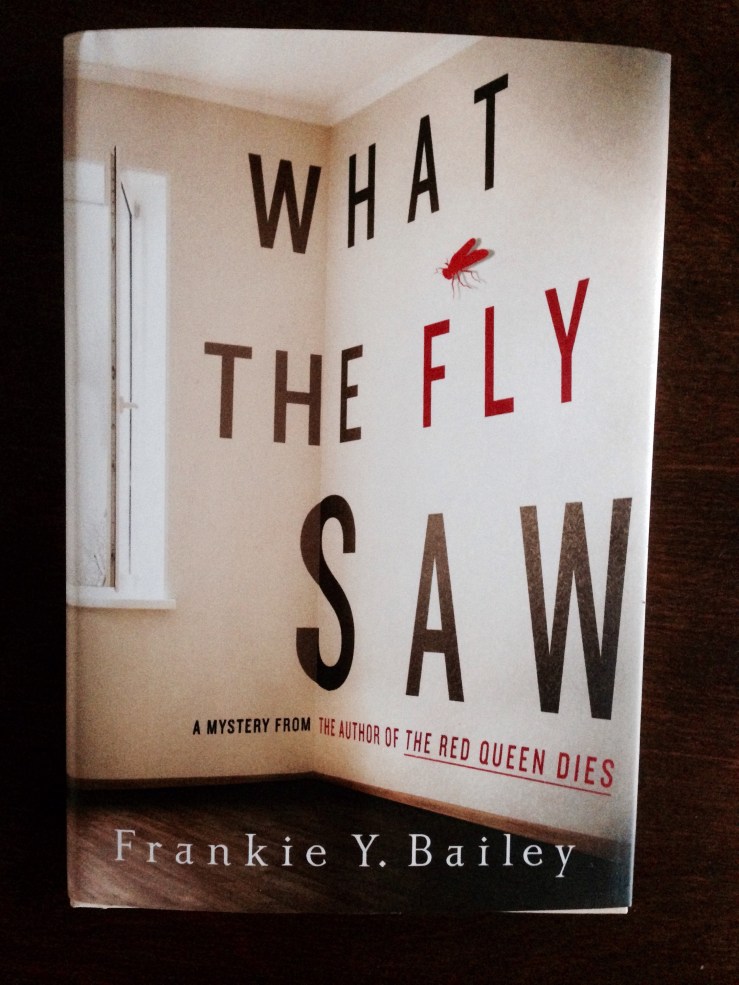
What the Fly Saw (Book acquired, some time in February 2015)

IMG_5098

Frankie Y. Bailey’s What the Fly Saw. Blurb from the author’s site:

The morning after a blizzard that shut down the city, funeral director Kevin Novak is found dead in the basement of his funeral home. The arrow sticking out of his chest came from his own hunting bow. A loving husband and father and an active member of a local megachurch, Novak had no known enemies. His family and friends say he had been depressed because his best friend died suddenly of a heart attack and Novak blamed himself. But what does his guilt have to do with his death? Maybe nothing, maybe a lot. The minister of the megachurch, the psychiatrist who provides counseling to church members, or the folksy Southern medium who irritates both men – one of these people may know why Novak was murdered. Detective Hannah McCabe and her partner, Mike Baxter, sort through lies and evasions to find the person who killed their “Cock Robin,” But McCabe is distracted by a political controversy involving her family, unanswered questions from another high-profile case, and her own guilt when a young woman dies after McCabe fails to act.


Place has enshrined the spirit (Eudora Welty)

Place in fiction is the named, identified, concrete, exact and exacting, and therefore credible, gathering spot of all that has been felt, is about to be experienced, in the novel’s progress. Location pertains to feeling; feeling profoundly pertains to – place; place in history partakes of feeling, as feeling about history partakes of place. Every story would be another story, and unrecognizable as art, if it took up its characters and plot and happened somewhere else. Imagine Swann’s Way laid in London, or The Magic Mountain in Spain, or Green Mansions in the Black Forest. The very notion of moving a novel brings ruder havoc to the mind and affections than would a century’s alteration in its time. It is only too easy to conceive that a bomb that could destroy all trace of places as we know them, in life and through books, could also destroy all feelings as we know them, so irretrievably and so happily are recognition, memory, history, valor, love, all the instincts of poetry and praise, worship and endeavor, bound up in place. From the dawn of man’s imagination, place has enshrined the spirit; as soon as man stopped wandering and stood still and looked about him, he found a god in that place; and from then on, that was where the god abided and spoke from if ever he spoke.

From Eudora Welty’s essay “Place in Fiction.”

Read Kurt Vonnegut’s early short story “Tomorrow and Tomorrow and Tomorrow”

“Tomorrow and Tomorrow and Tomorrow”

by

Kurt Vonnegut

(Originally published in Galaxy as “The Big Trip Up Yonder”)

001

GRAMPS FORD, his chin resting on his hands, his hands on the crook of his cane, was staring irascibly at the five-foot television screen that dominated the room. On the screen, a news commentator was summarizing the day’s happenings. Every thirty seconds or so, Gramps would jab the floor with his cane-tip and shout, “Hell, we did that a hundred years ago!”

Emerald and Lou, coming in from the balcony, where they had been seeking that 2185 A.D. rarity—privacy—were obliged to take seats in the back row, behind Lou’s father and mother, brother and sister-in-law, son and daughter-in-law, grandson and wife, granddaughter and husband, great-grandson and wife, nephew and wife, grandnephew and wife, great-grandniece and husband, great-grandnephew and wife—and, of course, Gramps, who was in front of everybody. All save Gramps, who was somewhat withered and bent, seemed, by pre-anti-gerasone standards, to be about the same age—somewhere in their late twenties or early thirties. Gramps looked older because he had already reached 70 when anti-gerasone was invented. He had not aged in the 102 years since.

“Meanwhile,” the commentator was saying, “Council Bluffs, Iowa, was still threatened by stark tragedy. But 200 weary rescue workers have refused to give up hope, and continue to dig in an effort to save Elbert Haggedorn, 183, who has been wedged for two days in a …”

“I wish he’d get something more cheerful,” Emerald whispered to Lou.


“SILENCE!” cried Gramps. “Next one shoots off his big bazoo while the TV’s on is gonna find hisself cut off without a dollar—” his voice suddenly softened and sweetened—”when they wave that checkered flag at the Indianapolis Speedway, and old Gramps gets ready for the Big Trip Up Yonder.”

He sniffed sentimentally, while his heirs concentrated desperately on not making the slightest sound. For them, the poignancy of the prospective Big Trip had been dulled somewhat, through having been mentioned by Gramps about once a day for fifty years.

“Dr. Brainard Keyes Bullard,” continued the commentator, “President of Wyandotte College, said in an address tonight that most of the world’s ills can be traced to the fact that Man’s knowledge of himself has not kept pace with his knowledge of the physical world.”

Hell!” snorted Gramps. “We said that a hundred years ago!”

“In Chicago tonight,” the commentator went on, “a special celebration is taking place in the Chicago Lying-in Hospital. The guest of honor is Lowell W. Hitz, age zero. Hitz, born this morning, is the twenty-five-millionth child to be born in the hospital.” The commentator faded, and was replaced on the screen by young Hitz, who squalled furiously.

“Hell!” whispered Lou to Emerald. “We said that a hundred years ago.” Continue reading “Read Kurt Vonnegut’s early short story “Tomorrow and Tomorrow and Tomorrow””

Control (Gravity’s Rainbow)

It’s control. All these things arise from one difficulty: control. For the first time it was inside, do you see. The control is put inside. No more need to suffer passively under ‘outside forces’—to veer into any wind. As if…A market needed no longer be run by the Invisible Hand, but now could create itself—its own logic, momentum, style, from inside. Putting the control inside was ratifying what de facto had happened—that you had dispensed with God. But you had taken on a greater, and more harmful, illusion. The illusion of control. That A could do B. But that was false. Completely. No one can do. Things only happen, A and B are unreal, are names for parts that ought to be inseparable…

From Thomas Pynchon’s novel Gravity’s Rainbow.