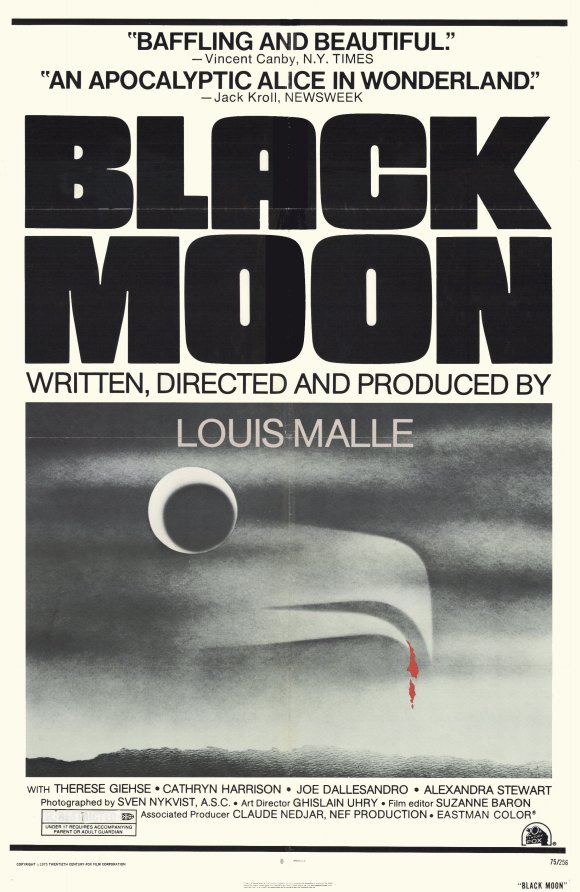
Black Moon may well deserve the title of Louis Malle’s film maudit. The release in September 1975 of what he called his “mythological fairy tale taking place in the near future” disconcerted many, especially as people had expected him to follow up on his previous work, the groundbreaking German-occupation drama Lacombe, Lucien (1974). As a result, the film was his least successful at the box office, and despite receiving two Césars in 1976, it remained until recently one of his most difficult to see.
Black Moon opens as quasi science fiction—there seems to be some kind of nuclear war going on, with soldiers wearing gas masks—but immediately evolves into an elaborate surrealist fantasy. In a deserted countryside, a fair young woman (Cathryn Harrison) fleeing the armed conflict stumbles upon a series of animals, ranging from the rural—a badger, pigs, sheep, snakes, and a horse—to a mythical unicorn. Narrowly escaping being shot, she ends up in a beautiful mansion that is itself overrun by animals, those she has seen outside now joined by a tame rat and an eagle, among others. The human inhabitants of the house are an androgynous and incestuous brother and sister couple, possibly twins (played by Alexandra Stewart and Joe Dallesandro), who, like the heroine, are both called Lily, and their bedridden elderly mother (Thérèse Giehse, who had played the grandmother in Lacombe, Lucien and whom Malle credited with indirectly generating Black Moon by suggesting that he make a film without dialogue; he dedicated the film to her, as she died before it was released). Although Black Moon was produced in an English and a French version—and Malle stated that he preferred the English one—language is reduced to a few grunts, a minute amount of intelligible dialogue, and animal noises. The film is instead replete with surrealist images, such as a talking piglet in a child’s high chair, decapitated animals, feral naked children driving pigs or sheep, and both the female twin and the heroine at one point breast-feeding the old woman.
Ghostbusters, Back to School, Stripes, Groundhog Day, Meatballs, SCTV—I’m one of the few people that actually really digs Multiplicity. Hell, I even saw Year One in the theater (it was awful, but dude has a lifetime pass that extends now past his lifetime, to be clear). Ramis undoubtedly colored the careers of all the people he worked with—he wrote their lines, made the lines fit into comedies that were smart and dumb and goofy and perceptive all at the same time. RIP.




 Biblioklept