John Brunner’s Stand on Zanzibar (Book acquired, 28 Aug. 2020)

I usually allow myself to peruse my favorite used bookstore every other Friday, poking around for weird finds and etc. I had no luck this week—nothing like a Vintage Contemporaries Barry Hannah—but they did have a copy of John Brunner’s 1968 novel Stand on Zanzibar, which I’d been searching (not-too-hard) for for a few years now. The thing is much longer than I expected (I knew it was long…but it’s long…650 pages). Not sure when I’ll even get to it. It’s supposed to be a cult classic right? Here’s the blurb from my edition:

There are seven billion-plus humans crowding the surface of 21st century Earth. It is an age of intelligent computers, mass-market psychedelic drugs, politics conducted by assassination, scientists who burn incense to appease volcanoes … all the hysteria of a dangerously overcrowded world, portrayed in a dazzlingly inventive style. Employing a dazzling range of literary techniques, John Brunner has created a future world as real as this morning’s newspaper – moving, sensory, impressionistic, as jagged as the times it portrays, this book is a real mind stretcher – and yet beautifully orchestrated to give a vivid picture of the whole.

And here’s an excerpt, via Macmillan’s site:


context (1)

SCANALYZE MY NAME

Stock cue SOUND: “Presenting SCANALYZER, Engrelay Satelserv’s unique thrice-per-day study of the big big scene, the INdepth INdependent INmediate INterface between you and your world!”
Stock cue VISUAL: cliptage, splitscreen, cut in bridge-melder, Mr. & Mrs. Everywhere depthunder (today MAMP, Mid-Atlantic Mining Project), spaceover (today freefly-suiting), transiting (today Simplon Acceleratube), digging (today as every day homimage with autoshout).
Autoshout cue: “It’s happening it’s happening! SCANALYZER SCANALYZER SCANALYZER SCANALYZER SCANALYZER SCANALYZER—”
Stock cue VISUAL: cliptage, wholescreen, planet Earth turning jerk-jerk-jerk and holding meridians for GMT, EST, PCT, Pacific Conflict Zone Time.
Live cue SOUND: “And it’s six poppa-momma for the happening people keeping it straight and steady on that old Greenwich Mean Time—how mean can time get, you tell me, hm? Zee for zero, bee for base, counting down to one after ess ee eks—sorree—ess EYE eks! We know what’s happening happening HAPPENING but that piece of the big big scene is strictly up to you, Mr. and Mrs. Everywhere—or Mr. and Miss, or Miss and Miss, or Mister and Mister, take your pick, hah-hah! Counting down to one after one poppa-momma for that good old Eastern Standard tie-yum, one after ten anti-matter for the Pacific Coast, and for all of you fighting the good fight in lonely midocean one after seven anti-matter—PIPS!”
Clock cue: 5 × 1-sec. countdown pips on G in alt, minute signal on C in alt.
Plug cue: “No time like the present for things to happen in, no better way to keep time straight and steady than by the signal from General Technics’ critonium clock, so accuright it serves to judge the stars.”
Script cue VISUAL: cliptage, splitscreen, excerpts from day’s news.
Live cue SOUND: “And no better way to keep abreast—pardon—than with SCANALYZER!”
Cut autoshout cue. (If they haven’t made it by this time they’ve switched off.)
Plug cue: “SCANALYZER is the one single, the ONLY study of the news in depth that’s processed by General Technics’ famed computer Shalmaneser, who sees all, hears all, knows all save only that which YOU, Mr. and Mrs. Everywhere, wish to keep to yourselves.”
Script cue: the happening world.
the happening world (1)

Continue reading “John Brunner’s Stand on Zanzibar (Book acquired, 28 Aug. 2020)”

Cain in the United States — Alfaro Siqueiros

https3a2f2fbucketeer-e05bbc84-baa3-437e-9518-adb32be77984.s3.amazonaws.com2fpublic2fimages2fc2349e36-7271-428f-a256-18e3f43d8afe_1814x1494

Cain in the United States, 1947 by David Alfaro Siqueiros (1896-1974)

Sentinel — Tilo Baumgärtel

Sentinel, 2020 by Tilo Baumgärtel (b. 1972)

“Tavern” — Edna St. Vincent Millay

“Tavern”

by

Edna St. Vincent Millay


I’ll keep a little tavern
Below the high hill’s crest,
Wherein all grey-eyed people
May set them down and rest.

There shall be plates a-plenty,
And mugs to melt the chill
Of all the grey-eyed people
Who happen up the hill.

There sound will sleep the traveller,
And dream his journey’s end,
But I will rouse at midnight
The falling fire to tend.

Aye, ’tis a curious fancy—
But all the good I know
Was taught me out of two grey eyes
A long time ago.

Sátántangó dance scene

A (perhaps titular) scene from Bela Tarr’s film Sátántangó (1994). Based on the novel of the same name by László Krasznahorkai.

Sequins and Fish — Matthew Carver

Sequins and Fish, 2018 by Matthew Carver (b. 1968)

Meantime, I continued to stand on the oozy margin of the stream | Nathaniel Hawthorne’s journal entry for August 24th, 1842

August 24th.–I left home at five o’clock this morning to catch some fish for breakfast. I shook our summer apple-tree, and ate the golden apple which fell from it. Methinks these early apples, which come as a golden promise before the treasures of autumnal fruit, are almost more delicious than anything that comes afterwards. We have but one such tree in our orchard; but it supplies us with a daily abundance, and probably will do so for at least a week to come. Meantime other trees begin to cast their ripening windfalls upon the grass; and when I taste them, and perceive their mellowed flavor and blackening seeds, I feel somewhat overwhelmed with the impending bounties of Providence. I suppose Adam, in Paradise, did not like to see his fruits decaying on the ground, after he had watched them through the sunny days of the world’s first summer. However, insects, at the worst, will hold a festival upon them, so that they will not be thrown away, in the great scheme of Nature. Moreover, I have one advantage over the primeval Adam, inasmuch as there is a chance of disposing of my superfluous fruits among people who inhabit no Paradise of their own.

Passing a little way down along the river-side, I threw in my line, and soon drew out one of the smallest possible of fishes. It seemed to be a pretty good morning for the angler,–an autumnal coolness in the air, a clear sky, but with a fog across the lowlands and on the surface of the river, which a gentle breeze sometimes condensed into wreaths. At first, I could barely discern the opposite shore of the river; but, as the sun arose, the vapors gradually dispersed, till only a warm, smoky tint was left along the water’s surface. The farm-houses across the river made their appearance out of the dusky cloud; the voices of boys were heard, shouting to the cattle as they drove them to the pastures; a man whetted his scythe, and set to work in a neighboring meadow. Meantime, I continued to stand on the oozy margin of the stream, beguiling the little fish; and though the scaly inhabitants of our river partake somewhat of the character of their native element, and are but sluggish biters, still I contrived to pull out not far from two dozen. They were all bream, a broad, flat, almost circular fish, shaped a good deal like a flounder, but swimming on their edges, instead of on their sides. As far as mere pleasure is concerned, it is hardly worth while to fish in our river, it is so much like angling in a mud-puddle; and one does not attach the idea of freshness and purity to the fishes, as we do to those which inhabit swift, transparent streams, or haunt the shores of the great briny deep. Standing on the weedy margin, and throwing the line over the elder-bushes that dip into the water, it seems as if we could catch nothing but frogs and mud-turtles, or reptiles akin to them. And even when a fish of reputable aspect is drawn out, one feels a shyness about touching him. As to our river, its character was admirably expressed last night by some one who said “it was too lazy to keep itself clean.” I might write pages and pages, and only obscure the impression which this brief sentence conveys. Nevertheless, we made bold to eat some of my fish for breakfast, and found them very savory; and the rest shall meet with due entertainment at dinner, together with some shell-beans, green corn, and cucumbers from our garden; so this day’s food comes directly and entirely from beneficent Nature, without the intervention of any third person between her and us.

Nathaniel Hawthorne’s journal entry, 24 August 1842. From American Note-Books.

He saw himself nailed to the cross of his own cradle and coffin | From László Krasznahorkai’s Satantango

He gazed sadly at the threatening sky, at the burned-out remnants of a locust-plagued summer, and suddenly saw on the twig of an acacia, as in a vision, the progress of spring, summer, fall and winter, as if the whole of time were a frivolous interlude in the much greater spaces of eternity, a brilliant conjuring trick to produce something apparently orderly out of chaos, to establish a vantage point from which chance might begin to look like necessity …and he saw himself nailed to the cross of his own cradle and coffin, painfully trying to tear his body away, only, eventually, to deliver himself—utterly naked, without identifying mark, stripped down to essentials—into the care of the people whose duty it was to wash the corpses, people obeying an order snapped out in the dry air against a background loud with torturers and flayers of skin, where he was obliged to regard the human condition without a trace of pity, without a single possibility of anyway back to life, because by then he would know for certain that all his life he had been playing with cheaters who had marked the cards and who would, in the end, strip him even of his last means of defense, of that hope of someday finding his way back home.

An excerpt from the beginning (and end) of László Krasznahorkai’s novel Satantango. English translation by George Szirtes.

I listened to the audiobook of Satantango last week and then launched into it again, reading bits in tandem with my New Directions edition from years ago, finding it funnier, richer, and more complex than I’d initially thought, its plot threads clarifying more easily in a reread. I think this passage does a nice job of laying out the novel’s themes of abjection, time (and deep time), observation (and surveillance), and life as one big con.


Reading to Celeste — Chelsea Gibson

818b5c4b9505fa6c79d510d1256b5903

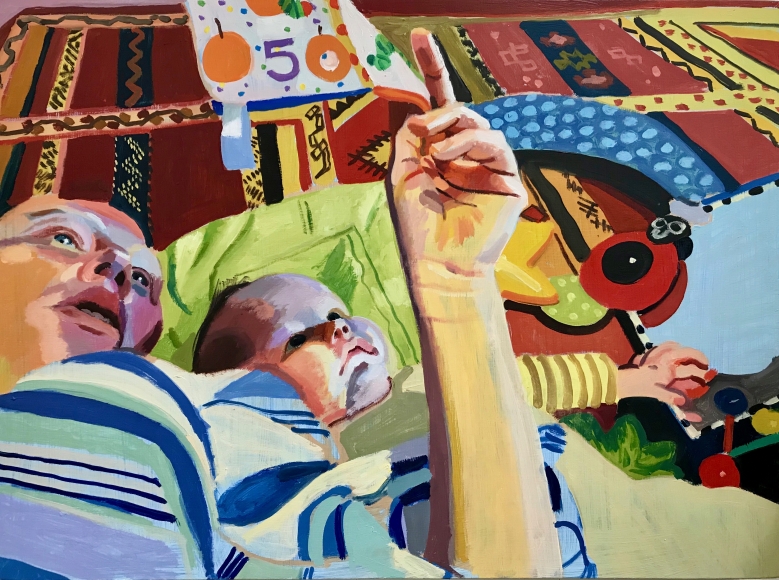
Reading to Celeste, 2020 by Chelsea Gibson

Flann O’Brien & Anne Carson (Violating building codes leads to a web of obssession) | David Berman


2020-08-15_151419_2

From The Minus Times #29, as republished in The Minus Times Collected. 

“The one-man band doesn’t look too happy,” Mathilda observed | Donald Barthelme

2020-06-28_183906_1

From Donald Barthelme’s children’s book The Slightly Irregular Fire Engine; or The Hithering Thithering Djinn.

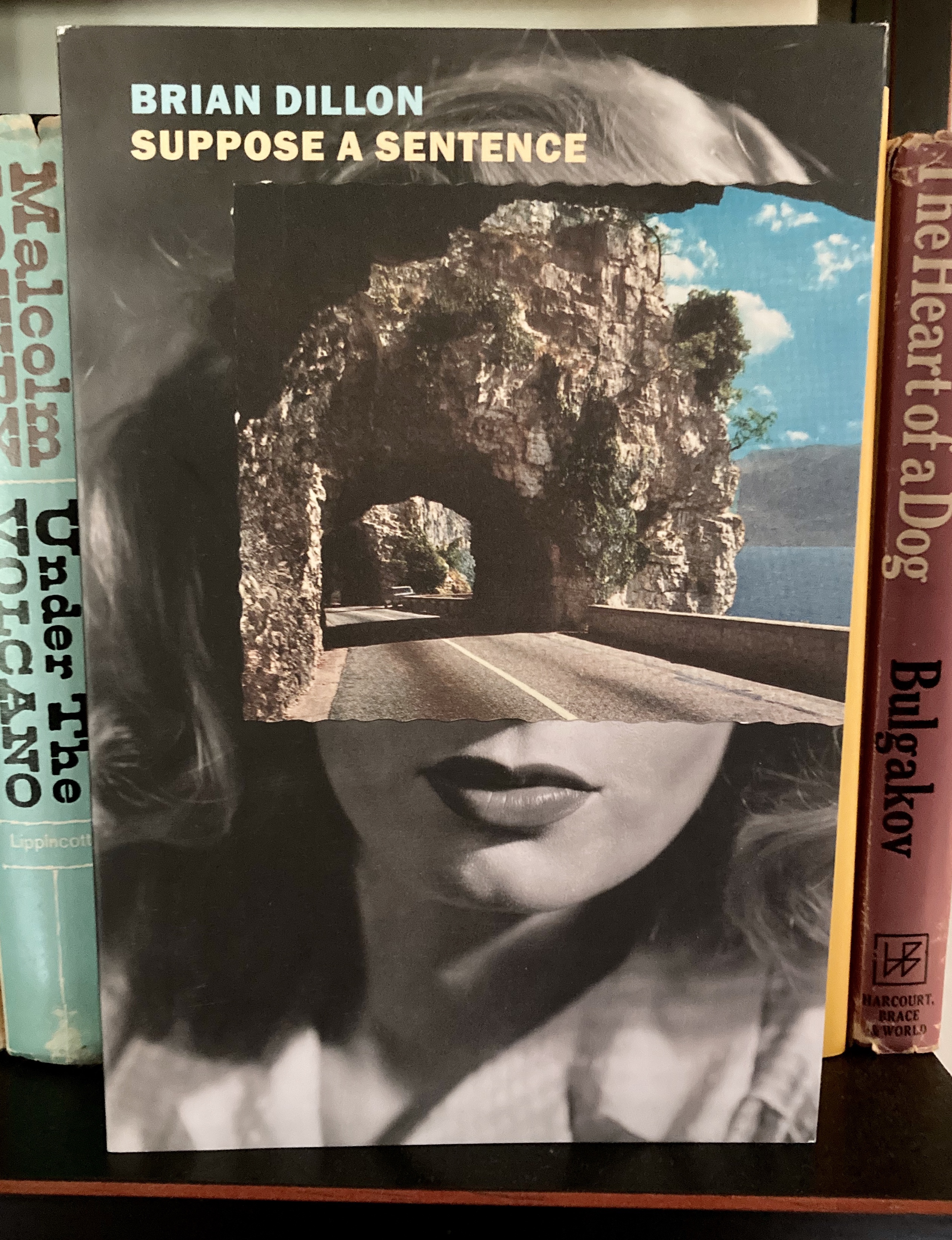
Brian Dillon’s Suppose a Sentence (Book acquired, 14 Aug. 2020)

Brian Dillon’s Suppose a Sentence is a collection of 27 essays that each take a single sentence as their starting point. Organized chronologically by author dates, the collection begins with Shakespeare and Donne and works its way to Anne Carson and Anne Boyer (with Eliot, Stein, Beckett, Bowen et al along the way). When it showed up at Biblioklept World Headquarters last week I was intrigued, and admittedly jumped to the end to read the pieces on Carson and Boyer. In subsequent days I read the pieces on Shakespeare (Dillon takes his sentence “O, o, o, o” from Hamlet, but finds the vowels reputation throughout the playwright’s oeuvre) and Robert Smithson (in the middle of the book). I’ve decided to settle down and read in order at a leisurely pace—a chapter a day?

In the meantime, NYRB’s blurb

In Suppose a Sentence, Brian Dillon, whom John Banville has called “a literary flâneur in the tradition of Baudelaire and Walter Benjamin,” has written a sequel of sorts to Essayism, his roaming love letter to literature. In this new book Dillon turns his attention to the oblique and complex pleasures of the sentence. A series of essays prompted by a single sentence—from Shakespeare to Janet Malcolm, John Ruskin to Joan Didion—the book explores style, voice, and language, along with the subjectivity of reading. Both an exercise in practical criticism and a set of experiments or challenges, Suppose a Sentence is a polemical and personal reflection on the art of the sentence in literature. Whether the sentence in question is a rigorous expression of a state of vulnerability, extremity, even madness, or a carefully calibrated arrangement, Dillon examines not only how it works and why but also, in the course of the book, what the sentence once was, what it is today, and what it might become tomorrow.

Niagra Red Chair — Jamie Adams 

Niagra Red Chair, 2013 by Jamie Adams (b. 1961)

TEST TEST TEST

They’re talking about things of which they don’t have the slightest understanding, anyway. It’s only because of their stupidity that they’re able to be so sure of themselves.

Very easy to read

I ate
Paradise
Congratulations
Our box

Everyone
You to you
Subject
On coffee

I do not have it
They are awesome
Very good
It is very cold


It totally depends
Get up

Red palesgra
Wheelchair

Rain covered
That

It’s white
Chicken


Posted in Art

test too

It is a singular thing, that, at the distance, say, of five feet, the work of the greatest dunce looks just as well as that of the greatest genius,–that little space being all the distance between genius and stupidity.

There is evil in every human heart, which may remain latent, perhaps, through the whole of life; but circumstances may rouse it to activity. To imagine such circumstances. A woman, tempted to be false to her husband, apparently through mere whim,–or a young man to feel an instinctive thirst for blood, and to commit murder. This appetite may be traced in the popularity of criminal trials. The appetite might be observed first in a child, and then traced upwards, manifesting itself in crimes suited to every stage of life.

Roommates — Roy Lichtenstein

Roommates, 1994 by Roy Lichtenstein (1923–1997)