Fritz Eichenberg’s illustration for Edgar Allan Poe’s “The Man of the Crowd”
“The Man of the Crowd”
by
Edgar Allan Poe
     Ce grand malheur, de ne pouvoir être seul.

              La Bruyère.
IT was well said of a certain German book that “er lasst sich nicht lesen“—it does not permit itself to be read. There are some secrets which do not permit themselves to be told. Men die nightly in their beds, wringing the hands of ghostly confessors and looking them piteously in the eyes—die with despair of heart and convulsion of throat, on account of the hideousness of mysteries which will not suffer themselves to be revealed. Now and then, alas, the conscience of man takes up a burthen so heavy in horror that it can be thrown down only into the grave. And thus the essence of all crime is undivulged.
Not long ago, about the closing in of an evening in autumn, I sat at the large bow window of the D——- Coffee-House in London. For some months I had been ill in health, but was now convalescent, and, with returning strength, found myself in one of those happy moods which are so precisely the converse of ennui—moods of the keenest appetency, when the film from the mental vision departs—the [Greek phrase]—and the intellect, electrified, surpasses as greatly its every-day condition, as does the vivid yet candid reason of Leibnitz, the mad and flimsy rhetoric of Gorgias. Merely to breathe was enjoyment; and I derived positive pleasure even from many of the legitimate sources of pain. I felt a calm but inquisitive interest in every thing. With a cigar in my mouth and a newspaper in my lap, I had been amusing myself for the greater part of the afternoon, now in poring over advertisements, now in observing the promiscuous company in the room, and now in peering through the smoky panes into the street.
This latter is one of the principal thoroughfares of the city, and had been very much crowded during the whole day. But, as the darkness came on, the throng momently increased; and, by the time the lamps were well lighted, two dense and continuous tides of population were rushing past the door. At this particular period of the evening I had never before been in a similar situation, and the tumultuous sea of human heads filled me, therefore, with a delicious novelty of emotion. I gave up, at length, all care of things within the hotel, and became absorbed in contemplation of the scene without. Continue reading “Read Edgar Allan Poe’s “The Man of the Crowd””→
This is not the dystopia we were promised. We are not learning to love Big Brother, who lives, if he lives at all, on a cluster of server farms, cooled by environmentally friendly technologies. Nor have we been lulled by Soma and subliminal brain programming into a hazy acquiescence to pervasive social hierarchies…
….Standard utopias and standard dystopias are each perfect after their own particular fashion. We live somewhere queasier—a world in which technology is developing in ways that make it increasingly hard to distinguish human beings from artificial things. The world that the Internet and social media have created is less a system than an ecology, a proliferation of unexpected niches, and entities created and adapted to exploit them in deceptive ways. Vast commercial architectures are being colonized by quasi-autonomous parasites. Scammers have built algorithms to write fake books from scratch to sell on Amazon, compiling and modifying text from other books and online sources such as Wikipedia, to fool buyers or to take advantage of loopholes in Amazon’s compensation structure. Much of the world’s financial system is made out of bots—automated systems designed to continually probe markets for fleeting arbitrage opportunities. Less sophisticated programs plague online commerce systems such as eBay and Amazon, occasionally with extraordinary consequences, as when two warring bots bid the price of a biology book up to $23,698,655.93 (plus $3.99 shipping).
In other words, we live in Philip K. Dick’s future, not George Orwell’s or Aldous Huxley’s
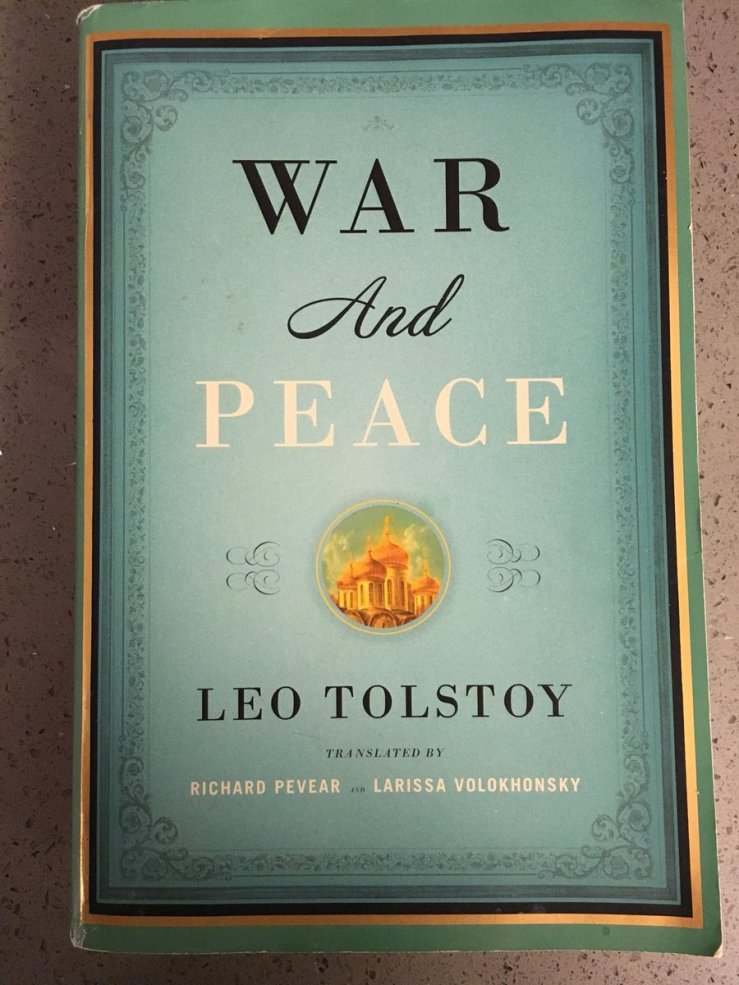
Huge thankyous to BLCKDGRD for sending me a spare copy of some obscure Russian novel called War and Peace. Now I have to read the damn thing. (The only Tolstoy I’ve really read is Hadji Murad).
I think I could turn and live with animals, they are so placid and self-contain’d;
I stand and look at them long and long.
They do not sweat and whine about their condition;
They do not lie awake in the dark and weep for their sins;
They do not make me sick discussing their duty to God;
Not one is dissatisfied—not one is demented with the mania of owning things;
Not one kneels to another, nor to his kind that lived thousands of years ago;
Not one is respectable or industrious over the whole earth.
So they show their relations to me, and I accept them;
They bring me tokens of myself—they evince them plainly in their possession.
I wonder where they get those tokens:
Did I pass that way huge times ago, and negligently drop them?
Myself moving forward then and now and forever,
Gathering and showing more always and with velocity,
Infinite and omnigenous, and the like of these among them;
Not too exclusive toward the reachers of my remembrancers;
Picking out here one that I love, and now go with him on brotherly terms.
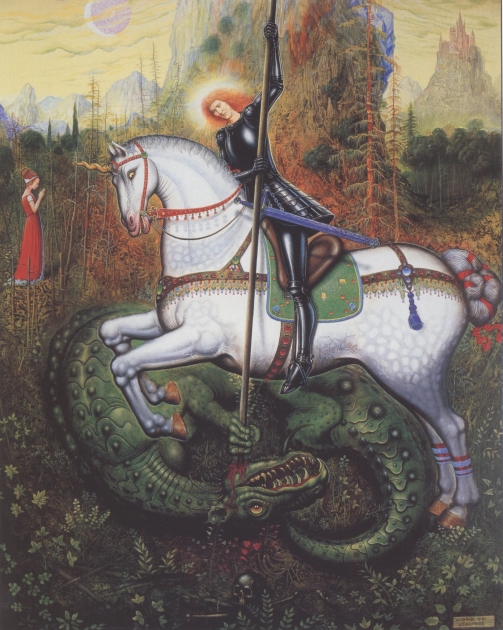
A gigantic beauty of a stallion, fresh and responsive to my caresses,
Head high in the forehead, wide between the ears,
Limbs glossy and supple, tail dusting the ground,
Eyes full of sparkling wickedness—ears finely cut, flexibly moving.
His nostrils dilate, as my heels embrace him;
His well-built limbs tremble with pleasure, as we race around and return.
I but use you a moment, then I resign you, stallion;
Why do I need your paces, when I myself out-gallop them?
Even, as I stand or sit, passing faster than you.










 Biblioklept