This is the reason why bards love wine, mead, narcotics, coffee, tea, opium, the fumes of sandal-wood and tobacco (Emerson)

It is a secret which every intellectual man quickly learns, that, beyond the energy of his possessed and conscious intellect he is capable of a new energy (as of an intellect doubled on itself), by abandonment to the nature of things; that beside his privacy of power as an individual man, there is a great public power on which he can draw, by unlocking, at all risks, his human doors, and suffering the ethereal tides to roll and circulate through him; then he is caught up into the life of the Universe, his speech is thunder, his thought is law, and his words are universally intelligible as the plants and animals. The poet knows that he speaks adequately then only when he speaks somewhat wildly, or, “with the flower of the mind;” not with the intellect used as an organ, but with the intellect released from all service and suffered to take its direction from its celestial life; or as the ancients were wont to express themselves, not with intellect alone but with the intellect inebriated by nectar. As the traveller who has lost his way throws his reins on his horse’s neck and trusts to the instinct of the animal to find his road, so must we do with the divine animal who carries us through this world. For if in any manner we can stimulate this instinct, new passages are opened for us into nature; the mind flows into and through things hardest and highest, and the metamorphosis is possible.

This is the reason why bards love wine, mead, narcotics, coffee, tea, opium, the fumes of sandal-wood and tobacco, or whatever other procurers of animal exhilaration. All men avail themselves of such means as they can, to add this extraordinary power to their normal powers; and to this end they prize conversation, music, pictures, sculpture, dancing, theatres, travelling, war, mobs, fires, gaming, politics, or love, or science, or animal intoxication,—which are several coarser or finer quasi-mechanical substitutes for the true nectar, which is the ravishment of the intellect by coming nearer to the fact. These are auxiliaries to the centrifugal tendency of a man, to his passage out into free space, and they help him to escape the custody of that body in which he is pent up, and of that jail-yard of individual relations in which he is enclosed. Hence a great number of such as were professionally expressers of Beauty, as painters, poets, musicians, and actors, have been more than others wont to lead a life of pleasure and indulgence; all but the few who received the true nectar; and, as it was a spurious mode of attaining freedom, as it was an emancipation not into the heavens but into the freedom of baser places, they were punished for that advantage they won, by a dissipation and deterioration. But never can any advantage be taken of nature by a trick. The spirit of the world, the great calm presence of the Creator, comes not forth to the sorceries of opium or of wine. The sublime vision comes to the pure and simple soul in a clean and chaste body. That is not an inspiration, which we owe to narcotics, but some counterfeit excitement and fury. Milton says that the lyric poet may drink wine and live generously, but the epic poet, he who shall sing of the gods and their descent unto men, must drink water out of a wooden bowl. For poetry is not ‘Devil’s wine,’ but God’s wine. It is with this as it is with toys. We fill the hands and nurseries of our children with all manner of dolls, drums, and horses; withdrawing their eyes from the plain face and sufficing objects of nature, the sun, and moon, the animals, the water, and stones, which should be their toys. So the poet’s habit of living should be set on a key so low that the common influences should delight him. His cheerfulness should be the gift of the sunlight; the air should suffice for his inspiration, and he should be tipsy with water. That spirit which suffices quiet hearts, which seems to come forth to such from every dry knoll of sere grass, from every pine-stump and half-imbedded stone on which the dull March sun shines, comes forth to the poor and hungry, and such as are of simple taste. If thou fill thy brain with Boston and New York, with fashion and covetousness, and wilt stimulate thy jaded senses with wine and French coffee, thou shalt find no radiance of wisdom in the lonely waste of the pinewoods.

From Ralph Waldo Emerson’s essay “The Poet.”

The witness

IMG_0350

IMG_0349

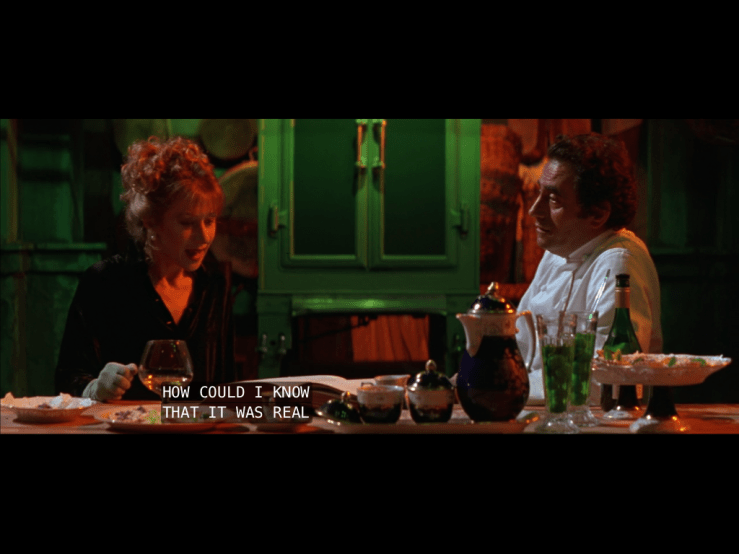
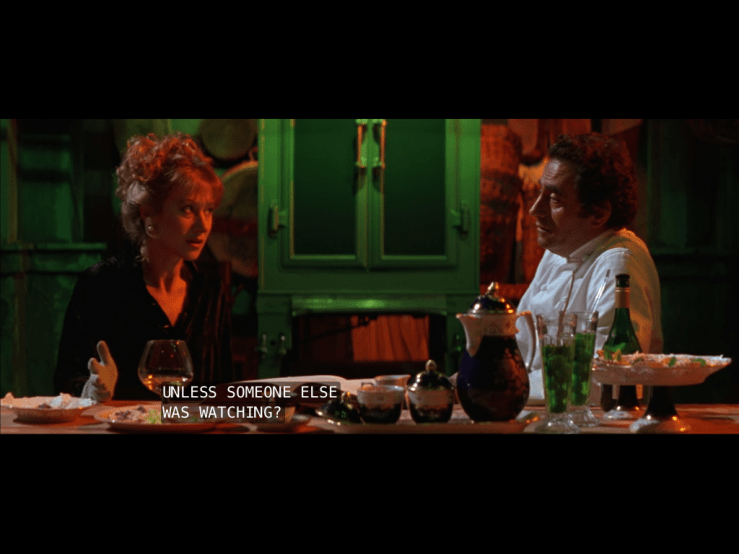
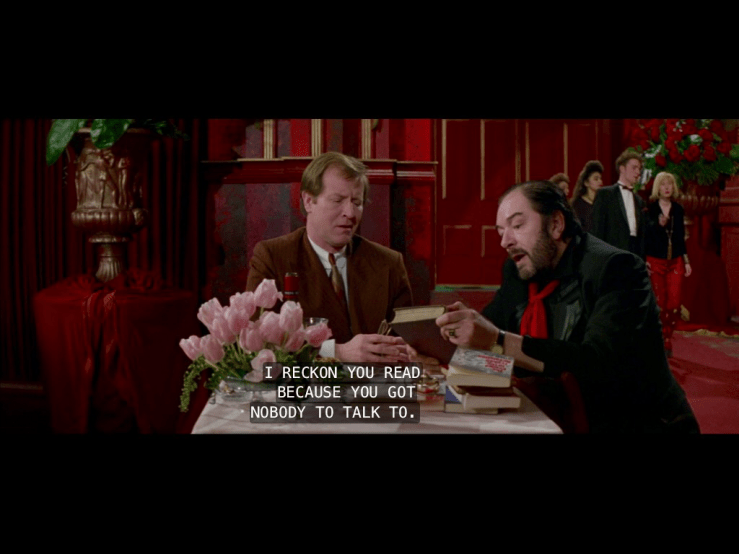
From The Cook, the Thief, His Wife & Her Lover (1989). Directed by Peter Greenaway. Cinematography by Sacha Vierny.

La Ville entière (The Entire City) — Max Ernst

Ernst the-entire-city-1935

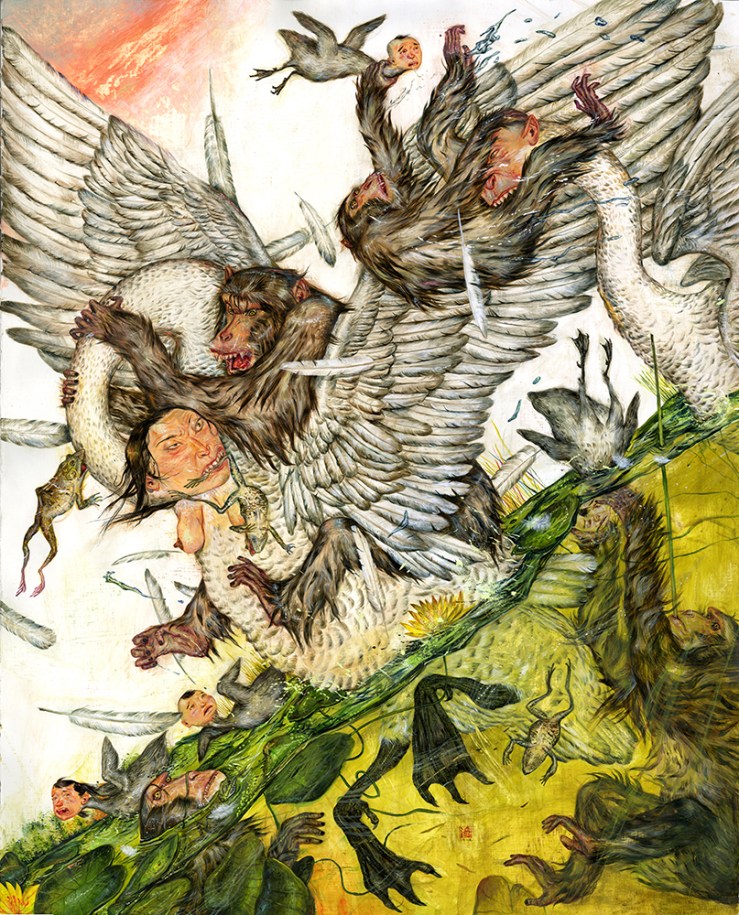
A Mouse as a Monk — Shibata Zeshin

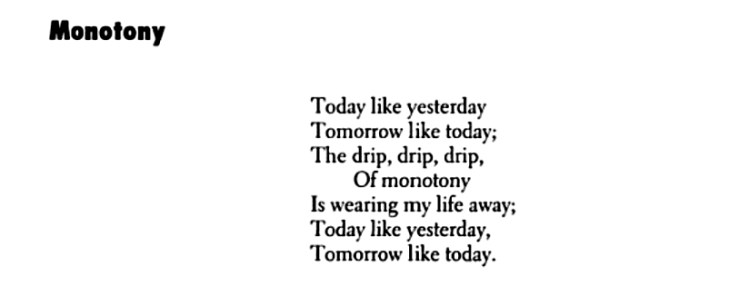
“Monotony” — Langston Hughes

monotony

Carnival in Athens — Nikolaos Gyzis

Sebald’s Vision (Book acquired 10.06.2015)

IMG_0023

  1. I can barely keep up with these “book acquired” posts this fall.
  2. I was actually reading Sebald last night—his essay on Rousseau in A Place in the Country. “How difficult it is in general to bring the machinery of thought to a standstill“—yes, yes, of course. Machinery! If there was just a switch…
  3. I mean that I would love to be like, transcendentalist (transcendent?  transcending? to transcend? trance? tr….) but the feeling of the feeling, the machinery of thought gets in the way. But anyway—
  4. (Sebald in this picture, and a few others, looks so much like my father that it frightens the fuck out of me. It’s horrifying).
  5. [Optometry joke]
  6. I was going somewhere with this (or not): Sebald’s Vision by Carol Jacobs. Publisher Columbia University Press’s blurb:

    W. G. Sebald’s writing has been widely recognized for its intense, nuanced engagement with the Holocaust, the Allied bombing of Germany in WWII, and other episodes of violence throughout history. Through his inventive use of narrative form and juxtaposition of image and text, Sebald’s work has offered readers new ways to think about remembering and representing trauma.

    In Sebald’s Vision, Carol Jacobs examines the author’s prose, novels, and poems, illuminating the ethical and aesthetic questions that shaped his remarkable oeuvre. Through the trope of “vision,” Jacobs explores aspects of Sebald’s writing and the way the author’s indirect depiction of events highlights the ethical imperative of representing history while at the same time calling into question the possibility of such representation.

    Jacobs’s lucid readings of Sebald’s work also consider his famous juxtaposition of images and use of citations to explain his interest in the vagaries of perception. Isolating different ideas of vision in some of his most noted works, including Rings of Saturn, Austerlitz, and After Nature, as well as in Sebald’s interviews, poetry, art criticism, and his lecture Air War and Literature, Jacobs introduces new perspectives for understanding the distinctiveness of Sebald’s work and its profound moral implications.

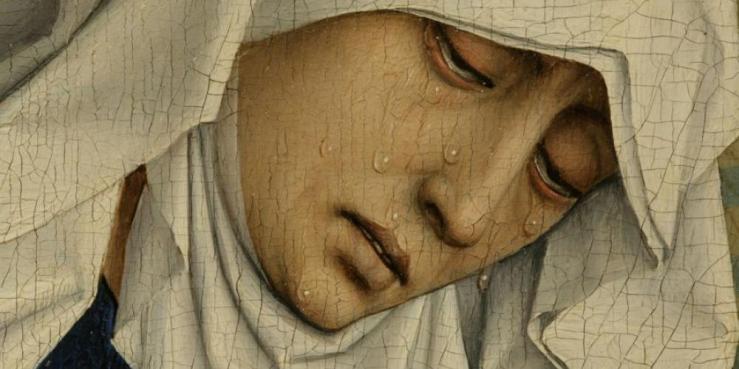
Detail from The Seven Sacraments — Rogier van der Weyden

rogier vdw

To bring the machinery of thought to a standstill (W.G. Sebald)

How difficult it is in general to bring the machinery of thought to a standstill is shown by Rousseau’s description of his apparently so happy days on the island in the Lac de Bienne. He has, as he writes in the fifth Promenade, deliberately forsworn the burden of work, and his greatest joy has been to leave his books safely shut away and to have neither ink nor paper to hand. However, since the leisure time thus freed up must be put to some use, Rousseau devotes himself to the study of botany, whose basic principles he had acquired in Môtiers on excursions with Jean Antoine d’Ivernois. “I set out to compose,” writes Rousseau in the fifth Promenade, “a Flora Petrinsularis and to describe every single plant on the island in enough detail to keep me busy for the rest of my days. They say a German once wrote a book about a lemon peel; I could have written one about every grass in the meadows, every moss in the woods, every lichen covering the rocks—and I did not want to leave even one blade of grass or atom of vegetation without a full and detailed description. In accordance with this noble plan, every morning after breakfast I would set out with a magnifying glass in my hand and my Systemae Naturae under my arm to study one particular section of the island, which I had divided for this purpose into small squares, intending to visit them all one after another in every season.” The central motif of this passage is not so much the impartial insight into the indigenous plants of the island as that of ordering, classification, and the creation of a perfect system. Thus this apparently innocent occupation—the deliberate resolve no longer to think and merely to look at nature—becomes, for the writer plagued by the chronic need to think and work, a demanding rationalistic project involving the compiling of lists, indices, and catalogs, along with the precise description of, for example, the long stamens of self-heal, the springiness of those of nettle and of wall-pellitory, and the sudden bursting of the seed capsules of balsam and of beech. Nonetheless, the leaves of the small herbaria which Rousseau later compiled for Madelon and Julie de la Tour and other young ladies take on the aspect of an innocent bricolage in comparison with the self-destructive business of writing to which he usually submitted himself. A faint aura of unconscious beauty still hovers over these flower collections, in which lichens, sprigs of veronica, lilies of the valley, and autumn crocuses have survived, pressed and a little faded, from the eighteenth century. They can still be admired today in the Musée Carnavalet and the Musée des Arts Décoratifs. The herbarium Rousseau compiled for himself, meanwhile—eleven quarto volumes—was, up to the Second World War, preserved in the Botanical Museum in Berlin, until, like so much and so many in that city, it went up in flames one night during one of the nocturnal bombing raids.

From W. G. Sebald’s essay “J’aurais voulu que ce lac eût été l’Océan.” Translated by Jo Catling and collected in A Place in the Country.

Nobody to talk to

IMG_0348

From The Cook, the Thief, His Wife & Her Lover (1989). Directed by Peter Greenaway. Cinematography by Sacha Vierny.

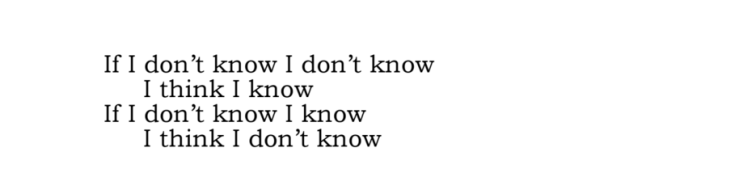
Don’t know (R.D. Laing)

Screenshot 2015-10-05 at 5.34.34 PM

From R.D. Laing’s Knots (1970).

God has not made some beautiful things, but Beauty is the creator of the universe (Emerson)

The poet is the sayer, the namer, and represents beauty. He is a sovereign, and stands on the centre. For the world is not painted or adorned, but is from the beginning beautiful; and God has not made some beautiful things, but Beauty is the creator of the universe. Therefore the poet is not any permissive potentate, but is emperor in his own right. Criticism is infested with a cant of materialism, which assumes that manual skill and activity is the first merit of all men, and disparages such as say and do not, overlooking the fact that some men, namely poets, are natural sayers, sent into the world to the end of expression, and confounds them with those whose province is action but who quit it to imitate the sayers. But Homer’s words are as costly and admirable to Homer as Agamemnon’s victories are to Agamemnon. The poet does not wait for the hero or the sage, but, as they act and think primarily, so he writes primarily what will and must be spoken, reckoning the others, though primaries also, yet, in respect to him, secondaries and servants; as sitters or models in the studio of a painter, or as assistants who bring building materials to an architect.

For poetry was all written before time was, and whenever we are so finely organized that we can penetrate into that region where the air is music, we hear those primal warblings and attempt to write them down, but we lose ever and anon a word or a verse and substitute something of our own, and thus miswrite the poem. The men of more delicate ear write down these cadences more faithfully, and these transcripts, though imperfect, become the songs of the nations. For nature is as truly beautiful as it is good, or as it is reasonable, and must as much appear as it must be done, or be known. Words and deeds are quite indifferent modes of the divine energy. Words are also actions, and actions are a kind of words.

The sign and credentials of the poet are that he announces that which no man foretold. He is the true and only doctor; he knows and tells; he is the only teller of news, for he was present and privy to the appearance which he describes. He is a beholder of ideas and an utterer of the necessary and causal. For we do not speak now of men of poetical talents, or of industry and skill in metre, but of the true poet.

From Ralph Waldo Emerson’s essay “The Poet.”

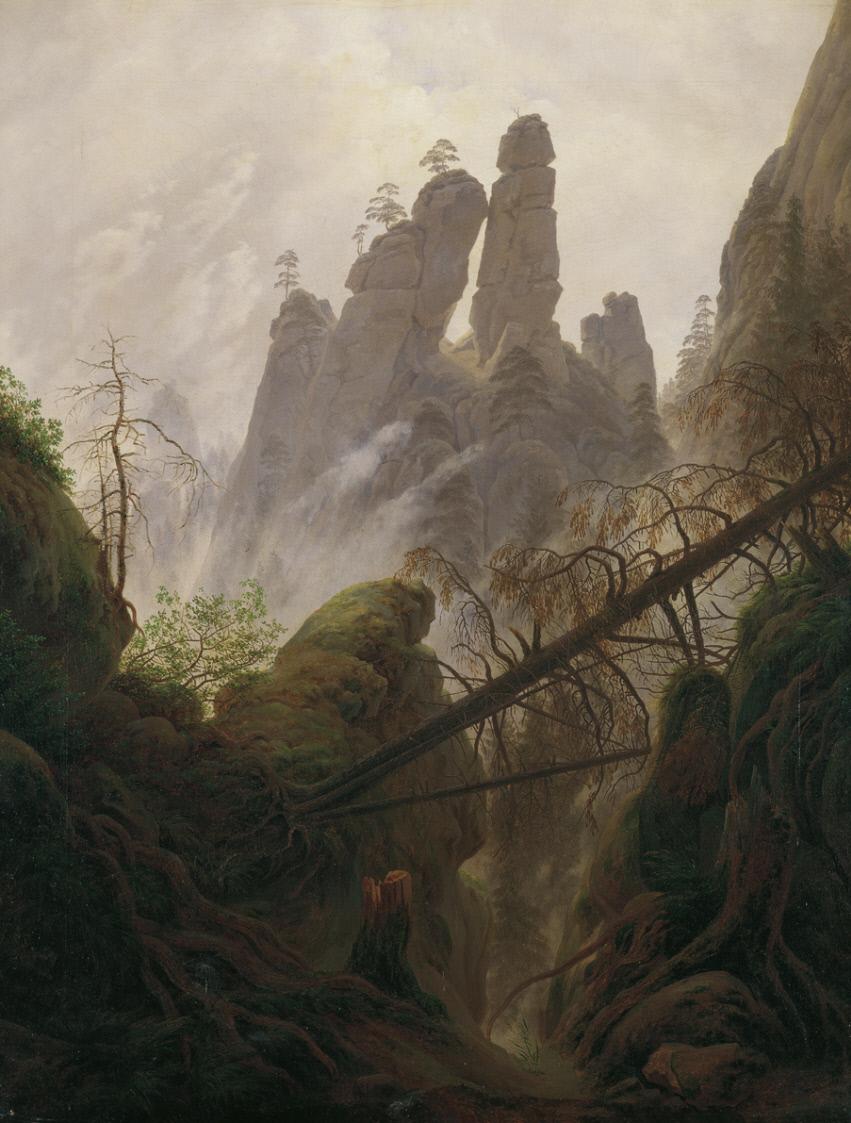
Rocky Landscape in the Elbsandsteingebirge — Caspar David Friedrich