
I just loved yesterday’s post from the Urban Core: a great collection of photos of the old Main St. Library. Not sure if Tony took these himself. Good stuff.
Ontology is (not) Overrated
A few weeks ago, one gentle reader was kind enough to respond to a post of mine. I reproduce in full said response:
“Speaking of things ontological: this, from Clay Shirky’s monumental “Ontology is Overrated.”
http://www.shirky.com/writings/ontology_overrated.html
“It comes down ultimately to a question of philosophy. Does the world make sense or do we make sense of the world? If you believe the world makes sense, then anyone who tries to make sense of the world differently than you is presenting you with a situation that needs to be reconciled formally, because if you get it wrong, you’re getting it wrong about the real world.
If, on the other hand, you believe that we make sense of the world, if we are, from a bunch of different points of view, applying some kind of sense to the world, then you don’t privilege one top level of sense-making over the other. What you do instead is you try to find ways that the individual sense-making can roll up to something which is of value in aggregate, but you do it without an ontological goal. You do it without a goal of explicitly getting to or even closely matching some theoretically perfect view of the world.””
Okay. I finally read the essay. Very cool stuff. From Shirky, again:
“It is a rich irony that the word “ontology”, which has to do with making clear and explicit statements about entities in a particular domain, has so many conflicting definitions. I’ll offer two general ones.
The main thread of ontology in the philosophical sense is the study of entities and their relations. The question ontology asks is: What kinds of things exist or can exist in the world, and what manner of relations can those things have to each other? Ontology is less concerned with what is than with what is possible.
The knowledge management and AI communities have a related definition — they’ve taken the word “ontology” and applied it more directly to their problem. The sense of ontology there is something like “an explicit specification of a conceptualization.”
The common thread between the two definitions is essence, “Is-ness.” In a particular domain, what kinds of things can we say exist in that domain, and how can we say those things relate to each other?”
Shirky then discusses the ways that the second definition of “ontology”–the one used by the “knowledge management”–bumps up against the first definition of ontology (the one that is “less concerned with what is than with what is possible”). I don’t really think Shirky is anti-ontology, I just think he sees a problematized, ironic “ontology.” In a sense, Shirky uses a deconstructionist approach, destabilizing the hierarchies enforced by the second definition of ontology (notably, the term “metaphysical” is absent from Shirky’s defs of “ontology,” another move we could link to a deconstructionist mindset which strikes at the foundations of Platonic ideals). Shirky again:
“But this is the ontological dilemma. Consider the following statements:
A: "This is a book about Dresden."B: "This is a book about Dresden, and it goes in the category 'East Germany'."
That second sentence seems so obvious, but East Germany actually turned out to be an unstable category. Cities are real. They are real, physical facts. Countries are social fictions. It is much easier for a country to disappear than for a city to disappear, so when you’re saying that the small thing is contained by the large thing, you’re actually mixing radically different kinds of entities. We pretend that ‘country’ refers to a physical area the same way ‘city’ does, but it’s not true, as we know from places like the former Yugoslavia.”
Throughout “Ontology is Overrated,” Shirky is specifically working out ontological quandaries as they relate to the ever-expanding world of internet technology, but he’s also concious of the underpinnings of the first definition of ontology–of the possibilities of “isness” and being and the relational (infinite multiplicity) of meanings this entails (Shirky’s discussion of Yahoo and Google sheds light on this somewhat abstract problematic. Shirky privileges Google as the company who, rather than reinforcing (false) hierarchies in their ontological method, take a more deconstructive approach–meanings are relational, and exist in a fluid, transformative space).
I think that Shirky’s essay works in the same spirit that I would like to believe I’m working in: a playful, disruptive mode that pokes, prods, and jabs at the foundational traditions of hierarchies that (we allow to) resist examination, traditions that are explained away as simply being “natural.”
Finally, Shirky proposes this approach to knowledge:
“[Y]ou try to find ways that the individual sense-making can roll up to something which is of value in aggregate, but you do it without an ontological goal. You do it without a goal of explicitly getting to or even closely matching some theoretically perfect view of the world.”
There is a paradox here, one which I’m sure Shirky is aware of, yet nonetheless it’s a problematic one: Shirky wants to do away with “ontology,” or “ontological goals,” yet he wants “individual sense-making” (and value-based sense-making at that) to somehow remain. If Shirky’s problem is with the word “ontology” (a word he qualifies as “ironic”), that’s a separate issue: however, following from Shirky’s own first-definition of “ontology”–a definition that I think gets to the spirit of ontology, the spirit of possibility–ontology is simply a tool, a way of seeing, an approach, a method. Calling ontology “overrated” seems like a cynical solution; one doesn’t have to hold a metaphysical (Platonic) viewpoint which privileges “perfect” ideals and truths in order to practice ontology. Rather, ontological questioning–questioning “isness” and the possiblities of “isness,” how that “isness” finds meaning in language and representation (or how language and representation create that “isness”)–is the root of philosophical inquiry.
Word of the Week
bird-man, birdman
From the OED:
“1. A man concerned with birds; an ornithologist.
1697 Lond. Gaz. No. 3269/4 At Black Joe’s, the German Bird-man..canary-birds. 1729 M. BROWNE Pisc. Eclog. VIII. (1773) 119 The Fisher on the green-sea-deep, And Birdsman in the osier copse. 1796 MORSE Amer. Geog. II. 17 The birdmen or climbers..bringing away the birds and their eggs. 1844 C. WATERTON Ess. Nat. Hist. (ed. 3) p. lxviii, These birdmen outwardly had the appearance of Italian banditti, but it was all outside and nothing more. 1969 Observer 16 Feb. 7/5 The Smithsonian staff itself is..envious of the birdmen for getting so much money. Those involved in the ornithological expedition have had to receive military clearance.
2. An aviator, airman. colloq.
1909 Daily Chron. 27 Oct. 4/4, I shall say: ‘I saw the first bird-men in England, my dears.’ 1917 ‘CONTACT’ Airman’s Outings 244 Even intrepid birdmen (war correspondentese for flying officers) tire of trying to be offensive on a patrol. 1957 J. BRAINE Room at Top iv. 44 You were both intrepid birdmen, weren’t you?”
Famous bird-men include:
Joe Sacco

Joe Sacco’s comic book journalism captures the human elements in disaster, bringing the world’s worst phenomena–war, political oppression, genocide–into a perspective that the average American can understand. Although I was certainly old enough to follow media coverage of the Bosnian War in the nineties, I didn’t really have any clue as to what the whole thing was about until I read Sacco’s alarmingly real Safe Area Goražde, a masterpiece of graphic journalism that puts a human face on planned extinction. Ditto for Palestine, a work detailing Sacco’s years in the Gaza Strip, exploring the Israeli-Palestinian conflict. Palestine distills an ancient and ungraspable conflict into a series of frames, images, faces, and words that becomes somehow easier to confront. Palestine certainly can’t explain the incursions and the stone-throwing and the land grabs and the refugee camps and the food shortages and the torture and the kidnapping–it doesn’t even try–but it does make these abstractions thoroughly concrete.
Sacco is by no means an impartial, objective observer–he eats and lives with the people he’s writing about, and appears in all his stories as a character. Some of the most poignant moments in Sacco’s work concern simple pleasures–like watching bad action movies on pirated VHS or sharing fresh coffee with a new friend–set against a backdrop of disaster. Like Marjane Satrapi’s Persepolis, Sacco’s comics work as an education in both politics and the humanities. Highly recommended.

Check out Sacco’s recent comics on Iraq, downloadable as pdfs–Trauma on Loan and Complacency Kills.
Also available online in-full, The Underground War in Gaza, originally published by The New York Times Magazine in 2003.
Don’t Ban Books
I rarely write about “local” events (although “local” blogs are my favorite), but circumstances provoke me tonight. According to Jacksonville’s own Citadel of Truth, First Coast News, Eddie de Oliveira’s novel Lucky is under review by Duval County Public Schools (my Esteemed Employer, I add in the interest of full disclosure). A parent has complained that the book contains “questionable” material and should be banned from the school library. Aparently even in the late oughties the theme of a sexually-confused teenager is “questionable.” According to the (short) report, the parent was particularly offended by “gay themes” and the words “swinger’s party.” The story was barely a blip in the background as the wife and I prepared fresh pesto, so I didn’t catch what particular school said parent’s spawn attends [ed. note–I found out Tuesday morning that the school is none other than LaVilla School of the Arts (emphasis mine)–Jiminy Cricket, what’s up when it’s the art school parents attacking books!] but even if it is an elementary school (which it probably isn’t, not that that matters), banning books from our public school system is regressive at best, and ultimately an abasement of knowledge and intellect. In the past, DCPS has restricted and/or banned The Autobiography of Malcolm X, Catcher in the Rye, Of Mice and Men and at least a dozen more books (I haven’t been able to locate a complete list as of now). Of course, every year many books are challenged (the Harry Potter series springs immediately to mind, and Judy Blume has always caused problems for uptight parents who don’t want to talk honestly with their kids) and as an English teacher I’ve dealt with this in my own classroom, from both parents and administration (an administrator advised [i.e. told] me not to have my students read The Adventures of Huckleberry Finn; another time an administrator was shocked by the diction of Zora Neale Hurston’s classic Their Eyes Were Watching God). This particular mother’s concern is the “questionable” nature of the Lucky‘s themes which might cause readers to uhm, you know, question stuff. If super-mom doesn’t want her kid to read so-and-so, that’s fine with me (and what a great, attentive parent to be all up in the grill of said child’s reading material. Seriously. We (educationeers) really encourage reading with your kids. For real)–but why attempt to ban the book? Why can’t the rest of us make these decisions for ourselves? I could go and on, but I think that my readers don’t need convincing (if you need convincing that banning books is an anti-progress gesture indicative of a caveman mentality, email me at biblioklept.ed@gmail.com). Let’s not add to Jax’s reputation as a bastion of provincial attitudes (particularly in light of recent vagina-controversies): if necessary, we must fight for this book, and every other book’s, place on the library shelf.

For a list of the 100 Most Frequently Challenged Books, go here.
Persepolis
“It was funny to see how Marx and God looked like each other.”
Marjane Satrapi’s Persepolis makes a nice introduction to the graphic novel autobiography for anyone who hasn’t read one before. Marjane’s memoir weaves the political turmoil of the Islamic Revolution with the everyday stuff of childhood experience. As the the repressive Islamic regime revokes liberal freedoms, Marjane’s folks (secular intellectuals, of course) smuggle Iron Maiden posters back from Turkey; young Marjane sneaks cigarettes and rock music to a backdrop of political assassinations and war with Iraq.
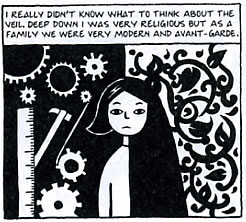
Persepolis succeeds by engaging the reader in a personal experience of revolution and cultural alienation. It works as a history lesson and as a coming of age story. Readers who try something different (maybe suspend some prejudices?) will be rewarded with an enriched perspective on a political/cultural upheaval still effecting global politics today.
Word of the Week
Gnoff
From the OED:
“Obs.
A churl, boor, lout.
c1386 CHAUCER Miller’s T. 2 A riche gnof, that gestes heeld to bord, And of his craft he was a Carpenter. 1566 DRANT Horace, Sat. I. i. Aib, The chubbyshe gnof that toyles and moyles and delueth in the downe. 1567 TURBERV. Epit., etc. 4 If Vulcan durst presume That was a Gnuffe to see..Dame Venus to assaile. 1575 A. NEVILLE De furor. Norf. 141 The cuntry gnooffes, Hob, Dick, & Hick, with clubs, and clouted shoon [so a1627 in Hayward Edw. VI, 76 (but spelt knuffes)]. 1581 J. STUDLEY Seneca’s Hercules  tæus 198 The covetous charle, the greedy gnoffe in deede..In plenty pines the wreatch. 1610 HEALEY St. Aug. Citie of God XIV. iv. 501 The Pagans wisdome and vertues were scorned of the ritch gnoffes [L. crassis diuitibus] that held shades for substances, and vertues for meere vanities.”
Famous gnoffs include:

Make It So
I promise to start writing about books again next week–but for now, I’ve got to share this: Patrick Stewart on Ricky Gervais’s Extras talking about the script he’s writing. I was literally on the floor laughing. (Caveat: My wife was neither on the floor with laughter, or laughing out loud; nor did she seem to think that I should be laughing at all, let alone on the floor).
Cookie Party
The Sarah Silverman Program debuted on Comedy Central last night and I was surprised at how much I enjoyed it. I like Silverman’s comedy, but I didn’t really think much of Jesus is Magic, her concert movie from a year or two ago–it felt stretched out, and her best bits, while still vicious and incisively stupid, felt somehow neutered and flat.
The Sarah Silverman Program is a big improvement. It’s a half-hour comedy based on the life of a fictional, orphaned Sarah Silverman, who is cared for by her younger sister. In the first episode Sarah goes nuts on cough syrup, inspiring a psychedelic spree reminiscent (and worthy of) Pee-wee’s Playhouse. In the mayhem that ensues, Sarah’s sister meets a police officer played by Jay Johnston (of Mr. Show fame); Sarah’s sis then blows off Cookie Party night to go on a date with said cop. Cookie Party was my favorite part of the show. It’s a contest show where people call in and vote for cookies. After Sarah’s sis skips their weekly standing date, Sarah gets into the cough syrup again; more mayhem.
There’s something in the tone and pacing of TSSP that’s a little bit deviant from the standard ironic tropes of satire; Sarah’s vision of a sitcom is a corroded mimesis of “hip,” “ironic” comedy–willfully stupid, infantile, scatological, zany, crushingly narcissistic, truly antisocial, coming off like an egotistical in-joke between Sarah and herself. Sarah’s songs, jokes, gestures, and non-jokes all add up to a truly bizarre, fun, and funny show.
A clip of the show (not last night’s, but all I could find on Youtube):
And here’s Sarah telling a famous joke in The Aristorcrats:
Rorschach Cow

“Rorshach Cow” by dpenguin. What do you see?
Early 2007
If you come to this blog regularly, chances are you’re killing a few minutes from what may or may not be a dreary day. So sorry if Biblioklept hasn’t been posting regularly enough to satisfy your cubicle boredom. Early 2007 has been very busy around here, what with bathroom renovations (books, even Time-Life books, will not lay new tile or replumb your corroded pipes), a new school year, and a baby on the way. Between philosophical treatises in graduate school, AP essays to grade, and the self-induced Ontology 101 reading list (“Week 4” begins…uhm…later this week?), I’ve had little time to read anything, let alone get anything decent written.
So well and hence, before January is officially over, The Biblioklept will attempt an assessment of 2007 so far. With one-twelfth of the year already gone, where do we stand?
Books: Okay, I still haven’t made it through David Foster Wallace’s Oblivion, which was published waaaaay back in 2004. Actually, in the interest of full disclosure, I’ve been attempting the same story repeatedly. My mistake is that I start reading right before I go to sleep–and then I go to sleep immediately. At this rate, I will probably finish anything published in 2007 in late 2011.
Magazines: TodayI got the February issue of The Believer. I still haven’t finished the Dec/Jan issue. A sorry state of affairs for someone who claims to love to read.
Movies: Why have you still not gone to see Children of Men? Go see it in the theater while you still have the chance. This weekend, if time permits, Pan’s Labyrinth. Has anyone seen this one yet?
Music: Lots of great stuff has dropped in 2007. Current favorites–Panda Bear’s Person Pitch, Bobby Conn’s King for a Day, Apostle of Hustle’s National Anthem of Nowhere, Menomena’s Friend or Foe. All of these are great listening and deserve more in-depth reviews, possibly at a later time. Also, Deerhoof’s Friend Opportunity dropped legal style.
TV: I must admit that I love the American Idol auditions (after the schadenfreude of watching losers have their illusions painfully revoked in front of millions, the show turns into pure drivel of course). It was also nice to see Jewel join the judges (do you remember when Jewel was like, alternative?)
Politics: My rage-fatigue has mellowed into a nice warm apathy. Does it matter that the Democrats are “in control”?
Furniture: I regret passing up an ottoman offered by my uncle.
Wine: I still advocate boxed wines, screwtops will be all the rage in 07.
Pets: As of now, our cat is still alive.
Shining
Last week we caught Children of Men at the lovely San Marco Theater. You should go see this movie posthaste. One of the best movies I’ve seen in a long, long time. Babies are special.
Before the movie, SMT ran a trailer for The Shining, their midnight movie that night. This trailer is brilliant–check it out!
Ontology 101


Word of the Week
Thaumaturge
From the OED:
“A worker of marvels or miracles; a wonder-worker.
1715 M. DAVIES Athen. Brit. I. 125 Petavius..attainted..Origen’s wonder-working Scholar Gregory the Thaumaturg, with Præarianisme. 1760 WESLEY Jrnl. 20 Dec., You throw out a hard word,..Thaumaturg. 1826 SOUTHEY Vind. Eccl. Angl. 479 The Thaumaturge..knelt before the Image to intercede for them. 1860 Sat. Rev. X. 269/2 The half-maudlin, half-cheating thaumaturg. 1881 Athenæum 12 Mar. 363/2 Pious mythologists have made out that she [St. Frideswide] was a thaumaturge of the first order.”
Famous thaumaturges (alternate orthographies: thaumaturgist, thaumaturgus) include:
— David Copperfield (the magician, not the book)
Mythologies–Roland Barthes
“Myth is a language”–Roland Barthes

Everyone should own a copy of Roland Barthes‘ Mythologies. Published over 50 years ago, the book seems more relevant than ever. Barthes wields his sense of ironic humor like a scalpel, dissecting the ideological abuse of the post-war spectacle society. In this collection of short essays, Barthes examines the ways in which societies create, use and mediate myths–particularly the way that the “elite,” monied crust of society create new myths–whole systems of myths, really–to control cultural perceptions of “reality.” Barthes uses the language and tools of linguistics in his meditations to examine the malleable space between the signifier and the signified. Barthes analyzes a range of disparate topics: amateur wrestling, plastic, advertisements for milk and wine, the face of Greta Garbo, children’s toys, and modern film’s conception of the ancient Roman haircut are all considered in relation to how these “everyday” things support the dominant cultural/economic ideology. The methods put forth in Mythologies are certainly a precursor to what we now call popular culture studies; Barthes is certainly one of the first writers I can think of to dissect mass-mediated, popular culture. And even though it was published half a century ago, Barthes’ keenly ironic style and short-essay format comes across as thoroughly contemporary.
In the final essay of the collection, “Myth Today,” Barthes warns us that the myths we uphold to protect our culture can ultimately destroy the culture. What are the contemporary myth-systems of the United States? What ideology do these myths uphold? Do these myths hold the potential to harm the culture of our great country?
Ontology 101









Ways of Seeing
In Ways of Seeing, John Berger riffs off of Walter Benjamin’s famous essay, “The Work of Art in the Age of Mechanical Reproduction,” calling into question how and why images are used and disseminated; in particular, Berger discusses capitalism, the female body, and “fine art.” The internet is clearly the next step in a series of progressions of how information is transmitted, and has been held up as a bastion of information democracy. The personal computer has revolutionized how we view, read, and create images and documents.
Look at the following images. What authority, if any, is present in each image? Who authors the picture? How do history, original context, and cultural paradigms play into how the viewer “reads” the image? What questions do these images provoke?





 Biblioklept