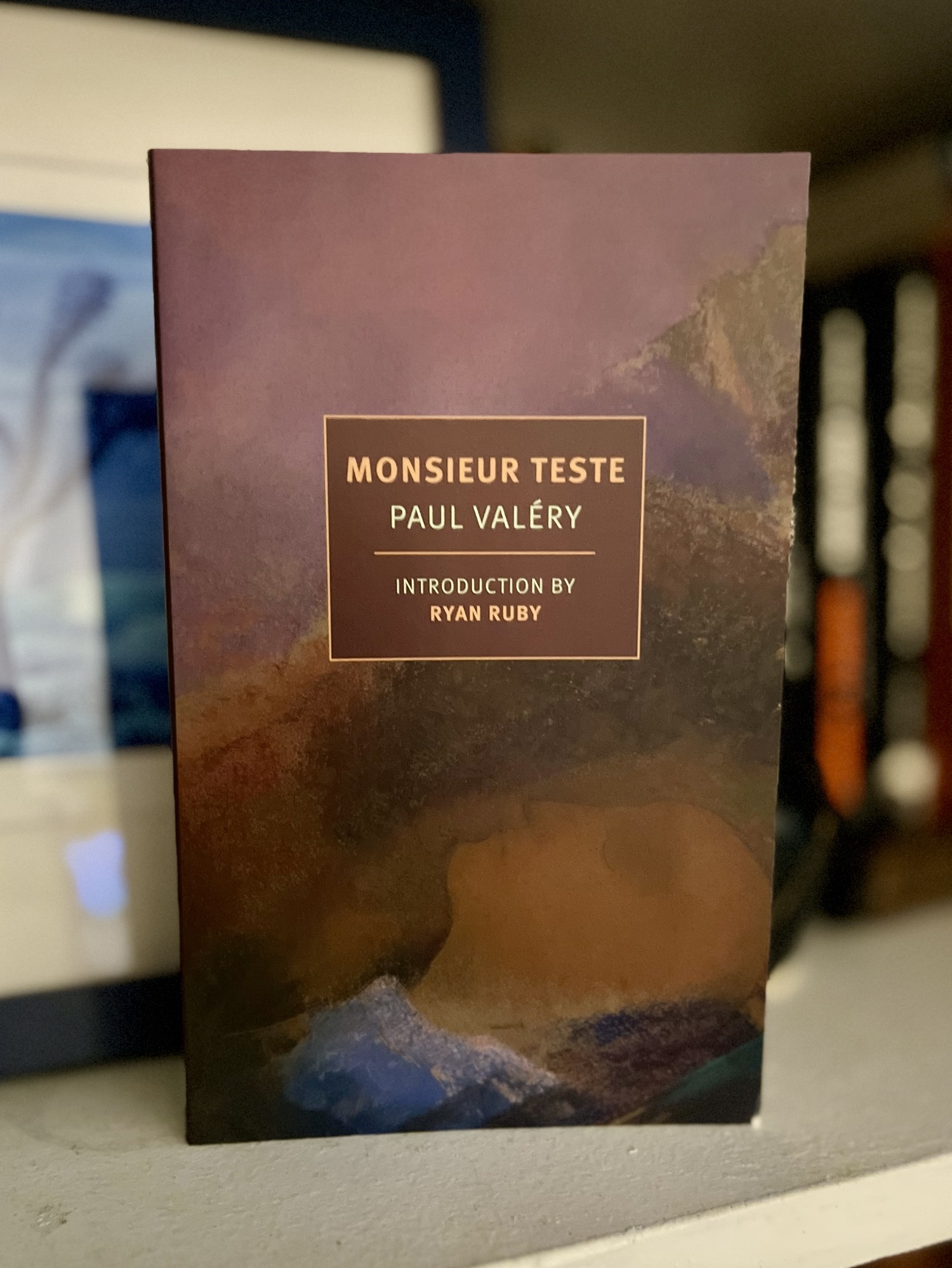
Paul Valéry’s Monsieur Teste (Book acquired, 14 Nov. 2024)

Got a review copy of Paul Valéry’s Monsieur Teste, a slim lil fellow from NYRB in translation by Charlotte Mandell. The back cover includes a blurb from William H. Gass—

Monsieur Teste is a monster, and is meant to be—an awesome, wholly individualized machine—yet in a sense he is also the sort of inhuman being Valéry aimed to become himself: a Narcissus of the best kind, a scientific observer of consciousness, a man untroubled by inroads of worldly trivia, who vacations in his head the way a Platonist finds his Florida in the realm of Forms.

What the fuck does Gass mean by “Florida” here? I really want to know.


This style of post, the book acquired post, is an established, which is to say tired, blog post format on this blog, Biblioklept, probably going back a decade now, born from a glut of review copies piling up, mostly unasked for but many asked for, books that stack up their own measures of guilt, unread, or then maybe read, months, years later—but the post style is ephemeral, yes, fluffy, sure, embarrassing even maybe. The form is stale; I apologize. I do think the Valéry book seems pretty cool.


I have a not-insubstantial stack of newly acquired new (and used books) stacked on the cherry side table by the black leather couch that I should have made book acquired posts about. These have piled up over the last few weeks. These are not interesting sentences (several of the books seem very interesting).


I am not going to find the new form I want here, am I?


When I was a freshman in high school, my then-girlfriend’s older brother gave me a mixtape that a girl had given him. He didn’t like anything on the mixtape; he liked Buddy Holly. I can’t remember why he gave me the tape—I think I saw it in his car and asked about it. But it ended up changing my life in some ways, as small giant things like songs or books or films can do when they come over you at the right time and place.

There were a few bands on the tape that I knew or had heard of, and even some I owned albums by, like the Cure and the Smiths. But for the most part, the tape opened a new aural world to me. I heard My Bloody Valentine, Big Star, Ride, the Cocteau Twins, and This Mortal Coil, among others, for the first time. There were also two songs by one band: Slowdive’s “When the Sun Hits” and “Dagger.”


(This particular blog post is no longer about acquiring a Valéry translation; it is about something else.)


Those songs are from Slowdive’s 1993 classic Souvlaki. I owned it on cassette. That cassette melted, just slightly, on the top of my 1985 Camry’s dashboard in like August of 1995. The tape was just warped enough not to fit into a cassette deck. I liked to imagine how it would sound. The next year, my lucky privileged ass found a used CD of Slowdive’s follow-up, Pygmallion on a school trip to London. Slowdive kinda sorta broke up after that.


I have always been a proponent of bands breaking up. I think a decade is long enough; get what you need done in five or six albums and move on. There are many many exceptions to this rule. But generally, I don’t think beloved bands—by which I means bands beloved by me—should keep going on too long. And if they break up, they should stay broken.


But I bought Slowdive’s 2017 reunion album Slowdive used at a St. Petersburg record store and listened to it again and again, amazed at how strong it was, how true to form. My kids liked it a lot. And then they put out a record last year, Everything Is Alive—I like that one too (not as good as the self titled one).


(There’s no point to any of this; I might’ve had some wine; I might just feel like writing.)


I guess if you’d told me back in ’95 or ’05 or even ’15 that I’d see a reunited Slowdive twice in one year I’d say that that sounded silly. (The ’15 version of me that had seen Dinosaur Jr.’s dinosaur act wouldn’t have been interested.) But we went out into the woods to see Slowdive this Sunday. They played the St. Augustine Amphitheatre to a large, strange, diverse crowd, out there in the Florida air. A band named Wisp, TikTok famous I’m told, opened, and they were pretty good. But Slowdive was perfect—better than back in May in Atlanta—echo and reverb ringing out into Anastasia State Park.


We stayed in a cheap motel off of AIA that night—another sign of my age. When I was younger, I could drive six hours, watch a band, and drive the six hours back without blinking. We are about 45 minutes from St. Augustine. It was a nice night out.


A younger version of me could’ve read the 80 pages of Paul Valéry’s Monsieur Teste in the time it took to twiddle my thumbs in this post and write a real (and likely bad) review to boot. Again, apologies. I’m getting old, a dinosaur act. But I can’t break up, not now.


Slowdive, St. Augustine Amphitheatre, 10 Nov. 2024 Slowdive, St. Augustine Amphitheatre, 10 Nov. 2024
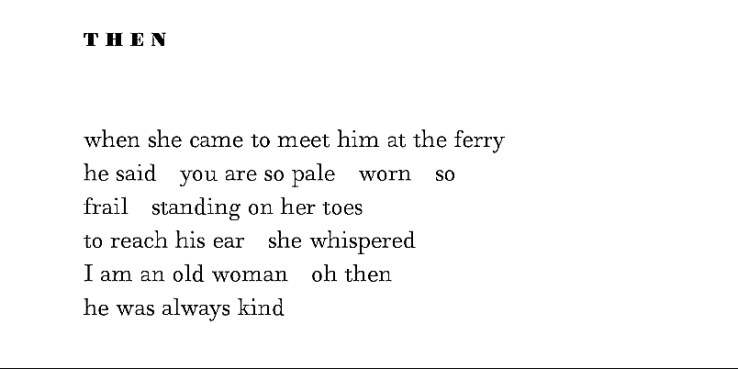
“Then” — Grace Paley

“Quickly Aging Here,” a poem by Denis Johnson

“Quickly Aging Here,” a poem by Denis Johnson—

1
nothing to drink in
the refrigerator but juice from
the pickles come back
long dead, or thin
catsup. i feel i am old
now, though surely i
am young enough? i feel that i have had
winters, too many heaped cold
and dry as reptiles into my slack skin.
i am not the kind to win
and win.
no i am not that kind, i can hear
my wife yelling, “goddamnit, quit
running over,” talking to
the stove, yelling, “i
mean it, just stop,” and i am old and
2
i wonder about everything: birds
clamber south, your car
kaputs in a blazing, dusty
nowhere, things happen, and constantly you
wish for your slight home, for
your wife’s rusted
voice slamming around the kitchen. so few
of us wonder why
we crowded, as strange,
monstrous bodies, blindly into one
another till the bed
choked, and our range
of impossible maneuvers was gone,
but isn’t it because by dissolving like so
much dust into the sheets we are crowding
south, into the kitchen, into
nowhere?

An authentically modern country (Michel Houellebecq)

At no moment in human history does growing old seem to have been a pleasure cruise; but, in the years preceding the disappearance of the species, it had manifestly become atrocious to the point where the level of voluntary deaths, prudishly renamed departures by the public-health bodies, was nearing 100 percent, and the average age of departure, estimated at sixty across the entire globe, was falling toward fifty in the most developed countries.

This figure was the result of a long evolution, scarcely begun at the time of Daniel1, when the average age at death was much higher, and suicide by old people was still infrequent. The now-ugly, deteriorated bodies of the elderly were, however, already the object of unanimous disgust, and it was undoubtedly the heat wave of summer 2003, which was particularly deadly in France, that provoked the first consciousness of the phenomenon. “The Death March of the Elderly” was the headline in Libération on the day after the first figures became known—more than ten thousand people, in the space of two weeks, had died in the country; some had died alone in their apartments, others in the hospital or in retirement homes, but all had essentially died because of a lack of care. In the weeks that followed, that same newspaper published a series of atrocious reports, illustrated with photos that were reminiscent of concentration camps, relating the agony of old people crammed into communal rooms, naked on their beds, in diapers, moaning all day without anyone coming to rehydrate them or even to give them a glass of water; describing the rounds made by nurses unable to contact the families who were on vacation, regularly gathering up the corpses to make space for new arrivals. “Scenes unworthy of a modern country,” wrote the journalist, without realizing that they were in fact the proof that France was becoming a modern country, that only an authentically modern country was capable of treating old people purely as rubbish, and that such contempt for one’s ancestors would have been inconceivable in Africa, or in a traditional Asian country.

From Michel Houellebecq’s novel The Possibility of an Island.

“How to Be Old” — May Swenson

ms

“The Tea Shop” — Ezra Pound

ezra

“Quickly Aging Here” — A Poem by Denis Johnson

“Quickly Aging Here,” a poem by Denis Johnson—

1


nothing to drink in
the refrigerator but juice from
the pickles come back
long dead, or thin
catsup. i feel i am old


now, though surely i
am young enough? i feel that i have had
winters, too many heaped cold


and dry as reptiles into my slack skin.
i am not the kind to win
and win.
no i am not that kind, i can hear


my wife yelling, “goddamnit, quit
running over,” talking to
the stove, yelling, “i
mean it, just stop,” and i am old and
2


i wonder about everything: birds
clamber south, your car
kaputs in a blazing, dusty
nowhere, things happen, and constantly you


wish for your slight home, for
your wife’s rusted
voice slamming around the kitchen. so few


of us wonder why
we crowded, as strange,
monstrous bodies, blindly into one
another till the bed


choked, and our range
of impossible maneuvers was gone,
but isn’t it because by dissolving like so
much dust into the sheets we are crowding


south, into the kitchen, into
nowhere?

“Twenty-nine Clouds” — A Passage on Aging from Malcolm Lowry’s Novel Under the Volcano

A passage about aging from Malcolm Lowry’s devastating novel Under the Volcano

Twenty-nine clouds. At twenty-nine a man was in his thirtieth year. And he was twenty-nine. And now at last, though the feeling had perhaps been growing on him all morning, he knew what it felt like, the intolerable impact of this knowledge that might have come at twenty-two, but had not, that ought at least to have come at twenty-five, but still somehow had not, this knowledge, hitherto associated only with people tottering on the brink of the grave and A. E. Housman, that one could not be young forever — that indeed, in the twinkling of an eye, one was not young any longer. For in less than four years, passing so swiftly to-day’s cigarette seemed smoked yesterday, one would be thirty-three, in seven more, forty; in forty-seven, eighty. Sixty-seven years seemed a comfortingly long time but then he would be a hundred. I am not a prodigy any longer. I have no excuse any longer to behave in this irresponsible fashion. I am not such a dashing fellow after all. On the other hand: I am a prodigy. I am young. I am a dashing fellow. Am I not? You are a liar, said the trees tossing in the garden. You are a traitor, rattled the plantain leaves. And a coward too, put in some fitful sounds of music that might have meant that in the zolaco the fair was beginning.

“I Don’t Feel Any Wiser” — Philip Roth on the Myths of Aging