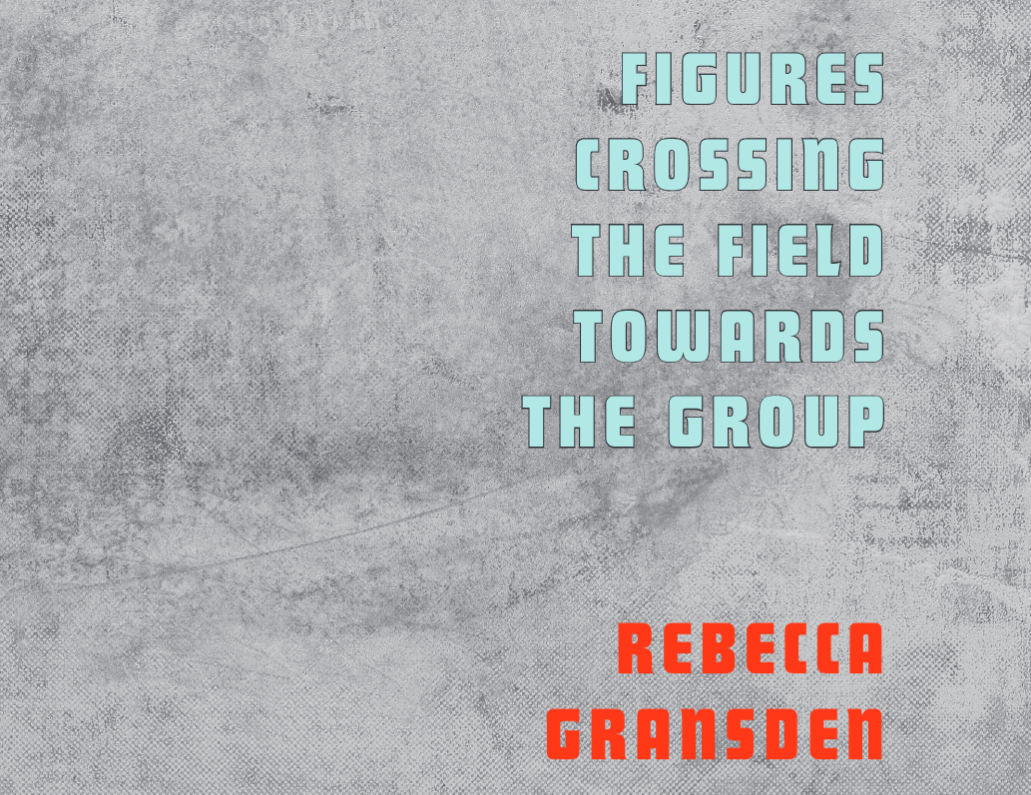
A review of Rebecca Gransden’s novella Figures Crossing the Field towards the Group

In Rebecca Gransden’s novella Figures Crossing the Field Towards the Group, an unidentified blight spreads from the south of England, driving refugees northward. Our hero, a girl named Flo, walks north through this ruined England on a quest to find her lost twin brother. In her strange journey, Flo encounters scattered figures who spill fragmented stories in broken voices. This England is barren, etiolated, and foul. Gransden conjures this apocalyptic barrenness in oblique and elliptical language. Most of the narration in Figures Crossing the Field Towards the Group slips out in clipped single-syllable beats, as if the world itself has been pared down to bone. The book’s end-times aren’t explosions or spectacle but the exhausted rhythms of a world already gone, the voice itself a survivor stumbling forward, blunt and breathless. What remains is not plot so much as the scraping of words against ruin.

And yet, within that scraped-down ruin, Gransden finds a strange fullness: stark fields and broken voices bloom with uncanny images, fleeting surges of feeling, flashes of lyric intensity that make the blasted landscape thrum with life even as it crumbles. Consider this passage, in which our hero Flo encounters a band of freed apes:

Howls eke out through branch and twig, and bods slink down the fell trunks, climb in shift shads on the broke build roof, a mess of swol leaves and wet spikes. Lab apes crawl and tick, their mugs stretch flesh, their heads bolt. Freed by the flee, and left to lone, their house fell in and they, shy and of wound nerve, did peek to the wood, and then run out and claim the trees. They stay near to where they know, fear keeps them so. One ape chomps on a bat, its legs kick as it dies. Most of the lab apes have one eye, a square patch of bald skin, a rash and some scabs.

Figures propels forward with a loose, picaresque energy, its moody, elliptical atmosphere stretched across an almost shapeless structure. It’s best not to look for causality here; things just happen. This isn’t post-apocalyptic fiction. The apocalypse is underway. And Gransden’s language drifts on the fumes of that apocalypse. I often found myself reading lines aloud, even repeatedly, in gnarly little loops: “Town rats puff with nits in their ruffs” is a simultaneously abject and beautiful image. Or consider this lovely little passage:

A shock of white moth wings sings from the shrubs, makes Flo step back and near fall. White flies round her like a snow storm, and moth dust fills the small grove. A film forms on dark leaves and the air smells of old nests. Moths brush her,just close to push a soft stroke on her face. Small round white moths, small white moth round.

The monosyllabic narrative style that dominates Figures may challenge or, more frankly, irritate some readers. I found it hypnotic. Gransden’s characters are not bound to single syllables though. When Flo talks to someone she encounters (an insane royalist, say, or a man sacrificing his body as food to tiny furry beasts), they speak in normal, multi-syllabic dialogue. More fascinating is a solitary chapter that divides the novella in halves. “Public Information Dreams” reads almost like its own Ballardian short story. Told in a clinical, detached style, the chapter gives an incomplete picture of observations made from afar on two children, Kid P and Kid Q. A taste:

Observer: 35

Day: 163

10:37:45 am — Kid Q exits property by back door (3b) and moves to end of garden. Weather is bright sunshine, occasional cloud shadows. No occlusion. Kid Q walks back and forth between end of garden and house, carrying objects. Objects observed to be recording equipment as previously noted (ID476). Kid Q collects the objects together on an empty patch of lawn behind the garden shed. The patch of lawn is square and is mostly unseen from the house. It ends at an overgrown fence, approx. 6ft tall that marks the perimeter boundary of the property’s rear. Beyond the rear fence are fields but the garden is not visible from this location due to the density of the foliage (full description and photographs of the layout of the property and garden are included in additional notes, at this time in the process of compilation). Kid Q assembles the recording equipment. Video camera on tripod is situated in the corner behind the shed and arranged to point across the lawn square diagonally, taking in as much of the space as possible.

10:52:13 am — Kid P exits house by the open back door (3b). Observed to have a listless demeanour. Kid P joins Kid Q. Kid Q and Kid P engage in long conversation (see transcript).

Are Kid Q and Kid P Flo and her brother? If you care, this book probably isn’t for you.

Too, Gransden refuses to settle Flo’s quest—or the apocalypse itself—into any final meaning. The ruined England she describes is not a backdrop but a language, one that stutters, doubles back, and opens fissures rather than closing them. Flo walks north, chasing the shadow of her brother, but whether she finds him, or whether there is anything left to find, hardly matters. What matters is the walking, the scraping of words across ruin, the pulse of strange life inside the waste. Figures Crossing the Field Towards the Group dwells in that space where endings blur into continuations, where survival is indistinguishable from loss, and where language itself flickers like the last light left to see by. Strange, gnarly, alive–great stuff.
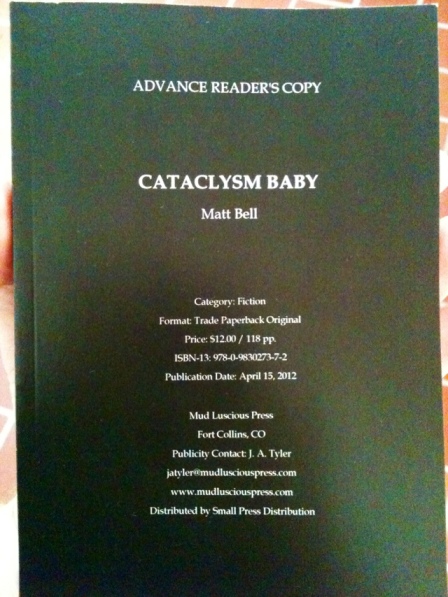
Book Acquired, 2.04.2012 — Cataclysm Baby

20120205-164712.jpg

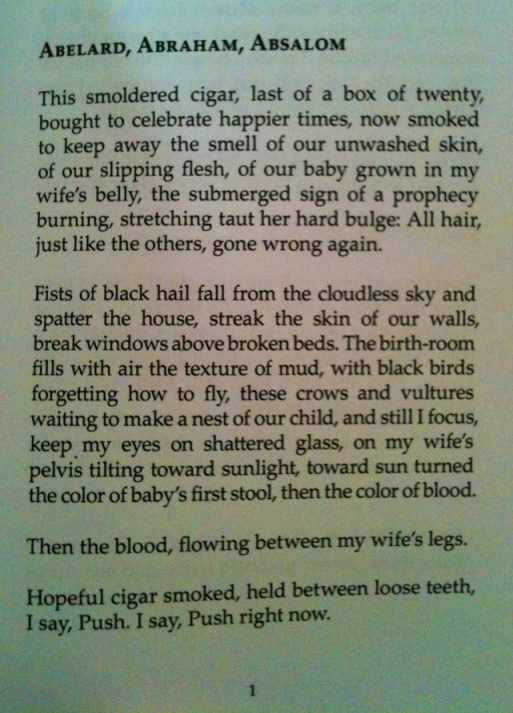
Okay, this one looks pretty cool—Cataclysm Baby by Matt Bell from indie Mud Luscious Press. More to come. Bell’s site describes the book as “twenty-six post-apocalyptic parenting stories, all narrated by fathers, each revealing some different family, some new end of the world.” First page:

20120205-164907.jpg

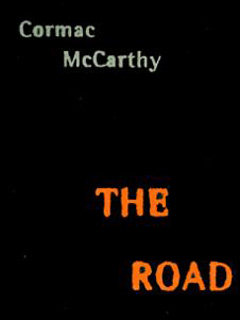
The Road–Cormac McCarthy

114930__road_l.jpg

At this point, I don’t know if it does any good to anyone for me to throw in my two cents regarding Cormac McCarthy’s latest novel The Road. This book won all sorts of awards and critical praise, topped The Believer‘s 2006 readers’ poll, and even became an Oprah’s Book Club selection. In fact, Cormac McCarthy gave his first ever television interview last month on The Oprah Winfrey Show, and I actually watched the damn thing. I was in the hospital; my daughter had just been born. Anyway, like I was saying, after the publication of The Road, everyone in the field of arts and letters and criticism seems to have simultaneously decided to confer “living master” status on Mr. McCarthy, most noting that he is an American writer. This is something we’re desperate for in American literature–masters of the art. And, if you cannot tell already, I have a somewhat cynical attitude toward this desperation, and a wary if not pessimistic approach to anything so unanimously lauded. So when my mother-in-law gave me a copy of The Road as a belated birthday gift–only a few days after the Oprah interview, in fact–I felt a mixture of intrigue and hesitation. I was reading The Children’s Hospital at the time (#3 on The Believer list, incidentally) which gave me some time and distance from the Oprah interview and some of the hype. When I finally finished The Children’s Hospital, I gave myself a little more distance, reading a few Faulkner short stories and a few magazine articles. Finally, I picked up The Road; I read about half of it in one sitting on a Friday night, finishing the rest of it over that weekend. I had to slow down in the end, because I knew that this book was a tragedy; I knew that (more) bad things were going to happen, and I loved the little boy and the man–the protagonists of the novel–and simply put, I put off reading as a way of putting off their deaths (I did the same with the end of The Children’s Hospital; also, just to get it out of the way, both novels are post-apocalyptic. Done with comparisons).

The premise of The Road will remind you of any number of other post-apocalyptic stories you’ve read or seen: the world is over and everything has gone to shit. However, McCarthy is unrelenting in his refusal to provide an explanation or even description for the epic disaster that precedes the events of the novel. Where most stories in the end-of-the-world genre delight in some sort of mythology, The Road eschews any fantastic back story. Instead, we get fragments, glimpses, the briefest hints. The overall effect of this lack of a reason is a stunning, awesome loneliness. This is an abandoned world, desolate, dead, cold, covered in ash. Nothing can live. Besides, the real story of The Road is the touching relationship between a nameless father and son. These are “the good guys” who “carry the fire”–this is the only mythology of the novel, the father’s only lessons to the son. The pair travels south, although their purpose is simply to stay alive, to not die. A large amount of the text is devoted to the simple day-to-day scavenging that is necessary to live, with occasional encounters with other living people being rare, unexpected, and ultimately meaningless. In a world where living people equal a good source of protein, no one can really help these two; all other people are threats–“the bad guys.” And as the novel progresses, the young boy begins to realize that the world is not so simple, that there may not be such a thing as “good guys” and “bad guys.”

The bond between the father and son, so beautifully expressed in McCarthy’s spartan prose, genuinely moved me. Their relationship propels a narrative absent of all but the dimmest kernel of hope; indeed, it doesn’t seem like there can be any future for these two at all in a world where nothing–no plants, no animals–can live. Which brings me to the last few pages of the book. I have a problem with this. First, I guess I should give a spoiler warning. Honestly, I believe that you can know the end of the book and not have it spoiled for you, but in the interest of etiquette: SPOILER WARNING! SPOILER WARNING! SPOILER WARNING! There. May we continue?

So yes, from the beginning of this book, it’s evident that either the father or the boy or both will die by the end of the book. And yes, the father does die, in a scene so moving that I actually cried. Unbelievably, however, McCarthy cops out in the last few pages of the book, and provides a deus ex machina in the form of a loving surrogate family to protect the boy. I mean, the new father figure comes literally out of nowhere and more or less says: “Okay, you’ll be safe now. Don’t worry readers, the kid is gonna make it!” This improbable resolution seems to contradict the 283 pages or so of the novel that preceded it. It seems far more likely in the world and vision that McCarthy crafted that the boy would be left alone to fend for himself. It’s almost as if McCarthy loved the boy too much to see him on his own, unattended to. And of course, a lot of his readers probably felt the same way–I certainly did. I really did. I wanted to see that kid make it, but at the same time the logic of the narrative does not support the ending that McCarthy wrote. Still, this really is a fantastic book–perhaps a bit overrated, but excellent nonetheless. Highly recommended.