Reading Girl — Ilya Repin

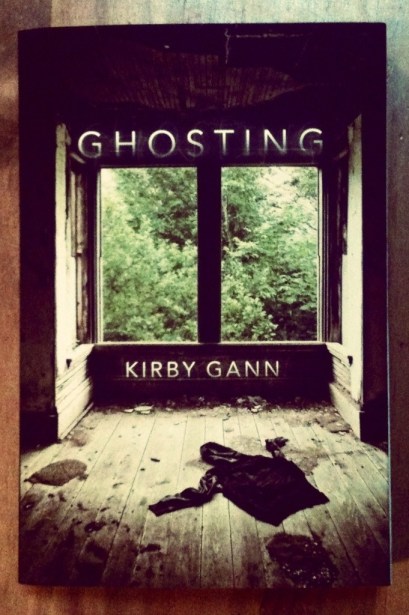
Ghosting (Book Acquired, 10.18.2012)

20121018-174628.jpg

I got a copy of Kirby Gann’s novel Ghosting a few week or so ago, and finally have had time to dip into the first three chapters this morning. Gann’s prose—and perhaps the framing of his characters—reminds me a bit of Russell Banks or Thomas McGuane—that combination of the rough and the refined, that rawness that actually comes from meticulous reworking. Sample of that prose (context not important):

The first cop to show nods at Dwayne Hardesty and stands beside him at the feet of four kids who lie spread-eagled face-down on the muddy portico steps leading to the graffiti-strewn boards that shield the seminary entrance. The wash of the cruiser’s spot frescoes their captive forms in hard outline, three underfed and thin and the fourth a fat block squeezed into a Kentucky basketball sweatshirt that strains to withstand his heavy nervous breathing, the grommets in their jeans and an occasional earring flashing agleam in the white light; four pairs of white sneakers, expensive and rain-wet, shine stark and severe and unworldly.

Ghosting is a thriller, and Gann propels the narrative forward with these cinematic images (and realistic dialogue), engaging the reader to keep turning the pages.

Here’s the jacket copy:

A dying drug kingpin enslaved to the memory of his dead wife; a young woman torn between her promising future and the hardscrabble world she grew up in; a mother willing to do anything to fuel her addiction to pills; and her youngest son, searching for an answer behind his brother’s disappearance—these are just some of the unforgettable characters that populate Ghosting, Kirby Gann’s lush and lyrical novel of family, community, and the ties that can both bond and betray.

Fleece Skaggs has disappeared along with Lawrence Gruel’s reefer harvest. Convinced that the best way to discover the fate of his older brother is to take his place as a drug runner for Greuel, James Cole plunges into a dark underworld of drugs, violence, and long hidden family secrets, where discovering what happened to his brother could cost him his life.

A genre-subverting literary thriller explored through the alternating viewpoints of different characters, Ghosting is both a simple quest for the solution to a mystery, and a complex consideration of human frailty and equivocation.
 

Italian Monk Reading — Camille Corot

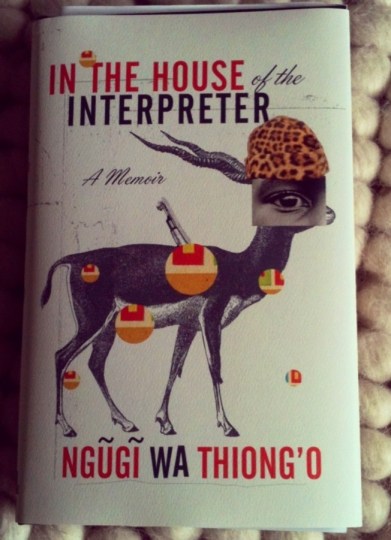
Ngugi wa Thiong’o’s Memoir — In the House of the Interpreter (Book Acquired, 10.24.2012)

20121025-161753.jpg

In the House of the Interpreter is a memoir from Ngugi wa Thiong’o. It’s new next month in hardback from Pantheon (lovely cover/design, on this one, Pantheon people. Seriously). Their blurb:

World-renowned Kenyan novelist, poet, playwright, and literary critic Ng˜ug˜ý wa Thiong’o gives us the second volume of his memoirs in the wake of his critically acclaimed Dreams in a Time of War.

In the House of the Interpreter richly and poignantly evokes the author’s life and times at boarding school—the first secondary educational institution in British-ruled Kenya—in the 1950s, against the backdrop of the tumultuous Mau Mau Uprising for independence and Kenyan sovereignty. While Ng˜ug˜ý has been enjoying scouting trips, chess tournaments, and reading about the fictional RAF pilot adventurer Biggles at the prestigious Alliance High School near Nairobi, things have been changing rapidly at home. Poised as he is between two worlds, Ng˜ug˜ý returns home for his first visit since starting school to find his house razed and the entire village moved up the road, closer to a guard checkpoint. Later, his brother Good Wallace, a member of the insurgency, is captured by the British and taken to a concentration camp. As for Ng˜ug˜ý himself, he falls victim to the forces of colonialism in the person of a police officer encountered on a bus journey, and he is thrown into jail for six days. In his second year at Alliance High School, the boarding school that was his haven in a heartless world is shattered by investigations, charges of disloyalty, and the politics of civil unrest.

In the House of the Interpreter hauntingly describes the formative experiences of a young man who would become a world-class writer and, as a political dissident, a moral compass to us all. It is a winning celebration of the implacable determination of youth and the power of hope.


The Reader — Pierre-Auguste Renoir

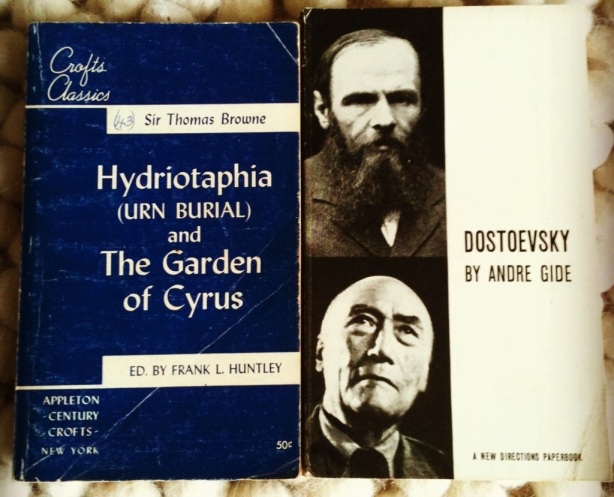
Thomas Browne’s Hydriotaphia, Gide’s Dostoevsky, David Foster Wallace’s AIDS Essay (Books Acquired, 10.25.2012)

20121025-161723.jpg

Needing more books like I need another hole in my head, I nevertheless visited my local bookshop (after an impressive three week abstinence period).

No, I haven’t read Thomas Browne’s Urn Burial yet. I’m a sucker for New Directions’ back stock, I just finished Crime & Punishment, and Gide’s book looks cool. Plus it was like a dollar.

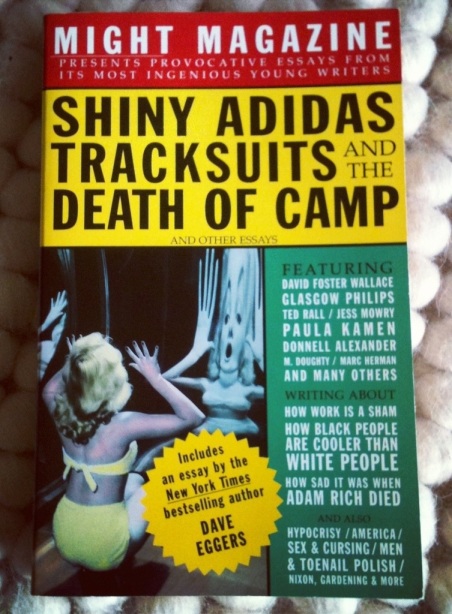
I spied the Might Magazine collection—I knew Might as Dave Eggers’s first venture. I picked it up for the (very short) David Foster Wallace essay “Hail the Returning Dragon, Clothed in New Fire”—which, incidentally, doesn’t appear to be is collected in the forthcoming collection Both Flesh and Not under the new not-as-Game of Thronesish title “Back in New Fire.” 

20121025-161730.jpg

Woman Reading a Letter — Gabriel Metsu

Poetry Reading — Milton Avery

Portrait of Madame Ginoux (L’Arlesienne) — Vincent van Gogh

A Young Girl Reading — Jean-Honore Fragonard

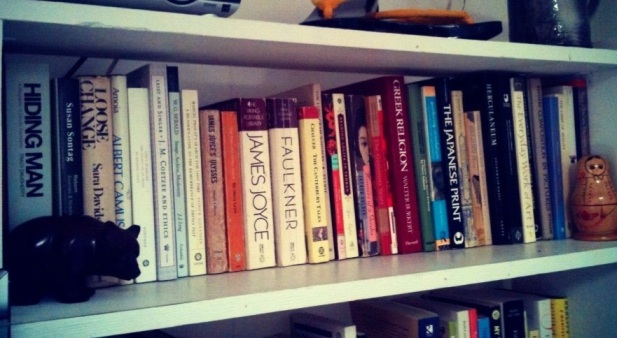
Book Shelves #43, 10.21.2012

20121021-104711.jpg

Book shelves series #43, forty-third Sunday of 2012

Kind of a hodgepodge shelf—some literary biography, a few now-redundant collections, some literary criticism, art books, etc.

Tracy Daugherty’s Donald Barthelme biography Hiding Man is on the far left; I reviewed it a few years ago, taking note of my favorite part, the so-called postmodernists’ dinner.

Next to it is Susan Sontag’s Reborn, a collection of early journals that I also reviewed.

Next to these two is Sara Davidson’s Loose Change. My aunt gave me a box of books years ago (lots of Asimov and Octavia Butler) and this was in here.

I knew about it because of a long essay in a 2007 issue of The Believer.

20121021-104718.jpg

I picked up Penguin’s The Essential James Joyce in Jimbocho, an area in Tokyo known for used bookstores.

I recall paying maybe ¥100 for it. It comprises a few selections from Ulysses and Finnegans Wake, some of  Joyce’s (totally unessential) poetry, and the entirety of Dubliners, Exiles, and Portrait. I’ve kept it because of sentiment (and  I like the cover).

20121021-104725.jpg

Reading a Book — James Tissot

Begging — Norman Rockwell

The Pensive Reader — Mary Cassatt

Adolescence — Milton Avery

Portrait of the Author Fyodor Dostoevsky — Vasily Perov

The Disciple of Las Vegas (Book Acquired, 9.27.2012)

20121009-161129.jpg

I guess these books are already big in the UK, or maybe they will be big, or something. This one’s an ARC and it doesn’t come out until early next year. Here’s the UK pub copy:

Hired by Tommy Ordonez, the richest man in the Philippines, to recover $50 million in a land swindle, Ava has her work cut out. Tommy’s brother has messed up and the Filipino billionaire’s reputation is on the line.

Tracking the money, Ava uncovers an illegal online gambling ring, and follows the trail to Las Vegas. Once there, she turns her gaze to David Douglas, one of the greatest poker players in the world – and someone who knows more about the missing money than he’s letting on.

Meanwhile, Jackie Leung, an old target of Ava’s, has made it rich. He wants revenge, and he’s going after Ava.