St. Ivo — Rogier van der Weyden

The Portinari Altarpiece, St. Mary Magdalen and St. Margaret with Maria Baroncelli and Daughter Margherita Portinari, Right Wing — Hugo van der Goes

Kindle Cover Disasters

tumblr_nmhce7z9RS1uorx89o1_1280

Kindle Cover Disasters is a tumblr devoted to Kindle cover disasters. My friend sent me the link so you must suffer too. Here are a few selections that are relatively SFW, but the site itself is not always this, uh, tame. Continue reading “Kindle Cover Disasters”

Marlene Deller — Jack Bush

Guitarra Minhota — Eduardo Viana

The Mérode Altarpiece — Robert Campin

A Dirty Pair — Eric Yahnker

2011_ADirtyPair

Pynchon in Public, 8 May 2015


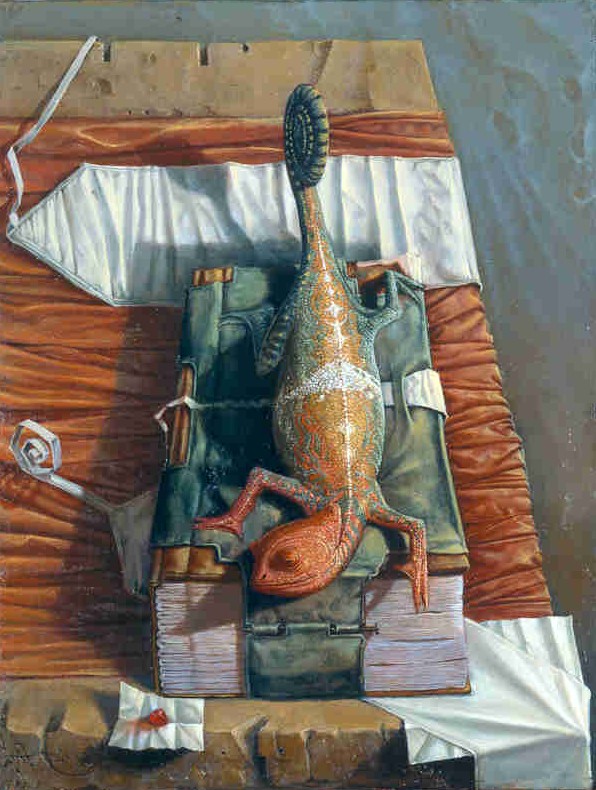
Chameleon with a Grain of Pomegranate — Agostino Arrivabene

tumblr_lxi0pf85ce1qhvnw6o1_1280

Don’t Try This at Home (Book acquired, 4.30.2015)

IMG_6010

Angela Readman’s short story collection Don’t Try This at Home is new from And Other Stories. Their blurb:

A girl repeatedly chops her boyfriend in half but, while her ‘other half’ multiplies, she is still not satisfied. Love transforms a mother working down the chippie – into Elvis! An old witch takes in a young one and, despite her best, magical powers, can’t help revealing something of the real world to her apprentice. Beautiful, sharp and fearless, these stories breathe. Do Try This at Home.

In Angela Readman’s debut collection, each story packs its share of explosive material.  In every one, quirky new strategies for surviving troubled lives are revealed, often through a transformative touch of contemporary magic.

If Angela Carter were Readman’s fairy godmother, would that make David Lynch her wicked stepbrother? Don’t say you weren’t warned!


The Great Serpent holding its own tail in its mouth (Gravity’s Rainbow)

Kekulé dreams the Great Serpent holding its own tail in its mouth, the dreaming Serpent which surrounds the World. But the meanness, the cynicism with which this dream is to be used. The Serpent that announces, “The World is a closed thing, cyclical, resonant, eternally-returning,” is to be delivered into a system whose only aim is to violate the Cycle. Taking and not giving back, demanding that “productivity” and “earnings” keep on increasing with time, the System removing from the rest of the World these vast quantities of energy to keep its own tiny desperate fraction showing a profit: and not only most of humanity—most of the World, animal, vegetable and mineral, is laid waste in the process. The System may or may not understand that it’s only buying time. And that time is an artificial resource to begin with, of no value to anyone or anything but the System, which sooner or later must crash to its death, when its addiction to energy has become more than the rest of the World can supply, dragging with it innocent souls all along the chain of life. Living inside the System is like riding across the country in a bus driven by a maniac bent on suicide… though he’s amiable enough, keeps cracking jokes back through the loudspeaker, “Good morning folks, this is Heidelberg here we’re coming into now, you know the old refrain, ‘I lost my heart in Heidelberg,’ well I have a friend who lost both his ears here! Don’t get me wrong, it’s really a nice town, the people are warm and wonderful—when they’re not dueling. Seriously though, they treat you just fine, they don’t just give you the key to the city, they give you the bung-starter!” u.s.w. On you roll, across a countryside whose light is forever changing—castles, heaps of rock, moons of different shapes and colors come and go. There are stops at odd hours of the mornings, for reasons that are not announced: you get out to stretch in lime-lit courtyards where the old men sit around the table under enormous eucalyptus trees you can smell in the night, shuffling the ancient decks oily and worn, throwing down swords and cups and trumps major in the tremor of light while behind them the bus is idling, waiting—passengers will now reclaim their seats and much as you’d like to stay, right here, learn the game, find your old age around this quiet table, it’s no use: he is waiting beside the door of the bus in his pressed uniform, Lord of the Night he is checking your tickets, your ID and travel papers, and it’s the wands of enterprise that dominate tonight… as he nods you by, you catch a glimpse of his face, his insane, committed eyes, and you remember then, for a terrible few heartbeats, that of course it will end for you all in blood, in shock, without dignity—but there is meanwhile this trip to be on… over your own seat, where there ought to be an advertising plaque, is instead a quote from Rilke: “Once, only once…” One of Their favorite slogans. No return, no salvation, no Cycle—that’s not what They, nor Their brilliant employee Kekulé, have taken the Serpent to mean. No: what the Serpent means is—how’s this—that the six carbon atoms of benzene are in fact curled around into a closed ring, just like that snake with its tail in its mouth, GET IT?

From pages 412-13 of Thomas Pynchon’s novel Gravity’s Rainbow.

Key and Hand — Tamara de Lempicka

St. Jerome in His Study — Workshop of Marinus van Reymerswaele

tumblr_lxafa5OzHE1r5569zo1_1280

“The Girls of Herland” — Charlotte Perkins Gilman

“The Girls of Herland,” below, is Chapter 8 of Charlotte Perkins Gilman’s 1915 novel Herland, a feminist utopian novel that was serialized during its author’s lifetime, but not published in one volume until 1979.  This chapter can, I believe, stand alone or serve even as an introduction even to Herland, depsite coming rather late in the text, but readers who wish more context/want the whole thing can legally download Herland via Project Gutenburg.

***

“The Girls of Herland”

by

Charlotte Perkins Gilman

At last Terry’s ambition was realized. We were invited, always courteously and with free choice on our part, to address general audiences and classes of girls.

I remember the first time—and how careful we were about our clothes, and our amateur barbering. Terry, in particular, was fussy to a degree about the cut of his beard, and so critical of our combined efforts, that we handed him the shears and told him to please himself. We began to rather prize those beards of ours; they were almost our sole distinction among those tall and sturdy women, with their cropped hair and sexless costume. Being offered a wide selection of garments, we had chosen according to our personal taste, and were surprised to find, on meeting large audiences, that we were the most highly decorated, especially Terry.

He was a very impressive figure, his strong features softened by the somewhat longer hair—though he made me trim it as closely as I knew how; and he wore his richly embroidered tunic with its broad, loose girdle with quite a Henry V air. Jeff looked more like—well, like a Huguenot Lover; and I don’t know what I looked like, only that I felt very comfortable. When I got back to our own padded armor and its starched borders I realized with acute regret how comfortable were those Herland clothes.

We scanned that audience, looking for the three bright faces we knew; but they were not to be seen. Just a multitude of girls: quiet, eager, watchful, all eyes and ears to listen and learn.

We had been urged to give, as fully as we cared to, a sort of synopsis of world history, in brief, and to answer questions. Continue reading ““The Girls of Herland” — Charlotte Perkins Gilman”

Cupid, caresses, fire and death (Three notes from Nathaniel Hawthorne’s Note-Books)

Caresses, expressions of one sort or another, are necessary to the life of the affections, as leaves are to the life of a tree. If they are wholly restrained, love will die at the roots.

Cupid in these latter times has probably laid aside his bow and arrows, and uses fire-arms,–a pistol,–perhaps a revolver.

I burned great heaps of old letters, and other papers, a little while ago, preparatory to going to England. Among them were hundreds of letters. The world has no more such, and now they are all dust and ashes. What a trustful guardian of secret matters is fire! What should we do without fire and death?

From Nathaniel Hawthorne’s American Note-Books.


Vanitas — Edward Collier

tumblr_lx8fblsvpT1r5569zo1_1280

Ballet Class, the Dance Hall — Edgar Degas