The Mérode Altarpiece — Robert Campin

A Dirty Pair — Eric Yahnker

2011_ADirtyPair

Pynchon in Public, 8 May 2015


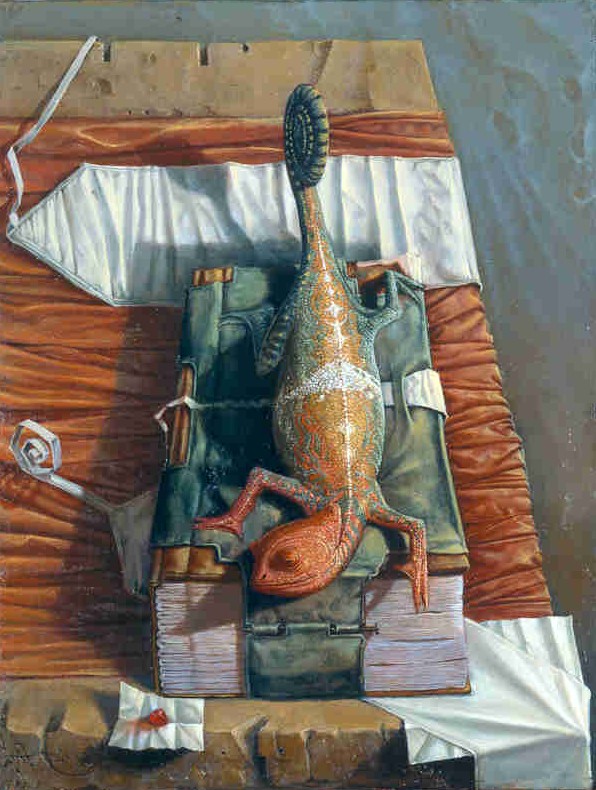
Chameleon with a Grain of Pomegranate — Agostino Arrivabene

tumblr_lxi0pf85ce1qhvnw6o1_1280

Don’t Try This at Home (Book acquired, 4.30.2015)

IMG_6010

Angela Readman’s short story collection Don’t Try This at Home is new from And Other Stories. Their blurb:

A girl repeatedly chops her boyfriend in half but, while her ‘other half’ multiplies, she is still not satisfied. Love transforms a mother working down the chippie – into Elvis! An old witch takes in a young one and, despite her best, magical powers, can’t help revealing something of the real world to her apprentice. Beautiful, sharp and fearless, these stories breathe. Do Try This at Home.

In Angela Readman’s debut collection, each story packs its share of explosive material.  In every one, quirky new strategies for surviving troubled lives are revealed, often through a transformative touch of contemporary magic.

If Angela Carter were Readman’s fairy godmother, would that make David Lynch her wicked stepbrother? Don’t say you weren’t warned!


The Great Serpent holding its own tail in its mouth (Gravity’s Rainbow)

Kekulé dreams the Great Serpent holding its own tail in its mouth, the dreaming Serpent which surrounds the World. But the meanness, the cynicism with which this dream is to be used. The Serpent that announces, “The World is a closed thing, cyclical, resonant, eternally-returning,” is to be delivered into a system whose only aim is to violate the Cycle. Taking and not giving back, demanding that “productivity” and “earnings” keep on increasing with time, the System removing from the rest of the World these vast quantities of energy to keep its own tiny desperate fraction showing a profit: and not only most of humanity—most of the World, animal, vegetable and mineral, is laid waste in the process. The System may or may not understand that it’s only buying time. And that time is an artificial resource to begin with, of no value to anyone or anything but the System, which sooner or later must crash to its death, when its addiction to energy has become more than the rest of the World can supply, dragging with it innocent souls all along the chain of life. Living inside the System is like riding across the country in a bus driven by a maniac bent on suicide… though he’s amiable enough, keeps cracking jokes back through the loudspeaker, “Good morning folks, this is Heidelberg here we’re coming into now, you know the old refrain, ‘I lost my heart in Heidelberg,’ well I have a friend who lost both his ears here! Don’t get me wrong, it’s really a nice town, the people are warm and wonderful—when they’re not dueling. Seriously though, they treat you just fine, they don’t just give you the key to the city, they give you the bung-starter!” u.s.w. On you roll, across a countryside whose light is forever changing—castles, heaps of rock, moons of different shapes and colors come and go. There are stops at odd hours of the mornings, for reasons that are not announced: you get out to stretch in lime-lit courtyards where the old men sit around the table under enormous eucalyptus trees you can smell in the night, shuffling the ancient decks oily and worn, throwing down swords and cups and trumps major in the tremor of light while behind them the bus is idling, waiting—passengers will now reclaim their seats and much as you’d like to stay, right here, learn the game, find your old age around this quiet table, it’s no use: he is waiting beside the door of the bus in his pressed uniform, Lord of the Night he is checking your tickets, your ID and travel papers, and it’s the wands of enterprise that dominate tonight… as he nods you by, you catch a glimpse of his face, his insane, committed eyes, and you remember then, for a terrible few heartbeats, that of course it will end for you all in blood, in shock, without dignity—but there is meanwhile this trip to be on… over your own seat, where there ought to be an advertising plaque, is instead a quote from Rilke: “Once, only once…” One of Their favorite slogans. No return, no salvation, no Cycle—that’s not what They, nor Their brilliant employee Kekulé, have taken the Serpent to mean. No: what the Serpent means is—how’s this—that the six carbon atoms of benzene are in fact curled around into a closed ring, just like that snake with its tail in its mouth, GET IT?

From pages 412-13 of Thomas Pynchon’s novel Gravity’s Rainbow.

Key and Hand — Tamara de Lempicka

St. Jerome in His Study — Workshop of Marinus van Reymerswaele

tumblr_lxafa5OzHE1r5569zo1_1280

“The Girls of Herland” — Charlotte Perkins Gilman

“The Girls of Herland,” below, is Chapter 8 of Charlotte Perkins Gilman’s 1915 novel Herland, a feminist utopian novel that was serialized during its author’s lifetime, but not published in one volume until 1979.  This chapter can, I believe, stand alone or serve even as an introduction even to Herland, depsite coming rather late in the text, but readers who wish more context/want the whole thing can legally download Herland via Project Gutenburg.

***

“The Girls of Herland”

by

Charlotte Perkins Gilman

At last Terry’s ambition was realized. We were invited, always courteously and with free choice on our part, to address general audiences and classes of girls.

I remember the first time—and how careful we were about our clothes, and our amateur barbering. Terry, in particular, was fussy to a degree about the cut of his beard, and so critical of our combined efforts, that we handed him the shears and told him to please himself. We began to rather prize those beards of ours; they were almost our sole distinction among those tall and sturdy women, with their cropped hair and sexless costume. Being offered a wide selection of garments, we had chosen according to our personal taste, and were surprised to find, on meeting large audiences, that we were the most highly decorated, especially Terry.

He was a very impressive figure, his strong features softened by the somewhat longer hair—though he made me trim it as closely as I knew how; and he wore his richly embroidered tunic with its broad, loose girdle with quite a Henry V air. Jeff looked more like—well, like a Huguenot Lover; and I don’t know what I looked like, only that I felt very comfortable. When I got back to our own padded armor and its starched borders I realized with acute regret how comfortable were those Herland clothes.

We scanned that audience, looking for the three bright faces we knew; but they were not to be seen. Just a multitude of girls: quiet, eager, watchful, all eyes and ears to listen and learn.

We had been urged to give, as fully as we cared to, a sort of synopsis of world history, in brief, and to answer questions. Continue reading ““The Girls of Herland” — Charlotte Perkins Gilman” →

Cupid, caresses, fire and death (Three notes from Nathaniel Hawthorne’s Note-Books)

Caresses, expressions of one sort or another, are necessary to the life of the affections, as leaves are to the life of a tree. If they are wholly restrained, love will die at the roots.

Cupid in these latter times has probably laid aside his bow and arrows, and uses fire-arms,–a pistol,–perhaps a revolver.

I burned great heaps of old letters, and other papers, a little while ago, preparatory to going to England. Among them were hundreds of letters. The world has no more such, and now they are all dust and ashes. What a trustful guardian of secret matters is fire! What should we do without fire and death?

From Nathaniel Hawthorne’s American Note-Books.


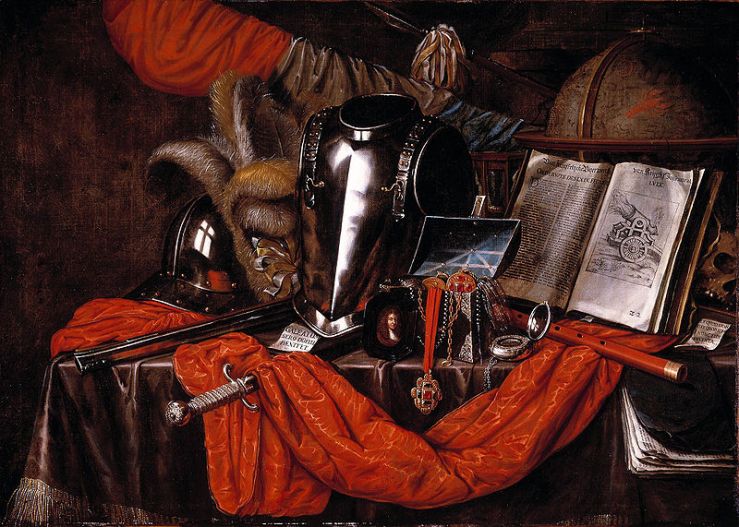
Vanitas — Edward Collier

tumblr_lx8fblsvpT1r5569zo1_1280

Ballet Class, the Dance Hall — Edgar Degas

A first riff on rereading Gravity’s Rainbow (and some thoughts on Weisenburger’s Companion)

I enjoy rereading more than reading. Returning to Moby-Dick, 2666, Ulysses, or Blood Meridian reveals so much more: More depth, more art, more structure, more precision, more humor, more pain, more more.

Thomas Pynchon’s novel Gravity’s Rainbow is all more. Rereading Gravity’s Rainbow is like reading it for the first time, or, rather, more precisely, that is how I am experiencing it now—with clarity—compelled as I was to immediately circle back through its loop again.

Gravity’s Rainbow’s cohesion hides (hides is not the right verb) under detritus, in the flux of objects and concepts that tangle and unravel throughout the text. Indeed, the novel’s themes seem to repeat (with difference, with opposition) in the lists and rants that lard it.

A simple, early example comes on page 18, where Teddy Bloat turns spying eyes over our hero Tyrone Slothrop’s desk, where “Things have fallen roughly into layers, over a base of bureaucratic smegma that sifts steadily to the bottom…” In A Gravity’s Rainbow Companion: Sources and Contexts for Pynchon’s Novel, Steven Weisenburger points out that “Among the list of objects on Slothrop’s desk are items, allusions, and brand names left in his wake throughout the novel.” Weisenburger proceeds to sift through these layers, pointing out connections, and offering (as always) helpful page numbers which attest how damn precise Pynchon’s novel is.

I picked up Weisenburger’s Companion on solicited recommendations from Twitter folk and readers of this blog, and I’ve found it unobtrusive and helpful so far. Weisenburger’s introductory essay is especially good, and foregrounds his intertextual approach to his Companion (he all but namechecks Mikhail Bakhtin: “Gravity’s Rainbow sets in motion ‘the Night’s Mad Carnvival’ (V133.38) of intertextual entertainments”; a few lines later, he describes the novel as a work of “encyclopedic heteroglossia”). Weisenburger also quickly helped to (re)confirm my sense that GR loops back into itself, its end cycling back to its beginning: “Gravity’s Rainbow is ‘heterocyclic’ (V249.26): rings are looped together in still larger, polymerized rings, looped together in the still larger cycling of its four parts.”

I’m about halfway through the second of those four parts, “Un Perm’ au Casino Hermann Goering,” but still playing catch-up with the Weisenburger. I sometimes skim—sometimes with undue pride (Hey I got that reference on my own, thanks anyway Dr. W), and sometimes, admittedly with a vague but cheerful boredom (Weisenburger has an occasional tendency to lay out Pynchon’s source texts in detailed detail).

The Companion is at its finest, in my estimation, when Weisenburger extrapolates from his sources and contexts into GR’s deepest themes, like here, where our introduction to Gottfried (a seemingly minor character) branches into etymology, mythology, and comparative religion:

image

(My favorite moment here is probably where Dr. W poses that question about Pynchon knowing Branston and Grimm, and then immediately answers it (in what I like to pretend is Robert Evans’s voice)).

While Weisenburger’s Companion often enlightens and clarifies, so does simply (or not so simply) rereading Gravity’s Rainbow enlighten and clarify the first reading. I’m thankful that I didn’t use Weisenburger’s book on my first full trip though GR. Sure, Companion hazards a number of plot spoilers, which I imagine would annoy many readers. But more significant to me is that using Weisenburger’s annotations as a first-timer’s guide through Pynchon’s detritus would have likely spoiled the aesthetic effect of that detritus. It would likely have spoiled some of the richness in the rereading that I’m enjoying so very much now.

Cool color signature covers

book-The-Road

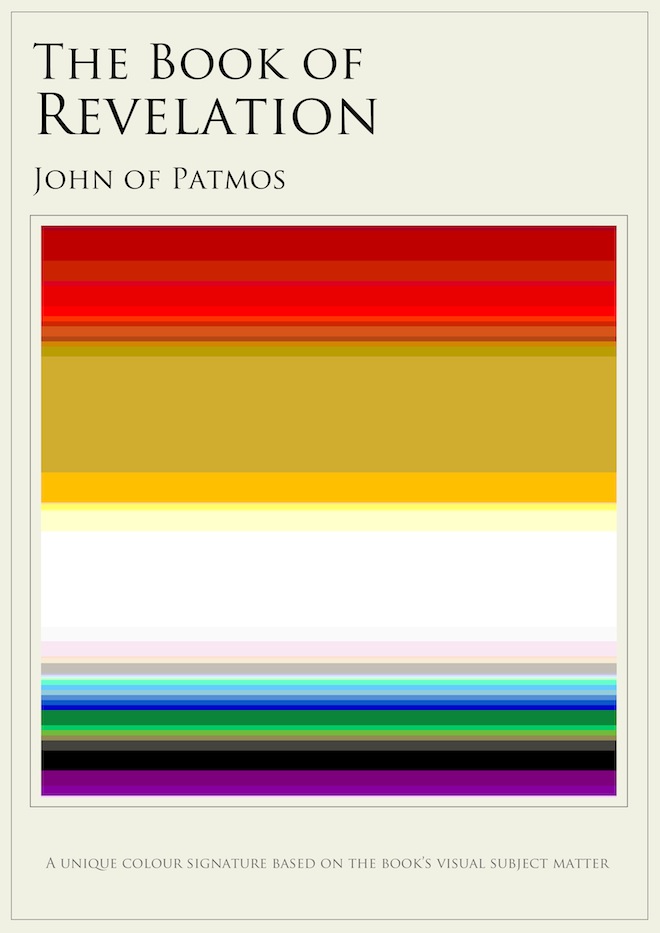
Cool article from Wired (yeah it’s a few years old now but hey) about artist Jaz Parkinson, who indexed the references to colors in various novels and created visual signatures of them. From the article

 Jaz Parkinson, an art student from England, was curious about how the written imagery in the work would translate into color, so she decided to chart the color signatures of some of her favorite books.

Using the color-related data pulled from novels, Parkinson visualized how famous books would look if you could only read them through a visual signature. “I think the charts are beautiful and informative, which is a very special mix of the subjective and the objective,” she says. “They reveal a new dataset which hasn’t been associated with the book before.”
book-The-Little-Prince book-Revelation

No Way Jose — Alan Macdonald

p_nowayjose

Riff on the end/beginning of Gravity’s Rainbow

Well: “A screaming comes across the sky. It has happened before [—]”

□ □ □ □ □ □ □

So. Okay. So I finished Gravity’s Rainbow on Friday night, and reread the opening section (and more than the opening section) on Saturday morning, resisting a compulsion to immediately return to the beginning.

□ □ □ □ □ □ □

So: Okay: Right?

The ending of Gravity’s Rainbow cycles back to the beginning (like Finnegans Wake): Blicero’s rocket, screaming across the sky—yes? no?—to invade the dreams (?) of psychic Pirate Prentice? The book: a loop, a Möbius strip, a film, its reels discombobulated, jostled, scattered…

□ □ □ □ □ □ □

“…it’s all theatre,” we learn on the book’s first page (page 3); the book ends in a theater—the Orpheus Theater!—where maybe scattered Slothrop is the leading man, scattered, we find ourselves in him, parts of him—where the audience demands, on the book’s last page: “Start-the-show!”

□ □ □ □ □ □ □

“You’re putting response before stimulus,” Spectro shakes his head at Pointsman, early in “Beyond the Zero,” the first section of Gravity’s Rainbow—does this describe the beginning/end of the novel? (“It has happened before”).

□ □ □ □ □ □ □

Or, a bit earlier even, at the seance, (page 32), Gloaming describes one kind of plot: “…we should get something like a straight line” — but then gives us another kind of plot — “…however we’ve data that suggest the curves for certain —conditions, well they’re actually quite different—schizophrenics for example tend to run a bit flatter in the upper part then progressively steeper—a sort of bow shape … classical paranoiac—” Is this the shape of Gravity’s Rainbow?

□ □ □ □ □ □ □

—but right this moment it’s that final dash that intrigues me—this in a novel full of dashes, this in a novel that name-checks Emily Dickinson, Eternal Empress of Dashes—the fragmented conclusion is full of dashes, lines obliterated by more perfect, straight lines, simultaneously connecting and disconnecting—like the novel’s final line:

“Now everybody—“

□ □ □ □ □ □ □ Continue reading “Riff on the end/beginning of Gravity’s Rainbow” →

The Blessed Guillaume de Toulouse Tormented by Demons — Ambroise Frédeau

tumblr_ltprof64JM1r1dpd5o1_1280