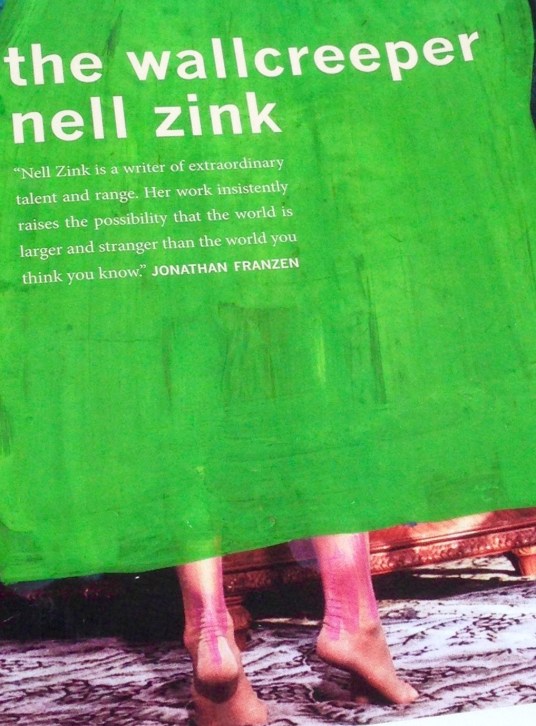
A review of Nell Zink’s extraordinary novel The Wallcreeper

image

The short review is, “Nell Zink’s début novel The Wallcreeper is extraordinary.”

But this argument is insufficient, unsupported, you, dear reader, may protest. Why should you spend your hard-earned time reading The Wallcreeper, eh? (I read the book in four sittings. I was late to Sunday dinner for finishing the thing). To invert one of the better book short book reviews I’ve ever read: Every sentence made me want to read the next sentence. Is that not a good enough reason to read The Wallcreeper? Maybe you want to read some of those sentences. Here’s the first one:

I was looking at the map when Stephen swerved, hit the rock, and occasioned the miscarriage.

Or a page or two later when our heroine/narrator Tiffany describes how she met Stephen:

Our first meeting prevented a crime. He saw me standing in front of the open gate of the vault.

(Don’t worry about that crime). Oh, and, on that first meeting with Stephen:

It was one of those moments where you think: We will definitely fuck. It might take a while, though, because Stephen looked as respectable as I did.

And here’s a simile from Tiffany, just because I love the line and can wedge it in here:

After the cranes had landed, the geese passed overhead in so many Vs that they merged into Xs and covered the entire sky like a fishnet stocking.

It occurs to me now that I’m probably doing this wrong, right? I should be summarizing the book a bit, no? I’m not particularly interested in that—the plot is the sentences—I mean, yeah, there’s a plot, about Tiffany and Stephen in Berne and later Berlin—and some other places too—and the different lovers they take and the various projects they undertake—music, language acquisition, ecoterrorism—and lots of birdwatching.

Maybe I should lazily just reblurb Keith Gessen’s blurb:

Who is Nell Zink? She claims to be an expatriate living in northeast Germany. Maybe she is; maybe she isn’t. I don’t know. I do know that this first novel arrives with a voice that is fully formed: mature, hilarious, terrifyingly intelligent, and wicked. The novel is about a bird-loving American couple that moves to Europe and becomes, basically, eco-terrorists. This is strange, and interesting, but in between is some writing about marriage, love, fidelity, Europe, and saving the earth that is as funny and as grown-up as anything I’ve read in years. And there are some jokes in here that a young Don DeLillo would kill to have written. I hope he doesn’t kill Nell Zink

The DeLillo comparison is apt, but Zink’s novel is funnier than anything DeLillo’s done in ages. Maybe that’s not fair. “Funny” seems like a weak word, really, for Zink and her narrator Tiffany (and Stephen)—all the words I would use to describe what Zink’s doing here seem pale and imprecise. I mean witty, smart, intelligent, devastating, confounding. Extraordinary, right, that was the word I used above, yes? (He looks the word up in an online dictionary, somehow at 36 and a lifelong native English speaker unsure what it actually means). A placeholder like strange would work, except some of y’all take that word as a pejorative. Eccentric or quirky imply, I think, a rhetorical imprecision wholly absent from the novel. The Wallcreeper is a precise book. The book is very good. It is an interesting book. (What awful sentences those were! But true).

Can you know a book through the words the reviewer uses to describe it though? (No). Can you really know a character through the words she launches your way, anyway? In The Wallcreeper, Tiffany doesn’t really know herself, or Stephen, and the narrative is in some ways her kinda sorta finding out about herself (and Stephen, and other stuff), in a non-urgent manner. Or maybe very urgent, I don’t know—she and Stephen are in a constant state of crisis, sort of, or epiphany-making—

Our marriage had begun in the most daunting way imaginable. We had barely known each other, and then we had those accidents and that jarring disconnect between causes (empty-headed young people liking each other, wallcreepers) and effects (pain, death).

A wallcreeper is a small bird with crimson wings, by the way.

The titular wallcreeper, also by the way, is the thing that makes Stephen swerve in that opening sentence I shared for you above. The book is full of swerves, dips, dives, turns—each sentence swerves into the next, artfully, gracefully, precisely. Tiffany’s consciousness, or the language that Zink uses to represent Tiffany’s consciousness, swerves:

We walked down into the lower garden and sat on a bench. He looked into the pond and remarked favorably on the lack of goldfish. I thought of all the spawn-guzzling carp I had admired in the past and felt abashed. I shrank at the vulgarity of raptures over beauty, nature’s most irrelevant and unnecessary quality.

Beautiful!

But where was I? I think swerves was the metaphor I was batting about a bit—well, I suppose I could go on, suggest that all that swerving swerves up to Something More, that the novel swerves (swells? no, not swells) to an ending shot-through with mythical undertones (which our narrator punctures)—I mean to say that, yes, okay, the novel is a wonderful witty aesthetic read—each sentence made me want to read the next sentence—but readers who require More Than That will also get it. Or maybe not. The Wallcreeper, like all extraordinary novels, is Not For Everyone. The Wallcreeper was/is for me though, and I hope it will also be for you too.

The Wallcreeper is available directly from publisher The Dorothy Project and finer bookshops.
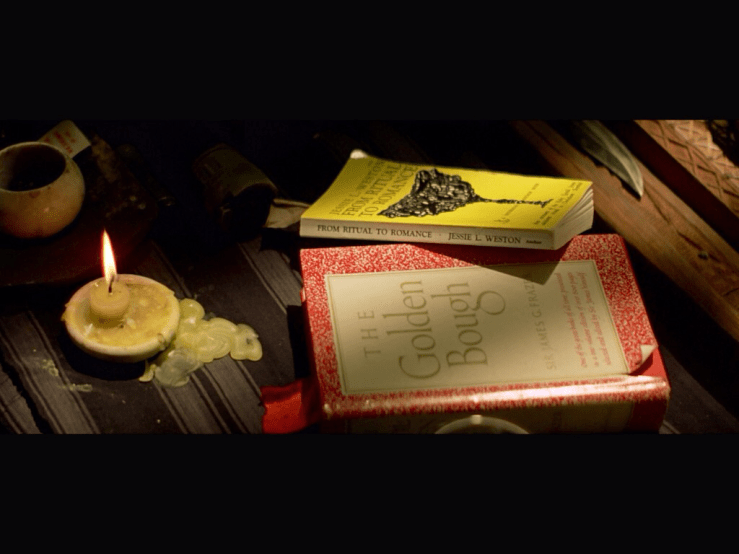
Colonel Walter E. Kurtz’s bedside reading

IMG_0280

From Apocalypse Now (1979); dir. Francis Ford Coppola with cinematography by Vittorio Storaro.

Daphne Spencer — Stanley Spencer

Reading/Have Read/Should Write About

IMG_7603

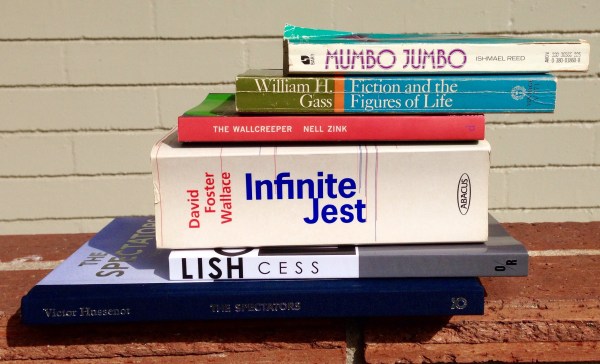
From top to bottom:

Mumbo Jumbo, Ishmael Reed

Last summer, I read Alasdair Gray’s novel Lanark and never mustered a review (Florida heat; Fourth of July fireworks; booze; other excuses). I’ve thought about Lanark all the time though. I’m afraid Mumbo Jumbo is gonna fall in the same slot as Lanark—too much to handle in one read. I need to go back and reread Mumbo Jumbo—just fantastic stuff—conspiracy theories, hoodoo, music, art theft—I owe it more than I seem to be able to register here.

Fiction and the Figures of Life, William H. Gass

So I read a handful of essays in Gass’s earliest essay collection interspersed with Infinite Jest, and I actually did write a bit about one of them here, in conjunction with IJ. Perfect sentences. (Gass’s sentences. Not mine). I wisely shelved the thing (Gass’s “review” of a Donald Barthelme collection almost paralyzed me), leaving more pieces to return to later.

The Wallcreeper, Nell Zink

I started Zink’s first novel The Wallcreeper this afternoon and only put it down when I had to go pick my kids up from day camp. Then I picked it up again. I just put it down again, at a break, of sorts, on page 77, to write this. Every sentence makes me want to read the next sentence (“I felt almost nostalgic toward socially acceptable horrors with larger meanings related to reproduction,” our narrator quips; a bit later: “My life was like falling off a log comfortably located somewhere light-years above the earth”). It’s about this young married couple living in Bern, Switzerland—also sex, birdwatching, music, etc. I was kinda worried that any novel I picked up after Infinite Jest (see below) might suffer, but nah. The Wallcreeper is fantastic so far.

Infinite Jest, David Foster Wallace

Okay, so I mustered a few riffs on rereading Infinite Jest, including a thing about the first 299 pages and a thing for first-time readers—but I finished the novel yesterday, and this is how I felt:

Twitter was the easiest way to try to bottle the feeling of finishing the novel, which is a feeling that I wanted to bottle because I didn’t record the feeling of finishing IJ the first time, back in 2001. But I remember finishing it, very, very late at night/early in the morning, and going back through it, rereading that first chapter, trying to figure out What Happened. So what I mean is I felt enthusiasm and energy—it was the opposite of the reread, which was deflationary, I suppose—richer and sadder. And I hate to write this, but it’s impossible not to reread Infinite Jest through the lens of Wallace’s suicide. Just too many suicides in the novel…and then this late passage, from Hal’s narration (elisions and emphasis mine):

…the old specimen’s horrified face as the boy sobs into the chartreuse satin and shrieks ‘Murderer! Murderer!’ over and over, so that almost a third of Accomplice!’s total length is devoted to the racked repetition of this word — way, way longer than is needed for the audience to absorb the twist and all its possible implications and meanings. This was just the sort of issue Mario and I argued about. As I see it, even though the cartridge’s end has both characters emoting out of every pore, Accomplice!’sessential project remains abstract and self-reflexive; we end up feeling and thinking not about the characters but about the cartridge itself. By the time the final repetitive image darkens to a silhouette and the credits roll against it and the old man’s face stops spasming in horror and the boy shuts up, the cartridge’s real tension becomes the question: Did Himself subject us to 500 seconds of the repeated cry ‘Murderer!’ for some reason, i.e. is the puzzlement and then boredom and then impatience and then excruciation and then near-rage aroused in the film’s audience by the static repetitive final 1⁄3 of the film aroused for some theoretical-aesthetic end, or is Himself simply an amazingly shitty editor of his own stuff?

It was only after Himself’s death that critics and theorists started to treat this question as potentially important. A woman at U. Cal–Irvine had earned tenure with an essay arguing that the reason-versus-no-reason debate about what was unentertaining in Himself’s work illuminated the central conundra of millennial après-garde film, most of which, in the teleputer age of home-only entertainment, involved the question why so much aesthetically ambitious film was so boring and why so much shitty reductive commercial entertainment was so much fun. The essay was turgid to the point of being unreadable, besides using reference as a verb and pluralizing conundrum as conundra.

From my horizontal position on the bedroom floor…

There’s hero Hal horizontal, psychic parallel to Don Gately, the hero of stasis, to borrow Hal’s own term…

I’ll try to muster more.

Cess, Gordon Lish

AKA Gordon Lish does whatever the fuck he wants. I read this in one alarmed sitting, and I’m not sure if I read it “correctly,” whatever that means.

The Spectators,Victor Hussenot

Another beautiful book from Nobrow—not a graphic novel, but something closer to a colorful illustrated tone poem, a meditation, a feeling. Excellent review at Loser City, which I made the mistake of reading before I composed my own.

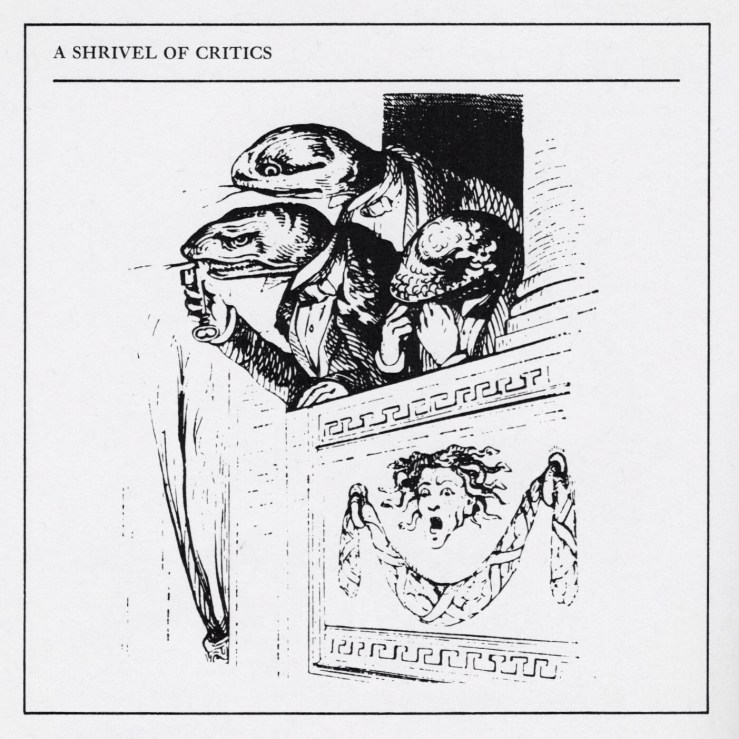
A Shrivel of Critics

IMG_7593

From James Lipton’s An Exaltation of Larks.

A brief note to readers new to Infinite Jest (and a very incomplete list of motifs in the novel)

David Foster Wallace’s 1996 novel Infinite Jest poses rhetorical, formal, and verbal challenges that will confound many readers new to the text. The abundance of (or excess of) guides and commentaries on the novel can perhaps have the adverse and unintentional consequence of making readers new to Infinite Jest believe that they can’t “get it” without help.  Much of the online analyses and resources for Infinite Jest are created by and targeted to readers who have finished or are rereading the novel. While I’ve read many insightful and enlightening commentaries on the novel over the years (and, in particular, over the past six weeks rereading IJ), my intuition remains that the superabundance of analysis may have the paradoxical effect of actually impeding readers new to the text. With this in mind, I’d suggest that first-time readers need only a dictionary and some patience.

(Still: Two online resources that might be useful are “Several More and Less Helpful Things for the Person Reading Infinite Jest,” which offers a glossary and a few other unobtrusive documents, and “Infinite Jest: A Scene-by-Scene Guide,”which is not a guide at all, but rather a brief series of synopses of each scene in the novel, organized by page number and year; my sense is that this guide would be helpful to readers attempting to delineate the novel’s nonlinear chronology—however, I’d advise against peeking ahead).

The big advantage (and pleasure) of rereading Infinite Jest is that the rereader may come to understand the plot anew; IJ is richer and denser the second go around, its themes showing brighter as its formal construction clarifies. The rereader is free to attend to the imagery and motifs of the novel more intensely than a first-time reader, who must suss out a byzantine plot propelled by a plethora of characters. Readers new to IJ may find it helpful to attend from the outset to some of the novel’s repeated images, words, and phrases. Tracking motifs will help to clarify not only the novel’s themes and “messages,” but also its plot. I’ve listed just a few of these motifs below, leaving out the obvious ones like entertainment, drugs, tennis (and, more generally, sports and games), and death. The list is in no way definitive or analytic, nor do I present it as an expert; rather, it’s my hope that this short list might help a reader or two get more out of a first reading.


Heads

Cages

Faces

Maps

Masks

Cycles

Teeth

Waste

Infants

Pain

Deformities

Subjects

Objects

Continue reading “A brief note to readers new to Infinite Jest (and a very incomplete list of motifs in the novel)” →

O Terceiro Polícia — Flann O’Brien

FlannLisbon

From Bertrand Bookstore in Lisbon, the longest continuously operating bookstore in the world (it opened in 1732).

Interior with Girl Reading — Peter Ilsted

c4422_1

Odalisque — Georgy Kurasov

Georgy Kurasov Odalesque 32 x 40

Ishmael Reed/Nell Zink (Books acquired, 6.24.2015)

image

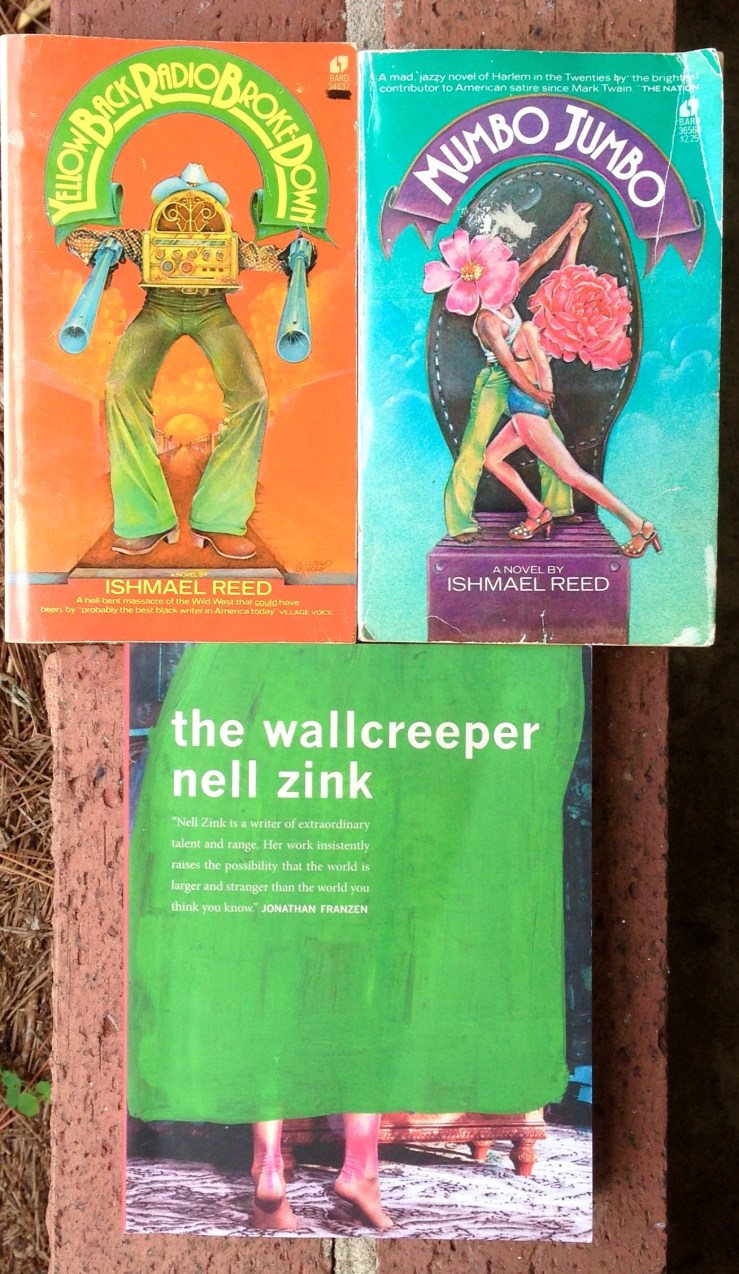
Went to my favorite bookstore today to get a copy of The Borrowers for my daughter and to replace a copy of Ishmael Reed’s Mumbo Jumbo, which I bought last month, read, and then gave away to a friend. I still aim to write something about it on the blog (hence replacing it), but short term: The book is extraordinary—metatextual, intratextual, very, very funny, filled with erudite citations and scathing humor. I can’t believe I hadn’t read it until now.

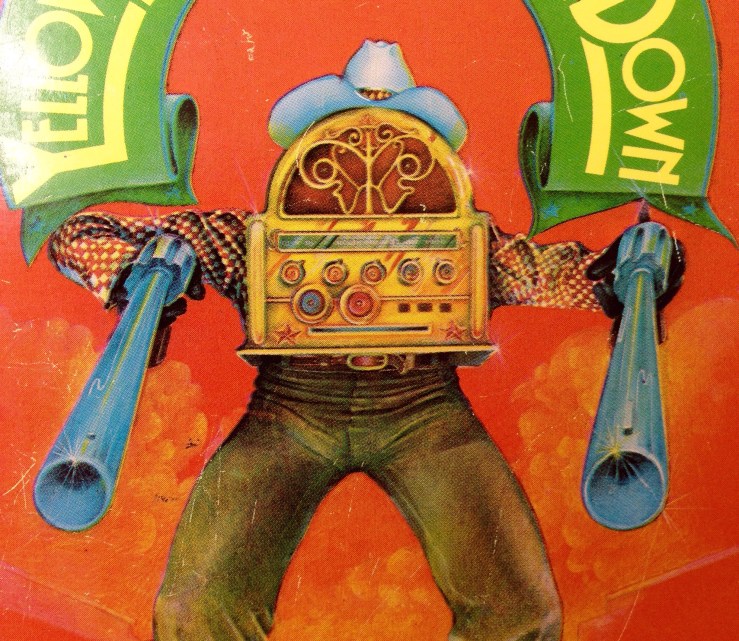
So, as I went to replace the copy I’d bought in May with the same edition, I spied this mass market paperback edition, which kinda sorta matches the copy of Yellow Back Radio Broke-Down—which hey look at that cover, how could I not pick it up?

image

I also found a copy of Nell Zink’s novel The Wallcreeper, which I’ve heard good things about from smart people.

Gothic Novel — Georgy Kurasov

Georgy Kurasov Gothic Novel 40 x 30

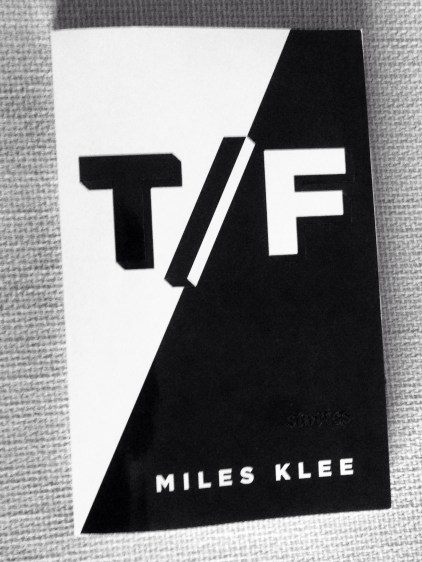
True False (Book acquired, 6.11.2015)

image

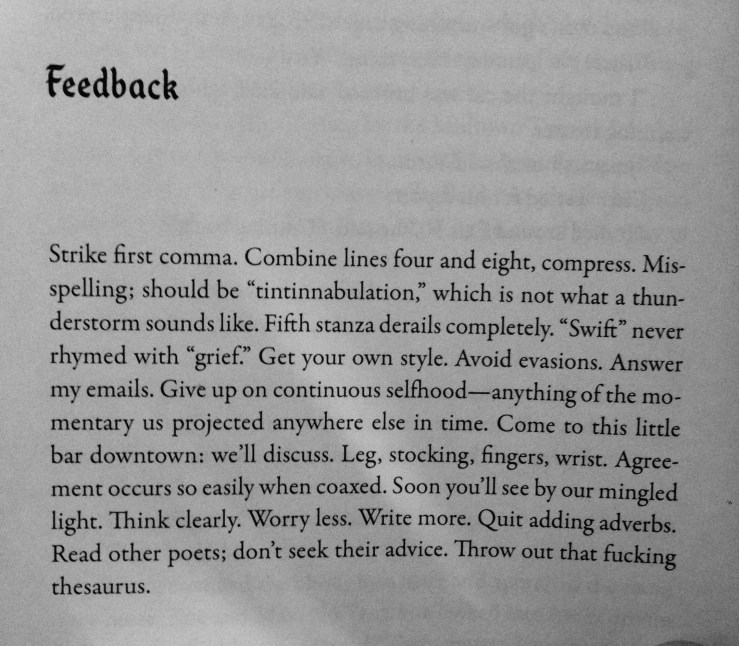
Miles Klee’s collection True False is new from indie O/R. You can read some excerpts at their site.

Blurb(s):

“Miles Klee demonstrates a delightfully prehensile grasp of the more oblique peculiarities of sentience. Very highly recommended.” —William Gibson

“Miles Klee is a fresh genius of the American literary sentence, and his every paragraph is aburst with nervous, agitative exactitudes. So much gets itself zanily and definitively rendered in the crackle of his ultravivid prose that True False is not just a joltingly original collection but the essential record of the inner terrors of our hyperurban era.” —Gary Lutz

A collection of stories that range from the very short to the merely short, these forty-four tales evoke extraordinary scenes in an understated manner that’s marked Klee one of today’s most intriguing writers. From the apocalyptic to the utopic, from a haunted office building to a suburban pool that may be alive, a day in the mind of a demi-god Pythagoras to a secret race to develop artificial love, True False captures a fractured reality more real than our own.

image

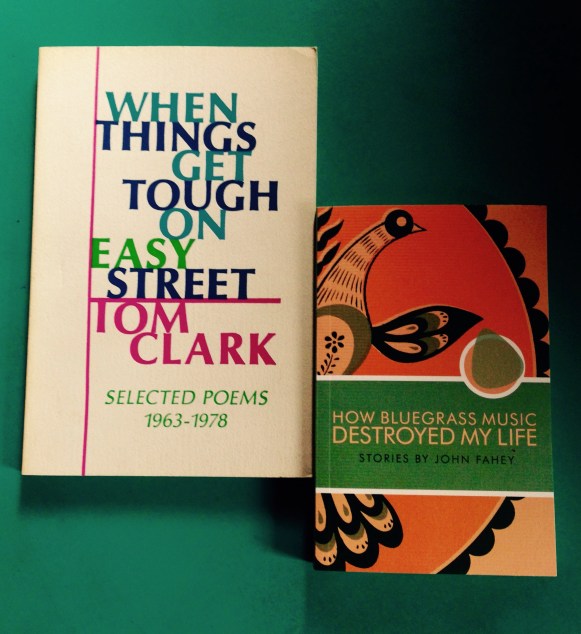
Tom Clark/John Fahey (Books acquired, 6.16.2015)

I spent the past couple of days in NYC, visiting friends and museums &c., and while to my shame I didn’t make it to the famous Strand (I blame my young children’s limited patience), I did visit Spoonbill & Sugartown Booksellers in Brooklyn, where I picked up this handsome Tom Clark collection for the friend who took me there, along with John Fahey’s collection How Bluegrass Music Destroyed My Life (which the same friend had loaned me 15 or so years ago, and I had actually returned). I also bought some kids books which I didn’t photograph because my kids absorbed them already.

Untitled (Reader) — José Sobral de Almada Negreiros

untitled

A U.S.A. that would die for the so-called perfect Entertainment (Infinite Jest)


The sky of U.S.A.’s desert was clotted with blue stars. Now it was deep at night. Only above the U.S.A. city was the sky blank of stars; its color was pearly and blank. Marathe shrugged. ‘Perhaps in you is the sense that citizens of Canada are not involved in the real root of the threat.’

Steeply shook the head in seeming annoyance. ‘What’s that supposed to mean?’ he said. The lurid wig of him slipped when he moved the head with any abrupt force.

The first way Marathe betrayed anything of emotion was to smooth rather too fussily at the blanket on his lap. ‘It is meaning that it will not of finality be Québecers making this kick to l’aine des Etats Unis. Look: the facts of the situation speak loudly. What is known. This is a U.S.A. production, this Entertainment cartridge. Made by an American man in the U.S.A. The appetite for the appeal of it: this also is U.S.A. The U.S.A. drive for spectation, which your culture teaches. This I was saying: this is why choosing is everything. When I say to you choose with great care in loving and you make ridicule it is why I look and say: can I believe this man is saying this thing of ridicule?’ Marathe leaned slightly forward on his stumps, leaving the machine pistol to use both his hands in saying. Steeply could tell this was important to Marathe; he really believed it.

Marathe made small emphatic circles and cuts in the air while he spoke: ‘These facts of situation, which speak so loudly of your Bureau’s fear of this samizdat: now is what has happened when a people choose nothing over themselves to love, each one. A U.S.A. that would die — and let its children die, each one — for the so-called perfect Entertainment, this film. Who would die for this chance to be fed this death of pleasure with spoons, in their warm homes, alone, unmoving: Hugh Steeply, in complete seriousness as a citizen of your neighbor I say to you: forget for a moment the Entertainment, and think instead about a U.S.A. where such a thing could be possible enough for your Office to fear: can such a U.S.A. hope to survive for a much longer time? To survive as a nation of peoples? To much less exercise dominion over other nations of other peoples? If these are other peoples who still know what it is to choose? who will die for something larger? who will sacrifice the warm home, the loved woman at home, their legs, their life even, for something more than their own wishes of sentiment? who would choose not to die for pleasure, alone?’

From David Foster Wallace’s novel Infinite Jest.


Silent Interior — Carlos Schwabe

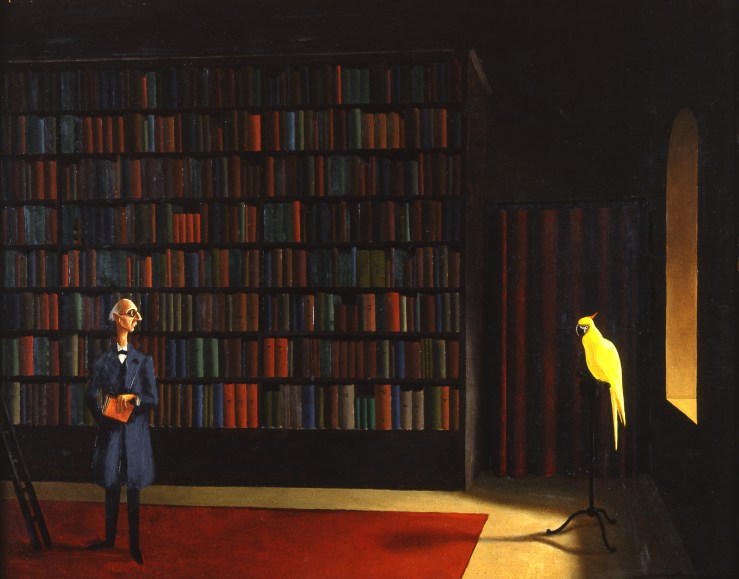
Library — Franz Sedlacek

U_60_978524610017_Franz_Sedlacek_Bibliothek_01