Last week I read a 1985 Washington Post profile of the American novelist William Gaddis. The profile, by Lloyd Grove, celebrated the publication of Gaddis’s third novel Carpenter’s Gothic. In the profile, Grove paraphrases literary critic Frederick Karl’s 1985 essay “The Mega-Novel” in the following way:
Karl argues that unlike “categories of Jewish novelists, gays, Black writers [and] female authors” who address special interests, “these white Protestant males [Gaddis, Pynchon, John Barth et al.] write very close to what America is,” having “sensed the country as a whole.”
I tracked down and read Karl’s essay “The Mega-Novel”; it is, almost entirely, a sustained argument for the kind of giant-assed so-called “experimental” novels typical of the bracketed Gaddis, Pynchon, and Barth above. And yet Karl seems to slide into and side with Harold Bloom in that old man’s pompous war against the so-called “School of Resentment”; once in the quote above, and then a few pages later, when he chooses to claim that “The Mega-Novelists have avoided the individuation of ethnic, gay, female (or even strictly male) experience and sensed the country as a whole.” Yes—Grove weds this second line in Karl’s covert attack on the “School of Resentment,” this maddening and dismissive “country as a whole” bit to the previous language. The effect is so odd, as if Grove has purposefully ignored every other bit of Karl’s essay and cherry-picked the lines that valorize the Real American Viewpoint™ as White Protestant Straight and Male.
Karl’s essay is, apart from these unnecessary declarations, really quite good—he champions Gaddis’s J R and Joseph McElroy’s Lookout Cartridge in particular. And yet I found myself troubled by his claim that it is the dead white guys who write very close to what America is because they sense the country as a whole, in a way that somehow, like, I guess Ishmael Reed or Fran Ross or Toni Morrison or etc. just can’t. And because I’m so simpatico with Karl’s general idea in “The Mega-Novel,” I found myself looking for his 1983 book American Fictions 1940-1980 : A Comprehensive History and Critical Evaluation.
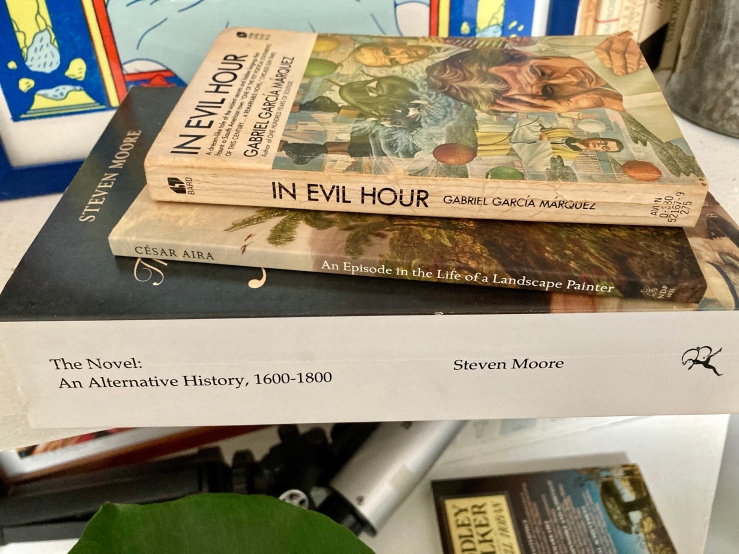
While I didn’t find it in the literary criticism section of my beloved used bookmine, I did find the second volume of Gaddis-scholar Steven Moore’s The Novel, covering 1600-1800.
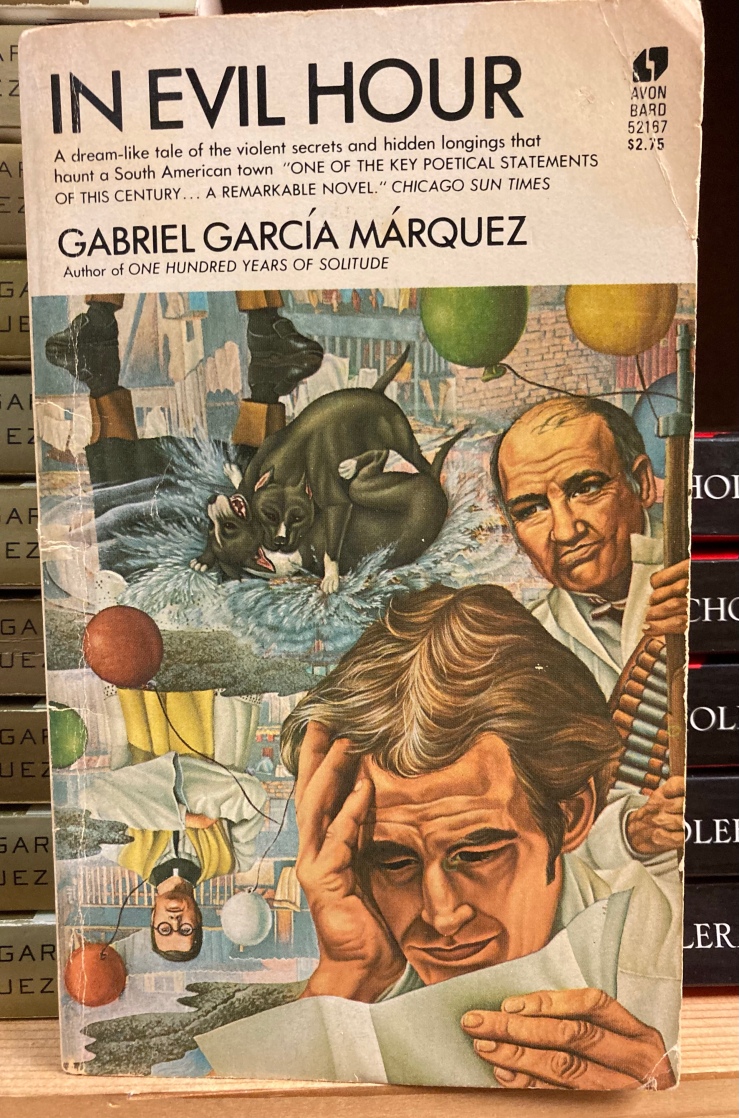
I also picked up César Aira’s An Episode in the Life of a Landscape Painter (in translation by Chris Andrews) and Gabriel García Márquez’s In Evil Hour (in translation by Gregory Rabassa). The latter is another title in Avon/Bard’s Latin American authors series, and I can’t resist them.
The next day, yesterday, Saturday, I participated in an online discussion about the literature of William Gaddis on non-academic forums. (I represented Ye Olde Bloggers, and I will share more about the forum some time in the future.) Early in our forum, one of the participants, the author Jeff Bursey, raised a copy of Frederick Karl’s American Fictions 1940-1980 in front of his webcam. I believe he declared it one of the first places he’d heard of Gaddis, although I could be misremembering. It seemed like a serendipitous moment. I hope to muster more words on most of this later.


 Biblioklept