
Susan Sontag on W.G. Sebald:
IS LITERARY GREATNESS still possible? Given the implacable devolution of literary ambition, and the concurrent ascendancy of the tepid, the glib, and the senselessly cruel as normative fictional subjects, what would a noble literary enterprise look like now? One of the few answers available to English-language readers is the work of W. G. Sebald.
Vertigo, the third of Sebald’s books to be translated into English, is how he began. It appeared in German in 1990, when its author was forty-six; three years later came The Emigrants; and two years after that, The Rings of Saturn. When The Emigrants appeared in English in 1996, the acclaim bordered on awe. Here was a masterly writer, mature, autumnal even, in his persona and themes, who had delivered a book as exotic as it was irrefutable. The language was a wonder—delicate, dense, steeped in thinghood; but there were ample precedents for that in English. What seemed foreign as well as most persuasive was the preternatural authority of Sebald’s voice: its gravity, its sinuosity, its precision, its freedom from all-undermining or undignified self-consciousness or irony.
In W. G. Sebald’s books, a narrator who, we are reminded occasionally, bears the name W. G. Sebald, travels about registering evidence of the mortality of nature, recoiling from the ravages of modernity, musing over the secrets of obscure lives. On some mission of investigation, triggered by a memory or news from a world irretrievably lost, he remembers, evokes, hallucinates, grieves.
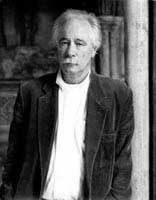
Is the narrator Sebald? Or a fictional character to whom the author has lent his name, and selected elements of his biography? Born in 1944, in a village in Germany he calls “W.” in his books (and the dust jacket identifies for us as Wertach im Allgau), settled in England in his early twenties, and a career academic currently teaching modern German literature at the University of East Anglia, the author includes a scattering of allusions to these bare facts and a few others, as well as, among other self-referring documents reproduced in his books, a grainy picture of himself posed in front of a massive Lebanese cedar in The Rings of Saturn and the photo on his new passport in Vertigo. Continue reading “Susan Sontag on W.G. Sebald”
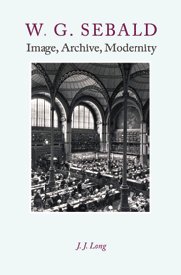 In W.G. Sebald: Image, Archive, Modernity, J.J. Long posits that the work of the late German author W.G. Sebald is best understood as the struggle for autonomous subjectivity in a world conditioned by the power structures of modernity. If the term “power structures” wasn’t a big enough tip-off, yes, Long’s analysis of Sebald is largely Foucauldian, and although he cites Foucault more than any other theorist (Freud is a distant second), the book is not a dogged attempt to make Sebald’s prose stick to Foucault’s theories. Rather, Long uses Foucault’s techniques to better understand Sebald’s works. As such, Long examines the ways that modernity affects power on the human body in Sebald’s work, tracing his protagonists’ encounters with modern institutions that exert power via archive and image.
 Long’s study of Sebald is very much a description of modernity; in particular, of modernity as a series of affects of power and discipline upon the subject (again, very Foucauldian). It’s not particularly surprising then that Long, after locating so many Sebaldian traumas in the 19th and early 20th centuries, asserts that Sebald is a modernist and not a postmodernist. He bases this claim not on the formal elements of Sebald’s prose, which he readily concedes can just as easily be read as postmodernist, but rather on the way his “texts respond to the specific historical constellation” of modernity. Long continues–
 Biblioklept