Happy Mother’s Day! Sure, it’s a marketing scam, but we all love moms, right?
Fascinating moms populate literary fiction, and there’s no shortage of great baddies, evil stepmothers, and distant headcases in our favorite literature—but we thought we’d focus instead on some of the moms that seem to be, you know, really great moms.
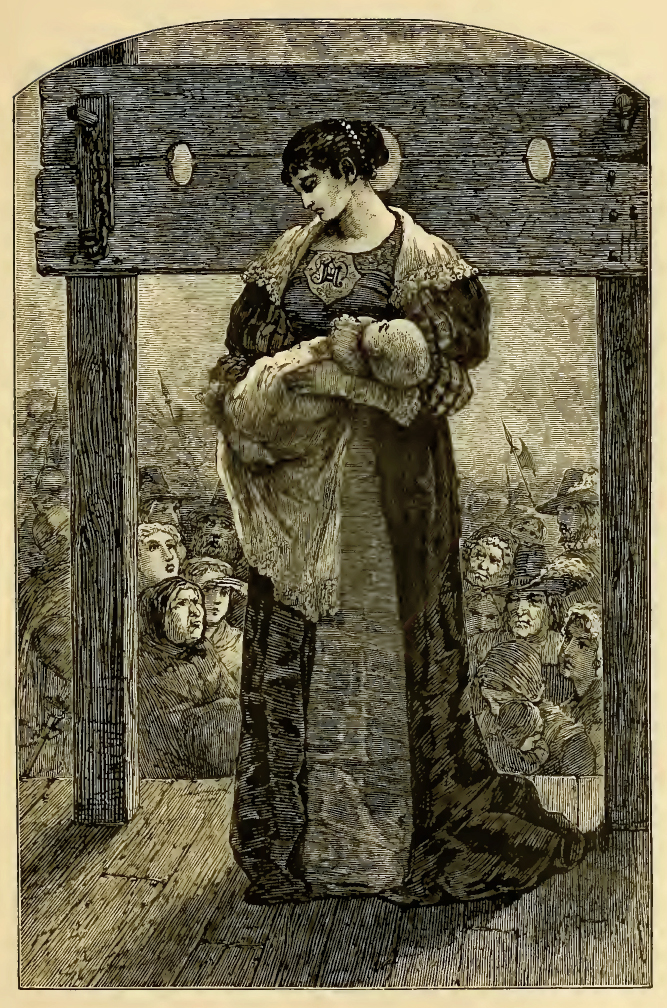
"Hester Prynne & Pearl before the stocks", an illustration by Mary Hallock Foote from an 1878 edition of The Scarlet Letter
1. Hester Prynne, The Scarlet Letter (Nathaniel Hawthorne)
Hester Prynne is a bundle of contradictions—sin and salvation, radical freedom and reactionary repression, hope and despair—all bound to a deeply patriarchal society that had to control women’s bodies at all turns. Fortunately, there’s no analog for the Puritans’ judgmental, shame-based behavior in our own society (har har). Hester and her daughter Pearl, living in a cottage outside of Boston, are outside the dominant social order. It’s a form of punishment that paradoxically frees the pair, allowing Pearl to grow into a kind of nature spirit—impish and willful, to be sure, but also artistic and able to express herself. Although Pearl is the human doubling of Hester’s titular letter, she’s ultimately no badge of shame, but rather a treasure in her mother’s eyes.
2. Penelope, The Odyssey (Homer et al.)
Patient Penelope weaving and unweaving her husband’s shroud—is she the faithful wife, waiting for Odysseus who’s having adventures asea? Or is she cunningly keeping her son safely alive from the predatory suitors who would certainly want to get him out of the way ASAP. Penelope is an extraordinary and ambiguous figure, but one thing is clear: she loves her son Telemachus.
3. Molly Bloom, Ulysses (James Joyce)
Speaking of Penelope . . . Molly might not be the most faithful wife, but damn if she isn’t a hot mama.
4. Ma Joad, The Grapes of Wrath (John Steinbeck)
Ma Joad never gets a first name in Grapes—she’s an elemental matriarchal force that keeps the family together against every kind of pain. The final scene of this novel is utterly amazing. When Rose of Sharon’s daughter dies in childbirth, Ma Joad directs the mother to nurse a man dying from hunger. All the while, a flood of epic proportions looms. Ma Joad’s determination to live transcends Darwinian impulses here; against the backdrop of infanticide, economic and social genocide, and natural disaster, she still directs her family to a loving, Emersonian course of action.
5. Grendel’s mother, Grendel (John Gardner)
In John Gardner’s fabulous retelling of the Beowulf saga from Grendel’s POV, we find a deeply alienated young man who, try as he might, cannot communicate with the plants and animals around him. Grendel should be a thing of nature, but he is a thinking thing, a thing with a conscience, a soul. He can understand men but they cannot understand him. In one of the book’s saddest conceits, Grendel cannot communicate through speech with his mother, who in many senses seems a creature apart from him. Gardner here dramatizes the radical alienation that all children must feel at some point for their mothers, an alterity grounded in the paradox that, hey, your mom gave birth to you—you came out of her, metaphorically, sure, but also, like, really. Even though Mama Grendel can’t speak to her son, she protects and lovingly cares for him, splitting a few skulls here and there in the process. Motherhood is tough.
Timeprofiles Jonathan Franzen this week (part of the push for his new novel Freedom, out later this month). Franzen also talks about five works that have “inspired him recently.” Here are his comments on those books–
The Charterhouse of Parma by Stendhal
Instead of sitting for years at his writing desk, pulling his hair, Stendhal served with the French diplomatic corps in his favorite country, Italy, and then came home and dictated his novel in less than eight weeks: what a great model for how to be a writer and still have some kind of life! The book is at once deeply cynical and hopelessly romantic, all about politics but also all about love, and just about impossible to put down.
The Greenlanders by Jane Smiley
There’s nothing fancy about the writing in Smiley’s masterpiece, and yet every sentence of its eight hundred pages is clean and necessary. For the two weeks it took me to read it, I didn’t want to be anywhere else but in late-medieval Greenland, following the passions and feuds and farming crises of European settlers trying to survive in the face of ecological doom. It all felt weirdly and plausibly contemporary. Sabbath’s Theater by Philip Roth
I finally got tired of being angry at Roth for his self-indulgent excesses and weak dialogue and thin female characters and decided to open myself to his genius for invention and his heroic lack of shame. Whole chunks of Sabbath’s Theater can be safely skipped, but the great stuff is truly great: the scene in which Mickey Sabbath panhandles on the New York with a paper coffee cup, for example, or the scene in which Sabbath’s best friend catches him relaxing in the bathtub and fondling his (the friend’s) young daughter’s underpants.
The House of Mirth by Edith Wharton
Wharton’s male characters suffer from some of the deficiencies that Roth’s female characters do, but the heroine of House of Mirth, Lily Bart, is one of the great characters in American literature, a pretty and smart but impecunious New York society woman who can’t quite pull the trigger on marrying for money. Wharton’s love for Lily is equal to the cruelty that Wharton’s story relentlessly inflicts on her; and so we recognize our entire selves in her.
East of Eden by John Steinbeck
A lifelong heavy drinker with his most famous novel well behind him, Steinbeck set out to write a mythic version of his family’s American experience that would embody the whole story of our country’s lost innocence and possible redemption. There are infelicities on almost every page, and the fact that the book succeeds brilliantly anyway is a testament to the power of Steinbeck’s storytelling: to his ferocious will to make sense of his life and his country.
I read John Steinbeck’s The Red Pony in the eighth grade and didn’t think much of it. I was more interested in Vonnegut and Kerouac and Kafka and HS Thompson at the time, all of whom seemed more substantial and just plain cooler. The boyhood adventures recounted in The Red Pony seemed hokey to me, and perhaps because of the title, I came to conflate Steinbeck’s novella with Marjorie Kinnan Rawlings’s Where the Red Fern Grows(ed. note: as gentle reader jd points out in the comments below, this is an error on Biblioklept’s part: it was actually Wilson Rawls who wrote Where the Red Fern Grows, Rawlings wrote The Yearling), which we also read that year, and which I also thought was interminably silly. Somehow, I managed to make it through both high school and college never reading anything by Steinbeck, and on the way, I also somehow managed to pick up the idea that he was an inferior or unimportant writer, unequal to Twain or Fitzgerald or Hemingway or Salinger, and certainly more boring than my beloved PK Dick and William Burroughs.
Fortunately, this ignorance was corrected the first year I started teaching high school. A more experienced teacher recommended that I read Of Mice and Men with my ninth graders. I probably wrinkled my nose at the idea (prejudiced as I was), but desperate to find a text that would engage them (as she swore up and down Of Mice and Men would), I gave it a shot.
The story of the child-like Lennie and his brother-keeper George hooked me from the first few paragraphs, and I, along with the students, became entranced, hooked on the book, unable to wait for the next day to read more. The next semester a new group of ninth graders and I worked our way through the book; a little more savvy now, I utilized Gary Sinise’s reading on audio book, possibly the best audio version of a book I’ve ever heard. He also directed and starred in a film version, with John Malkovich’s portrayal of mentally handicapped Lennie translating with realistic warmth and pathos. Sinise’s movie version is nearly perfect. By the fourth time I went through OMAM with the kids, I had introduced all kinds of different approaches to the text: gender readings, readings that focused on the disabled body, readings that troped against the book of Genesis and so on. I found that no matter how many times I read the text, I was never bored, and I always found something new in Steinbeck’s spare language. And it was–and is–Steinbeck’s measured and controlled prose that so impressed (impresses) me. Like Hemingway, Steinbeck eliminates everything extraneous, loading each word and sentence with significance; unlike Hemingway, Steinbeck’s writing shows a keen sensitivity toward persons besides macho white males.
I don’t teach ninth grade anymore, but I always slip a few Steinbeck readings into my AP Language and Composition course. Over the past few years, I’ve read a good deal of The Portable Steinbeck; if you want to boast a decent library of great American literature, this book is essential. Not only does it contain the whole of Of Mice and Men and The Red Pony, it also has carefully-chosen chapters from The Grapes of Wrath that manage to stand on their own (a testament to both editor Pascal Covici, Jr. as well as Steinbeck’s writing). Plus, look at that cover–very cool (I have a class set of these, and one student added a speech bubble to Steinbeck’s image with the text: “I’m a pimp”)
What prompted this post? Well, I have one tenth-grade section right now–World Literature–and I usually introduce some of the themes I like to cover over the course of the year–colonialism, cultural clash, etc. (we’ll read Achebe’s Things Fall Apart next)–with Steinbeck’s novella The Pearl, a beautiful and sad book that is often overlooked as a lesser work, childhood fare like The Red Pony (admittedly a lesser work). This morning, starting a new reading (sixth? seventh?) with a group of young kids all engaged in a story they didn’t think they wanted to read, I realized that I wanted to say this: Steinbeck is great. Steinbeck is great and that’s something I had to find out from a bunch of kids. Steinbeck is great and I almost didn’t know it because my prejudice prompted me overlook him. Steinbeck is great and I want you to read him. Go for it. You can find a used copy of Of Mice and Men anywhere. It’s about a hundred pages long. If you read a chapter a night, you’ll be done in less than a week. Take the Biblioklept challenge. If you don’t like it, let me know.
This Saturday, the missus and I headed to the Jacksonville Fairgrounds for the annual Friends of the Library Sale. Parking was no problem, and the event was well attended but not crowded. Amidst the seemingly endless horde of V.C. Andrews and Robert Ludlum leftovers, we grabbed some great stuff.
I got an extremely handsome first edition of Steinbeck’s The Acts of King Arthur and His Noble Knights, which appears to have never been touched, let alone read. This book will fit nicely within an already-large collection of Arthur book’s I’ve never finished (with the exception of T.H. White’s version, which I devoured as a youth).
While searching through kids books, my special lady came across a hardback edition of Persepolis 2. You may recall I wrote about Satrapi’s first book of Persepolisa few weeks ago. I’m happy to report that the books now exist in a special harmony, together at peace on my shelf.
I also picked up a few books I may never get around to reading, including Ian McEwan’s Atonement. This list-topper won all kinds of awards a few years ago, despite accusations of plagiarism. I’m sure that Gabriel Garcia Marquez’s One Hundred Years of Solitude is like, the best book ever: I’ve thoroughly enjoyed the first fifty pages several times now. I keep promising myself: next summer. The strangest thing is that I didn’t actually own this book before now. The “Oprah Book Club” sticker came off no problem, by the way. Another one that I started years ago in college, a library loan, was John Barth’s The Sot-Weed Factor, a humorous tale of Americana that I couldn’t make heads or tails of as an undergrad. The book is huge; the copy I bought, despite being a paperback edition from the early 80s, has no spinal damage and appears unread. Undoubtedly it will stay this way.
Much more useful, I’m sure, will be The Dictionary of Literary Terms by J.A. Cuddon. This book is fantastic, and I’ve already put it to good use. Cuddon’s approach is exciting: he uses plenty of illustrative examples, and even puts the specialized terminology into historical context–in many ways, this book is like a crash course on the history of rhetoric.
I was thrilled (no really, thrilled) to come across two books from the 33 1/3 series. In this series, one writer takes a close look at just one musical album. I’d already read Chris Ott’s take on Joy Division’s Unknown Pleasures; I was lucky enough to snap up Jimi Hendrix’s Electric Ladyland by John Perry and Prince’s Sign O’ the Times by Michaelangelo Matos. So far, John Perry’s take on Hendrix has been one of the best musical biographies I’ve ever read, which is really saying something (for the record, it’s still no contest against the immortal classic, Crazy from the Heat, by one David Lee Roth). In edition to being concise and well-written, these books are small and have a stylish design. Perfect bathroom reading material.
Of course there were other sundry books bought, and plenty abandoned (I still regret not spending the fifty cents on Bikini Planet, a pulp sci-fi that promised “Benny Hill style humor” What was I thinking?) I could hardly carry our box as it was (although, in the interest of full-disclosure, I am very physically weak).
After the book sale, we headed across Downtown to the Prime Osborn Convention Center. My father had given us free passes to the Home and Patio Show. It was shocking. People were paying five bucks to park, waiting in a line that zigzagged out the door to pay who-knows-how-much to gain entry to what amounted to a bunch of vendors trying to sell you crap. I kept shaking my head in disbelief. Down the road were thousands and thousands of books that were practically being given away, but here people were lining up and paying to be sold things. Ah…Jacksonville! You’ve gotta love it.










 Time
Time 


 Biblioklept