Sharon Olds’ bread

“Bread”

by

Sharon Olds


When my daughter makes bread, a cloud of flour

hangs in the air like pollen. She sifts and

sifts again, the salt and sugar

close as the grain of her skin. She heats the

water to body temperature

with the sausage lard, fragrant as her scalp

the day before hair-wash, and works them together on a

floured board. Her broad palms

bend the paste toward her and the heel of her hand

presses it away, until the dough

begins to snap, glossy and elastic as the torso bending over it,

this ten-year-old girl, random specks of yeast

in her flesh beginning to heat,

her volume doubling every month now, but still

raw and hard. She slaps the dough and it crackles under her palm, sleek and

ferocious and still leashed, like her body, no

breasts rising like bubbles of air toward the surface

of the loaf. She greases the pan, she is

shaped, glazed, and at any moment goes

into the oven, to turn to that porous

warm substance, and then under the

knife to be sliced for the having, the tasting, and the

giving of life.


Don DeLillo’s chicken parts and brownies

  No one wanted to cook that night. We all got in the car and went out to the commercial strip in the no man’s land beyond the town boundary. The never-ending neon. I pulled in at a place that specialized in chicken parts and brownies. We decided to eat in the car. The car was sufficient for our needs. We wanted to eat, not look around at other people. We wanted to fill our stomachs and get it over with. We didn’t need light and space. We certainly didn’t need to face each other across a table as we ate, building a subtle and complex cross-network of signals and codes. We were content to eat facing in the same direction, looking only inches past our hands. There was a kind of rigor in this. Denise brought the food out to the car and distributed paper napkins. We settled in to eat. We ate fully dressed, in hats and heavy coats, without speaking, ripping into chicken parts with our hands and teeth. There was a mood of intense concentration, minds converging on a single compelling idea. I was surprised to find I was enormously hungry. I chewed and ate, looking only inches past my hands. This is how hunger shrinks the world. This is the edge of the observable universe of food. Steffie tore off the crisp skin of a breast and gave it to Heinrich. She never ate the skin. Babette sucked a bone. Heinrich traded wings with Denise, a large for a small. He thought small wings were tastier. People gave Babette their bones to clean and suck. … We sent Denise to get more food, waiting for her in silence. Then we started in again, half stunned by the dimensions of our pleasure.

From Don DeLillo’s novel White Noise.

Italo Calvino’s love noodles

And all of this, which was true of me, was true also for each of the others. And for her: she contained and was contained with equal happiness, and she welcomed us and loved and inhabited all equally.

We got along so well all together, so well that something extraordinary was bound to happen. It was enough for her to say, at a certain moment: “Oh, if I only had some room, how I’d like to make some noodles for you boys!” And in that moment we all thought of the space that her round arms would occupy, moving backward and forward with the rolling pin over the dough, her bosom leaning over the great mound of flour and eggs which cluttered the wide board while her arms kneaded and kneaded, white and shiny with oil up to the elbows; we thought of the space that the flour would occupy, and the wheat for the flour, and the fields to raise the wheat, and the mountains from which the water would flow to irrigate the fields, and the grazing lands for the herds of calves that would give their meat for the sauce; of the space it would take for the Sun to arrive with its rays, to ripen the wheat; of the space for the Sun to condense from the clouds of stellar gases and burn; of the quantities of stars and galaxies and galactic masses in flight through space which would be needed to hold suspended every galaxy, every nebula, every sun, every planet, and at the same time we thought of it, this space was inevitably being formed, at the same time that Mrs. Ph(i)Nk0 was uttering those words: “… ah, what noodles, boys!” the point that contained her and all of us was expanding in a halo of distance in light-years and light-centuries and billions of light-millennia, and we were being hurled to the four corners of the universe (Mr. Mr. PbertPbertd all the way to Pavia), and she, dissolved into I don’t know what kind of energy-light-heat, she, Mrs. Ph(i)Nk0, she who in the midst of our closed, petty world had been capable of a generous impulse, “Boys, the noodles I would make for you!,” a true outburst of general love, initiating at the same moment the concept of space and, properly speaking, space itself, and time, and universal gravitation, and the gravitating universe, making possible billions and billions of suns, and of planets, and fields of wheat, and Mrs. Ph(i)Nk0, scattered through the continents of the planets, kneading with floury, oil-shiny, generous arms, and she lost at that very moment, and we, mourning her loss.

From Italo Calvino’s “All at One Point,” part of Cosmicomics. Translation by William Weaver.

Thomas Pynchon’s recipe for the first British pizza

“Lud wishes to know,” Whike relays at last, “Mr. Emerson’s Cousin’s Views, upon the Structure of the World.”
“A Spheroid, the last I heard of it, Sir.”
“Ahr Ahr ahr, ’ahr ahhrr!”
“ ’And I say, ’tis Flat,’” the Jesuit smoothly translates. “Why of course, Sir, flat as you like, flat as a Funnel-Cake, flat as a Pizza, for all that,— ”
“Apologies, Sir,—” Whike all Unctuosity, “the foreign Word again, was . . . ?”
“The apology is mine,— Pizza being a Delicacy of Cheese, Bread, and Fish ubiquitous in the region ’round Mount Vesuvius. . . . In my Distraction, I have reach’d for the Word as the over-wrought Child for its Doll.”
“You are from Italy, then, sir?” inquires Ma.
“In my Youth I pass’d some profitable months there, Madam.”
“Do you recall by chance how it is they cook this ‘Pizza’? My Lads and Lasses grow weary of the same Daily Gruel and Haggis, so a Mother is ever upon the Lurk for any new Receipt.”
“Why, of course. If there be a risen Loaf about . . . ?”
Mrs. Brain reaches ’neath the Bar and comes up with a Brown Batch-Loaf, rising since Morning, which she presents to “Cousin Ambrose,” who begins to punch it out flat upon the Counter-Top. Lud, fascinated, offers to assault the Dough himself, quickly slapping it into a very thin Disk of remarkable Circularity.
“Excellent, Sir,” Maire beams, “I don’t suppose anyone has a Tomato?”
“A what?”
“Saw one at Darlington Fair, once,” nods Mr.”“Brain.
“No good, in that case,— eaten by now.”
“The one I saw, they might not have wanted to eat . . . ?”
Dixon, rummaging in his Surveyor’s Kit, has come up with the Bottle of Ketjap, that he now takes with him ev’rywhere. “This do?”
“That was a Torpedo, Husband.”
“That Elecktrickal Fish? Oh . . . then this thing he’s making isn’t elecktrical?”
“Tho’ there ought to be Fish, such as those styl’d by the Neopolitans, Cicinielli. . . .”
“Will Anchovy do?” Mrs. Brain indicates a Cask of West Channel ’Chovies from Devon, pickl’d in Brine.
“Capital. And Cheese?”
“That would be what’s left of the Stilton, from the Ploughman’s Lunch.”
“Very promising indeed,” Maire wringing his Hands to conceal their trembling. “Well then, let us just . . .”
By the Time what is arguably the first British Pizza is ready to come out of the Baking-Oven beside the Hearth, the Road outside has gone quiet and the Moorland dark, several Rounds have come and pass’d, and Lud is beginning to show signs of Apprehension. “At least ’tis cloudy tonight, no Moonlight’ll be getting thro’,” his Mother whispers to Mr. Emerson.”

From Thomas Pynchon’s novel Mason & Dixon.

Nathaniel Hawthorne’s sherry cobbler cocktail

In the final third of Nathaniel Hawthorne’s 1852 novel The Blithedale Romance, the narrator, having departed the titular would-be utopian farm, enjoys some city time in a hotel. He takes a voyeuristic pleasure in watching people from his window, and elects to deepen the pleasure by ordering a drink: “Just about this time a waiter entered my room. The truth was, I had rung the bell and ordered a sherry-cobbler.” The explanatory end note for my Penguin Classics copy of Blithedale gives the following recipe: “A drink made with sherry, lemon juice, sugar, and cracked ice.” I decided to make a few.

A brief internet search resulted in dozens and dozens of recipes, all more or less the same iteration: long glass, crushed ice, sherry, simple syrup, citrus (oranges cited most frequently), fresh berries if you have ’em, and a straw. The straw is the kicker here. Here is a passage from Charles Dickens’ 1844 novel Life and Adventures of Martin Chuzzlewit that shows the titular hero’s delight with his first sherry cobbler (note Chuzzlewit’s ecstasy when he gets “the reed” to his lips):

‘I wish you would pull off my boots for me,’ said Martin, dropping into one of the chairs ‘I am quite knocked up—dead beat, Mark.’

‘You won’t say that to-morrow morning, sir,’ returned Mr Tapley; ‘nor even to-night, sir, when you’ve made a trial of this.’ With which he produced a very large tumbler, piled up to the brim with little blocks of clear transparent ice, through which one or two thin slices of lemon, and a golden liquid of delicious appearance, appealed from the still depths below, to the loving eye of the spectator.

‘What do you call this?’ said Martin.

But Mr Tapley made no answer; merely plunging a reed into the mixture—which caused a pleasant commotion among the pieces of ice—and signifying by an expressive gesture that it was to be pumped up through that agency by the enraptured drinker.

Martin took the glass with an astonished look; applied his lips to the reed; and cast up his eyes once in ecstasy. He paused no more until the goblet was drained to the last drop.

‘There, sir!’ said Mark, taking it from him with a triumphant face; ‘if ever you should happen to be dead beat again, when I ain’t in the way, all you’ve got to do is to ask the nearest man to go and fetch a cobbler.’

‘To go and fetch a cobbler?’ repeated Martin.

‘This wonderful invention, sir,’ said Mark, tenderly patting the empty glass, ‘is called a cobbler. Sherry cobbler when you name it long; cobbler, when you name it short. Now you’re equal to having your boots took off, and are, in every particular worth mentioning, another man.’

Anyway. Where was I? Oh, yeah—so I looked around for recipes. David Wondrich’s 2007 cocktail history Imbibe! gives a helpful baseline recipe by citing Jerry Thomas’s 1862 classic, How to Mix Drinks. From Thomas’s book:

cobbler-1

Thomas doesn’t mention muddling the oranges, although pretty much every online recipe I read called for muddling.

So reader, I muddled.

Here is my variation on the sherry cobbler (or Sherry Cobbler, or sherry-cobbler). In the loose spirit of the cocktail, I made ours entirely of ingredients I already had at the house. These were for each cocktail:

–4 oz of sherry

–1/2 oz of simple syrup

–1/2 oz of maraschino syrup

–1 oz of sparkling water

–1 clementine (muddled)

–sprigs of mint

–blueberries

–crushed ice
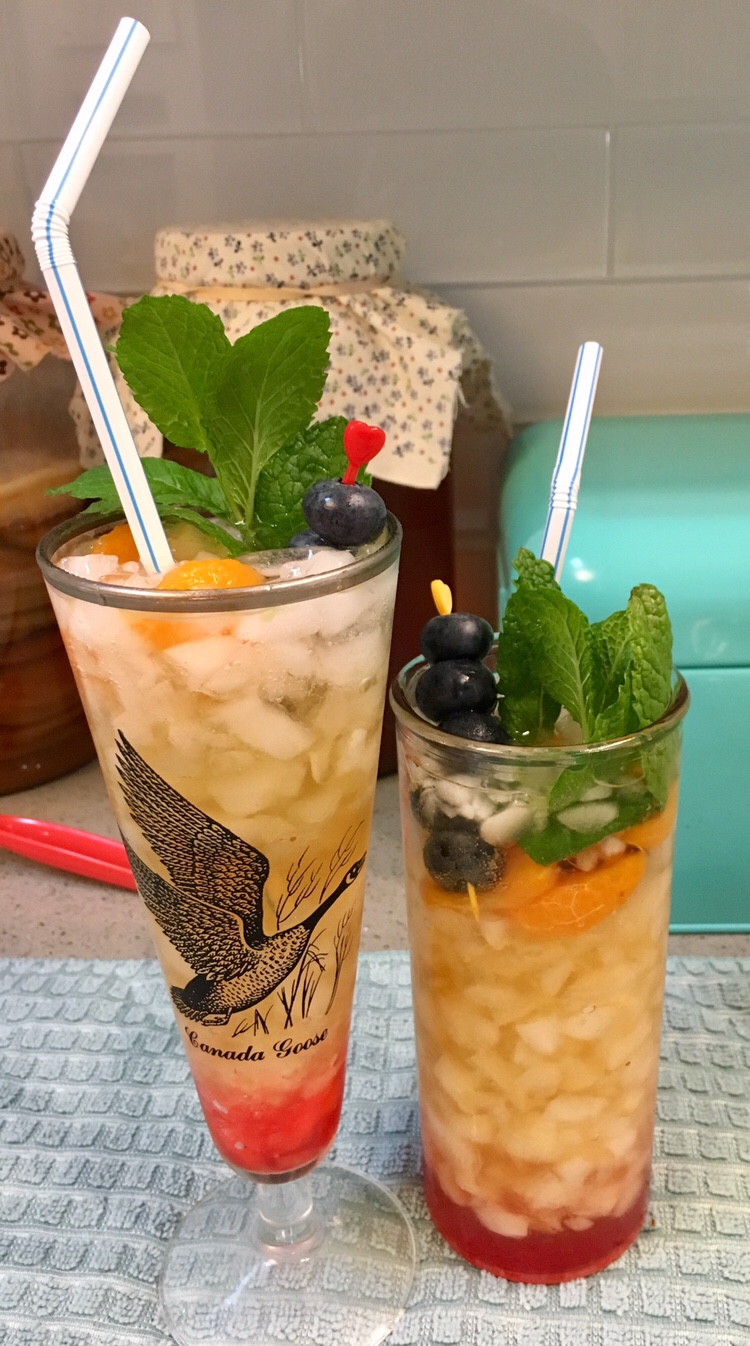
img_9558

The maraschino syrup was an afterthought after I’d mixed the cocktail and was about to pour it over ice—I wanted to get a pop of color at the bottom of the glass. The mint and blueberries were from our garden. The pic above is lousy; sorry—not sure why I didn’t move the dishcloth and maybe photograph the cocktails like, uh, not in front of my wife’s kombucha hotels.

So how was it? Pretty refreshing. My wife enjoyed it more than I did, although I’m not a huge cocktail guy. (I think it’s pretty hard, for example, to improve upon neat scotch , although I do like bourbon straight up in the hotter months).

I’ve always been fascinated by literary recipes, so I’m a bit surprised the sherry cobbler has evaded my attention until now, despite its having shown up in various novels I’ve read (including Nicholson Baker’s House of Holes, as Troy Patterson pointed out in a remarkably thorough literary history of the cocktail at Slate years ago). I’m not sure I’d go out of my way to make a sherry cobbler again (not that I went out of my way to make these ones), but the basic cobbler recipe’s spirit is very close to my approach to making cocktails at home anyway—use what you have. In fact, the major difference between the sherry cobblers I made yesterday and the kind of cocktail I’d normally cobble together for my wife on a Saturday afternoon is the sherry—I’d usually use rum or maybe vodka. Anyway, the whole thing was fun, which is like, the point of cocktails.

[Ed. note–Biblioklept first published this post in 2018. Happy Thanksgiving!]

Gordon Lish’s chopped liver for gentiles

From “Chopped Liver for Gentiles” by Gordon Lish, published in Esquire, 1 March 1977.


Go get your scissors. Here goes.

Take chicken livers. Take as many as you want— because I never consider proportions. Engineers measure ; the nephew gropes, with eyes closed tight to better illumine the inner vision. So take chicken livers. Rinse in cold water. Put chicken fat in skillet. Salt it. Get good and hot and add liver. Sauté twelve minutes with cover on. Set drained liver aside, scarf out skillet, ladle in bacon grease (you heard me!), again get good and hot, then lay in your sliced onions. At instant they threaten to brown, remove onions and drain. Hard-boil yourself some eggs. In total number, use one and a half as many eggs as you used livers. Ditto with the onions. (Don’t talk to me about sizes: I can’t think at this point.) Now what you have is your sautéed liver and your translucent onions and your hard-boiled eggs. All this goes into your wooden chopping bowl that is supposed to be roomy enough to let you really go to town without later having to hose down everything in sight. All set? Now here’s where you separate the nephews from the tantes. In goes beer, a couple of good splashes; in goes more chicken fat, nothing stingy; the same with butter. Follow with dry mustard, garlic powder, pepper, salt, chive, a notable dash of cinnamon (you heard me again, hoss!), a shy spritz of Worcestershire, a little ground dillweed, and you’re in business—start chopping. But you’re not chopping up a bowl of gold unless you went heavy on the ingredients I didn’t tell you to go light on. That means I’m looking for an expansive nature when you reach for the mustard and the garlic and the chive—salt and pepper being one of life’s large problems every nephew must solve for himself.

…Now here’s the rest. If you can’t get corn rye bread to accompany this epistle from God, I’ll understand—but I will also know they’ll never count you in when they number up the chosen.

Sassafrass’ Rice Casserole #36, a recipe from Ntozake Shange’s novel Sassafrass, Cypress & Indigo

Sassafrass’ Rice Casserole #36

1 1/2 cups medium grain brown rice

3 ounces pimentos

1 cup baby green peas

1/2 cup fresh walnuts


2/3 pound smoked cheddar cheese

1/2 cup condensed milk

Diced garlic to taste

Cayenne to taste


Cook rice as usual. In an eight-inch baking dish, layer rice, cheese, pimentos, walnuts, and peas. Spread garlic and cayenne as you see fit. Pour milk along side of dish so it cushions rice against the edge. Bake in oven 20-30 minutes, or until all the cheese melts and the top layer has a nice brown tinge.

–From Ntozake’s Shange’s novel Sassafrass, Cypress & Indigo.

Sassafrass’ homemade banner hangs above her stove:

A recipe for Charles Dickens’s hare soup

Skin a hare and put it on to roast. Whilst it is cooking, fry in the best English butter two carrots, a head of celery, two onions, two ounces of raw ham, two bay leaves, two cloves, a blade of mace, four shallots, a little thyme and parsley. Fry all these to a brown color in a stew pan.

When the hare has been roasting for an hour, remove the back fillets and pound the remainder in a mortar and add it to the vegetables. Add to this mixture a half pound of brown thickening which has been made with a pound of butter and sifted flour, and cook over a slow fire. The mixture should be moistened with two quarts of good stock and stirred over a fire until it boils. A glass of wine should be added and a small pinch of cayenne.

The recipe comes from the unsigned article “London Chef Explains Dickens’s Hare Soup,” published in The New York Times, 26 Dec. 1926.

According to the article, a “well-known London chef” shared the recipe as “a kind of Christmas card” with his patrons in 1926. Apparently Dickens enjoyed eating this hare soup regularly “a Strand restaurant” in the 1850s.


Mother Lish’s Bologna Sandwich, a recipe from Gordon Lish

  1. First check the refrigerator to make certain none of the following are in there: lettuce, butter, margarine, mustard, ketchup or mayo.
  2. Remove the jar of mint jelly from the cupboard. (Marmalade is an acceptable substitution.)
  3. Your bread should be of the diet variety, well-aged and adequately chilled. If the counter is wet, place two slices of bread on it. Press down with the heel of your hand to make sure they lie flat. (If you experience some difficulty in separating two slices of bread from the rest of the loaf, rap the loaf smartly on the edge of the counter.)
  4. Never use presliced bologna. Your bologna should be of the sausage type, with good stout rind on it. Working with a dull knife, hack off what you need. What you’re aiming for here are pieces of bologna that display a certain ragged configuration.
  5. Spread mint jelly on one slice of your dampened bread. On the other slice, distribute chunks of bologna. Lift jellied slice up, jellied side up and lower it over the other slice. (If jellied slice sticks to the counter, use screwdriver to pry it off.)
  6. Still working with the same knife, halve the finished product, cutting from one corner to the other. (Bread should come apart into a number of small pieces all by itself. But if this does not occur, start over again.) Serve immediately. (If this is not possible, store in freezer for later use.) keeps indefinitely if wrapped in a brown paper bag with a rubber band around it.)

From “The Day Mother Invented Junk Food” by Gordon Lish. The full piece was published in The New York Times, 2 Aug. 1978. Thanks to David Winters for sharing it with me years ago.

Blog about making a sherry cobbler, a cocktail I read about in a Nathaniel Hawthorne novel

In the final third of Nathaniel Hawthorne’s 1852 novel The Blithedale Romance, the narrator, having departed the titular would-be utopian farm, enjoys some city time in a hotel. He takes a voyeuristic pleasure in watching people from his window, and elects to deepen the pleasure by ordering a drink: “Just about this time a waiter entered my room. The truth was, I had rung the bell and ordered a sherry-cobbler.” The explanatory end note for my Penguin Classics copy of Blithedale gives the following recipe: “A drink made with sherry, lemon juice, sugar, and cracked ice.” I decided to make a few.

A brief internet search resulted in dozens and dozens of recipes, all more or less the same iteration: long glass, crushed ice, sherry, simple syrup, citrus (oranges cited most frequently), fresh berries if you have ’em, and a straw. The straw is the kicker here. Here is a passage from Charles Dickens’ 1844 novel Life and Adventures of Martin Chuzzlewit that shows the titular hero’s delight with his first sherry cobbler (note Chuzzlewit’s ecstasy when he gets “the reed” to his lips):

‘I wish you would pull off my boots for me,’ said Martin, dropping into one of the chairs ‘I am quite knocked up—dead beat, Mark.’

‘You won’t say that to-morrow morning, sir,’ returned Mr Tapley; ‘nor even to-night, sir, when you’ve made a trial of this.’ With which he produced a very large tumbler, piled up to the brim with little blocks of clear transparent ice, through which one or two thin slices of lemon, and a golden liquid of delicious appearance, appealed from the still depths below, to the loving eye of the spectator.

‘What do you call this?’ said Martin.

But Mr Tapley made no answer; merely plunging a reed into the mixture—which caused a pleasant commotion among the pieces of ice—and signifying by an expressive gesture that it was to be pumped up through that agency by the enraptured drinker.

Martin took the glass with an astonished look; applied his lips to the reed; and cast up his eyes once in ecstasy. He paused no more until the goblet was drained to the last drop.

‘There, sir!’ said Mark, taking it from him with a triumphant face; ‘if ever you should happen to be dead beat again, when I ain’t in the way, all you’ve got to do is to ask the nearest man to go and fetch a cobbler.’

‘To go and fetch a cobbler?’ repeated Martin.

‘This wonderful invention, sir,’ said Mark, tenderly patting the empty glass, ‘is called a cobbler. Sherry cobbler when you name it long; cobbler, when you name it short. Now you’re equal to having your boots took off, and are, in every particular worth mentioning, another man.’

Anyway. Where was I? Oh, yeah—so I looked around for recipes. David Wondrich’s 2007 cocktail history Imbibe! gives a helpful baseline recipe by citing Jerry Thomas’s 1862 classic, How to Mix Drinks. From Thomas’s book:

cobbler-1

Thomas doesn’t mention muddling the oranges, although pretty much every online recipe I read called for muddling.

So reader, I muddled.

Here is my variation on the sherry cobbler (or Sherry Cobbler, or sherry-cobbler). In the loose spirit of the cocktail, I made ours entirely of ingredients I already had at the house. These were for each cocktail:

–4 oz of sherry

–1/2 oz of simple syrup

–1/2 oz of maraschino syrup

–1 oz of sparkling water

–1 clementine (muddled)

–sprigs of mint

–blueberries

–crushed ice

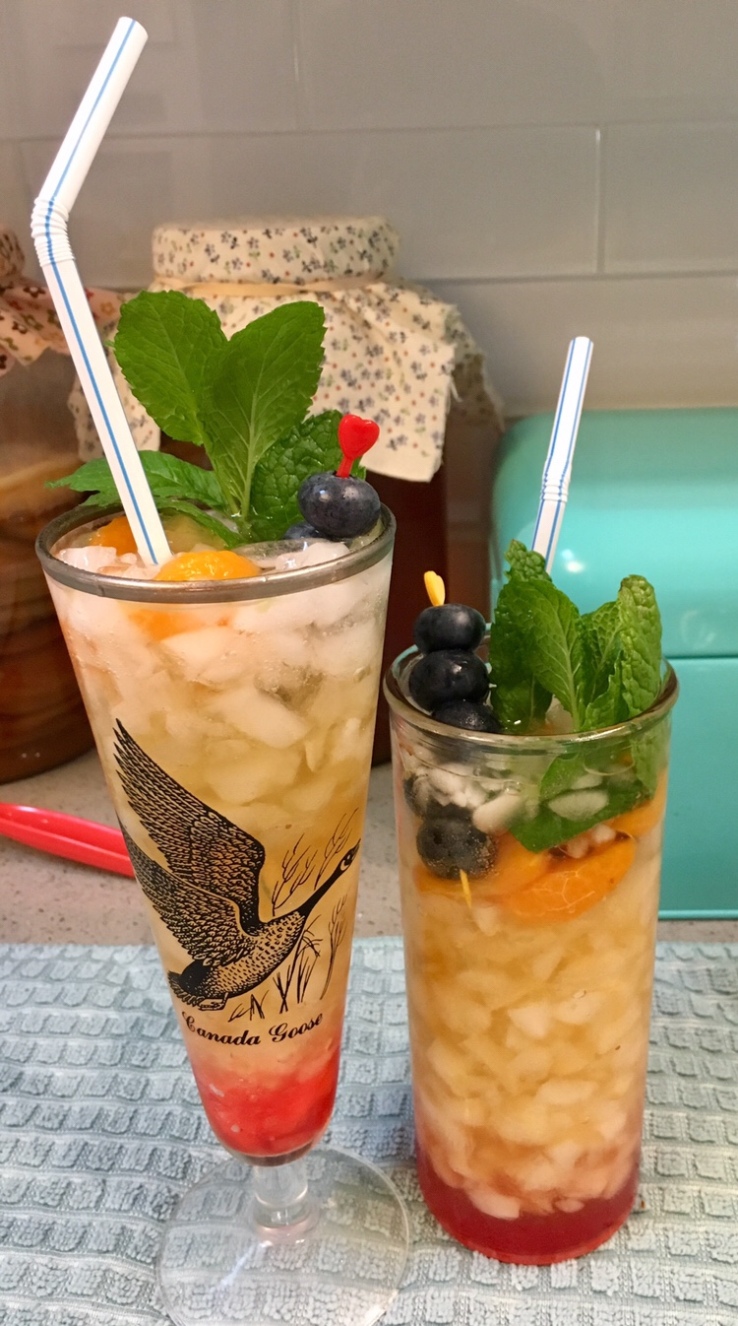
img_9558

The maraschino syrup was an afterthought after I’d mixed the cocktail and was about to pour it over ice—I wanted to get a pop of color at the bottom of the glass. The mint and blueberries were from our garden. The pic above is lousy; sorry—not sure why I didn’t move the dishcloth and maybe photograph the cocktails like, uh, not in front of my wife’s kombucha hotels.

So how was it? Pretty refreshing. My wife enjoyed it more than I did, although I’m not a huge cocktail guy. (I think it’s pretty hard, for example, to improve upon neat scotch , although I do like bourbon straight up in the hotter months).

I’ve always been fascinated by literary recipes, so I’m a bit surprised the sherry cobbler has evaded my attention until now, despite its having shown up in various novels I’ve read (including Nicholson Baker’s House of Holes, as Troy Patterson pointed out in a remarkably thorough literary history of the cocktail at Slate years ago). I’m not sure I’d go out of my way to make a sherry cobbler again (not that I went out of my way to make these ones), but the basic cobbler recipe’s spirit is very close to my approach to making cocktails at home anyway—use what you have. In fact, the major difference between the sherry cobblers I made yesterday and the kind of cocktail I’d normally cobble together for my wife on a Saturday afternoon is the sherry—I’d usually use rum or maybe vodka. Anyway, the whole thing was fun, which is like, the point of cocktails.

Happy Thanksgiving! Here’s a bunch of literary recipes and a painting

Merry Family, Jan Steen, 1688

F. Scott Fitzgerald’s Turkey Twelve Ways

Gordon Lish’s Chicken Soup

Zora Neale Hurston’s Mulatto Rice

Roberto Bolaño’s Brussels Sprouts with Lemon

Ian McEwan’s Fish Stew

James Joyce’s Burnt Kidney Breakfast

Herman Melville’s Whale Steaks

Ernest Hemingway’s Absinthe Cocktail, Death in the Afternoon

Vladimir Nabokov’s Eggs à la Nabocoque

Thomas Pynchon’s Banana Breakfast

Cormac McCarthy’s Turtle Soup

Robert Crumb’s Macaroni Casserole

Truman Capote’s Caviar-Smothered Baked Potatoes with 80-Proof Russian Vodka

Emily Dickinson’s Cocoanut Cake

Thomas Jefferson’s Vanilla Ice Cream

Charles Dickens’s Own Punch

Ben Jonson’s Egg Wine

Willam Faulkner’s Hot Toddy

Christmas Bonus:  George Orwell’s Recipes for Plum Cake and Christmas Pudding

Happy Thanksgiving! Here’s a bunch of literary recipes and a Bosch painting

Enjoy Thanksgiving with this menu of literary recipes:

F. Scott Fitzgerald’s Turkey Twelve Ways

Gordon Lish’s Chicken Soup

Zora Neale Hurston’s Mulatto Rice

Ian McEwan’s Fish Stew

James Joyce’s Burnt Kidney Breakfast

Herman Melville’s Whale Steaks

Ernest Hemingway’s Absinthe Cocktail, Death in the Afternoon

Vladimir Nabokov’s Eggs à la Nabocoque

Thomas Pynchon’s Banana Breakfast

Cormac McCarthy’s Turtle Soup

Robert Crumb’s Macaroni Casserole

Truman Capote’s Caviar-Smothered Baked Potatoes with 80-Proof Russian Vodka

Emily Dickinson’s Cocoanut Cake

Thomas Jefferson’s Vanilla Ice Cream

Charles Dickens’s Own Punch

Ben Jonson’s Egg Wine

Willam Faulkner’s Hot Toddy

Christmas Bonus:  George Orwell’s Recipes for Plum Cake and Christmas Pudding

Because It’s So Damn Cold, Donald Barthelme’s Recipes for Fine Homemade Oxtail Soup and Fine Homemade Leek Soup

In his introduction to The Teachings of Don B, Thomas Pynchon praises Donald Barthelme’s soups:

Those recipes. That oxtail soup mix. That “burgoo,” with the frozen ducks in it? A notable moment in chef psychopathology, to be sure — yet such is Barthelme’s genius that even the most porkophobic or duck-intolerant among us is drooling, unashamed, by recipe’s end.

I don’t own The Teachings of Don B, but Pynchon’s description (which I found while looking for something entirely different) piqued my interest (first and foremost: was the recipe even a real thing?). Anyway: Via Maude Newton, via Overnight to Many Distant Cities, and then an additional Google search to The Purest of Treats:

FINE HOMEMADE OXTAIL SOUP

Take Knorr Oxtail Soupmix, decant into same any leftover meat (sliced or diced) from the old refrigerator. Follow above strategies to the letter. The result will make you happy. Knorr’s Oxtail is also good as a basic gravy maker and constituent of a fine fake cassoulet about which we can talk at another time. Knorr is a very good Swiss outfit whose products can be found in both major and minor cities. The point here is not to be afraid of the potential soup but to approach it with the attitude that you know what’s best for it. And you do. The rawness of the vegetables refreshes the civilization of the Soupmixes. And there are opportunities for mercy–if your ox does not wish to part with his tail, for example, to dress up your fine Oxtail Soup, you can use commercial products from our great American supermarkets, which will be almost as good.

And if you’re into Lenten observation:

FINE HOMEMADE LEEK SOUP

Take one package Knorr Leek Soupmix. Prepare as directed. Take two live leeks. Chop leeks into quarter-inch rounds. Throw into Soupmix. Throw in ½ cup Tribuno Dry Vermouth. Throw in chopped parsley. Throw in some amount of salt and a heavy bit of freshly ground pepper. Eat with good-quality French bread, dipped repeatedly in soup.

(See also: Gordon Lish’s recipe for chicken soup).

A Bunch of Literary Recipes

Enjoy Thanksgiving with this menu of literary recipes:

F. Scott Fitzgerald’s Turkey Twelve Ways

Gordon Lish’s Chicken Soup

Zora Neale Hurston’s Mulatto Rice

Ian McEwan’s Fish Stew

James Joyce’s Burnt Kidney Breakfast

Herman Melville’s Whale Steaks

Ernest Hemingway’s Absinthe Cocktail, Death in the Afternoon

Vladimir Nabokov’s Eggs à la Nabocoque

Thomas Pynchon’s Banana Breakfast

Cormac McCarthy’s Turtle Soup

Robert Crumb’s Macaroni Casserole

Truman Capote’s Caviar-Smothered Baked Potatoes with 80-Proof Russian Vodka

Emily Dickinson’s Cocoanut Cake

Thomas Jefferson’s Vanilla Ice Cream

Charles Dickens’s Own Punch

Ben Jonson’s Egg Wine

Willam Faulkner’s Hot Toddy

Christmas Bonus:  George Orwell’s Recipes for Plum Cake and Christmas Pudding

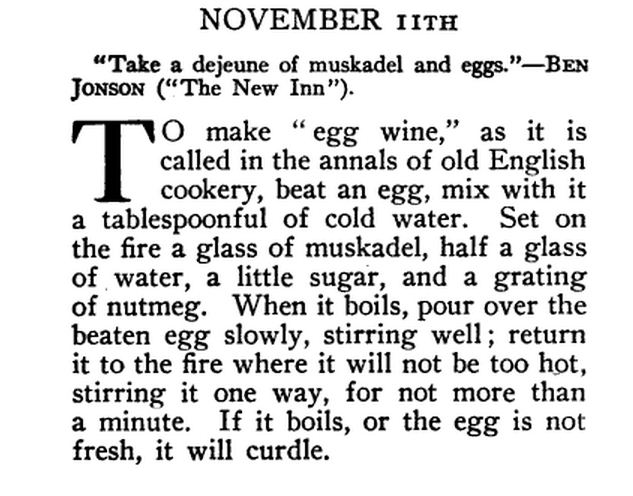
Ben Jonson’s Egg Wine

From Books and my food: with literary quotations and original recipes for every day of the year by Elisabeth Luther Cary and Annie Maria Jones

Literary Recipes

Fat Kitchen, Jan Steen

***

Enjoy Thanksgiving with our menu of literary recipes:

F. Scott Fitzgerald’s Turkey Twelve Ways

Zora Neale Hurston’s Mulatto Rice

Ian McEwan’s Fish Stew

James Joyce’s Burnt Kidney Breakfast

Herman Melville’s Whale Steaks

Ernest Hemingway’s Absinthe Cocktail, Death in the Afternoon

Vladimir Nabokov’s Eggs à la Nabocoque

Thomas Pynchon’s Banana Breakfast

Cormac McCarthy’s Turtle Soup

Robert Crumb’s Macaroni Casserole

Truman Capote’s Caviar-Smothered Baked Potatoes with 80-Proof Russian Vodka

Emily Dickinson’s Cocoanut Cake

Thomas Jefferson’s Vanilla Ice Cream

Charles Dickens’s Own Punch

Ben Jonson’s Egg Wine

Willam Faulkner’s Hot Toddy

Christmas Bonus:  George Orwell’s Recipes for Plum Cake and Christmas Pudding

William Faulkner’s Hot Toddy

Faulkner’s favorite drink is often listed as the julep, which is probably correct: his house in Oxford still displays his beloved metal julep cup. But his old standby was the toddy, which he describes “compounding … with ritualistic care.” It comes in two forms, hot and cold. Faulkner’s niece, Dean Faulkner Wells, clearly recalled her uncle making hot toddies and serving them to his ailing children on a silver tray. But unlike today, the cold toddy seems to have been the more popular in Faulkner’s day.

Recipe:

2 ounces of bourbon or white whiskey
4 ounces of water (cold or boiling)
If cold, 1 lemon slice; if hot, 1/2 lemon, both juice + rind
1 teaspoon of sugar

The key to a toddy, according to Faulkner, is that the sugar must be dissolved into a small amount of water before the whiskey is added, otherwise it “lies in a little intact swirl like sand at the bottom of the glass.” (One of Faulkner’s short stories, “An Error in Chemistry,” hinges on this point: a northern murderer, pretending to be a Southern gentleman, mistakenly mixes sugar with “raw whiskey”; the Southerners recognize his faux pas and immediately pounce on him.) Once the sugar is dissolved, the whiskey is poured over it. Top it off, to taste, with the remaining water—preferably “rainwater from a cistern.” Add lemon and serve in a heavy glass tumbler.

(Via).