Scary Stories: Scary Books–Part III

When was the last time you read Poe? Stories like “The Tell-Tale Heart” and “The Fall of the House of Usher” explore the ebb and flow of manic identity and the horror of displacement. These are rich texts. While you’re revisiting Poe, check out the lesser-known but masterful “Descent into the Maelstrom.”

I always read “The Raven” with my students on Halloween, and then we watch The Simpsons version of “The Raven” from one of the first “Treehouse of Horror” episodes.

Check it out!


This edition makes a great introduction to Kafka. “In the Penal Colony,” the horrific tale of a machine that kills you by inscribing your sentence on you, is pretty scary.

From Hell: Scary Books–Part II

 Alan Moore (writer), Eddie Campbell (artist).

Alan Moore’s well-researched, 500+ page graphic novel theorizes that the Jack the Ripper murders were in fact a conspiracy to get rid of a royal’s illegitimate child who posed a threat to the Victorian lineage. I can’t say enough good things about this book. I am a huge fan of graphic novels, and this is one of the best, right up there with Art Spiegelman’s Maus, Dave Sim’s Cerebus and Joe Sacco’s Palestine. The intricate plot involves Masonic conspiracy, Victorian sexual mores, 19th century surgery, insanity, and a blood ritual resulting in transcendental time travel. Eddie Campbell’s art does a wonderful tight-rope act in putting order to chaos. His scratchy inks burst with emotion–I can’t imagine a better artist for this story. I actually wonder if some of Moore’s other work (V for Vendetta, Watchmen) would resonate deeper with me had an artist of Campbell’s caliber (Bill Sienkiewicz or Mike Mignola, possibly) worked on those books. I doubt it though. I always recommend this book to persons who don’t think graphic novels are literary. I won’t loan it out though. I don’t want it to go MIA.

(By the way, the Hughes brothers-directed movie adaptation of this novel, starring Johnny Depp, IS NOT the same story at all. I know, hard to believe that Hollywood could screw up great source material, but nonetheless true).

Scary Books–Part I

I love Halloween.

Some favorite scary books:

The monster’s point of view.

One of my classes is reading this version of Macbeth right now. I know–the cover sucks (the cauldron look’s like a latte), but I think it makes a fantastic introduction to Shakespeare; great for highschool students.

 We’re also watching Roman Polanski’s 1971 film version.

macbeth1.jpg

 And who can deny this old chestnut?

Fun links, methinks

Ricotta Park is stealing my gig. Fair enough, considering my gig is stealing. RP does a few mini book reviews today, including a review of The Psychic Soviet by ex-Nation of Uylsses frontman Ian Svenonious. Some consider Ulysses by James Joyce to be the best book ever written in English. Not me though! (It’s Moby Dick, hands down).

Go hit up Troglogyte Mignon to see some art (you need it kid!) Her watercolors are humorous and often affecting. A sample below (reproduced with permission of the artist).

smitten-b.jpg smitten panty lovers unite troglodyte mignon art


I found BibliOdyssey when looking for other “biblio” blogs. I was crushed, green to the gills with envy. This blog is fantastic! Go get some knowledge.

Shelfari is MySpace for book nerds. Go set up a shelf and meet some people. Argue about books. Posit Hemmingway as way overrated, or find that certain somebody who also trucked their way through Celine’s Journey to the End of the Night.

If you live in Jacksonville, no doubt you already travel daily to The Urban Core and Urban Jacksonville. What’s that you say? You haven’t visited yet? Go get some awareness (local, son!) Urban Jax has a great post today on artist Dan May. Urban Core was kind enough to include this blog in his write-up of Top 10 Jacksonville Blogs (the ‘klept came in lucky number 7! woo!) Urban Core was voted the best blog in Jacksonville by local indie paper Folio Weekly.

More fun links and hi-jinks next week.

Abominable Fallout by Dan May. Copyright Dan May, 2006.

Graham Greene and Donnie Darko

The Portable Graham Greene, ed. Philip Stratford. I haven’t read a single story in this beautiful Viking Portable Library edition, save “The Destructors,” (full text here) (sorry, the page is no longer up [3/07]. Ed.) which I only read because it was referenced in one of my favorite movies, Donnie Darko.

I found this one in another teacher’s classroom. My uncle Lee had just given me a copy of Greene’s The Quiet American, which I finished in a weekend; it’s a slim, spare novel, and I enjoyed it quite a bit, despite the fact that Brendan Fraser was on the cover (the book was re-released to coincide with a film adaptation that I never saw). Anyway, I’d just read TQA, and I saw this beautiful Viking Portable Library edition (I’m a big fan of VPL), so I surreptitiously absconded with it only to never read it. A meaningless theft?

Anyway, last year a new director’s cut of Donnie Darko came out; the wife and I saw it at the San Marco Theater, I was reminded of the book, and read “The Destructors.” “The Destructors” is a simple story about a teenage gang that destroys a beautiful old house from the inside to the outside. “The Destructors” functions as an abyss structure or reading rule that informs the text-proper of Donnie Darko (it’s assigned reading from an English teacher). If you’re a fan of this movie (and if you’re not, why not?!) check out this story; it’s short and to the point. Flipping through it again, I realize that I should probably put The Portable Graham Greene back on the “To Read” stack.

If you haven’t seen Donnie Darko, enjoy the following review courtesy The Comic Critic.

Riddley Walker–Russell Hoban

I never gave Riddley Walker back to Patrick Tilford (aka TLFRD). A few years ago I loaned it to a student who never returned it. Said student never returned Dune, or The Left Hand of Darkness, or several Jules Verne novels either. Doesn’t matter, I know that he read them.

This book is a favorite. Russell Hoban’s coming-of-age story takes place in a future that has regressed to the iron age due to a catastrophic war. Hoban writes in his own language, a mutated English, full of fragments of the 20th century.

I couldn’t find an image of the edition I stole/lost. This edtion from 2000 features an introduction by Will Self, whose latest book, The Book of Dave, apparently was directly influenced by Riddley Walker. Will Self’s book Great Apes deeply, deeply disturbed me. Nothing repulses me more than images of chimpanzees dressed as humans; Great Apes is the literary equivalent.

Great Apes was an airport bookstore buy; I suppose at some point on this blog I will address the “airport bookstore buy.”

Microserfs

Microserfs, Douglas Coupland; loaned out, never to be returned. I remember this book as being relatively entertaining. I mostly recall the design of the book–very cool, playful, and ahead of its time. This book will be more interesting in twenty or twenty-five years. Coupland’s site: beautiful. 

http://www.coupland.com/

The Unknown

The Unknown is a sprawling hypertext novel. It’s basically a postmodern choose your own adventure written in a ludic, recursive style. It’s a jumble of ideas, authors (their faves–The Unknown are a collective of sorts–include Thomas Pynchon, Wm Burroughs and Michel Foucault), and half-cooked philosophies. 

Choose Your Own Adventure

I loved these things growing up. Images lead to fun links (or grisly death!)


The Crucible/Bohemian Grove

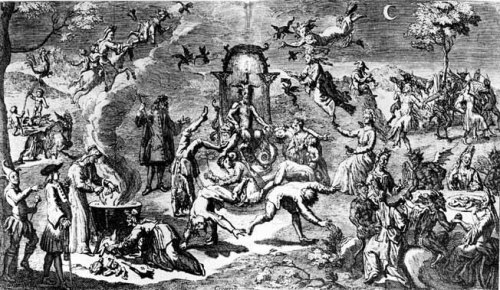
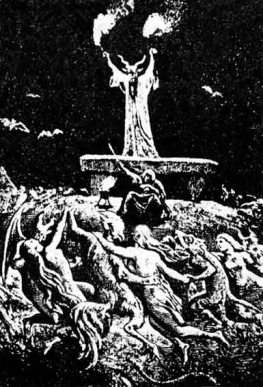
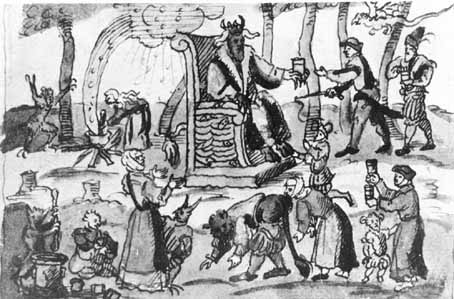
My 11th graders just finished The Crucible. Here are a few images that we looked at in class.

sabbath-12.jpg

sabbath-16.jpg

sabbath-11.jpg

These images remind me of a video I saw a couple of years ago, Inside the Bohemian Grove. This video claims to expose the bizarre rituals of the Bohemian Club, a secret society of world leaders, industrialists, and so on. The important people. To get a relatively mainstream take on the Bohemian Grove meetings go here; of course the internet hordes an abundance of (mis?)information on the BG. Just google it. File under Illuminati/conspiracy/paranoia.

 Here’s an image of a Bohemian Grove ritual from a 1915 issue of National Geographic.


Philip K. Dick Cover Art Gallery


Via an excellent and fun blog, robertmonroe.org, a gallery of PKD covers. Check out the gallery here.

Fear and Loathing in Las Vegas


I procured this from my cousin’s closet. My cousin Tripp is ten years older than me; he was in college at the time and I was staying with my aunt and uncle over the summer, in his old bedroom. I’m pretty sure both he and my uncle recommended that I read Fear and Loathing in Las Vegas. The edition (not pictured above–I couldn’t find the one I snagged, but it had a similar cover–more on the cover below) could have belonged to Tripp, but it may have belonged to my uncle.  

Reading Fear and Loathing was an initiation into some kind of new literature for me. It opened the way to authors like Vonnegut, Wm Burroughs, Herman Hesse, JD Salinger (admittedly, I read some Tom Robbins in this period as well. Ugh). Before HST I was reading lots and lots of science fiction and fantasy books, both classic and trash. I had also read lots of the “adventure classics,” stuff like Robinson Crusoe and Dracula and Great Expectations and the Tarzan novels. And comic books. Always comic books. But Fear and Loathing was something new for me; it combined the fantasy and adventure and weirdness I’d been reading with a political ethos and a sense of social-reality-via-unreality. Surreality. Fear and Loathing contained a whole new set of reading rules for me, chief among them: irony and paradox. All of a sudden, the verity of all past narrators was cast into doubt. I was savvy now. I was ironized. I was, y’know, hip to what may be under a text now, whereas before I was just scanning the text. Or at least it seemed that way. Looking back, I don’t know for sure. 

Of course I lent this book out to anyone who seemed vaguely interested. I did this for years, and amazingly, the book kept coming back to me. Must be some mystical sign when I think about it. Who returns books? I loaned it out all the way through college before it finally escaped me for ever. I’m not sure who has it now. At the point this particular edition left me forever, it had a duck-tape cover with title and author in Sharpie-font, courtesy of one innovative reader. I like to think others were initiated by it, but I know that most of the readers I lent it to had already read their revelation-text, whether it was that Kerouac book or Slaughterhouse Five or Kafka’s The Metamorphosis. And I haven’t read this book in years, although I’m a big fan of Terry Gilliam’s movie. Still, it’ll always have a special place in my trunk full of drugs–er, heart.

Moby Dick

Another one courtesy of the Andrew Jackson High School Library. Not really a straight up theft; it was a remainder that the librarian gave to me.

This is one of the best books I’ve ever read, right up there with Infinite Jest, King Lear, and The Fortress of Solitude. Everyone should read this book before they die.

Blue (Moby Dick), Jackson Pollock. 1943.

James Weldon Johnson — Part II

In 1912, James Weldon Johnson anonymously published The Autobiography of an Ex-Colored Man. It was later republished under Johnson’s name in 1927, at the acme of the Harlem Renaissance.

The Autobiography of an Ex-Colored Man strikes me as a thoroughly postmodern move. This fictional novel is presented as the true life story of a talented man who chooses to “pass” as white so that he might have greater–or at least equal–access to opportunity in America. Autobiography is a fictional novel “passing” as another genre, autobiography. This mirroring wasn’t intended as just a fancy rhetorical device–it was a subversive, incendiary gesture on JWJ’s part, meant to question the mores of white America. In fact, after it’s initial publication, several reviews were written suggesting that the book was a hoax, the premise of these reviews being that a black man could never pass as a white man–let alone marry a white woman and become a landowner of some importance.

Ultimately, the voice in Autobiography problematizes all easy readings. The ex-colored man is a bona fide narcissist with an almost preternatural ability to succeed at everything he attempts–except of course when he is thwarted by racist social norms. The reader seems most encouraged to sympathize with the narrator at these times, when the ex-colored man’s natural and cultivated abilities are confronted or ousted by the dominant system. At other times, the narrator condescends working class blacks he terms “inferior”; he also frequently wishes to sanitize “primitive” forms of black art, such as spirituals and ragtime music, by recasting them in a classical, canonical mode. The ex-colored man clearly feels frustration that the acumen of his genius is constantly delimited by his color, but this frustration sometimes seems aimed at his fellow blacks.

All of this makes for a challenging but brisk and enjoyable read. Paired with JWJ’s real autobiography, Along This Way, a savvy reader can come up with all kinds of ironic, postmodern readings. Or straightforward readings. Or whatever. Read it yourself.

James Weldon Johnson — Part I

Everything in Jacksonville, Florida should be named after native son James Weldon Johnson.


Well, maybe not everything–that could get confusing. But as it stands, the only thing we Jacksonvillians have bearing that great man’s name is a middle school, and an obscure plaque somewhere downtown–which is great. People love plaques.

James Weldon Johnson Middle School feeds Stanton College Preparatory School, an excellent school that JWJ served as principal of from 1894 to 1902. In the interest of full disclosure, I should point out that I’m a proud graduate of the Stanton School (go Blue Devils!). Under JWJ’s plan, Stanton became the first black high school in Florida. In his autobiography, Along This Way, JWJ discloses the genius of his plans for educational reform: he simply asked the eighth grade class to come back again, partitioned off some rooms, and based the new high school program on the curriculum of his alma mater Atlanta University (now known as Clark). The real genius of this is that he didn’t bother to ask the all-white board of education, who undoubtedly would’ve found some way to say “no.” He just did it, and then let the board come see what he had done. Brilliant.

Why isn’t there a single prominent statue of JWJ in Jacksonville? Or a library named after him? Or even a street? It seems to me that the average Jacksonvillian simply isn’t aware of JWJ, or has only a passing knowledge of who he was, not realizing that he was born and raised here.

So:

1. I will continue writing about James Weldon Johnson on this blog.

2. I challenge every Jacksonvillian to read a book by James Weldon Johnson.

 3. Maybe if we read his books, we’ll come to feel his genius, celebrate the fact that he is from our hometown, and honor him appropriately.

Rear Window

I promise I’ll return this one.

This book makes a great introduction to film writing, although I’m not sure it’s necessarily for film fans — more of a theory book, really. This book is from my uncle’s library; for years now, whenever I visit my aunt and uncle down in the Gulf Coast, I pick this book up and read from it. My uncle also has a fantastic book of essays on Lynch’s Blue Velvet. The essays in Alfred Hitchcock’s Rear Window (ed. John Belton), written largely in the deconstructionist, post-Derrida vein, did much to influence my own college tries at film writing. I realize now that I learned more about contemporary theory (Lacanian psycholinguistics, Mulvey’s “the gaze,” etc) through these essays than I ever did in a classroom lecture. 

I didn’t mean to take this book; I’ll blame this one on the wife. Last time we stayed down in St. Pete Beach, I guess I had left the book out and she simply packed it up. We’re supposed to go down there this weekend; again, I promise to return it.

rear.jpg

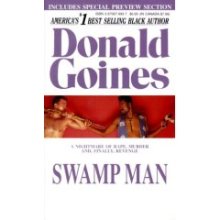
Swamp Man

This one is kind of a double-library theft

The librarian at the high school I teach at keeps a pile of books from the public library system that are mistakenly returned to our school library. I couldn’t help but notice Donald Goines’ Swamp Man on top, with it’s strange, somewhat homoerotic cover. I knew right away that I was going to take it. This book was due back to the Regency Square Library,  October 13th, 2000.

swamp-man.jpg

Written in 1974, Swamp Man taps into that whole 70s-creepy-shenanigans-rape-in-the-woods-Deliverance vibe. In the backwood swamps of Mississippi, George Jackson hunts down the evil racist crackers who have kidnapped and gangraped his sister Henrietta, killing them off one at a time, swamp man-style.

Goines, a former heroin addict, started writing in prison, cranking out 16 books in five years. He was shot to death in 1974.