Mass-market Monday | John Barth’s End of the Road

End of the Road, 1958, by John Barth. Avon Books (1960). No cover artist or designer credited. 158 pages.

I already owned a more attractive edition of John Barth’s The End of the Road (or End of the Road as the title is given in this edition), but I couldn’t pass up on the odd rounded corners.

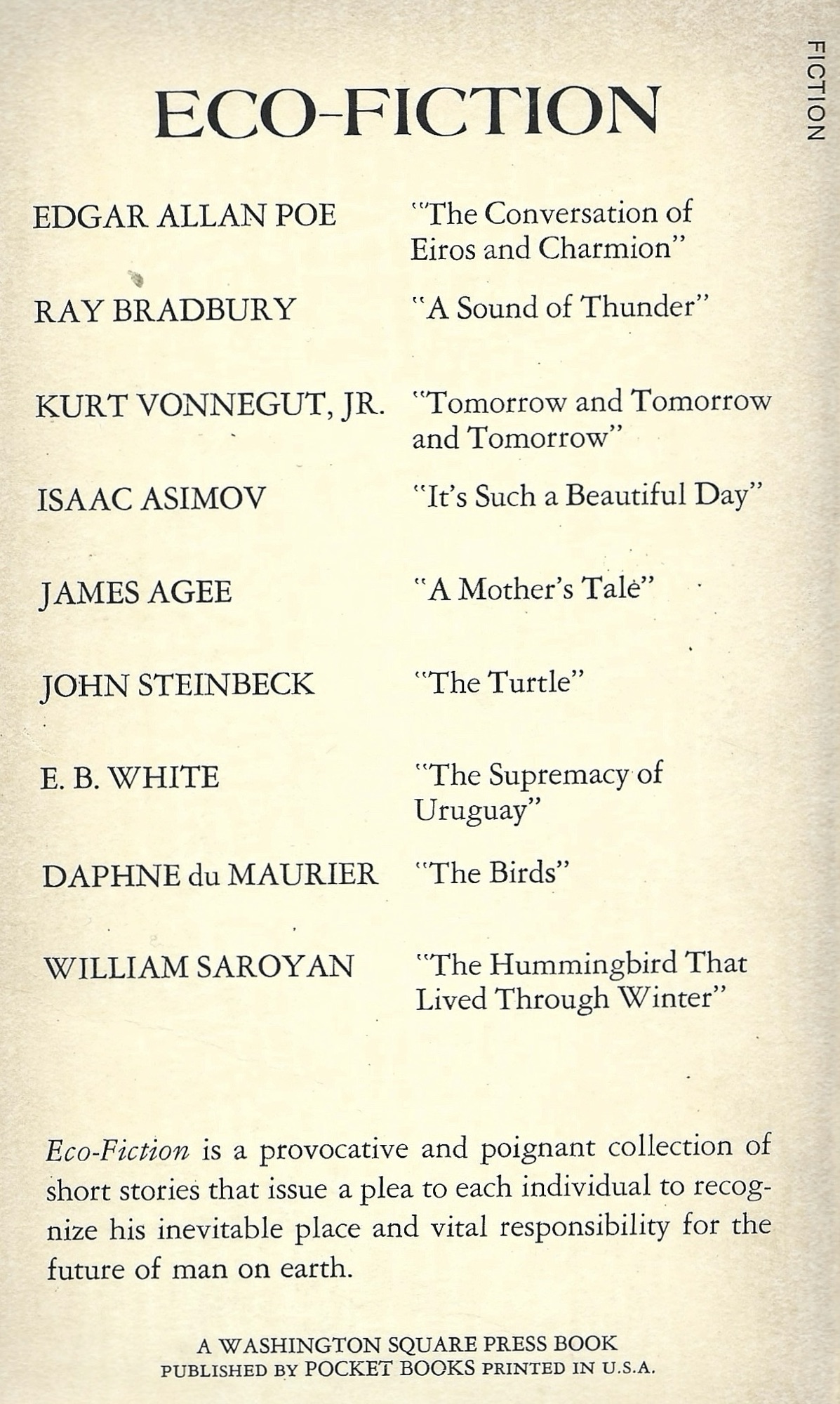
Mass-market Monday | Eco-Fiction

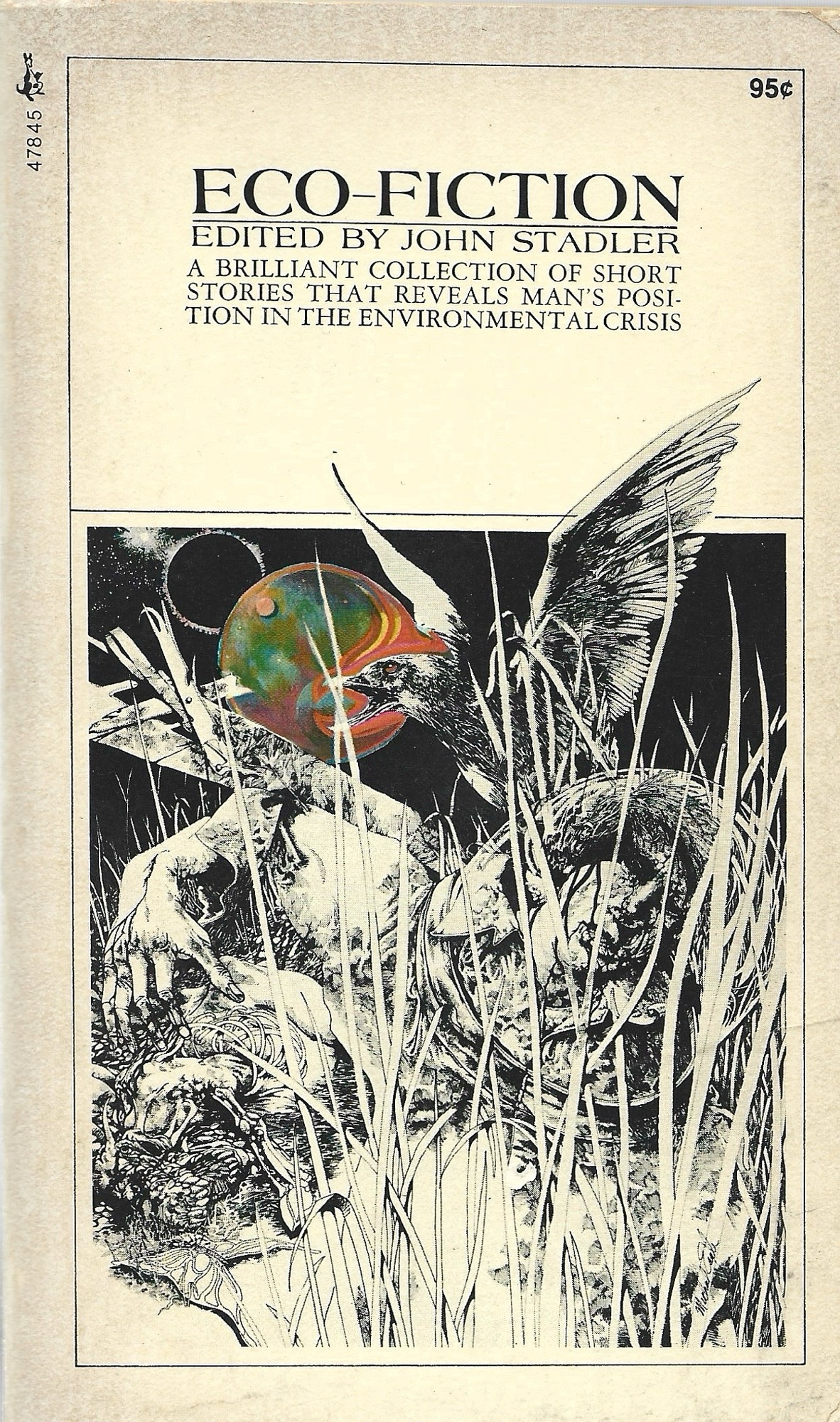
Eco-Fiction, 1971, ed. John Stadler. Pocket Books (1971). No cover artist or designer credited. 206 pages.

The cover art is by Michael Eagle (you can see his signature in the illustration).

In addition to the names listed on the back cover, this collection also features stories by J.G. Ballard, Frank Herbert, J.F. Powers and more.

The vignette “The Turtle” condenses all of The Grapes of Wrath–and most of Steinbeck’s themes in general–into four paragraphs.


“The Turtle”

by

John Steinbeck

The concrete highway was edged with a mat of tangled, broken, dry grass, and the grass heads were heavy with oat beards to catch on a dog’s coat, and foxtails to tangle in a horse’s fetlocks, and clover burrs to fasten in sheep’s wool; sleeping life waiting to be spread and dispersed, every seed armed with an appliance of dispersal, twisting darts and parachutes for the wind, little spears and balls of tiny thorns, and all waiting for animals or the hem of a woman’s skirt, all passive but armed with appliances of activity, still, but each possessed of the anlage of movement.

The sun lay on the grass and warmed it, and in the shade under the grass the insects moved, ants and ant lions to set traps for them, grasshoppers to jump into the air and flick their yellow wings for a second, sow bugs like little armadillos, plodding restlessly on many tender feet. And over the grass at the roadside a land turtle crawled, turning aside for nothing, dragging his high-domed shell over the grass: His hard legs and yellow-nailed feet threshed slowly through the grass, not really walking, but boosting and dragging his shell along. The barley beards slid off his shell, and the clover burrs fell on him and rolled to the ground. His horny beak was partly opened, and his fierce, humorous eyes, under brows like fingernails, stared straight ahead. He came over the grass leaving a beaten trail behind him, and the hill, which was the highway embankment, reared up ahead of him. For a moment he stopped, his head held high. He blinked and looked up and down. At last he started to climb the embankment. Front clawed feet reached forward but did not touch. The hind feet kicked his shell along, and it scraped on the grass, and on the gravel. As the embankment grew steeper and steeper, the more frantic were the efforts of the land turtle. Pushing hind legs strained and slipped, boosting the shell along, and the horny head protruded as far as the neck could stretch. Little by little the shell slid up the embankment until at last a parapet cut straight across its line of march, the shoulder of the road, a concrete wall four inches high. As though they worked independently the hind legs pushed the shell against the wall. The head upraised and peered over the wall to the broad smooth plain of cement. Now the hands, braced on top of the wall, strained and lifted, and the shell came slowly up and rested its front end on the wall. For a moment the turtle rested. A red ant ran into the shell, into the soft skin inside the shell, and suddenly head and legs snapped in, and the armored tail clampled in sideways. The red ant was crushed between body and legs. And one head of wild oats was clamped into the shell by a front leg. For a long moment the turtle lay still, and then the neck crept out and the old humorous frowning eyes looked about and the legs and tail came out. The back legs went to work, straining like elephant legs, and the shell tipped to an angle so that the front legs could not reach the level cement plain. But higher and higher the hind legs boosted it, until at last the center of balance was reached,  the front tipped down, the front legs scratched at the pavement, ad it was up. But the head of wild oats was held by its stem around the front legs.

Now the going was easy, and all the legs worked, and the shell boosted along, waggling from side to side. A sedan driven by a forty-year-old woman approached, She saw the turtle and swung to the right, off the highway, the wheels screamed and a cloud of dust boiled up. Two wheels lifted for a moment and then settled. The car skidded back onto the road, and went on, but more slowly. The turtle had jerked into its shell, but now it hurried on, for the highway was burning hot.

And now a light truck approached, and as it came near, the driver saw the turtle and swerved to hit it. His front wheel struck the edge of the shell, flipped the turtle like a tiddly-wink, spun it like a coin, and rolled it off the highway. The truck went back to its course along the right side. Lying on its back, the turtle was tight in its shell for a long time. But at last its legs waved in the air, reaching for something to pull it over. Its front foot caught a piece of quartz and little by little the shell pulled over and flopped upright. The wild oat head fell out and three of the spearhead seeds stuck in the ground. And as the turtle crawled on down the embankment, its shell dragged dirt over the seeds. The turtle entered a dust road and jerked itself along, drawing a wavy shallow trench in the dust with its shell. The old humorous eyes looked ahead, and the horny beak opened a little. His yellow toe nails slipped a fraction in the dust.

Mass-market Monday | The Essential James Joyce

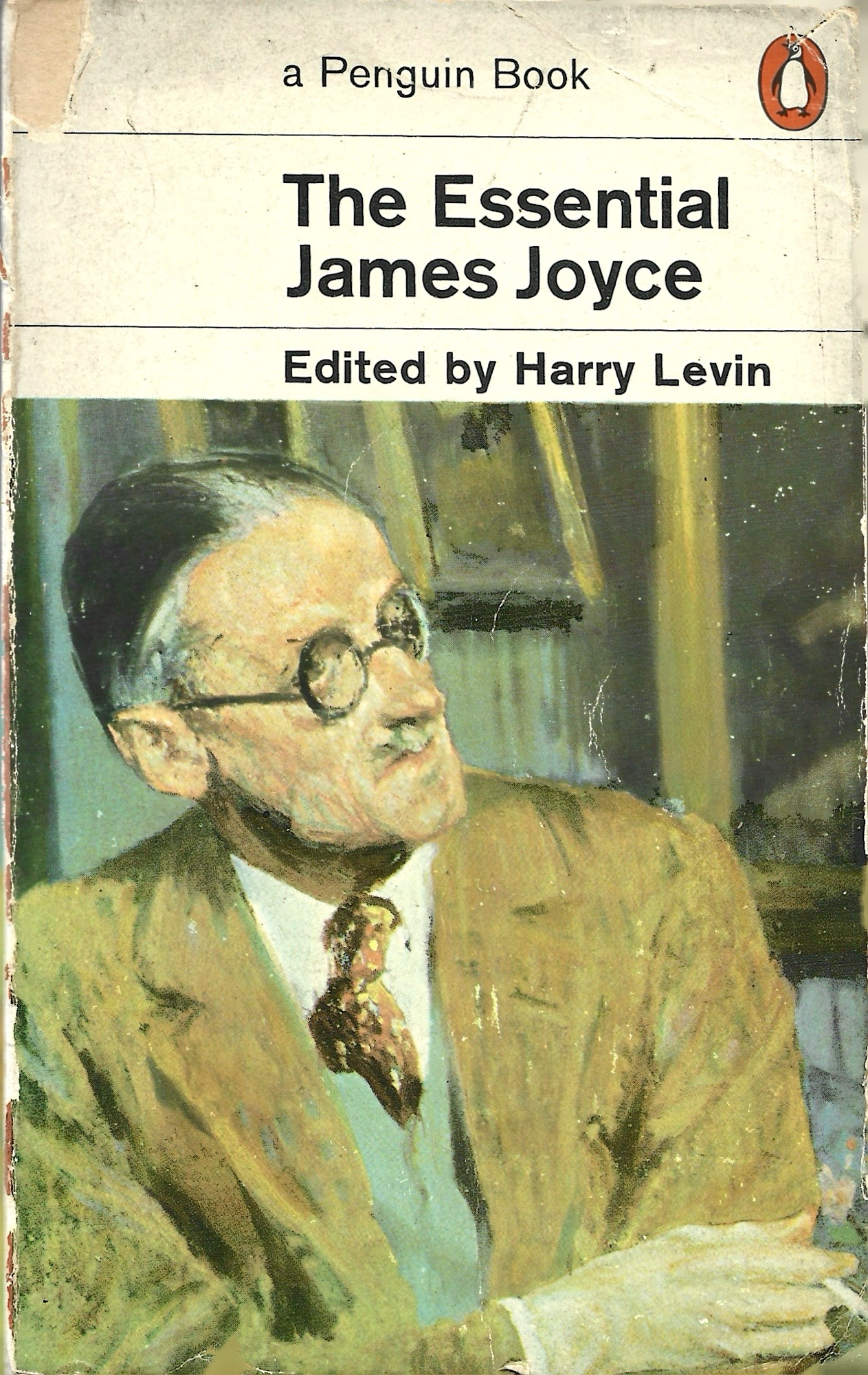
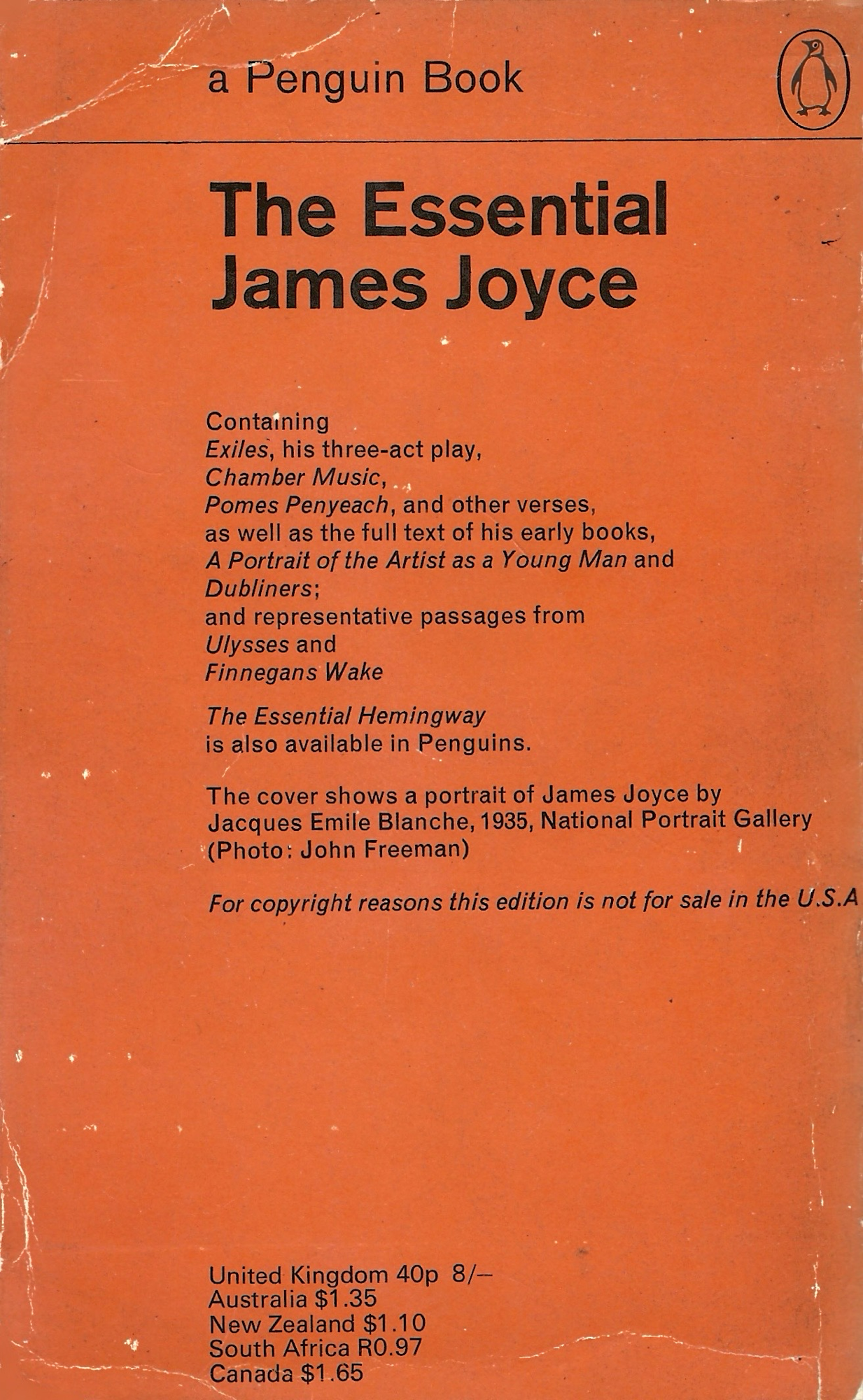
The Essential James Joyce, 1948, ed. Harry Levin. Penguin Books (1969). Cover art by Jacques Emile Blanche; photographed by John Freeman. 550 pages.

I found this book on the street in Shin-Kōenji, the neighborhood I lived in in Tokyo twenty-five years ago. It was, if I recall, stacked on top of a pile of pornographic manga. I may have taken those as well. Happy Bloomsday!

Mass-market Monday | Muriel Spark’s Memento Mori

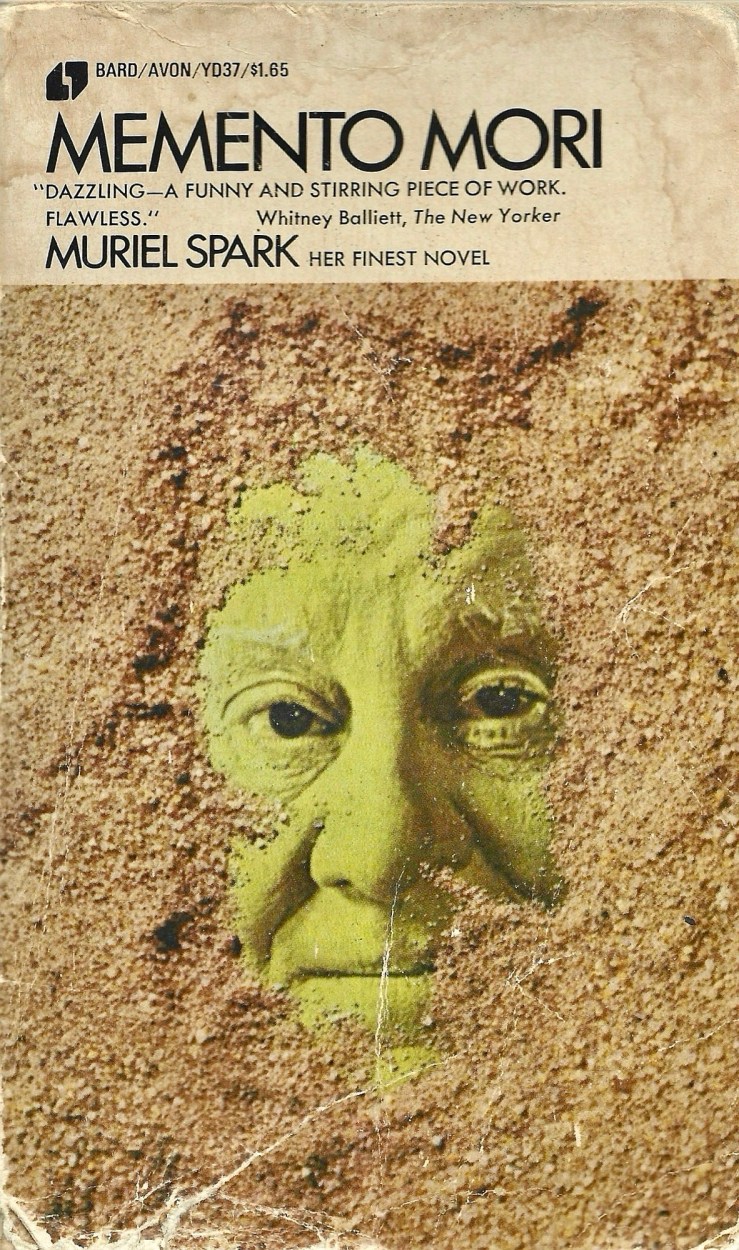
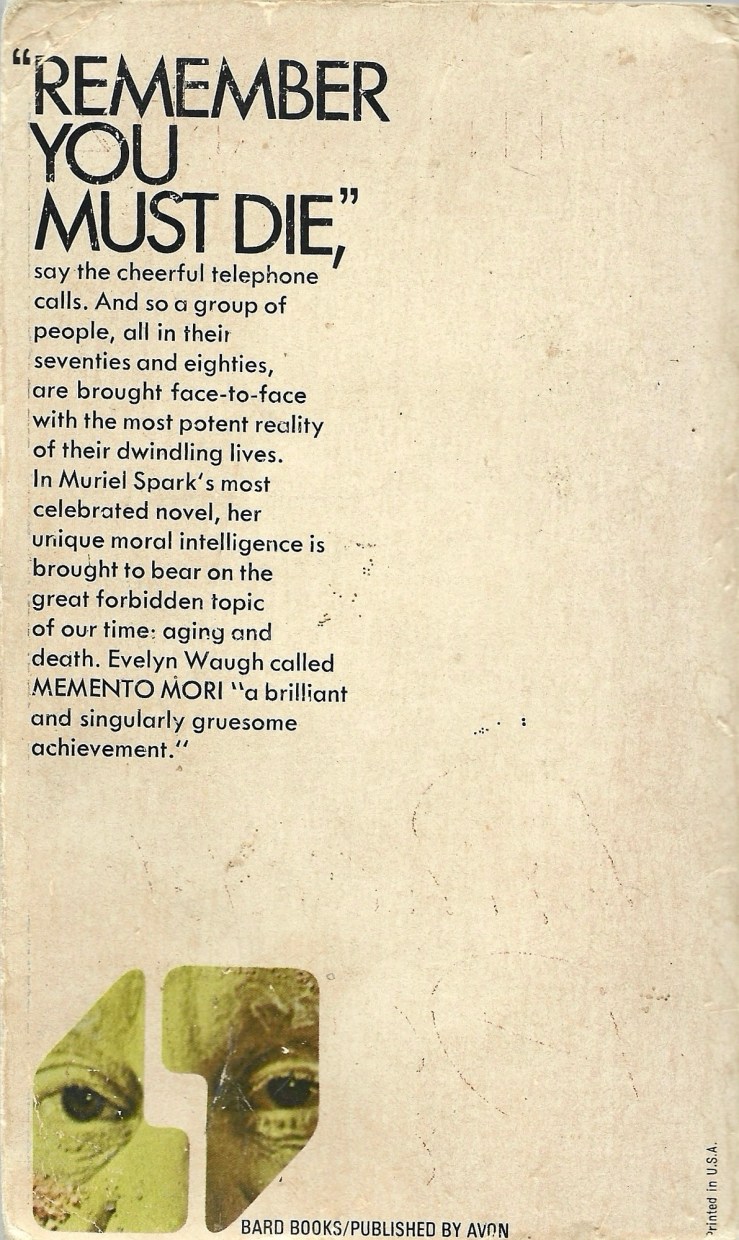
Memento Mori, 1954, Muriel Spark. Avon Bard (1978). No cover artist or designer credited. 191 pages.

From David Lodge’s 2010 reappraisal of the novel in The Guardian:

The fiction of the 50s was dominated by a new wave of social realism, represented by novels such as Lucky Jim, Saturday Night and Sunday Morning, and Room at the Top, whose originality lay in tone and attitude rather than technique. Typically they were narrated in the first person or in free indirect style, articulating the consciousness of a single character, usually a young man, whose rather ordinary but well observed life revealed new tensions and fault-lines in postwar British society. An unsympathetic character in Memento Mori called Eric has evidently written two dispiriting works of this kind. Memento Mori itself was an utterly different and virtually unprecedented kind of novel. It is a short book, but it has a huge cast of characters, to nearly all of whose minds the reader is given access. The speed and abruptness with which the narrative switches from one point of view to another, managed and commented on by an impersonal but intrusive narrator, is a distinguishing feature of nearly all Spark’s fiction, and it violated the aesthetic rules not only of the neorealist novel, but also of the modernist novel from Henry James to Virginia Woolf. Spark was a postmodernist writer before that term was known to literary criticism. She took the convention of the omniscient author familiar in classic 19th-century novels and applied it in a new, speeded-up, throwaway style to a complex plot of a kind excluded from modern literary fiction – in this case involving blackmail and intrigues over wills, multiple deaths and discoveries of secret scandals, almost a parodic update of a Victorian sensation novel. And she added to the mix an element of the uncanny, through which the existence of a transcendent, eternal and immaterial reality impinges on the lives of her ageing characters, reminding them of their mortality.

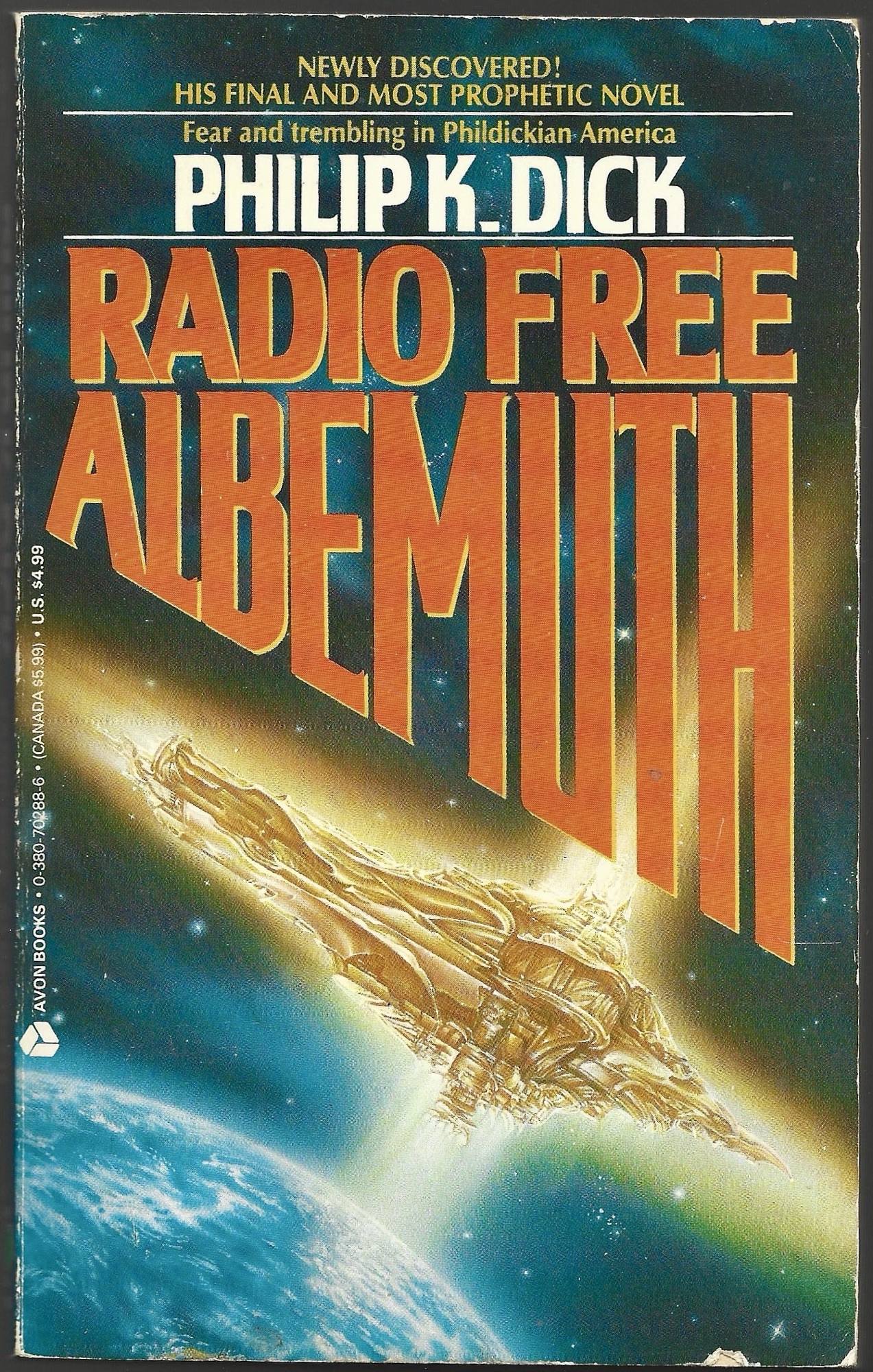
Mass-market Monday | Philip K. Dick’s Radio Free Albemuth

Radio Free Albemuth, 1985, Philip K. Dick. Avon Bard (1987). Cover art by Ron Walotsky. 212 pages.

From Philip K. Dick’s posthumous (and likely never-fully revised) novel Radio Free Albemuth:

The human being has an unfortunate tendency to wish to please.

I was in effect exactly like those captured Americans: a prisoner of war. I had become that in November 1968 when F.F.F. got elected. So had we all; we now dwelt in a very large prison, without walls, bounded by Canada, Mexico, and two oceans. There were the jailers, the turnkeys, the informers, and somewhere in the Midwest the solitary confinement of the special internment camps. Most people did not appear to notice. Since there were no literal bars or barbed wire, since they had committed no crimes, had not been arrested or taken to court, they did not grasp the change, the dread transformation, of their situation. It was the classic case of a man kidnapped while standing still. Since they had been taken nowhere, and since they themselves had voted the new tyranny into power, they could see nothing wrong. Anyhow, a good third of them, had they known, would have thought it w
as a good idea. As F.F.F. told them, now the war in Vietnam could be brought to an honorable conclusion, and, at home, the mysterious organization Aramchek could be annihilated. The Loyal Americans could breathe freely again. Their freedom to do as they were told had been preserved.

I returned to the typewriter and drafted another statement. It was important to do a good job.

Mass-market Monday | Ivan Ângelo’s The Celebration

The Celebration, 1975, Ivan Ângelo. Translation by Thomas Colchie. Avon Bard (1982). No cover designer or artist credited. 223 pages.

From Theodore McDermott’s review of The Celebration in Context:

You can see something of Borges in The Celebration: in the way that the central event of the book—the event that gives it its title—is absent from its pages. You can see something of Cortázar in the way the chronology coils around and crosses over itself. You can see something of Nabokov in the fictional annotations that retell the story from an entirely new vantage, implying an endless number of other versions as yet untold. You can see something of Barth in the stylistic variations. You can see something of Machado de Assis, Osman Lins, and Ignacio Loyola Brandao in the peculiarly Brazilian integration of remarkable formal innovation and social and political engagement.
You can see all of this, but what’s most apparent, and most important, is that Ângelo has written a book unlike any other.

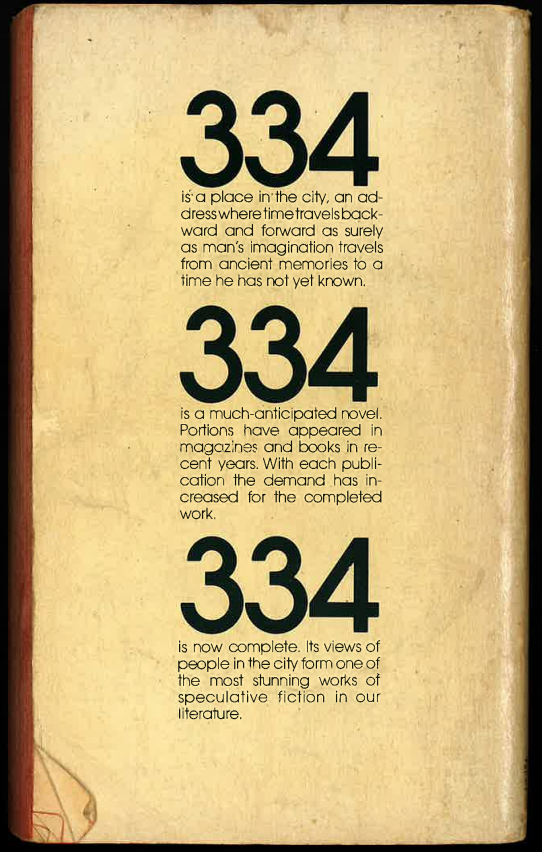
Mass-market Monday | Thomas M. Disch’s 334

334, 1972, Thomas M. Disch. Avon Bard (1974). No cover designer or artist credited. 269 pages.

Disch’s dystopian novel 334 is comprised of five separate but related novellas. The stories are set in and around the year 2025. Here’s “The Teevee,” the first vignette of the last novella in the collection, 334:

“The Teevee (2021)”

Mrs. Hanson liked to watch television best when there was someone else in the room to watch with her, though Shrimp, if the program was something she was serious about—and you never knew from one day to the next what that might be—, would get so annoyed with her mother’s comments that Mrs. Hanson usually went off into the kitchen and let Shrimp have the teevee to herself, or else to her own bedroom if Boz hadn’t taken it over for his erotic activities. For Boz was engaged to the girl at the other end of the corridor and since the poor boy had nowhere in the apartment that was privately his own except one drawer of the dresser they’d found in Miss Shore’s room it seemed the least she could do to let him have the bedroom when she or Shrimp weren’t using it.

With Boz when he wasn’t taken up with l‘amour, and with Lottie when she wasn’t flying too high for the dots to make a picture, she liked to watch the soaps. As the World Turns. Terminal Clinic. The Experience of Life. She knew all the ins and outs of the various tragedies, but life in her own experience was much simpler: life was a pastime. Not a game, for that would have implied that some won and others lost, and she was seldom conscious of any sensations so vivid or threatening. It was like the afternoons of Monopoly with her brothers when she was a girl: long after her hotels, her houses, her deeds, and her cash were gone, they would let her keep moving her little lead battleship around the board collecting her $200, falling on Chance and Community Chest, going to Jail and shaking her way out. She never won but she couldn’t lose. She just went round and round. Life.

But better than watching with her own children she liked to watch along with Amparo and Mickey. With Mickey most of all, since Amparo was already beginning to feel superior to the programs Mrs. Hanson liked best—the early cartoons and the puppets at five-fifteen. She couldn’t have said why. It wasn’t just that she took a superior sort of pleasure in Mickey’s reactions, since Mickey’s reactions were seldom very visible. Already at age five he could be as interior as his mother. Hiding inside the bathtub for hours at a time, then doing a complete U-turn and pissing his pants with excitement. No, she honestly enjoyed the shows for what they were—the hungry predators and their lucky prey, the good-natured dynamite, the bouncing rocks, the falling trees, the shrieks and pratfalls, the lovely obviousness of everything. She wasn’t stupid but she did love to see someone tiptoeing along and then out of nowhere: Slam! Bank! something immense would come crashing down on the Monopoly board scattering the pieces beyond recovery. “Pow!” Mrs. Hanson would say and Mickey would shoot back, “Ding-Dong!” and collapse into giggles. For some reason “Ding-Dong!” was the funniest notion in the world.

“Pow!”

“Ding-Dong!” And they’d break up.

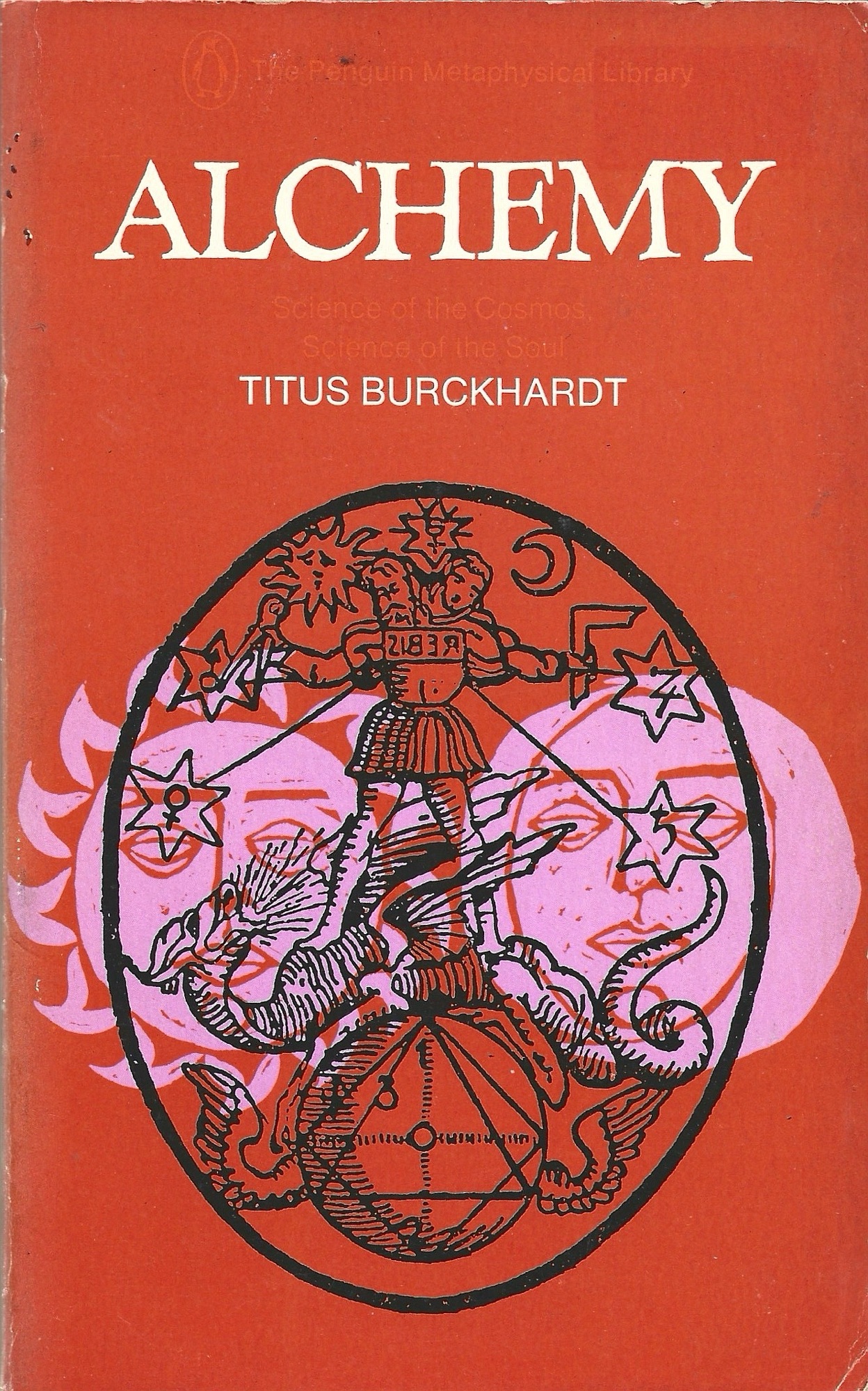
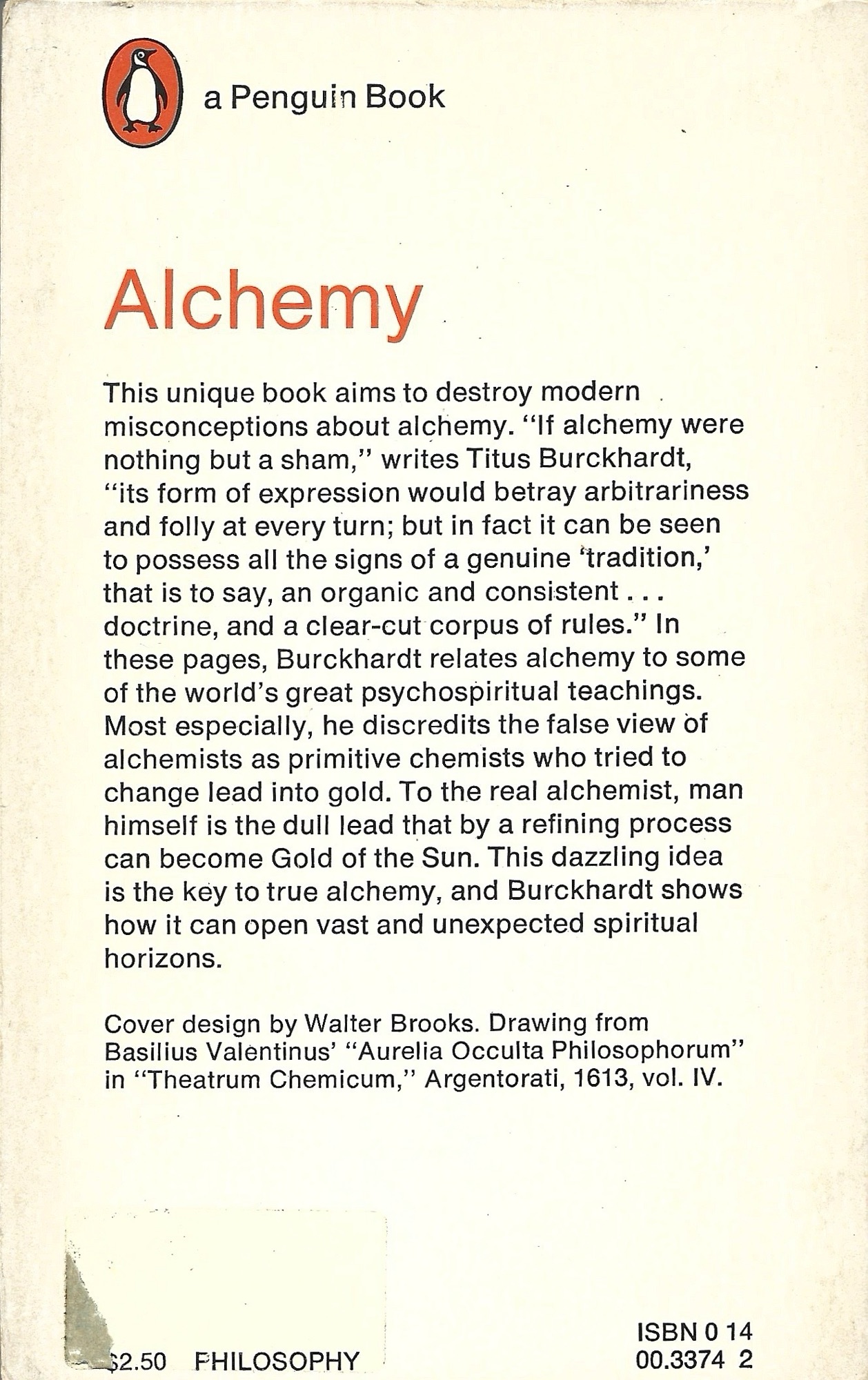
Mass-market Monday | Titus Burckhardt’s Alchemy

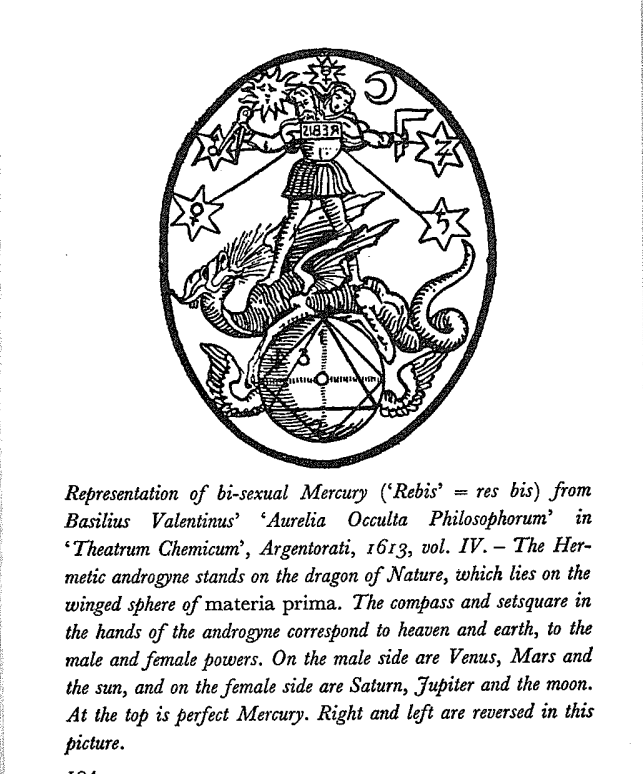
Alchemy, 1960, Titus Burckhardt. Translation by William Stoddart. Penguin Books (1971). Cover design by Walter Brooks employing an illustration from Basilius Valentinus’ Aurelia Occulta Philosophorum. 206 pages.

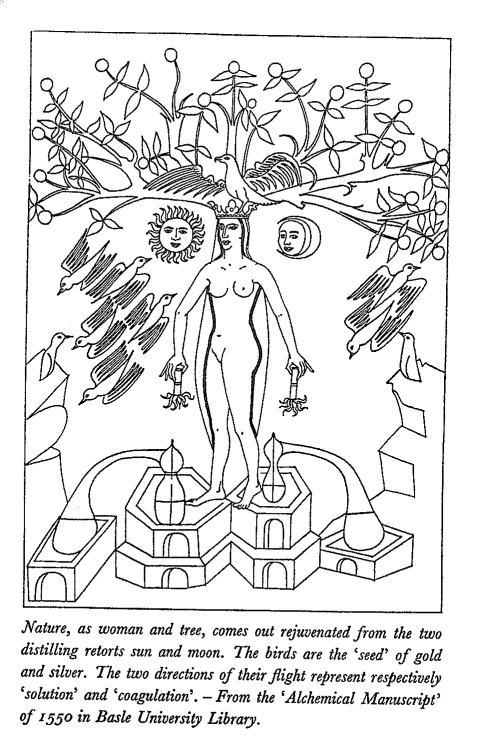
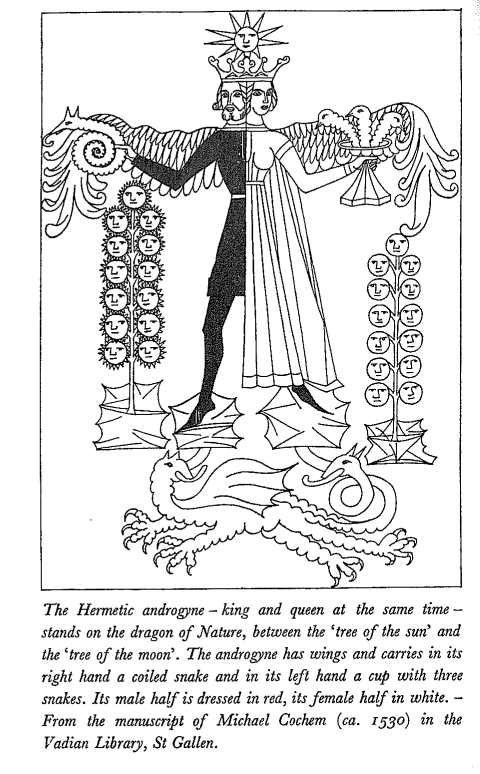
From Alchemy:

Mass-market Monday | Tadeusz Konwicki’s A Dreambook for Our Time

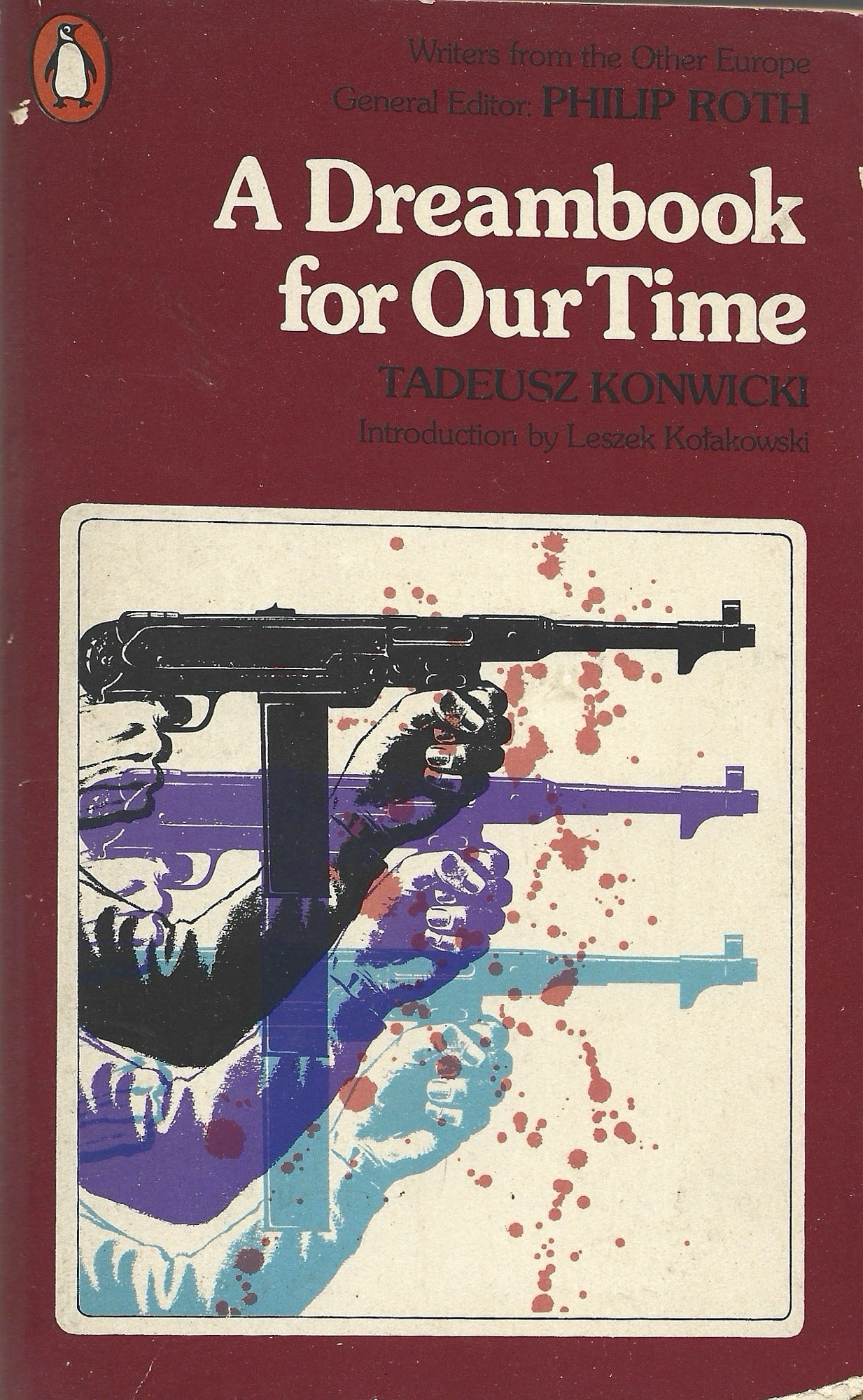
A Dreambook for Our Time, 1963, Tadeusz Konwicki. Translation by David Welsh. Penguin Books (1976). Cover illustration by Christopher Davis; cover design by Walter Brooks. 282 pages.

Mass-market Mondays | Flann O’Brien’s Stories and Plays

Stories and Plays, collected 1974, Flann O’Brien. Penguin Books (1977). Cover design by Neil Stuart. 208 pages.

From “A Bash in the Tunnel” —

James Joyce was an artist. He has said so himself. His was a case of Ars gratia Artist. He declared that he would pursue his artistic mission even if the penalty was as long as eternity itself. This seems to be an affirmation of belief in Hell, therefore of belief in Heaven and God.

Mass-market Monday | J.G. Ballard’s Hello America

Hello America, 1981, J.G. Ballard. Triad Grenada (1983). Cover illustration by Tim White. 236 pages.

Today’s mass-market Monday selection was inspired by last night’s rewatch of David Cronenberg’s 1975 film Shivers. Shivers’ first fortyish minutes play as one of the more persuasive Ballardian commitments to film—more Ballardian than Cronenberg’s Crash (2016) or Ben Wheatley’s High-Rise (2015). Indeed, Shivers is an aesthetic foster twin to Ballard’s novel High-Rise, born the same year. High-Rise is far superior to Hello America, but I think Hello America is probably better than it comes off in my short review from 2022:

You’d think a novel where President Manson wants to make America great Again would feel more prescient, but Ballard’s so in love here with the sparkle and pop of Pop Art America that he fails to attend to the dirt, grease, and grime that make the machine run. A fun novel, but its contemporary currency is squashed not so much by historical reality as the weight of Ballard’s oeuvre before it.

Mass-market Monday | Aldous Huxley’s The Doors of Perception

The Doors of Perception, 1955, Aldous Huxley. Perennial Library (1970). Cover design by Pat Steir. 79 pages.

Here’s Huxley on mescaline, marveling at the folds of cloth in Botticelli’s Judith:

Civilized human beings wear clothes, therefore there can be no portraiture, no mythological or historical storytelling without representations of folded textiles. But though it may account for the origins, mere tailoring can never explain the luxuriant development of drapery as a major theme of all the plastic arts. Artists, it is obvious, have always loved drapery for its own sake – or, rather, for their own. When you paint or carve drapery, you are painting or carving forms which, for all practical purposes, are nonrepresentational-the kind of unconditioned forms on which artists even in the most naturalistic tradition like to let themselves go. In the average Madonna or Apostle the strictly human, fully representational element accounts for about ten per cent of the whole. All the rest consists of many colored variations on the inexhaustible theme of crumpled wool or linen. And these non-representational nine-tenths of a Madonna or an Apostle may be just as important qualitatively as they are in quantity. Very often they set the tone of the whole work of art, they state the key in which the theme is being rendered, they express the mood, the temperament, the attitude to life of the artist. Stoical serenity reveals itself in the smooth surfaces, the broad untortured folds of Piero’s draperies. Torn between fact and wish, between cynicism and idealism, Bernini tempers the all but caricatural verisimilitude of his faces with enormous sartorial abstractions, which are the embodiment, in stone or bronze, of the everlasting commonplaces of rhetoric – the heroism, the holiness, the sublimity to which mankind perpetually aspires, for the most part in vain. And here are El Greco’s disquietingly visceral skirts and mantles; here are the sharp, twisting, flame-like folds in which Cosimo Tura clothes his figures: in the first, traditional spirituality breaks down into a nameless physiological yearning; in the second, there writhes an agonized sense of the world’s essential strangeness and hostility. Or consider Watteau; his men and women play lutes, get ready for balls and harlequinades, embark, on velvet lawns and under noble trees, for the Cythera of every lover’s dream; their enormous melancholy and the flayed, excruciating sensibility of their creator find expression, not in the actions recorded, not in the gestures and the faces portrayed, but in the relief and texture of their taffeta skirts, their satin capes and doublets. Not an inch of smooth surface here, not a moment of peace or confidence, only a silken wilderness of countless tiny pleats and wrinkles, with an incessant modulation – inner uncertainty rendered with the perfect assurance of a master hand – of tone into tone, of one indeterminate color into another. In life, man proposes, God disposes. In the plastic arts the proposing is done by the subject matter; that which disposes is ultimately the artist’s temperament, proximately (at least in portraiture, history and genre) the carved or painted drapery. Between them, these two may decree that a fete galante shall move to tears, that a crucifixion shall be serene to the point of cheerfulness, that a stigmatization shall be almost intolerably sexy, that the likeness of a prodigy of female brainlessness (I am thinking now of Ingres’ incomparable Mme. Moitessier) shall express the austerest, the most uncompromising intellectuality.

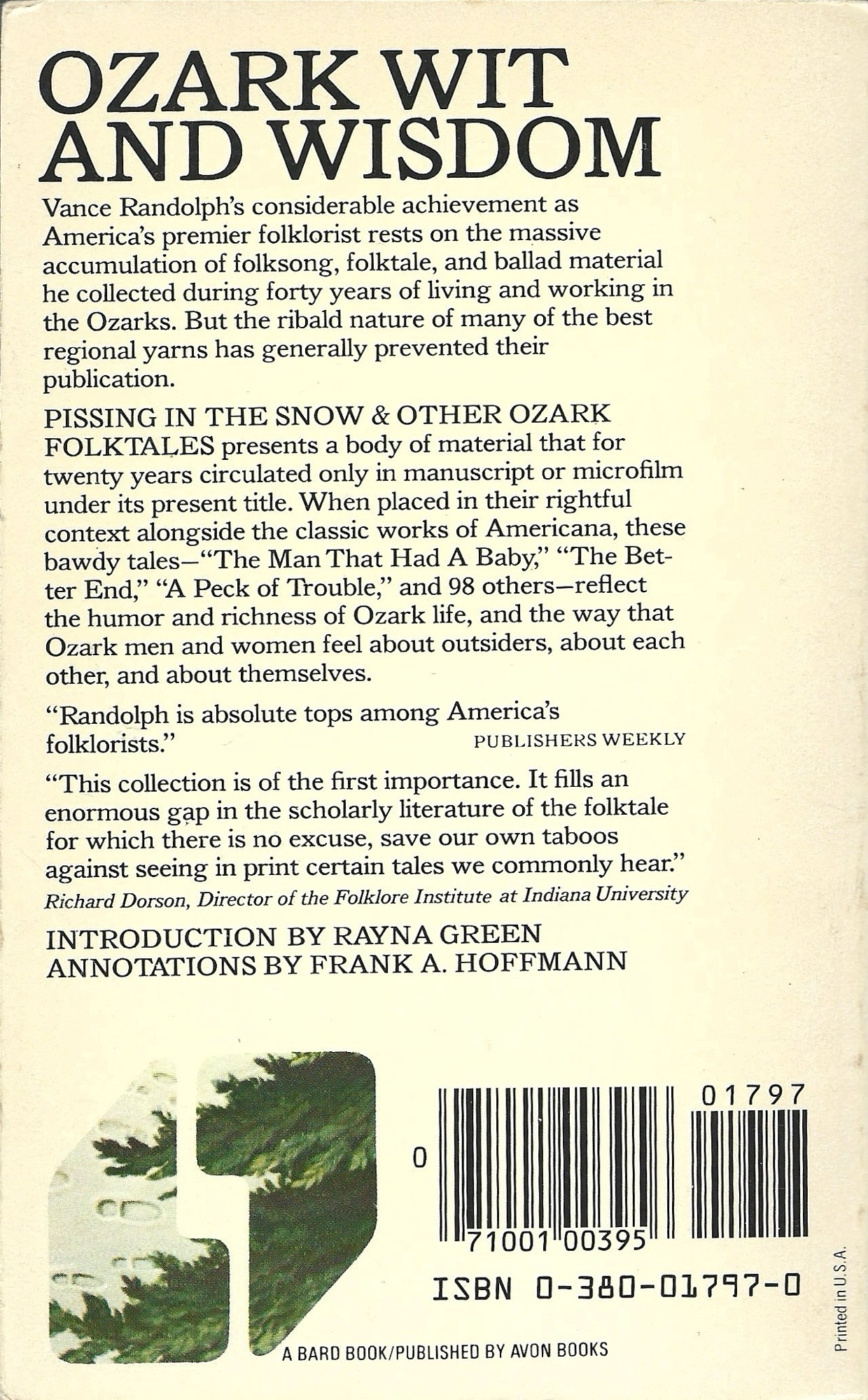
Mass-market Monday | Vance Randolph’s Pissing in the Snow & Other Ozark Folktales

Pissing in the Snow & Other Ozark Folktales, collected and transcribed by Vance Randolph with annotations by Frank A. Hoffmann. Avon Bard (1977). No cover artist credited. 239 pages. A tale from the collection:

“Have You Ever Been Diddled?”

Told by J. L. Russell, Harrison, Ark., April, 1950. He heard this one near Berryville, Ark., in the 1890’s.

One time there was a town girl and a country girl got to talking about the boys they had went with. The town girl told what kind of a car her boyfriends used to drive, and how much money their folks has got. But the country girl didn’t take no interest in things like that, and she says the fellows are always trying to get into her pants.

So finally the town girl says, “Have you ever been diddled?” The country girl giggled, and she says yes, a little bit.

“How much?” says the town girl. “Oh, about like that,” says the country girl, and she held up her finger to show an inch, or maybe an inch and a half.

The town girl just laughed, and pretty soon the country girl says, “Have you ever been diddled?” The town girl says of course she has, lots of times. “How much?” says the country girl. “Oh, about like that,” says the town girl, and she marked off about eight inches, or maybe nine.

The country girl just set there goggle-eyed, and she drawed a deep breath. “My God,” says the country girl, “that ain’t diddling! Why, you’ve been fucked!”

[J1805.5]

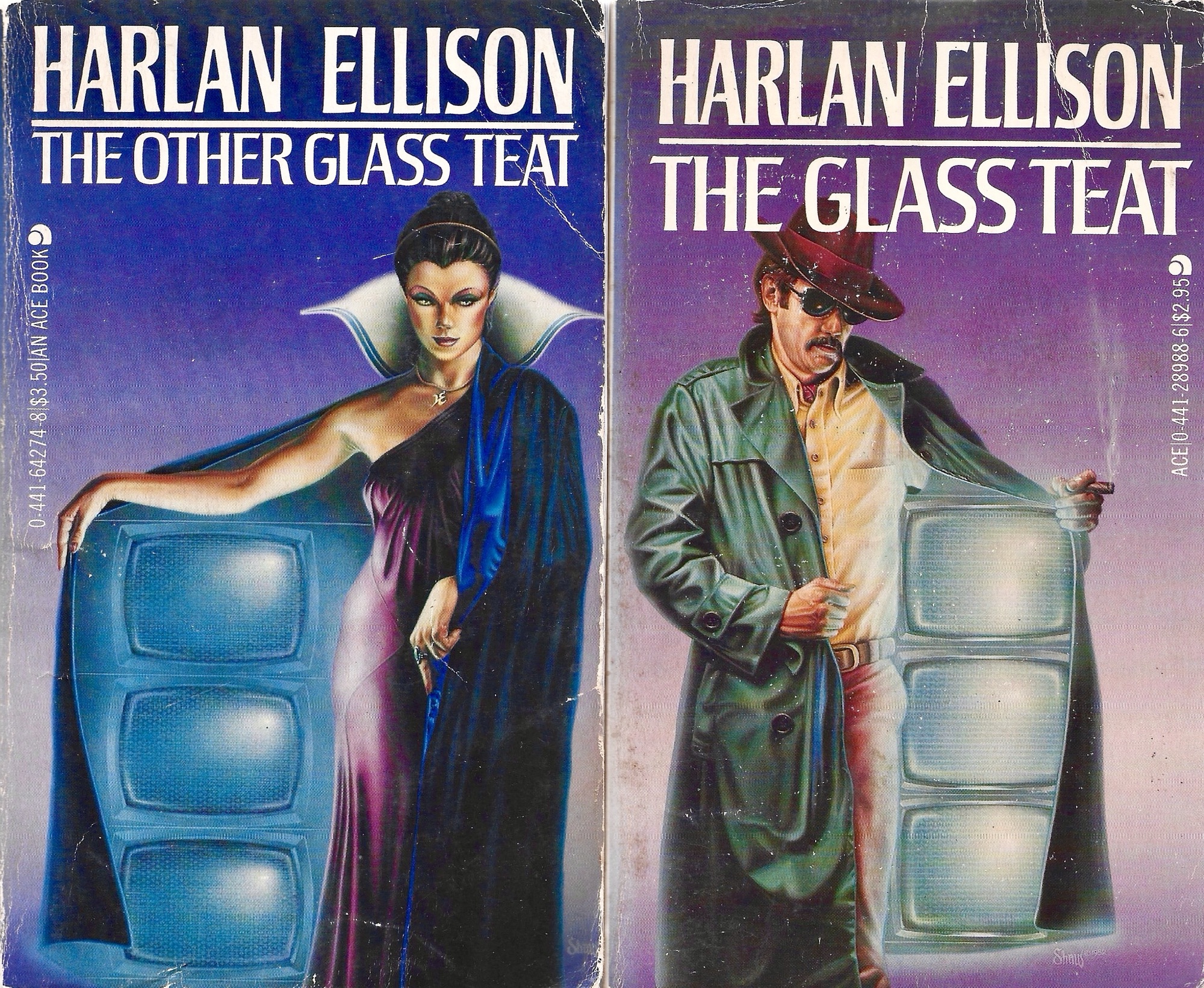
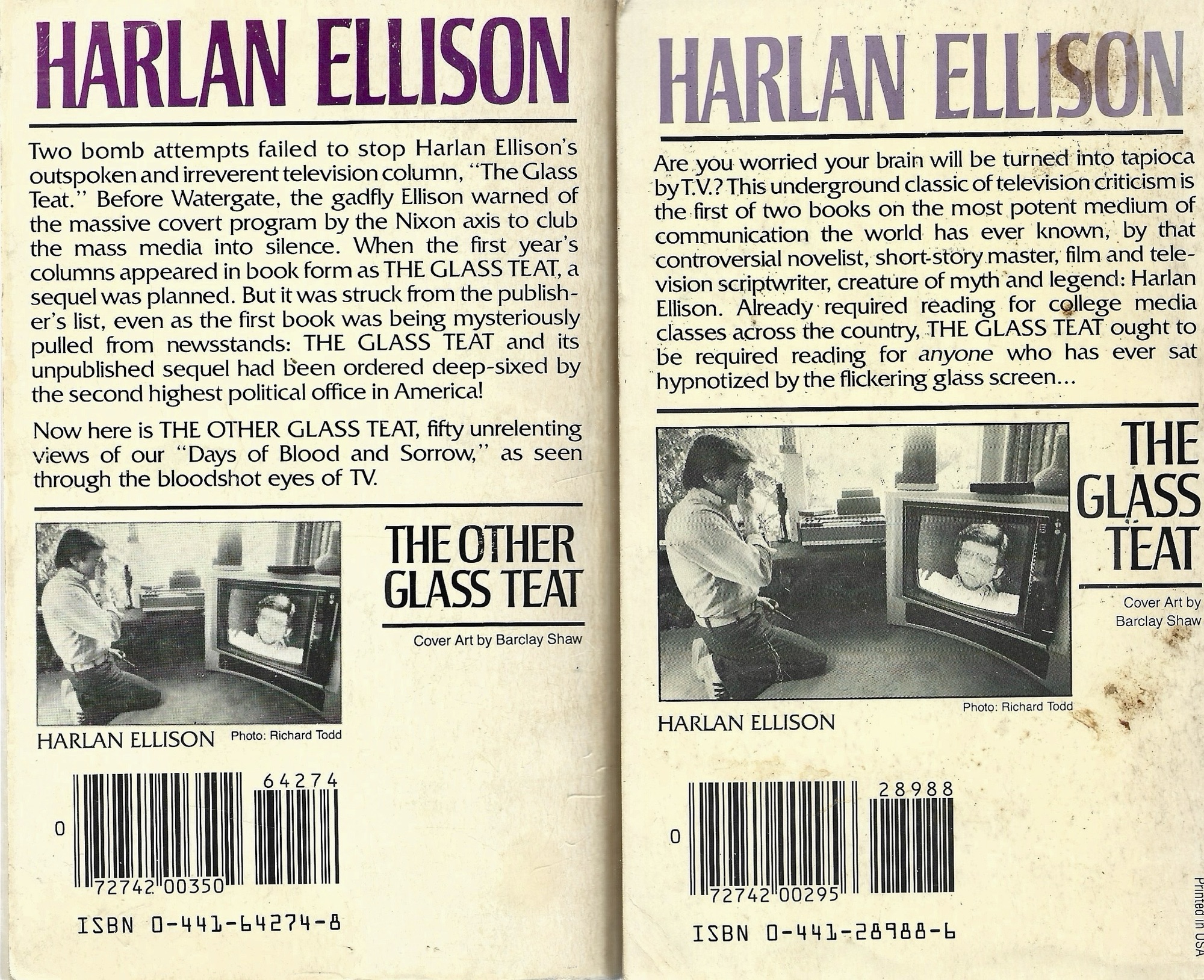
Mass-market Monday | Harlan Ellison’s The Glass Teat and The Other Glass Teat

The Glass Teat, Harlan Ellison. Ace Books (1983 reprint). Cover art by Barclay Shaw. 319 pages.

The Other Glass Teat, Harlan Ellison. Ace Books (1983). Cover art by Barclay Shaw. 397 pages.

Part of an ostensible review of the sitcom Happy Days; from Ellison’s column published on 3 July 1970 and reprinted in The Other Glass Teat:

One begins to realize that our national middle-class hunger to return to two decades of Depression, world war, Prohibition, Racism Unadmitted, Covert Fascination with Sex, Deadly Innocence, Isolationism, Provincialism, and Deprivation Remembered as Good Old Days has become a cultural sickness.

The past has always been a rich source for fun and profit. Nostalgia is a good thing. It keeps us from forgetting our roots. Readers of this column know I trip down Memory Lane myself frequently. But it is clearly evident that when an entire nation refuses to accept the responsibilities of its own future, when it seeks release in a morbid fascination with its past, and when it elevates the dusty dead days of the past to a pinnacle position of Olympian grandeur … we are in serious trouble.

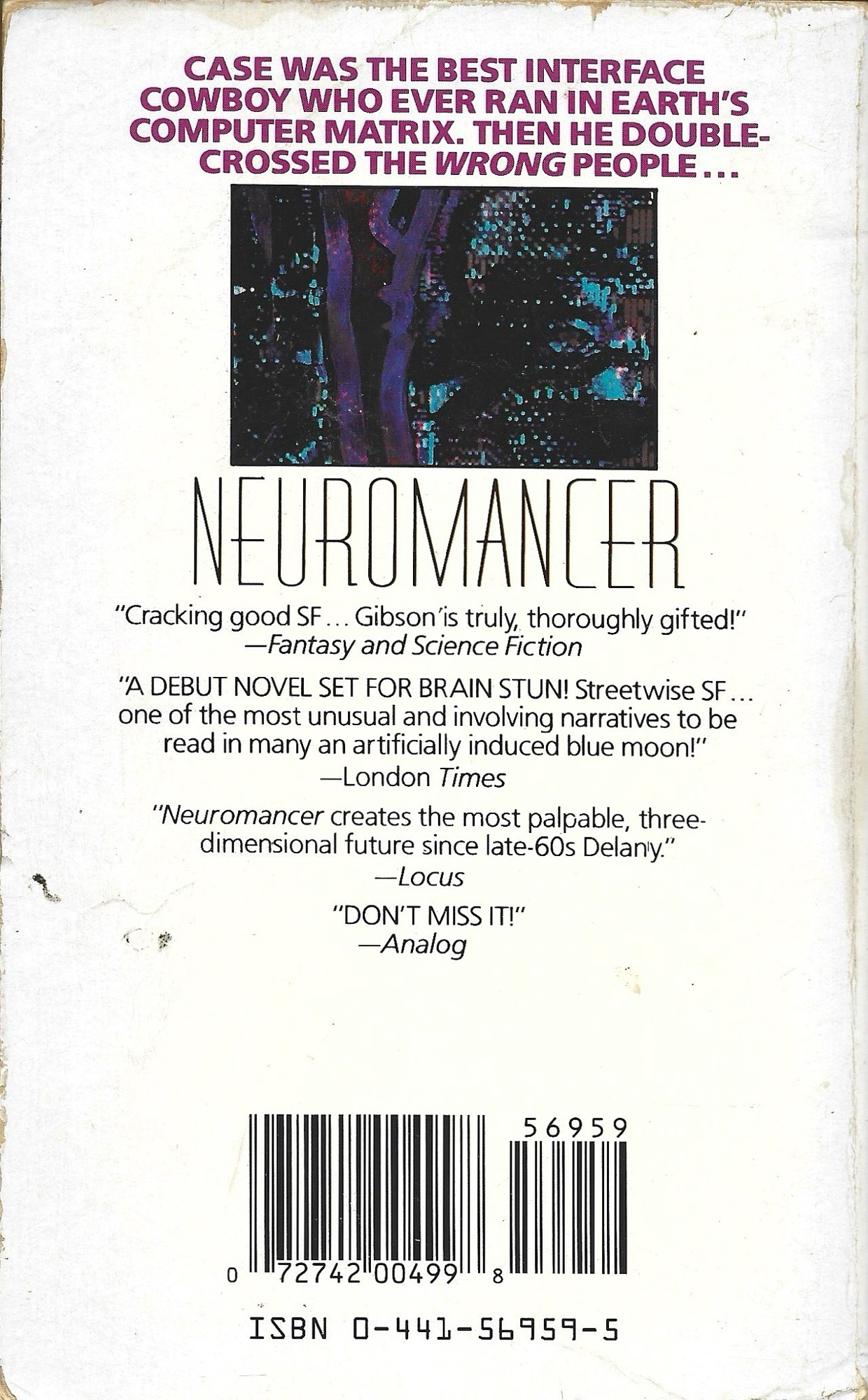
Mass-market Monday | William Gibson’s Neuromancer

Neuromancer, William Gibson. Ace Books (1984 imprint; 29th printing). No cover designer or artist credited. 271 pages.

ISFDB gives the cover artist as Rick Berry.

I borrowed and never returned Neuromancer from one of my best friends. We were best friends in middle school, but I stole this book like senior year of high school or maybe the year after. 1997ish, when the world seemed fairly settled.

According to a blog I wrote in 2006 (JFC), I lost my friend’s copy to one of my students, who took it and never returned it. Did I buy this 29th printing to replace the copy that I’d sorta-kinda-stolen years ago? I can’t recall. I vaguely recall doing so, but it’s also possible I’ve fabricated the past, creating memories like a man wielding large shears and bolts of felt might create strange stupid felt shapes.

Tilford, I’m sorry. You probably can’t have your book back, but you can have this one. Just let me know.

I would love to bottle the feeling of reading those first three Gibson novels and to sip from that bottle, but that’s nostalgia, and fuck nostalgia. 

Mass-market Monday | J.G. Ballard’s Billenium

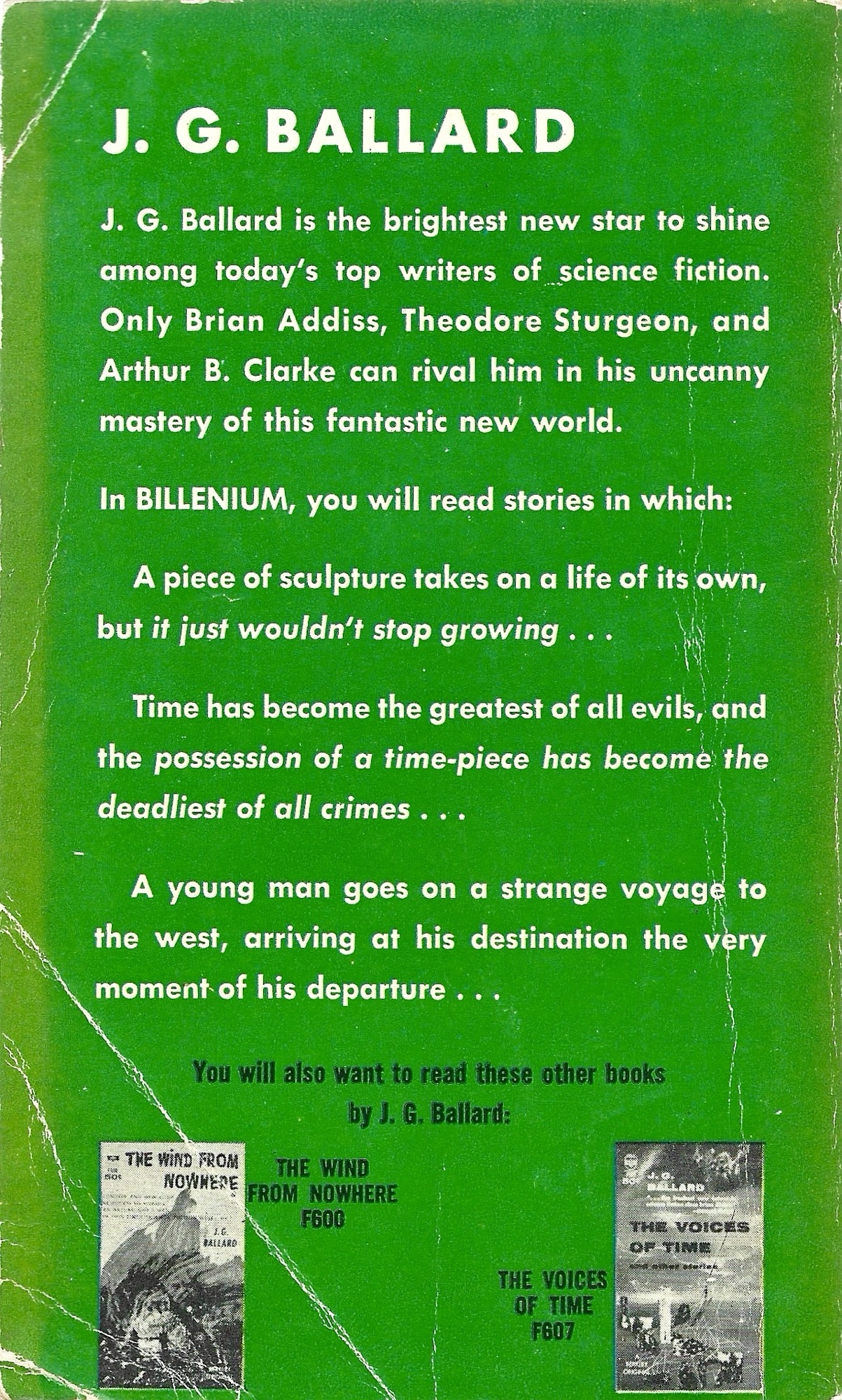
Billenium, J.G. Ballard. Berkley Medallion Books (1962). No cover designer or artist credited. 159 pages.

ISFDB credits Richard Powers as the cover artist.

Ten years ago I read The Complete Short Stories of J.G. Ballard and wrote about them on this blog. At the end of the (exhausting) project (about 1200 pages and just under 100 stories), I made a shortlist of 23 “essential” J.G. Ballard short stories. I included two of the ten stories from Billenium in that list: the title track “Billenium” and “Chronopolis.” Of the latter, I wrote:

“Chronopolis” offers an interesting central shtick: Clocks and other means of measuring and standardizing time have been banned. But this isn’t what makes the story stick. No, Ballard apparently tips his hand early, revealing why measuring time has been banned—it allows management to control labor:

‘Isn’t it obvious? You can time him, know exactly how long it takes him to do something.’ ‘Well?’ ‘Then you can make him do it faster.’

But our intrepid young protagonist (Conrad, his loaded name is), hardly satisfied with this answer, sneaks off to the city of the past, the titular chronopolis, where he works to restore the timepieces of the past. “Chronopolis” depicts a technologically-regressive world that Ballard will  explore in greater depth with his novel The Drowned World, but the details here are precise and fascinating (if perhaps ultimately unconvincing if we try to apply them as any kind of diagnosis for our own metered age). Ending on a perfect paranoid note, Ballard borrows just a dab of Poe here, synthesizing his influence into something far more original, far more Ballardian. Let’s include it in something I’m calling The Essential Short Stories of J.G. Ballard.

Mass-market Monday | Ursula K. Le Guin’s The Compass Rose

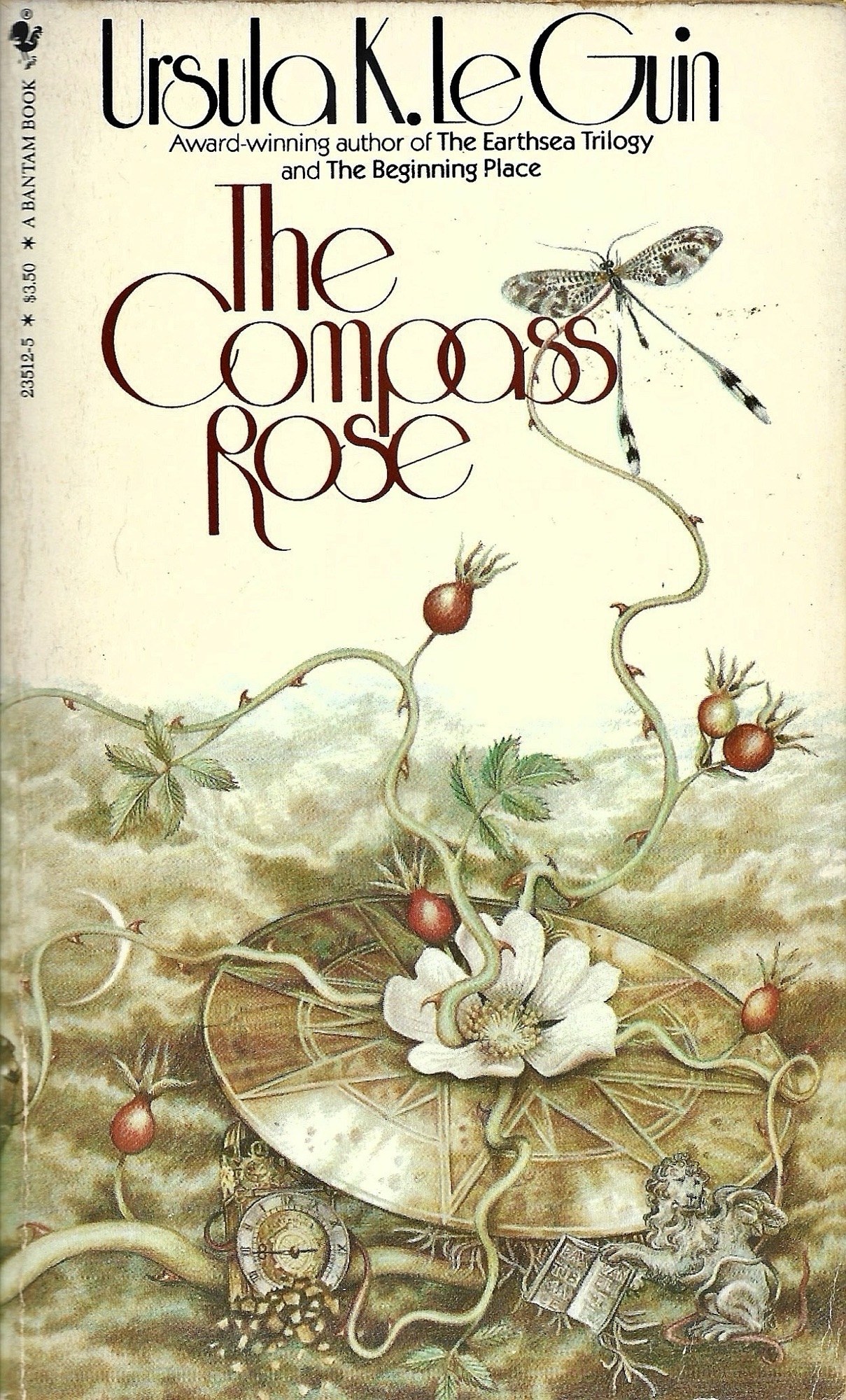
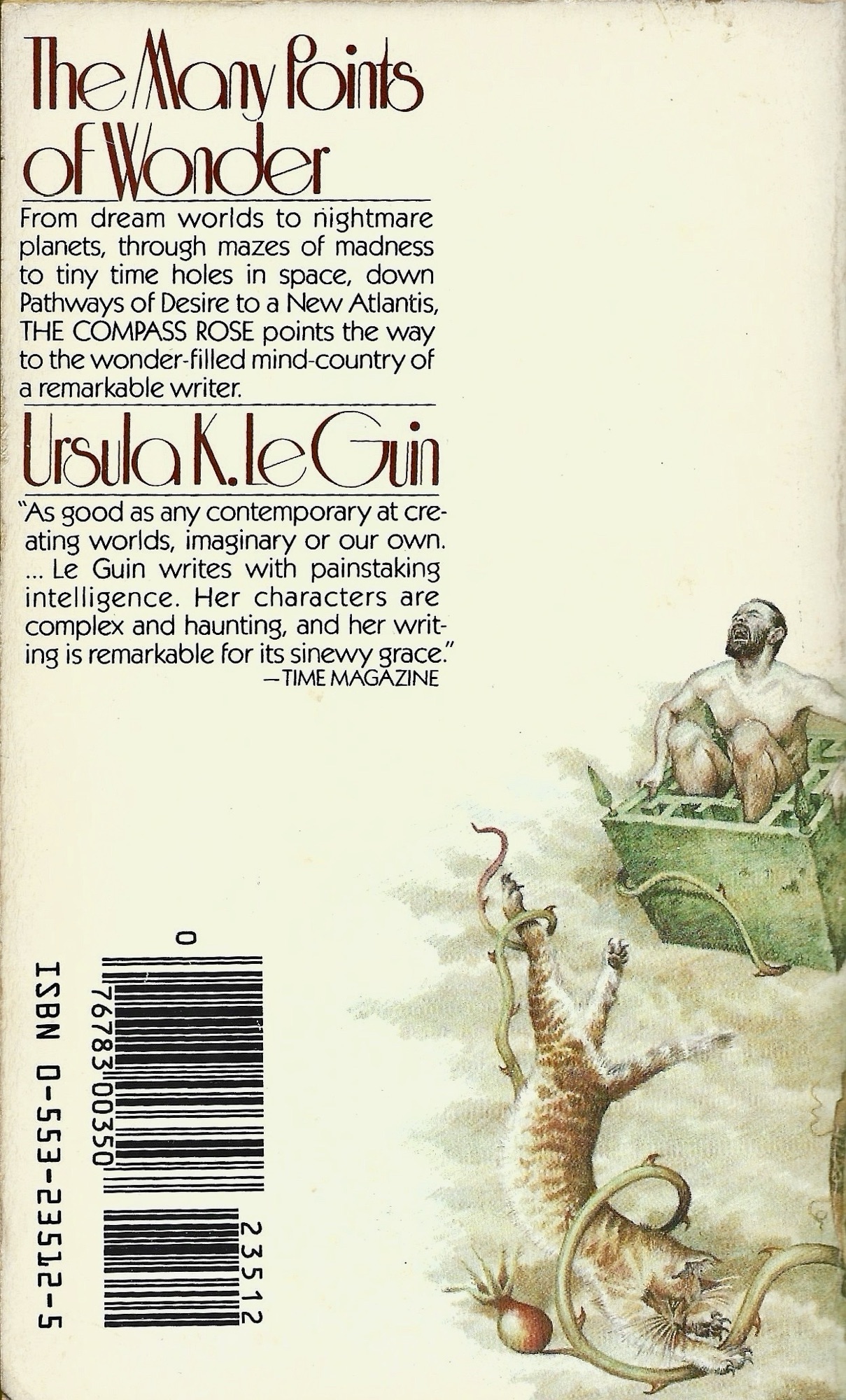
The Compass Rose, Ursula K. Le Guin. Bantam Books (1983). Cover art by Yvonne Gilbert. 271 pages.

A strong collection, containing one of Le Guin’s classic stories, “Schrödinger’s Cat,” which I wrote about a few years ago. From that riff:

Ursula K. Le Guin’s 1982 short story “Schrödinger’s Cat” is a tale about living in radical uncertainty. The story is perhaps one of the finest examples of postmodern literature I’ve ever read. Playful, funny, surreal, philosophical, and a bit terrifying, the story is initially frustrating and ultimately rewarding.

While I think “Schrödinger’s Cat” has a thesis that will present itself to anyone who reads it more than just once or twice, the genius of the story is in Le Guin’s rhetorical construction of her central idea. She gives us a story about radical uncertainty by creating radical uncertainty in her reader, who will likely find the story’s trajectory baffling on first reading. Le Guin doesn’t so much eschew as utterly disrupt the traditional form of a short story in “Schrödinger’s Cat”: setting, characters, and plot are all presented in a terribly uncertain way.