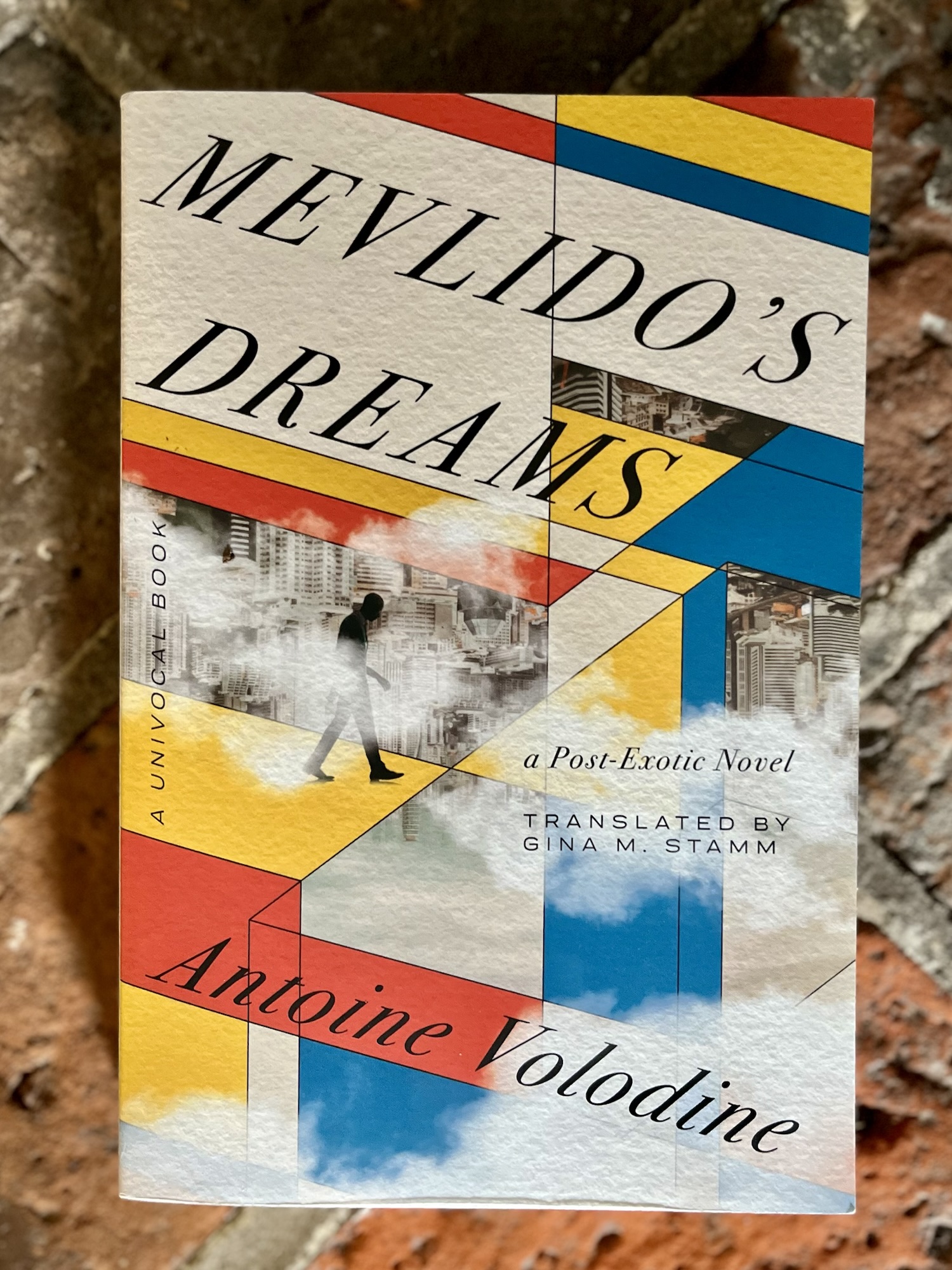
Antoine Volodine’s 2007 novel Mevlido’s Dreams is a bleak, dystopian noir novel set several centuries in the future in the ruined city-state of Oulang-Oulane. Here, weary revolutionary Mevlido lives in a decaying ghetto called Henhouse Four, an eerie quarter inhabited by indigents, junkies, and other remnants of failed uprisings who must contend with the giant mutated birds who terrorize the borough.
Once a soldier of the revolution, Mevlido now serves as a policeman, yet he may also be a double or even triple agent, a sleeper sent through time from a kind of liminal afterlife, a bardo between death and rebirth. The novel drifts between waking and dream states, war memories and spectral futures, as Mevlido’s fragmented consciousness becomes a vessel for Volodine’s haunting post-exotic vision of history, language, and apocalypse.
About halfway through the novel, Mevlido’s bardo boss offers a handy summary of the apocalypse:
They’ve become an inexplicable species. They are just getting out of multiple wars of extermination, but a new conflict is already in sight. The population has decreased by a hundredfold, even more. Entire continents are currently uninhabitable. Those who have survived remain socially organized, but they no longer believe in themselves, or in society. They’ve inherited political systems to which they’ve lost the keys; for them ideology is a prayer devoid of meaning. The ruling classes have become criminalized, the poor obey them. Both classes act as if they were already dead. And as if, on top of that, they don’t even care. … Something in them has changed. You’d think that they no longer have the ability to differentiate between life, dreams, and death.
Our hero will be reborn into this turmoil, his consciousness a roiling mess of anxious irreality. “Even if I’m dreaming, I’m in reality,” he concludes at one point, as if to anchor himself in his mission. What that mission is, exactly, is never fully clear to Mevlido or the reader. Or perhaps the mission is very clear; as translator Gina M. Stamm puts it in her introduction, the plot of Mevlido’s Dreams “has the elements of a fairly classic tragic romance: man and woman are in love, the world prevents their being together, man descends into tragic circumstances.” This motif repeats in dreamlike iterations in the novel; Mevlido drifts through a post-exotic wasteland following orders no one remembers giving, haunted by his dead wife Verena Becker, whose presence threads through his days like a recurring dream or a flickering film reel.
We come to learn that Verena Becker died cruelly, murdered by the “child soldiers” who were pressed in to service by agents of the exploitative upper class. In Mevlido’s present time (or, more specifically one of Mevlido’s present times), the child soldiers are now “ex-child soldiers,” reviled refugees who hide under new identities, hoping to avoid the vengeance of people like Mevlido. The vengeance is not aimed just at these foot soldiers though; one of the novel’s heroes, Sonia Wolguelane, plots the assassination of the upper-echelon genociders who, now absolved of their war crimes, continue to rule the city-state with their one-time political foes. Here is Volodine’s description of one of the men Wolguelane assassinates:
Toni Müller, forty-nine years old, delegate to the Office of Fuel, policy officer during the final project of pacification of the remaining zones, initiator of the so-called controlled genocide practice, threatened with legal action after the disappearance of the Wongres, the Spanish, and the Myrzes, sued for not having been able to provide an explanation for the mysterious annihilation of the inhabitants of the Philippines. Amnestied. Director of the petroleum trusts in the remaining zones, billionaire, numerous books of economics published in his name, numerous honorific titles. During his last self-criticism, he admitted having constantly hidden from the masses the fact that he didn’t share the household chores with his wife.
While the apocalyptic stakes here are swollen to hyperbolic levels, Volodine’s critique of how the ruling class wields power nevertheless applies neatly to our own 21st-century blues. Henry Kissinger, for example, died fat and happy. I’m reminded too here of Thomas Pynchon’s critique of power, particularly in Gravity’s Rainbow, where the narrator laments that the Nazi war criminal Weissmann will not be punished but rather elevated, set to sit “among the successful academics, the Presidential advisers, the token intellectuals who sit on boards of directors. He is almost certainly there. Look high, not low.” Look low for the preterite heroes of Mevlido’s Dreams though. They are the “faded zombies, probably candidates for another hallucinatory expedition, left-behinds who imagine they will be able to leave again.”
I am making the novel sound too grim. It is rich, and much of that richness comes from a bureaucratic, deadpan humor, the laughter of exhausted ideologues trapped in their own paperwork. But what happens to faith in any ideology when it is sundered from observable reality? Consider this exchange, in which a lost Mevlido tries to communicate with a band of men who fail to recognize him as a human being:
“Incredible,” says one of the normal ones, “it’s still talking.”
“And what is it talking about?” asks the red cap.
“About the night,” says the fat one.
“It’s talking about the night?” the bare-chested one asks, surprised.
“Yes, it must still believe in night,” says one of the normal ones.
“Incredible,” says the other normal one, “it still believes in night.”
And beneath the satire, there’s love. Volodine writes love as a metaphysical condition, a persistence that outlasts ideology, memory, and even death. The tenderness between Mevlido and Verena gives the novel its pulse. It’s the one human rhythm left in a mechanical world. Stamm’s translation conveys this rhythm in clipped, moody sentences, wounded and precise.
Like Volodine’s 2014 novel Radiant Terminus, Mevlido’s Dreams operates in the twilight between horror and tenderness. But Mevlido’s Dreams is quieter, more interior—a story of a single man’s dissolution told in flickering vignettes. It reads like the afterimage of a life projected on a cracked wall.
That light, dim and trembling, is what Volodine and Stamm preserve. Mevlido’s Dreams reads not like a film script but like a film itself: shadowy scenes unfolding in silence, broken by bursts of deadpan dialogue and ghostly humor. You can see the ash swirling, hear the echo of curses in an alley haunted by mutant birds.
Oulang-Oulane feels shot through a grim lens, intense, ugly, beautiful, like something from Tarkovsky’s Stalker or a Béla Tarr film, with scenes of desolation punctuated by tenderness. Volodine isn’t cinematic because he borrows film tropes, but because he composes through atmosphere and rhythm. His sentences drift like a camera through fog and memory.
That line above—“it still believes in night”—could be the novel’s credo. Dreaming isn’t retreat; it’s resistance. Writing, too. Mevlido’s Dreams works as both a political fable and a séance for the lost, a way of keeping consciousness flickering in the dark. Highly recommended.
 Biblioklept