
Concord, June 6th.–. . . Mr. F—- arrived yesterday, and appeared to be in most excellent health, and as happy as the sunshine. About the first thing he did was to wash the dishes; and he is really indefatigable in the kitchen, so that I am quite a gentleman of leisure. Previous to his arrival, I had kindled no fire for four entire days, and had lived all that time on the corned beef, except one day, when Ellery and I went down the river on a fishing excursion. Yesterday, we boiled some lamb, which we shall have cold for dinner to-day. This morning, Mr. F—- fried a sumptuous dish of eels for breakfast. Mrs. P. —- continues to be the instrument of Providence, and yesterday sent us a very nice plum-pudding.
I have told Mr. F—- that I shall be engaged in the forenoons, and he is to manage his own occupations and amusements during that time, . . .
Leo, I regret to say, has fallen under suspicion of a very great crime,–nothing less than murder,–a fowl crime it may well be called, for it is the slaughter of one of Mr. Hayward’s hens. He has been seen to chase the hens, several times, and the other day one of them was found dead. Possibly he may be innocent, and, as there is nothing but circumstantial evidence, it must be left with his own conscience.
Meantime, Mr. Hayward, or somebody else, seems to have given him such a whipping that he is absolutely stiff, and walks about like a rheumatic old gentleman. I am afraid, too, that he is an incorrigible thief. Ellery says he has seen him coming up the avenue with a calf’s whole head in his mouth. How he came by it is best known to Leo himself. If he were a dog of fair character, it would be no more than charity to conclude that he had either bought it, or had it given to him; but with the other charges against him, it inclines me to great distrust of his moral principles. Be that as it may, he managed his stock of provisions very thriftily, burying it in the earth, and eating a portion of it whenever he felt an appetite. If he insists upon living by highway robbery, it would be well to make him share his booty with us. . . .
Tag: Notebooks
No one reaches to him (Franz Kafka’s diary entry of 19 May 1922)
19 May. He feels more deserted with a second person than when alone. If he is together with someone, this second person reaches out for him and he is helplessly delivered into his hand. If he is alone, all mankind reaches out for him – but the innumerable outstretched arms become entangled with one another and no one reaches to him.
Franz Kafka’s diary entry of 19 May 1922. From The Diaries of Franz Kafka.” Schocken Books. Translation by Martin Greenberg.
May 11, 1838 entry from Nathaniel Hawthorne’s Note-Books
May 11, 1838.–At Boston last week. Items:–A young man, with a small mustache, dyed brown, reddish from its original light color. He walks with an affected gait, his arms crooked outwards, treading much on his toes. His conversation is about the theatre, where he has a season ticket,–about an amateur who lately appeared there, and about actresses, with other theatrical scandal.–In the smoking-room, two checker and backgammon boards; the landlord a great player, seemingly a stupid man, but with considerable shrewdness and knowledge of the world.– F—-, the comedian, a stout, heavy-looking Englishman, of grave deportment, with no signs of wit or humor, yet aiming at both in conversation, in order to support his character. Very steady and regular in his life, and parsimonious in his disposition,–worth $50,000, made by his profession.–A clergyman, elderly, with a white neck-cloth, very unbecoming, an unworldly manner, unacquaintance with the customs of the house, and learning them in a childlike way. A ruffle to his shirt, crimped.–A gentleman, young, handsome, and sea-flushed, belonging to Oswego, New York, but just arrived in port from the Mediterranean: he inquires of me about the troubles in Canada, which were first beginning to make a noise when he left the country,–whether they are all over. I tell him all is finished, except the hanging of the prisoners. Then we talk over the matter, and I tell him the fates of the principal men,–some banished to New South Wales, one hanged, others in prison, others, conspicuous at first, now almost forgotten.–Apartments of private families in the hotel,–what sort of domesticity there may be in them; eating in public, with no board of their own. The gas that lights the rest of the house lights them also, in the chandelier from the ceiling.–A shabby-looking man, quiet, with spectacles, at first wearing an old, coarse brown frock, then appearing in a suit of elderly black, saying nothing unless spoken to, but talking intelligently when addressed. He is an editor, and I suppose printer, of a country paper. Among the guests, he holds intercourse with gentlemen of much more respectable appearance than himself, from the same part of the country.–Bill of fare; wines printed on the back, but nobody calls for a bottle. Chairs turned down for expected guests. Three-pronged steel forks. Cold supper from nine to eleven P.M. Great, round, mahogany table, in the sitting-room, covered with papers. In the morning, before and soon after breakfast, gentlemen reading the morning papers, while others wait for their chance, or try to pick out something from the papers of yesterday or longer ago. In the forenoon, the Southern papers are brought in, and thrown damp and folded on the table. The eagerness with which those who happen to be in the room start up and make prize of them. Play-bills, printed on yellow paper, laid upon the table. Towards evening comes the “Transcript.”
Cupid, caresses, fire and death (Three notes from Nathaniel Hawthorne’s Note-Books)
Caresses, expressions of one sort or another, are necessary to the life of the affections, as leaves are to the life of a tree. If they are wholly restrained, love will die at the roots.
Cupid in these latter times has probably laid aside his bow and arrows, and uses fire-arms,–a pistol,–perhaps a revolver.
I burned great heaps of old letters, and other papers, a little while ago, preparatory to going to England. Among them were hundreds of letters. The world has no more such, and now they are all dust and ashes. What a trustful guardian of secret matters is fire! What should we do without fire and death?
From Nathaniel Hawthorne’s American Note-Books.
Just when I was on the point of choking with a huge German word (Nathaniel Hawthorne’s journal entry, 11 April 1843)
April 11th.–I meditated accordingly, but without any very wonderful result. Then at eight o’clock bothered myself till after nine with this eternal tale of Tieck. The forenoon was spent in scribbling; but at eleven o’clock my thoughts ceased to flow,–indeed, their current has been wofully interrupted all along,–so I threw down my pen, and set out on the daily journey to the village. Horrible walking! I wasted the customary hour at the Athenæum, and returned home, if home it may now be called. Till dinner-time I labored on Tieck’s tale, and resumed that agreeable employment after the banquet.
Just when I was on the point of choking with a huge German word, Molly announced Mr. Thoreau. He wished to take a row in the boat, for the last time, perhaps, before he leaves Concord. So we emptied the water out of her, and set forth on our voyage. She leaks, but not more than she did in the autumn. We rowed to the foot of the hill which borders the North Branch, and there landed, and climbed the moist and snowy hill-side for the sake of the prospect. Looking down the river, it might well have been mistaken for an arm of the sea, so broad is now its swollen tide; and I could have fancied that, beyond one other headland, the mighty ocean would outspread itself before the eye. On our return we boarded a large cake of ice, which was floating down the river, and were borne by it directly to our own landing-place, with the boat towing behind.
Parting with Mr. Thoreau, I spent half an hour in chopping wood, when Molly informed me that Mr. Emerson wished to see me. He had brought a letter of Ellery Channing, written in a style of very pleasant humor. This being read and discussed, togetherwith a few other matters, he took his leave, since which I have been attending to my journalizing duty; and thus this record is brought down to the present moment.
Incapable of writing even one word (Kafka diary entry, 8 April 1914)
8 April. Yesterday incapable of writing even one word. Today no better. Who will save me? And the turmoil in me, deep down, scarcely visible; I am like a living lattice-work, a lattice that is solidly planted and would like to tumble down.
Today in the coffee-house with Werfel. How he looked from the distance, seated at the coffee-house table. Stooped, half reclining even in the wooden chair, the beautiful profile of his face pressed against his chest, his face almost wheezing in its fullness (not really fat); entirely indifferent to the surroundings, impudent, and without flaw. His dangling glasses by contrast make it easier to trace the delicate outlines of his face.
From the diaries of Franz Kafka. The entry is from 8 April 1914. English translation by Martin Greenberg.
Always eat grapes downwards (Samuel Butler)
Always eat grapes downwards—that is, always eat the best grape first; in this way there will be none better left on the bunch, and each grape will seem good down to the last. If you eat the other way, you will not have a good grape in the lot. Besides, you will be tempting Providence to kill you before you come to the best. This is why autumn seems better than spring: in the autumn we are eating our days downwards, in the spring each day still seems “Very bad.” People should live on this principle more than they do, but they do live on it a good deal; from the age of, say, fifty we eat our days downwards.
In New Zealand for a long time I had to do the washing-up after each meal. I used to do the knives first, for it might please God to take me before I came to the forks, and then what a sell it would have been to have done the forks rather than the knives!
From Samuel Butler’s Note-Books
Even more beautiful emotions (Kafka’s diary entry, 27 March 1912)
27. March. Monday, on the street. The boy who with several others, threw a large ball at a servant girl walking defencelessly in front of them; just as the ball was flying at the girls’ behind I grabbed him by the throat, choked him in a fury, thrust him aside, and swore. Then walked on and didn’t even look at the girl. One quite forgets one’s earthly existence because one is so entirely full of fury is permitted to believe that, given the opportunity, one would in the same way fill oneself with even more beautiful emotions.
Franz Kafka’s diary entry, 27 March 1912. Translation by Joseph Kresh.
Six Notes from Nathaniel Hawthorne’s Note-Books
Imitators of original authors might be compared to plaster casts of marble statues, or the imitative book to a cast of the original marble.
For a child’s story,–the voyage of a little boat made of a chip, with a birch-bark sail, down a river.
Fourier states that, in the progress of the world, the ocean is to lose its saltness, and acquire the taste of a peculiarly flavored lemonade.
How pleasant it is to see a human countenance which cannot be insincere,–in reference to baby’s smile.
The best of us being unfit to die, what an inexpressible absurdity to put the worst to death!
“Is that a burden of sunshine on Apollo’s back?” asked one of the children,–of the chlamys on our Apollo Belvedere.
Happiness comes incidentally (Nathaniel Hawthorne)
Happiness in this world, when it comes, comes incidentally. Make it the object of pursuit, and it leads us a wild-goose chase, and is never attained. Follow some other object, and very possibly we may find that we have caught happiness without dreaming of it; but likely enough it is gone the moment we say to ourselves, “Here it is!” like the chest of gold that treasure-seekers find.
An article on cemeteries, and other ideas from Nathaniel Hawthorne’s Note-Books
The spells of witches have the power of producing meats and viands that have the appearance of a sumptuous feast, which the Devil furnishes: But a Divine Providence seldom permits the meat to be good, but it has generally some bad taste or smell,–mostly wants salt,–and the feast is often without bread.
An article on cemeteries, with fantastic ideas of monuments; for instance, a sundial;–a large, wide carved stone chair, with some such motto as “Rest and Think,” and others, facetious or serious.
“Mamma, I see a part of your smile,”–a child to her mother, whose mouth was partly covered by her hand.
“The syrup of my bosom,”–an improvisation of a little girl, addressed to an imaginary child.
“The wind-turn,” “the lightning-catch,” a child’s phrases for weathercock and lightning-rod.
“Where’s the man-mountain of these Liliputs?” cried a little boy, as he looked at a small engraving of the Greeks getting into the wooden horse.
When the sun shines brightly on the new snow, we discover ranges of hills, miles away towards the south, which we have never seen before.
To have the North Pole for a fishing-pole, and the Equinoctial Line for a fishing-line.
“To have ice in one’s blood” (And other ideas from Nathaniel Hawthorne’s Note-Books)
- “A story there passeth of an Indian king that sent unto Alexander a fair woman, fed with aconite and other poisons, with this intent complexionally to destroy him!” –Sir T. Browne.
- Dialogues of the unborn, like dialogues of the dead,–or between two young children.
- A mortal symptom for a person being to lose his own aspect and to take the family lineaments, which were hidden deep in the healthful visage. Perhaps a seeker might thus recognize the man he had sought, after long intercourse with him unknowingly.
- Some moderns to build a fire on Ararat with the remnants of the ark.
- Two little boats of cork, with a magnet in one and steel in the other.
- To have ice in one’s blood.
- To make a story of all strange and impossible things,–as the Salamander, the Phoenix.
The impenetrable outline of human bodies is horrible (Kafka’s diary, Oct 30, 1921)
30 October. In the afternoon to the theatre, Pallenberg.
The possibilities within me, I won’t say to act or write The Miser, but to be the miser himself. It would need only a sudden determined movement of my hands, the entire orchestra gazes in fascination at the spot above the conductor’s stand where the baton will rise.
Feeling of complete helplessness.
What is it that binds you more intimately to these impenetrable, talking, eye-blinking bodies than to any other thing, the penholder in your hand, for example? Because you belong to the same species? But you don’t belong to the same species, that’s the very reason why you raised this question.
The impenetrable outline of human bodies is horrible.
The wonder, the riddle of my not having perished already, of the silent power guiding me. It forces one to this absurdity: ‘Left to my own resources, I should have long ago been lost.’ My own resources.
From Franz Kafka’s diary entry of October 30, 1921.
Nine Figments from Nathaniel Hawthorne’s Notebook
- An ancient wineglass (Miss Ingersol’s), long-stalked, with a small, cup-like bowl, round which is wreathed a branch of grape-vine, with a rich cluster of grapes, and leaves spread out. There is also some kind of a bird flying. The whole is excellently cut or engraved.
- In the Duke of Buckingham’s comedy, “The Chances,” Don Frederic says of Don John (they are two noble Spanish gentlemen), “One bed contains us ever.”
- A person, while awake and in the business of life, to think highly of another, and place perfect confidence in him, but to be troubled with dreams in which this seeming friend appears to act the part of a most deadly enemy. Finally it is discovered that the dream-character is the true one. The explanation would be–the soul’s instinctive perception.
- Pandora’s box for a child’s story.
- Moonlight is sculpture; sunlight is painting.
- “A person to look back on a long life ill-spent, and to picture forth a beautiful life which he would live, if he could be permitted to begin his life over again. Finally to discover that he had only been dreaming of old age,–that he was really young, and could live such a life as he had pictured.”
- A newspaper, purporting to be published in a family, and satirizing the political and general world by advertisements, remarks on domestic affairs,–advertisement of a lady’s lost thimble, etc.
- L. H—-. She was unwilling to die, because she had no friends to meet her in the other world. Her little son F. being very ill, on his recovery she confessed a feeling of disappointment, having supposed that he would have gone before, and welcomed her into heaven!
- H. L. C—- heard from a French Canadian a story of a young couple in Acadie. On their marriage day, all the men of the Province were summoned to assemble in the church to hear a proclamation. When assembled, they were all seized and shipped off to be distributed through New England,–among them the new bridegroom. His bride set off in search of him,–wandered about New England all her lifetime, and at last, when she was old, she found her bridegroom on his death-bed. The shock was so great that it killed her likewise.
September 23, 1843 — From Nathaniel Hawthorne’s Journal
September 23d.–I have gathered the two last of our summer-squashes to-day. They have lasted ever since the 18th of July, and have numbered fifty-eight edible ones, of excellent quality. Last Wednesday, I think, I harvested our winter-squashes, sixty-three in number, and mostly of fine size. Our last series of green corn, planted about the 1st of July, was good for eating two or three days ago. We still have beans; and our tomatoes, though backward, supply us with a dish every day or two. My potato-crop promises well; and, on the whole, my first independent experiment of agriculture is quite a successful one.
This is a glorious day,–bright, very warm, yet with an unspeakable gentleness both in its warmth and brightness. On such days it is impossible not to love Nature, for she evidently loves us. At other seasons she does not give me this impression, or only at very rare intervals; but in these happy, autumnal days, when she has perfected the harvests, and accomplished every necessary thing that she had to do, she overflows with a blessed superfluity of love. It is good to be alive now. Thank God for breath,–yes, for mere breath! when it is made up of such a heavenly breeze as this. It comes to the cheek with a real kiss; it would linger fondly around us, if it might; but, since it must be gone, it caresses us with its whole kindly heart, and passes onward, to caress likewise the next thing that it meets. There is a pervading blessing diffused over all the world. I look out of the window and think, “O perfect day! O beautiful world! O good God!” And such a day is the promise of a blissful eternity. Our Creator would never have made such weather, and given us the deep heart to enjoy it, above and beyond all thought, if he had not meant us to be immortal. It opens the gates of heaven and gives us glimpses far inward.
Bless me! this flight has carried me a great way; so now let me come back to our old abbey. Our orchard is fast ripening; and the apples and great thumping pears strew the grass in such abundance that it becomes almost a trouble–though a pleasant one–to gather them. This happy breeze, too, shakes them down, as if it flung fruit to us out of the sky; and often, when the air is perfectly still, I hear the quiet fall of a great apple. Well, we are rich in blessings, though poor in money. . . .
From Nathaniel Hawthorne’s American Note-Books.
Ultimate Fiction: Fake Memoir of Job at IRS by Fake Name (David Foster Wallace Archive)
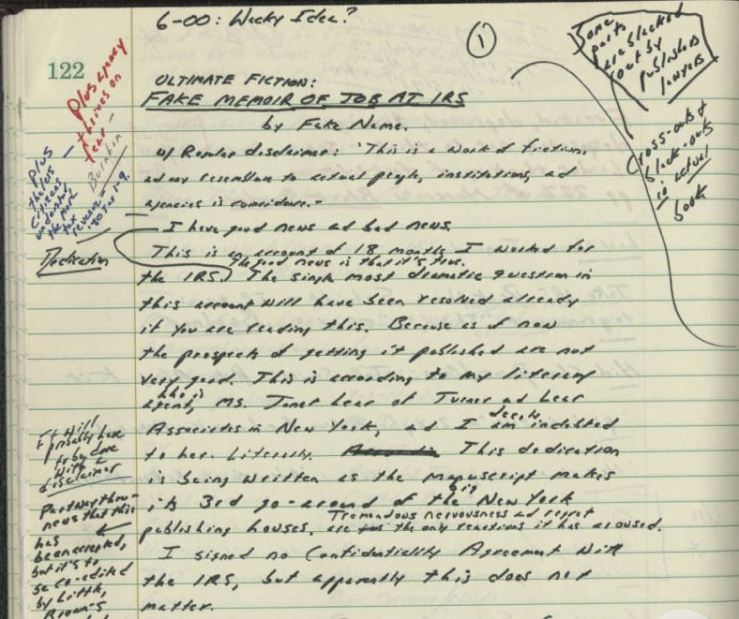 The David Foster Wallace archive at the Harry Ransom Center UT has made some documents from The Pale King accessible online, including a few pages of his workbook, handwritten drafts, and typed edits.

(Via).
September 1st, 1848 | From Nathaniel Hawthorne’s Note-Books
Thursday, September 1st.–Mr. Thoreau dined with us yesterday. . . . He is a keen and delicate observer of nature,–a genuine observer,–which, I suspect, is almost as rare a character as even an original poet; and Nature, in return for his love, seems to adopt him as her especial child, and shows him secrets which few others are allowed to witness. He is familiar with beast, fish, fowl, and reptile, and has strange stories to tell of adventures and friendly passages with these lower brethren of mortality. Herb and flower, likewise, wherever they grow, whether in garden or wildwood, are his familiar friends. He is also on intimate terms with the clouds, and can tell the portents of storms. It is a characteristic trait, that he has a great regard for the memory of the Indian tribes, whose wild life would have suited him so well; and, strange to say, he seldom walks over a ploughed field without picking up an arrow-point, spear-head, or other relic of the red man, as if their spirits willed him to be the inheritor of their simple wealth.
With all this he has more than a tincture of literature,–a deep and true taste for poetry, especially for the elder poets, and he is a good writer,–at least he has written a good article, a rambling disquisition on Natural History, in the last “Dial,” which, he says, was chiefly made up from journals of his own observations. Methinks this article gives a very fair image of his mind and character,–so true, innate, and literal in observation, yet giving the spirit as well as letter of what he sees, even as a lake reflects its wooded banks, showing every leaf, yet giving the wild beauty of the whole scene. Then there are in the article passages of cloudy and dreamy metaphysics, and also passages where his thoughts seem to measure and attune themselves into spontaneous verse, as they rightfully may, since there is real poetry in them. There is a basis of good sense and of moral truth, too, throughout the article, which also is a reflection of his character; for he is not unwise to think and feel, and I find him a healthy and wholesome man to know.
After dinner (at which we cut the first watermelon and muskmelon that our garden has grown), Mr. Thoreau and I walked up the bank of the river, and at a certain point he shouted for his boat. Forthwith a young man paddled it across, and Mr. Thoreau and I voyaged farther up the stream, which soon became more beautiful than any picture, with its dark and quiet sheet of water, half shaded, half sunny, between high and wooded banks. The late rains have swollen the stream so much that many trees are standing up to their knees, as it were, in the water, and boughs, which lately swung high in air, now dip and drink deep of the passing wave. As to the poor cardinals which glowed upon the bank a few days since, I could see only a few of their scarlet hats, peeping above the tide. Mr. Thoreau managed the boat so perfectly, either with two paddles or with one, that it seemed instinct with his own will, and to require no physical effort to guide it. He said that, when some Indians visited Concord a few years ago, he found that he had acquired, without a teacher, their precise method of propelling and steering a canoe. Nevertheless he was desirous of selling the boat of which he was so fit a pilot, and which was built by his own hands; so I agreed to take it, and accordingly became possessor of the Musketaquid. I wish I could acquire the aquatic skill of the original owner.
From Nathaniel Hawthorne’s American Note-Books.
 Biblioklept