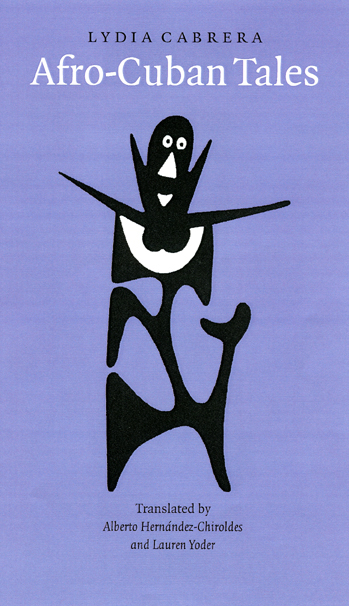
Lydia Cabrera–Afro-Cuban Tales

afro-cuban-tales.jpg

In a sublime synthesis of traditional folklore and imagistic surrealism, Lydia Cabrera’s Afro-Cuban Tales questions the normative spaces occupied by bodies. Deriving from animist tradition, her characters exist in an impossible multiplicity of spaces, being at once animals and plants, humans and gods. Cabrera’s characters endure trials of biological identity and social co-existence, and through these problems they internalize authority, evince taboos, and create a social code. Cabrera’s trickster characters provoke, challenge, or otherwise disrupt the symbolic order of this code. In “Bregantino Bregantín,” a story that recalls Freud’s primal horde theory, as well as the work of more contemporary theorists such as Julia Kristeva and Judith Butler,  narcissist Bull kills all the males of his kingdom and takes all the women for himself.  The sadistic titular turtle of “Papa Turtle and Papa Tiger” uses the power of his dead friend’s antlers to shame, torment, and torture the other animals of his community. And in the magical realism of “Los Compadres,” Capinche seeks to put the horns on his best friend Evaristo by sleeping with his wife–a transgression that ends in necrophilia. This union of sex and death, creation and destruction is the norm in Cabrera’s green and fecund world; the trickster’s displacements of order invariably result in reanimation, transformation, and regeneration—the drawing, stepping-over, and re-drawing of boundaries. A couple of days, Bob hipped me to this really cool Run Wrake short film called Rabbit. While not directly related to Afro-Cuban Tales, this film nonetheless captures the book’s key themes and motifs of death and resurrection, transformation and language, and the trickster’s power to disrupt social and familial codes. Highly recommended.
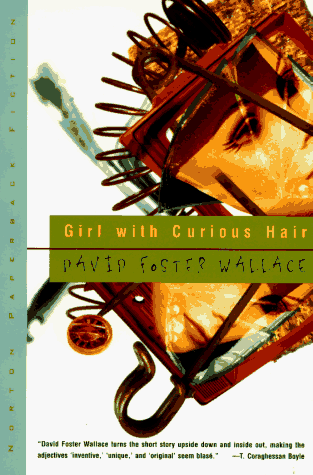
Girl With Curious Hair–David Foster Wallace

dfw.gif

Scott Martin was kind enough to loan me this book. Did he know that it would forever change the way I read? It was the first semester of my freshman year in college, and I was slowly reaching beyond stuff like Henry Miller, Wm Burroughs and Franz Kafka. David Foster Wallace’s short story collection Girl With Curious Hair introduced me to a whole new world of writing. Reading DFW is like having a very witty friend tell you a moving and funny story over a  few beers. He’s hilarious, thought-provoking, and not nearly as hard to read as people seem to think (by the way, simply googling “David Foster Wallace” will yield several vitriolic essays by people who think that DFW is somehow duping his readers. He’s not. These people don’t know a good story when they read one.)

Girl features “real people” like Alex Trebek, David Letterman, and Lyndon Johnson as characters, but constantly destabilizes any realism these figures might lend to the story. The novella included in this collection, Westward the Course of Empire Takes Its Way, alludes directly to John Barth’s Lost in the Funhouse (another book I’ve loaned out and never gotten back). Westward takes a critical but humorous look at how culture is commodified: the plot centers around a reunion for everyone who has ever acted in a McDonald’s commercial. At the reunion, plans are revealed for a series of real-life “Funhouses,” based on the work of “Dr. Ambrose” (Barth’s stand-in in Westward).

Girl with Curious Hair is probably the best starting point for anyone interested in DFW but daunted by 1000 pages of Infinite Jest (IJ is yet another one I loaned out and never got back). Girl‘s stories have a little more ‘pop’ to them than DFW’s latest collection, Oblivion, and Girl tends to be easier to find used than DFW’s other collections, Brief Interviews with Hideous Men (actually a better collection, in my opinion) and A Supposedly Fun Thing I’ll Never Do Again (a collection of hilarious essays and nonfiction).

To sum up: if you still haven’t read DFW go consume this book; when you’re done you’ll be left wondering: “What other good stuff have I been missing out on?”

William Burroughs Cover Gallery

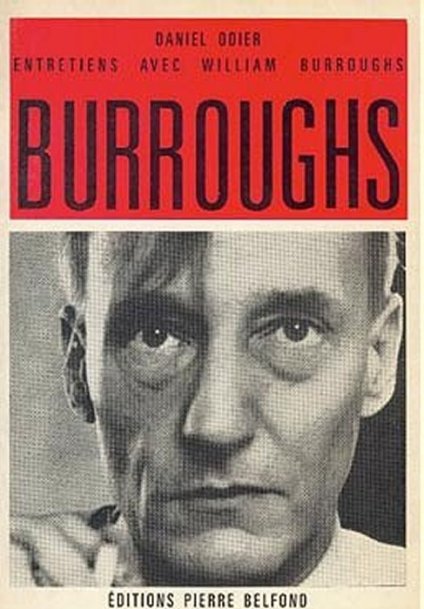
wbjob_france_1969.jpg

Burroughs appears on a large number of his covers, whether as a photograph, or something more iconic:

wbnl_germany_1992.jpg

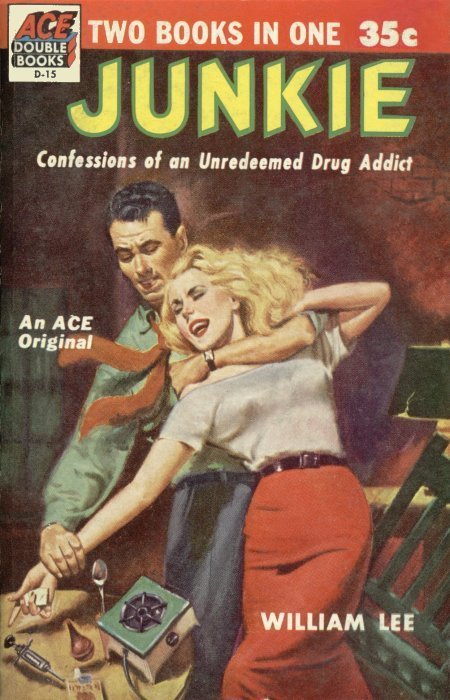
I like this early, lurid pulp edition of Junky. Note the spelling of the title, as well as Burroughs’ pseudonym, William Lee:

junkie_us_ace_1953_front.jpg

The Wild Boys: One of my faves.

wb_us_grove_1971.jpg

This Spanish edition of Naked Lunch really captures the squeamish quality of all things Burroughs:

wbnl_spain_2004.jpg

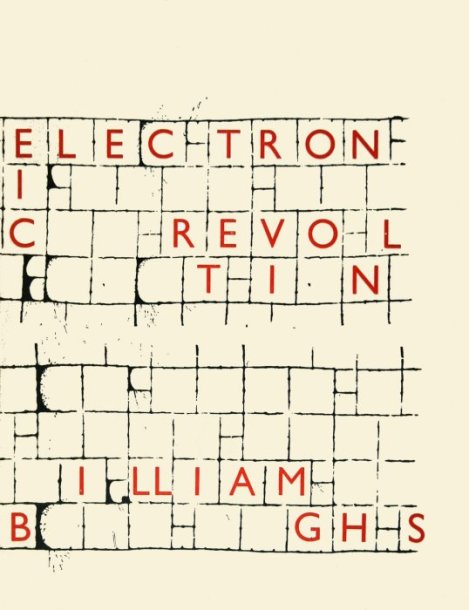
wbelrev_uk_blackmoor_1971.jpg

Check out the full gallery here.

The Religious Experience of Philip K. Dick

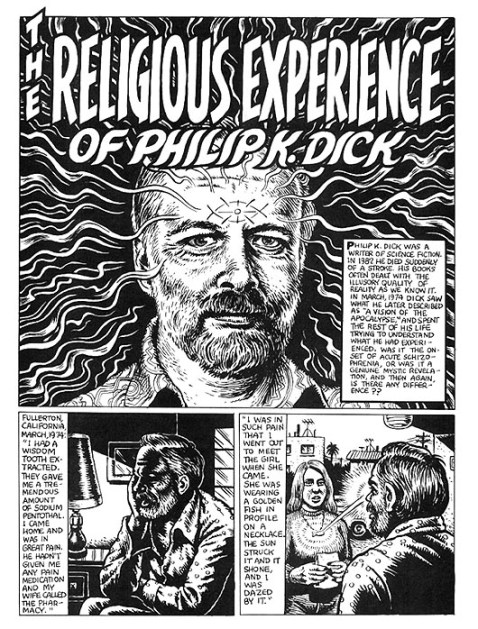
Want to learn about PK Dick’s bizarre apocalypse visions? Sure you do–and who better to tell a bizarre story than underground comix avatar Robert Crumb, whose accoutnt is available here in full.  Dick’s revelations led him to believe that he was coexisting in a Roman Empire that never fell, and that the spirit of the prophet Elijah lived within him. Highly recommended. 

weirdo1.jpg

Graham Greene and Donnie Darko

The Portable Graham Greene, ed. Philip Stratford. I haven’t read a single story in this beautiful Viking Portable Library edition, save “The Destructors,” (full text here) (sorry, the page is no longer up [3/07]. Ed.) which I only read because it was referenced in one of my favorite movies, Donnie Darko.

I found this one in another teacher’s classroom. My uncle Lee had just given me a copy of Greene’s The Quiet American, which I finished in a weekend; it’s a slim, spare novel, and I enjoyed it quite a bit, despite the fact that Brendan Fraser was on the cover (the book was re-released to coincide with a film adaptation that I never saw). Anyway, I’d just read TQA, and I saw this beautiful Viking Portable Library edition (I’m a big fan of VPL), so I surreptitiously absconded with it only to never read it. A meaningless theft?

Anyway, last year a new director’s cut of Donnie Darko came out; the wife and I saw it at the San Marco Theater, I was reminded of the book, and read “The Destructors.” “The Destructors” is a simple story about a teenage gang that destroys a beautiful old house from the inside to the outside. “The Destructors” functions as an abyss structure or reading rule that informs the text-proper of Donnie Darko (it’s assigned reading from an English teacher). If you’re a fan of this movie (and if you’re not, why not?!) check out this story; it’s short and to the point. Flipping through it again, I realize that I should probably put The Portable Graham Greene back on the “To Read” stack.

If you haven’t seen Donnie Darko, enjoy the following review courtesy The Comic Critic.

Riddley Walker–Russell Hoban

I never gave Riddley Walker back to Patrick Tilford (aka TLFRD). A few years ago I loaned it to a student who never returned it. Said student never returned Dune, or The Left Hand of Darkness, or several Jules Verne novels either. Doesn’t matter, I know that he read them.

This book is a favorite. Russell Hoban’s coming-of-age story takes place in a future that has regressed to the iron age due to a catastrophic war. Hoban writes in his own language, a mutated English, full of fragments of the 20th century.

I couldn’t find an image of the edition I stole/lost. This edtion from 2000 features an introduction by Will Self, whose latest book, The Book of Dave, apparently was directly influenced by Riddley Walker. Will Self’s book Great Apes deeply, deeply disturbed me. Nothing repulses me more than images of chimpanzees dressed as humans; Great Apes is the literary equivalent.

Great Apes was an airport bookstore buy; I suppose at some point on this blog I will address the “airport bookstore buy.”

Microserfs

Microserfs, Douglas Coupland; loaned out, never to be returned. I remember this book as being relatively entertaining. I mostly recall the design of the book–very cool, playful, and ahead of its time. This book will be more interesting in twenty or twenty-five years. Coupland’s site: beautiful. 

http://www.coupland.com/

The Unknown

The Unknown is a sprawling hypertext novel. It’s basically a postmodern choose your own adventure written in a ludic, recursive style. It’s a jumble of ideas, authors (their faves–The Unknown are a collective of sorts–include Thomas Pynchon, Wm Burroughs and Michel Foucault), and half-cooked philosophies. 

Philip K. Dick Cover Art Gallery


Via an excellent and fun blog, robertmonroe.org, a gallery of PKD covers. Check out the gallery here.