The Collected Stories of Lydia Davis

The Collected Stories of Lydia Davis compiles all 198 of Davis’s short stories in one handsome volume. That’s all four of Davis’s exceptional short story collections: Break It Down, Varieties of Disturbance, Samuel Johnson Is Indignant, and Almost No Memory. FS&G debuted the hardback edition a year ago, and this month Picador offers up a lovely (and more affordable) trade paperback version; it sports deckle edge pages and French flaps, and runs over 700 pages.

I front-load my review with this data to make it obvious that, if you have any interest in Lydia Davis, this is a book to pick up. It’s a wonderful collection, a tidy brick of words that begs for immersion, the kind of book you float around in, flipping pages at random to find and enjoy yet another strange little gem. Go get it.

If you’re not sure why you should be interested in Davis, read on.

Most of Davis’s stories are very short; many are just a paragraph or two, and some a mere sentence in length. They are not stories in the traditional sense: don’t look for sweeping character development or grand plot arcs. These stories thrive rather on tone, a keen sense of inspection, perception, and mood, and an intensity of observation on matters large and small. They are tales, fables, riffs, annotations, skits, jokes, japes, anecdotes, journals, thought experiments, epigrams, half-poems, and would-be aphorisms.

“In a House Besieged,” from her first collection Break It Down (1986) reveals much about the Davis program. Here it is in full–

In a house besieged lived a man and a woman. From where they cowered in the kitchen the man and woman heard small explosions. “The wind,” said the woman. “Hunters,” said the man. “The rain,” said the woman. “The army,” said the man. The woman wanted to go home, but she was already home, there in the middle of the country in a house besieged.

“In a House Besieged” illustrates a number of the themes and motifs that run throughout Davis’s oeuvre: unnamed protagonists identified only as “the man” and “the woman” (later stories might call them “the husband” and “the wife”) who are at once allegorical placeholders and at the same time singular individuals; a domestic setting (with family members as protagonists); an unknowable and perhaps unidentifiable threat; a pervasive sense of alienation balanced by an ironic sense of humor. The story’s brevity also shows that, from the outset of her publishing career, Davis was already working toward something wholly different from the Carveresque stories that dominated MFA fiction in the 80s.

The domestic settings of Break It Down–spaces often haunted by mothers and fathers–rear up again and again throughout the collection. 1997’s Almost No Memory kicks off with “Meat, My Husband,” a story about a wife who is trying to get her husband to eat healthier–a difficult prospect considering his affection for beef. The tale should be utterly banal, but instead it is humorous and even oddly moving; the wife, who narrates the piece, concludes by realizing that her husband would really just prefer to cook for himself. The insight transcends the particular domestic scenario: it seems applicable to the reader’s own life (or to this reader’s, anyway). “How He Is Often Right,” also from the same collection, is a short paragraph where the narrator concludes that the titular “he” is often wrong, “but wrong for circumstances different from the circumstances as they actually were, while [his decision] was right for circumstances I clearly did not understand.” The story captures the way that we impart great meaning to the smallest arguments, dwelling on them, connecting them to our sense of identity. We see the same analysis at work in “The Outing” (also from Almost No Memory). In full–

An outburst of anger near the road, a refusal to speak on the path, a silence in the pine woods, a silence across the old railroad bridge, an attempt to be friendly in the water, a refusal to end the argument on the flat stones, a cry of anger on the steep bank of dirt, a weeping among the bushes.

Davis’s sentence might be telescopic, but it also, paradoxically, puts the relationship in the story under a microscope. The reader can fill in the gaps with his or her own background: we’ve all experienced this anger, this silence, this refusal. We’ve been there. The story is real. It’s true.

The truth of Davis’s stories is what unites them; it’s the reader’s recognition of their truth that makes them so pleasurable. Take “Boring Friends” from 2001’s Samuel Johnson Is Indignant (again, in full)–

We know only four boring people. The rest of our friends we find interesting. However, most of the friends we find interesting find us boring: the most interesting find us the most boring. The few who are somewhere in the middle, with whom there is reciprocal interest, we distrust: at any moment, we feel, they may become too interesting for us, or we too interesting for them.

Davis’s treatment on friendship consistently penetrates facades, exposes our competitive cores, and, at the same time, celebrates the joys we might take in others. This precarious line also evinces in Davis’s stories about taking care of young children. The short scene “Child Care” focuses on a grumpy father who’d rather watch TV than take his turn with the baby. Solution: “Together they watch The Odd Couple.” And perhaps it is because I have two young children, but I can’t recall a more accurate depiction of the simultaneous wonder and boredom of taking care of a new baby than “What You Learn About the Baby” (a lengthy treatise at six pages).

Not all of Davis’s stories focus on family and friends. There’s much here about academia: troubles with translation, grappling with tenure, the perils of teaching, and so on. There are at least three entries on grammar here. If not all readers can connect with these stories (although I certainly did), they need not worry–part of the joy of the book is its diversity. If a story doesn’t catch right away, flick to the next one, or one a hundred pages down the line. Perhaps you will alight on one of the collection’s imaginative historical biographies, like “Kafka Cooks Dinner” or “Marie Curie, So Honorable Woman,” positively epic at 18 pages. Davis’s histories fascinate; they seem utterly real and true and absurd and improbable, all at the same time.

Indeed, discursive movement is the core of Davis’s, but her digressions all point to a thematic analysis of truth, of an individual’s attempt to understand the world in terms other than the individual herself. They dwell on problems of self-consciousness, often employing literary distortion as an analytical tool. Davis’s literary distortions always point to a concrete reality, a livable, experiential reality; the fact that we should experience the real as surreal or absurd only makes her work more truthful.

It would be easy to park Davis with the postmodernist counter-tradition, but I think her work looks to something else, something post-postmodernist (I write this, I know, at the risk of falling into an abyssal loop).  Davis’s work presages contemporary “flash fiction”; her stories’ brevity reflect the simultaneous contraction of our attention spans and the expansion of our diverse interests. Her story “Samuel Johnson Is Indignant:” reads like a Facebook update. Here it is in full — “that Scotland has so few trees.” Davis transmutes an amusing annotation into a story that somehow brings the great critic back to life. The title of the story is also the title of the book; what follows then is a kind of meta-joke on reader expectations, subverting our expectations of Dr. Johnson’s (supposed) meta-commentary on the book-proper. But I fear I’m headed into a lit-crit navel-gazing snoozefest (in what has already been a long review). Far better to wrap things up, I think, by simply noting again how joyful it is to move through the book, to open at random and read. Very highly recommended.

Cloud Atlas — David Mitchell

Friedrich Nietzsche famously wrote that “There are no facts, only interpretations.” David Mitchell takes this idea to heart in his 2004 novel Cloud Atlas, using six nested narratives to mull over Nietzschean matters of truth and perspective, the will to power, what it means to be a slave or a master, and the different methods by which one might narrativize one’s life. At its core, Cloud Atlas works to illustrate Nietzsche’s hypothesis of eternal recurrence, the idea that we live our lives again and again. To wit, each of the central characters in Cloud Atlas‘s six sections seems to be a reincarnation of a previous one. Mitchell arranges his narrative like a matryoshka doll, interrupting the first five stories with Scheherazade-style cliffhangers. Each narrative propels the book’s chronology forward a century or more until reaching a crescendo in a post-apocalyptic world, the only section that remains uninterrupted. Mitchell then resumes each narrative, working backward through time to his starting point in 1850, with The Pacific Journal of Adam Ewing.

The Pacific Journal of Adam Ewing features a naïve American’s tour of the South Pacific, focusing roughly on his trek from New Zealand to Hawaii. The journal’s style readily and purposefully recalls Herman Melville; indeed, Ewing himself professes to be a fan of Melville. Early in Ewing’s journal–which is to say, early in the novel Cloud Atlas–we are treated to (or subjected to) a somewhat lengthy description of the enslavement and slaughter of the pacifist Moriori tribes of the Chatham Islands at the hands of the Māori. Here, Mitchell introduces his novel’s dominant theme of slavery and civilization. Again and again in Cloud Atlas, we find groups of people preying upon other people, enslaving them and decimating their cultures. The Pacific Journal reiterates this theme when Ewing helps to rescue an enslaved Moriori who has escaped his slavers by stowing away; the episode also echoes the relationship between Ishmael and Queequeg, of course.

The next episode, Letters from Zedelghem, features a young bisexual composer named Frobisher; his narrative comprises letters he sends to his best-friend (and sometime lover) Rufus Sixsmith. Frobisher’s robust voice is one of the great achievements of Cloud Atlas; he finds music everywhere and in everything, and even though he repeatedly gets himself into terrible situations (which are always entirely his own fault) it’s hard not to feel for him. In debt and on the lam, he finds work as an amanuensis in Belgium, laboring under an aged, sometimes-despotic composer named Ayrs. Ayrs enlists Frobisher’s talents in creating a work named “Eternal Recurrence,” but ends up stealing most of his ideas. The Frobisher narrative is the only section to explicitly name Nietzsche and his ideas. Given the setting–Belgium, 1931, Europe precariously dangling before the precipice of another war–there’s a certain ambivalence toward Nietzsche perhaps, or at least a tacit acknowledgment that ideas like the Will to Power might be radically misapplied. Letters also most openly alludes to the structure of Cloud Atlas. In its second part–which is to say its conclusion, which is to say near the end of Cloud Atlas–Frobisher writes the following–

Spent the fortnight gone in the music room, reworking my year’s fragments into a “sextet for overlapping soloists”: piano, clarinet, ‘cello, flute, oboe, and violin, each in its own language of key, scale, and color. In the first set, each solo is interrupted by its successor: in the second, each interruption is recontinued, in order. Revolutionary or gimmicky?

Frobisher’s question perhaps reflects Mitchell’s own reticence over his complicated structure; in any case, it amounts to a post-modern wink. Frobisher’s narrative also initiates the book’s process of connecting the narratives, as each protagonist finds a copy of the earlier principal’s story. Frobisher finds Ewing’s Journal and devours it; in one of the book’s funnier moments, he scolds Ewing’s naïvety, comparing him to Captain Delano in Melville’s Benito Cereno. Frobisher’s criticism is apt. With its themes of slavery and mastery, truth and representation, and exterior and interior, there is probably no book that Cloud Atlas echoes as strongly as Benito Cereno.

Mitchell moves from a wonderful and witty approximation of the epistolary novel into a dull exercise in boilerplate fiction with the next narrative. Half-Lives: The First Luisa Rey Mystery follows the adventures of a plucky newspaper reporter in the 1970s as she tries to reveal a multinational corporation’s evil doings to the public. Aided by the report of a scientist named Rufus Sixsmith (yes, that Rufus Sixsmith), Luisa plunges into a world of intrigue and mystery and blah blah blah. Half-Lives intends to comment on airport novels, but Mitchell outdoes himself with the bad writing–it’s easily the weakest section of Cloud Atlas, and although it plays with the novel’s overarching themes it does little to enlarge or invigorate them. It does, however, introduce the comet-shaped birthmark that connects the heroes of these tales as they are born and reborn.

Mitchell seems more at home in the amplified voice that propels The Ghastly Ordeal of Timothy Cavendish. Set in and outside of London in the near future–that is to say, our near future–The Ghastly Ordeal is probably the funniest section of Cloud Atlas. Cavendish, the aging publisher of a small vanity press, finds success (and trouble) when one of his authors openly murders a critic. A dispute over royalties finds him hitting the road and fleeing for safety outside the urbane confines of London. Soon, he’s held prison in a home for the elderly somewhere in the barbaric north. Cavendish is scowling, imperious, overeducated, and arch; his racism and classism seem to belong to a different age and he’s prone to hyperbole (scratch that–he’s all hyperbole). Cavendish’s narrative is deeply reactionary: early in, he relates being mugged by a group of school girls, and the episode seems to come from A Clockwork Orange. How honest he is here, of course, is under suspicion, but that’s kinda sorta the whole point of Cloud Atlas. Cavendish’s narrative is the hardest to place stylistically–it doesn’t immediately resonate with any of the genre tropes that characterize the other section–but I suppose that there’s something of the post-Modernist (as opposed to postmodernist, of course) white-male-reactionary flavor to his Ordeal–hints of Saul Bellow, Updike, Roth perhaps? I’m not sure. The Ghastly Ordeal is the most contemporaneous episode of Cloud Atlas, so its tropes may be harder to spot.

The dystopian tropes of An Orison of Sonmi-451 are more readily apparent. Orison jumps centuries ahead, pointing to a future where an imperial Korean dominates what’s left of the non-burned Earth. Corporations have replaced government and consumerism has replaced religion. The rigid class structure that has developed relies on a slave class of fabricants–genetically modified clones–who perform dangerous jobs and manual labor. The narrative unfolds as an interview with Sonmi-451, a fabricant who “ascends,” positioning her in a level of unprecedented self-awareness that positions her to become the signal in a revolution to end slavery. There’s more to Orison than I can possibly unpack here, an observation that cuts both ways for Cloud Atlas. On one hand, Mitchell’s dystopia is repellent and enchanting, grimy and brightly lit, a world of fascinating extrapolations that mirror and satire contemporary society. On the other hand, Orison is overstuffed; its seams show the strains of containment. One gets the sense that Mitchell’s had to restrain an entire novel here, and the frequent need to dump exposition on his readers undercuts his otherwise nimble prose. (Alternately, the clunky exposition dumping might be a reference to Philip K. Dick). Mitchell is clearly comfortable working in the idiom of Orwell and Huxley (Sonmi explicitly references both writers, by the by), but the second half of Orison–the descending half, if you will–cannot reclaim the energy of its first part. Beyond Orison, a sense of contraction rules the second half of Cloud Atlas.

Perhaps the deflation in the novel’s second half results from its triumphant middle passage, Sloosha’s Crossin’ an’ Ev’rythin’ After. Dystopia moves to post-apocalypse, and maybe a thousand years after the time of Ewing, we are back in the Pacific, in the Hawaiian islands, where a man named Zachry spins one of the better adventure yarns I’ve heard in some time. Mitchell writes Sloosha’s Crossin’ in an invented argot that readily (and purposefully) recalls Russell Hoban’s post-apocalyptic masterpiece Riddley Walker. Like that book, Sloosha’s Crossin’ showcases an environment removed from the apocalypse–the narrative is more about how civilizations might reform after a fall. When a woman named Meronym from a “tribe” called the Prescients comes to stay with Zachry’s family, the stress between civilization and savagery comes to a head. The Prescients seem to be the last group of people on earth with any vestige of command over prelapsarian technology. Meronym (who bears a comet-shaped birthmark) does her best not to intervene in the day-to-day life of the family, but when the Kona, an aggressive tribe of slavers attack, she finds her self unable not to act. As the central, unbroken narrative of Cloud Atlas, Sloosha’s Crossin’ must both climax the novel as well as tie its disparate ends to its organizing themes. It doesn’t disappoint, both encapsulating, repeating, and commenting on the various slave-slaver narratives that run through the rest of the text. When the Kona attack Zachry’s Valleysmen, we see eternal recurrence–Māori slaughtering Moriori, Christian colonials ousting aboriginals, corporations using their fabricants for slave labor. A dialogue between Zachry and Meronym (delivered in Zachry’s argot, of course) spells out the novel’s concerns. Zachry asks Meronym if it’s “better to be savage’n to be Civ’lized?” She replies–

What’s the naked meanin’ b’hind them two words?

Savages ain’t got no laws, I said, but Civ’lizeds got laws.

Deeper’n that it’s this. The savage sat’fies his needs now. He’s hungry, he’ll eat. He’s angry, he’ll knuckly. He’s swellin’, he’ll shoot up a woman. His master is his will, an if his will say soes “Kill” he’ll kill. Like fangy animals.

Yay, that was the Kona.

Now the Civ’lized got the same needs too, but he sees further. He’ll eat half his food now, yay, but plant half so he won’t go hungry ‘morrow. He’s angry, he’ll stop’n’ think why so he won’t get angry next time. He’s swellin’, well, he’s got sisses an’ daughters what need respectin’ so he’ll respect his bros’ sisses and daughters. his will is his slave, an’ if his will say soes, “Don’t!” he won’t, nay.

What we see here is, I believe, a subtle reading of Nietzsche’s famous, infamous, and not-so-well understood concept of the will to power. Meronym’s solution to save endangered humanity is not blind adherence to conventional morality but rather an individual’s ability to overcome his or her animal instincts to thrive. The Übermensch enslaves his own will, his id, and preserves his ego.

As Sloosha’s Crossin’ concludes and Cloud Atlas moves outward and back into the past, there’s a twin sense of deflation and redemption. Orision does not have the room it needs to breathe; although Sonmi’s inevitable martyrdom follows a narrative logic that Sloosha’s Crossin’ more than justifies, it feels undercooked. The second half of the Cavendish narrative is more fulfilling. No spoilers. Mitchell manages to shoehorn a strange missive by a physicist into the second half of Luisa Rey; it’s only a page and a half, it doesn’t really belong there, and it’s the most interesting thing about the whole narrative. Like Frobisher’s description of his sextet, it functions as one description of the book. Luisa gets to hear that sextet, by the way; she special orders one of only fifty pressings. Frobisher’s narrative I’ve remarked upon at some length, so I will leave it alone by saying that it’s one of the finer points of Cloud Atlas and noting that it ends with a specific invocation of Nietzsche’s idea of eternal recurrence. The Journal of Adam Ewing is also very satisfying; in many ways it has to be, for it is the beginning and the end and the second end (and thus new beginning) of the novel. Ewing’s experiences–which, to leap right through the chain of protagonists, must also be Meronym’s experiences–lead him to reject the common morality of his time. As the novel concludes, he elects to return to the United States as a committed abolitionist, his stated mission in life to fight slavery in all its forms.

Cloud Atlas is a postmodern novel through and through. It riffs on genre and style with a keen awareness of textuality, an overt reliance on intertextuality, and a formally experimental schema that, as one of its principals puts it, might be “Revolutionary or gimmicky.” It lovingly pairs the high with the low, the philosophical with the vulgar, the musical with the mud, and its best moments do so seamlessly and gracefully. It’s a very good read–a fun read–and readers daunted by its structure need not be: Mitchell has created a book that they in many ways probably already know–they just don’t know that they know it like this. Highly recommended.

W.G. Sebald: Image, Archive, Modernity — J.J. Long

In W.G. Sebald: Image, Archive, Modernity, J.J. Long posits that the work of the late German author W.G. Sebald is best understood as the struggle for autonomous subjectivity in a world conditioned by the power structures of modernity. If the term “power structures” wasn’t a big enough tip-off, yes, Long’s analysis of Sebald is largely Foucauldian, and although he cites Foucault more than any other theorist (Freud is a distant second), the book is not a dogged attempt to make Sebald’s prose stick to Foucault’s theories. Rather, Long uses Foucault’s techniques to better understand Sebald’s works. As such, Long examines the ways that modernity affects power on the human body in Sebald’s work, tracing his protagonists’ encounters with modern institutions that exert power via archive and image.

From the outset, Long distinguishes his book-length study on Sebald from the tradition of so-called Holocaust studies, as well as some of the other foci that dominate analyses of Sebald — “trauma and memory, melancholy, photography, travel and flânerie, intertextuality and Heimat.” Long claims that these are simply “epiphenomena” of the “problem of modernity” that dominates Sebald’s work, and goes on to scrutinize Sebald’s novels like The Emigrants, Austerlitz, and The Rings of Saturn by focusing instead on the various ways that modern institutions proscribe power on the subject’s body. Long writes–

Sebald is interested in the ways in which subjectivity in modernity is formed by archival and representational systems through which various forms of disciplinary power are exercised. He is also concerned with the scope that might exist for eluding disciplinary power or reconfiguring its archival systems in order to assert a degree of subjective autonomy or evade the determinations of power/knowledge.

Long’s study of Sebald is very much a description of modernity; in particular, of modernity as a series of affects of power and discipline upon the subject (again, very Foucauldian). It’s not particularly surprising then that Long, after locating so many Sebaldian traumas in the 19th and early 20th centuries, asserts that Sebald is a modernist and not a postmodernist. He bases this claim not on the formal elements of Sebald’s prose, which he readily concedes can just as easily be read as postmodernist, but rather on the way his “texts respond to the specific historical constellation” of modernity. Long continues–
What is notable about Sebald is that the fictional worlds he constructs are not postmodern spaces of global capital, hyperspace and ever-faster cycles of production, consumption and waste (despite his narrators’ occasional visits to McDonald’s). His texts do not present unrelated present moments in time, nor do they partake of the waning of history that is frequently noted as a characteristic of the postmodern. Sebald’s spaces are those of an earlier modernity that are deeply marked by the traces of history.

If the question of whether or not a book is postmodern or modern strikes you as merely academic, that’s because it is merely academic. Long makes a solid case for Sebald-as-modernist, but the best parts of his book are really his Foucauldian analyses of Sebald’s texts. They make you want to go back and reread (or, in some cases read for the first time.) I’m inclined to believe that Sebald (along with a host of other writers) is better described as something beyond modern or postmodern, something we might not have a name for yet, but that’s fine–we need distance, time. In Long’s take, Sebald is, of course, trying to sort out the detritus of modernity–even as it’s happening to him. But I’m not sure if that makes him a modernist.

W.G. Sebald: Image, Archive, Modernity is available now from Columbia University Press.

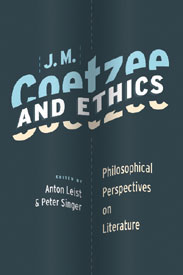
J.M. Coetzee and Ethics — Anton Lesit & Peter Singer

In their introduction to J.M. Coetzee and Ethics, editors Anton Lesit and Peter Singer make the claim that the essays in the new collection “show the folly of Plato’s idea that literature has nothing to contribute to philosophical discussion. Instead they are an invitation to a dialogue that can sharpen the issues that literature raises while making philosophy more imaginative.” Lesit and Singer briefly review the philosophical tradition, from the time of Plato’s call to banish the poets to the current wars between pragmatists and postmodernists, specifically foregrounding the case for Coetzee’s literature as a legitimate source of philosophical inquiry. They identify three specific features of his works — reflectivity, truth seeking, and an exploration of social ethics — that merit critical attention. The essays in the volume address “the psychological and moral phenomenology of personal relationships; the consequences of human suffering, evildoing, and death for human rationality and reason; and the literary methods invoked to open areas of experience beyond the abstract language of philosophers.” The editors also point out that “Unsurprisingly, the ethics of animals looms large in this collection,” a concern that might attract animal ethicists and others interested in animal-human relationships who might not immediately turn to literature for answers (or questions). On the whole, J.M. Coetzee and Ethics, while obviously a specialty volume, strives to appeal to a wider audience, eschewing much of the acadamese that plagues (and obfuscates the arguments of) so many critical volumes. Fans of Coetzee will wish to take note. J.M. Coetzee and Ethics is new in hardback from Columbia University Press.
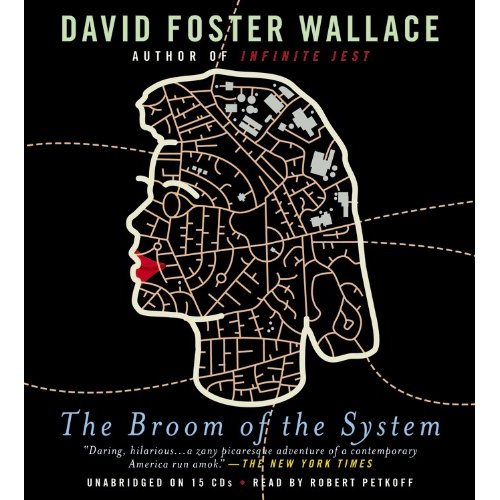
The Broom of the System — David Foster Wallace

David Foster Wallace’s first novel The Broom of the System obsesses over language, words, storytelling and what it might mean to have our lives circumscribed in another person’s narrative. Hatchette Audio’s new audiobook version of Broom highlights the strength of Wallace’s dialogue, a feature of his writing perhaps overlooked, or at least overshadowed, by his complex diction and syntax and his innovative narrative structures. The Broom audiobook features the considerable talents of reader Robert Petkoff, who brings life to its many characters like protagonist Lenore Stonecipher Beadsman, a switchboard operator looking for her grandmother (and namesake) in the weird nooks and crannies of Wallace’s fictional Cleveland. Gramma Lenore (grammar Lenore; lost Lenore) is a former pupil of Wittgenstein, a conceit that allows Wallace to run wild with his own philosophical-linguistic concerns. I first read Broom as an undergrad–this was almost 15 years ago now–and I was pretty soaked in post-structuralist philosophy at the time, at least enough to think I was getting what many of Wallace’s mouthpieces were saying. There’s an obsession with Self and Other and whatever membrane might keep them separate; there’s the paranoia that language dictates our lives; there’s a sense that the postindustrial landscape has led to the need to engender new means of communion. Politicians create the Great Ohio Desert–or G.O.D. (subtle, I know) as a place for spiritual quests; psychiatrists prescribe bizarre ritual theaters for families to produce in front of a recording of a TV audience; a drugged bird develops speech abilities and is mistaken for a miracle. Broom is a dizzying satire of modernity, or more properly, postmodernity (the book was first published in 1987 but set in 1990).

Journeying through the book years later is a new experience, especially in light of how much Wallace and his literary followers have remapped the terrain of fiction. Many of Broom‘s experimental innovations, like the incorporation of TV transcripts, scholarly articles, medical documents, and other “found footage” are so normalized in contemporary fiction as to be almost clichéd in 2010. While these moments are never glaring or gauche in Broom, their inclusion lacks the finesse that Wallace would later demonstrate in Infinite Jest. Similarly, Wallace’s characters in Broom are too cartoonish to connect with. Read aloud, their punning names become a cavalcade of groans:Wang-Dang Lang, Peter Abbott, Candy Mandible, Judith Prietht, Biff Diggerance, and so on, as if Wallace can’t help himself. The Pynchonesque goofiness gets in the way of the reader-writer relationship that Wallace ultimately wants, the Wittgensteinian language game that would allow for identification beyond words. Purposeful bathos is still bathos. Lenore is an engaging character but, as she frequently worries and suspects, she is just that, a character, never transcending the page like Don Gately of Infinite Jest. But it’s cruel and stupid to fault Broom for not being Infinite Jest, especially when Broom is such a rewarding novel. Published when Wallace was just 24, it shows the grand strains of First Novel Syndrome, of a genius trying to push out too many ideas, too many characters, too many philosophical riffs at once. While Infinite Jest is hardly restrained, it shows Wallace’s powerful control over Too Much; it converts Too Much into Not Enough, into Give Me More.

The highlight of Broom is in its storytelling, in its capacity to explode clichés and expose the truth and energy stored within them. Rick Vigorous, Lenore’s would-be beau with literary aspirations, repeatedly shares stories with Lenore (and us, of course). They can be silly and maudlin and mawkish and downright awful, but also inspiring and sad and horrific, all at the same time, and Wallace engineers and comments on these stories (and the other stories that populate the book) in a way that somehow breaks with or goes past the postmodern tradition he’s otherwise relatively beholden to in Broom. And while Wallace’s first novel never achieves the exquisite sadness of Infinite Jest (although it would clearly like to), it does share the same rap-session humor, the same intimate narrative voice that welcomes the reader to laugh, to ponder, to play the game. Recommended.

Tom McCarthy on Technology and the Novel

Great essay today at The Guardian from Tom McCarthy, author of Remainder and the the forthcoming, highly-anticipated C. McCarthy discusses technology, modernity, and literature, mulling over writers like Blake, Cervantes, Shelley, Joyce, and Ballard. He also talks about some of the research that went into C. From his essay:

C takes place, specifically, between 1898 and 1922. The dates aren’t accidental: they mark the period between Marconi’s early short-distance radio experiments and the founding of that centralised state broadcaster of entertainment, news and propaganda that we still know as the BBC. In 1922, Britain was erecting, in its colonial territory Egypt, the first long-distance pylons of its proposed imperial wireless chain – and as it went about this, it lost Egypt, which gained independence in February of that year. For ancient Egyptians, “pylons” were gateways to the underworld: these modern ones came to symbolise bereavement on a national scale. In November, also in Egypt, Howard Carter disinterred what would become the most famous family crypt of all time. 1922 was also modernism’s annus mirabilis, seeing the publication of The Waste Land, in which voices, dialogues and even weather reports drift in and out of audibility as its author-operator fiddles with his literary dial – and Ulysses, a huge textual switchboard in which the themes of death and media are plugged into each other time and again.

Look for our full review of C sometime next week.

The Thousand Autumns of Jacob de Zoet — David Mitchell

At some point, almost every character in David Mitchell’s new novel, The Thousand Autumns of Jacob de Zoet tells a story. The book teems with storytellers and their stories, overflows with compact bildungsromans, wistful jeremiads, high adventures drawn in miniature, comic escapades, bizarre folk tales, and romantic myths, all pressed into the service of the book’s larger narrative, the story of Jacob de Zoet, a Dutchman in Shogunate era Japan. In 1799, the relative starting point for this massive novel, Japan limited economic trade with Europeans to the Dutch East India Company, who, with a few rare exceptions, were not permitted to touch Japanese soil. Instead, the Dutch were confined to the man-made isle of Dejima in the bay of Nagasaki. With its rich cultural mishmash, claustrophobic isolation, and strange hybrid nature, Dejima makes a fascinating platform for Mitchell’s tale.

Most reviews of Mitchell’s new book have squared it against his earlier novels, particularly his experimental opus Cloud Atlas (The Guardian‘s review even begins by asking “Does it matter what books a novelist has written before? Should readers need to know an author’s preceding works fully to grasp the new one?”). The reason for this is plain. By and large, Thousand Autumns is a conventional historical novel, a straightforward linear narrative that combines a forbidden love triangle story with elements of high adventure. There are good guys and bad guys, Enlightened thinkers and scheming crooks, warriors and spies, and even an evil monk who may or may not have supernatural powers. Thousand Autumns (like its main setting Dejima) is richly detailed but hermetically sealed; what leaks from that seal are its myriad stories, its capacity for storytelling. This effusion of stories also marks the novel, I believe, as something more than the conventional historical novel it is purported to be. Even more interesting though is the space the novel is occupying in a current literary debate–is The Thousand Autumns of Jacob de Zoet a postmodern novel or not? The rest of my review will discuss this issue, along with James Wood’s review at The New Yorker and Dave Eggers’s review at The New York Times. The simple answer, of course, is that it doesn’t matter whether the book is postmodern or something else–it’s a very good book, I enjoyed it very much, and you probably will too. I encourage you to read Wood’s precis, which I’ve excised here, and then pick up the book. Anyone else interested in the foolish minutiae of what may or may not make a book postmodern or post-postmodern or something else may wish to continue (or not).

Here’s James Wood, using Mitchell’s oeuvre to dither over the fact that “The serious literary novel is at an interesting moment of transition” —

If postmodernism came after modernism, what comes after postmodernism? For that is where we are. “Post-postmodernism” tends toward an infinite stutter. “After postmodernism” suggests a severance that has not occurred. We might settle for “late postmodernism,” a term that suggests the peculiar statelessness of contemporary fiction, which finds itself wandering—not unhappily—between tradition and novelty, realism and anti-realism, the mass audience and the élitist critic. Thus David Mitchell can follow a “postmodern” novel with a “traditional” comic bildungsroman, and then follow that with a conventional historical novel. It is hard to know whether this statelessness is difficult freedom or easy imprisonment, but the more ambitious contemporary fiction will often blend a bewildering variety of elements and historical techniques [. . .]

Dave Eggers, however, feels no need to look for machinations beyond straightforward storytelling. He claims that Thousand Autumns retains the

[. . .] narrative tendencies [of Mitchell’s earlier works] while abandoning the structural complexities often (and often wrongly) called postmodern. This new book is a straight-up, linear, third-person historical novel, an achingly romantic story of forbidden love and something of a rescue tale — all taking place off the coast of Japan, circa 1799. Postmodern it’s not.”

There’s a certain reticence in Eggers’s review to situate Thousand Autumns against anything but itself, including even the rest of Mitchell’s works. In contrast, Wood spends the first half of his review positioning Mitchell’s postmodernism, throughout both his novels (against each other), and as the oeuvre of one author (against other authors). For Wood, Thousand Autumns, because of “its self-enclosed quality [. . .] represents an assertion of pure fictionality.” He continues, arguing that “although the book contains no literary games, it is itself a kind of long game.” Wood would like to see in Thousand Autumns‘s discrete self-containedness a kind of literary gesture, perhaps a sort of conventional historical novel (in scare quotes) that is so conventional as to efface all signs of self-awareness (and thus erase the scare quotes around the gesture). At the same time, Wood recognizes the power of storytelling in the book, asserting that this feature is what makes it a “representative late-postmodern document.” Wood continues:

In place of the grave silence that was the great theme of early postmodernism (or late modernism, if you prefer), language announcing a postwar exhaustion, its own impossibility, as in the work of Beckett or Blanchot, there is a confident profusion of narratives, an often comic abundance of story-making. Never, when reading Mitchell, does the reader worry that language may not be adequate to the task, and this seems to me both a fabulous fortune and a metaphysical deficiency.

These last sentiments are where I strongly disagree with Wood (as perhaps my lede attests)–the greatest strength of Mitchell’s work here is the fabulous fortune of its abundant storytelling. Far from being a metaphysical deficiency, the characters in Thousand Autumns, major and minor, repeatedly transcend their social, spiritual, economic, psychological, and physical confinement via storytelling. Again and again language breaks characters away from their isolation or imprisonment, gives them access to adventure and romance–to spirit. Ultimately, Wood condemns the book for this “metaphysical deficiency,” arguing that “the reader wants a kind of moral or metaphysical pressure that is absent, and that has ceded all the ground to pure storytelling.” (In Wood’s critical body, it is always “the reader,” never “this reader”). I think that the pleasure and power of pure storytelling is its own end, and perhaps it is this recognition that leads Eggers to pronounce of the book simply that “Postmodern it’s not.” And while this declaration is ultimately a more reader-friendly take on Thousand Autumns, it’s also clear to see how the experimental nature of Mitchell’s previous work calls for Wood’s need to place the novel, to situate it against a developing canon (even if Wood chooses ultimately to deny its status).

Wood is perhaps right in his assertion that the term “post-postmodernism” leads to an “infinite stutter.” Still, post-postmodernism ultimately seems more fitting to describe Thousand Autumns than Wood’s “late postmodernism.” The Thousand Autumns of Jacob de Zoet cunningly sets the spiky traps of language and then gracefully leaps over them. Like David Foster Wallace and William Vollmann–two writers who I believe mark the beginnings of post-postmodernism–Mitchell wants to transcend postmodernism’s ironic vision, and storytelling–giving his characters voices–is a means to this end. Perhaps it is Mitchell’s earnestness in conveying the power of storytelling leads Wood to conclude Thousand Autumns “a kind of fantasy [. . .] Or, rather, it is a brilliant fairy tale; and even nightingales, as a Russian proverb has it, can’t live off fairy tales.” If, finally, Thousand Autumns is not a late postmodernist historical fiction but indeed a fairy tale, then it’s worth noting that it’s a particularly enjoyable and nourishing one. Highly recommended.

Collected Prose — Paul Auster

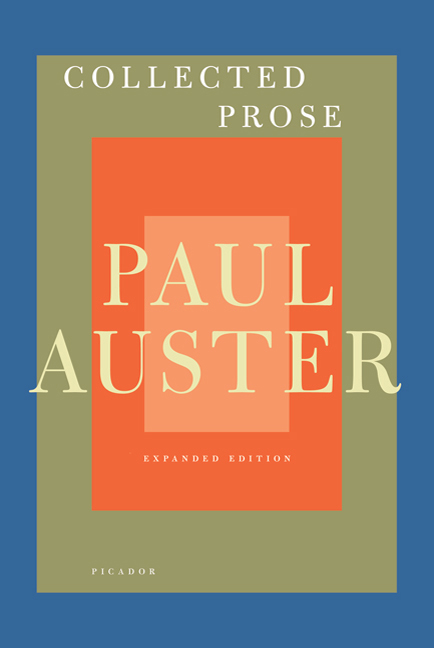
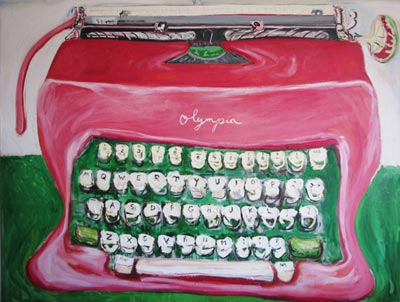
This month, the good folks at Picador are issuing an expanded edition of Paul Auster’s essays, memoirs, prefaces, true stories, anecdotes, and interviews. Inconspicuously titled Collected Prose and running to just under six hundred pages, the volume includes Auster’s début work The Invention of Solitude in its entirety. Solitude is a strange blend of personal memoir, an account of the young writer’s reaction to and relationship with the death (and life) of his father, as well as a philosophical meditation on the absurdity of family, art, and time. Collected Prose also includes the later memoir, Hand to Mouth, a reflective piece on Auster’s early failures as he tries to make it as a writer, including his time in Paris, his marriage to Lydia Davis, his hunger, and his poverty. While Solitude inaugurates many of the experimental structures and postmodern tropes that Auster would be identified with throughout his career as a novelist, the flatter, more direct style of Hand to Mouth is more indicative of the tone of much of Collected Prose. There’s a journalistic directness and keen earnestness to Auster’s essays that perhaps belie his postmodern bona fides. That’s a good thing, allowing Auster to communicate directly about his sometimes challenging subjects to a wider audience. Style aside, both of the book-length memoirs at the front end of Collected Prose neatly delineate the themes that preoccupy much of the rest of the book: art, language, writing, writers, poverty, absurdity, movement, New York City, and so on. And although the book turns away from Auster’s memoirs and true stories in its second half, presenting his essays, editorials, and prefaces, there’s still a sharp sense of Auster in each essay. These are personal essays. Auster writes about his friend Philippe Petite, the French high-wire artist; he writes about the literal hunger artists face, using Knut Hamsun and Franz Kafka as examples; he writes a vindication for Dada daddy Hugo Ball; he writes on over half a dozen relatively obscure poets to let us know why they matter. There are wonderful little moments, like “The Story of My Typewriter,” where Auster exclaims his love for his quiet Olympia (he buys 50 typewriter ribbons fearing the specie’s eventual extinction). The book reprints the Sam Messner paintings that originally accompanied Auster’s text (or, perhaps, vice versa).

Another great moment is the essay “Hawthorne at Home,” which takes a look at a little known piece by Nathaniel Hawthorne called Twenty Days with Julian & Little Bunny. Hawthorne’s piece is more or less a straightforward narrative account of Hawthorne alone with his five-year old son Julian and his pet rabbit for three weeks while wife Sophia visited the Peabodys. While Auster gives the reader a lesson on Hawthorne and his composition of The Scarlet Letter here, the essay focuses on the idyllic charm of a father and son, a rare subject in Hawthorne’s oeuvre. As a bonus, Herman Melville makes a cameo. “Hawthorne at Home” is the sort of essay that makes you want to go read the source material; it sent me hunting for a used copy of American Notebooks.

As one might imagine, Collected Prose is absolutely larded with writers, and lovingly so. Auster does not suffer from the inclination toward meanness that so many critics feel toward their peers, perhaps because he writes foremost from the perspective of an artist. Not that it’s difficult to praise Art Spiegelman (“The Art of Worry”) or pray for Salman Rushdie (um, “A Prayer for Salman Rushdie”) or speak to the genius of Samuel Beckett (“Remembering Beckett on His One Hundredth Birthday”) and Jim Jarmusch (“Night on Earth: New York”)–but Auster illuminates their work in a way that transcends the postmodern concerns of technique, place, and politics, and speaks directly to a certain aesthetic excellence. His love for storytellers extends beyond the pros, of course, evinced in his work with NPR’s National Story Project. He credits wife Siri with coming up with the idea of having NPR listeners write and submit their own original stories, but his enthusiasm for her idea resonates in his warm preface to the eventual book that collected the listeners’ submissions. Auster writes, “I learned that I am not alone in my belief that the more we understand of the world, the more elusive and confounding that world becomes.” The world becomes more “confounding” after the 9/11 attacks, of course, and like so many other writers Auster attempted to somehow measure the tragedy in words. “Random Notes–September 11, 2001–4:00 PM” is a scrap, a fragment, a shell-shocked missive that ends with the haunting words “And so the twenty-first century finally begins.”

It might be misleading to call Collected Prose a good introduction to Paul Auster’s nonfiction–can a work so comprehensive, so massive be a mere starting point?–but it is a great introduction, so there. It’s also a fantastic overview of critical, literary, and artistic theory, written from a deeply personal perspective. Let’s hope that fifteen years from now we’ll have another expanded edition of Auster’s prose; in the meantime, we can look forward to his new novel Sunset Park this November. Highly recommended.

Post-postmodern Satire and More Juggalo Wonder

Two weeks ago, I wrote a piece about the Insane Clown Posse and Juggalo culture where I argued that ICP’s project, so heavily distorted in the tropes and defenses of postmodernity, is essentially resistant to ironic satire and even parody. My piece was prompted largely by ICP’s newest video, “Miracles,” a mawkish, sweetly dumb anthem brought to life as a mutant Spencer’s Gifts blacklight poster. A day or two after I posted, a friend sent me Daniel O’Brien’s article in Cracked, “Learn Your Motherf#@kin’ Science: A Textbook for Juggalos.” O’Brien’s piece seeks to correct ICP’s notion that “rainbows,” “giraffes,” and “magnets” are somehow unexplainable “miracles”; he uses Juggalo vernacular to address the myriad questions (and misapprehensions) expressed in “Miracles.” O’Brien juxtaposes Juggalo-speak against the schema of school texts to point out that “Miracles” is insanely, almost heroically stupid. He does this to be funny, of course, but I think that there’s a sense of exasperation to his parody. It buckles under the strain of mocking something already so radically open to an ironic viewpoint as to render said viewpoint null and void.

About a week after O’Brien and I ran our pieces on “Miracles,” Saturday Night Live attempted another parody of ICP (see my first post for more on their first attempt). Here’s their spoof of “Miracles”:

Again, it’s not very funny. There’s no insight or satirical value, no allegorical leap–it’s just an ironic viewpoint. But what else could it be? What’s left to a satirist when his subject is literally a clown in oversized shorts rapping about the magical mysteries of magnets? In her review of the episode at AV Club, Claire Zullkey wondered, “if SNL should get much credit for a near line-by-line parody of an Insane Clown Posse video that is already ridiculous and ironic,” and Annie Wu at TV Squad noted that “it quickly became obvious that the real Insane Clown Posse video was funnier. Sorry, ‘SNL,’ but no matter how hard you try, you cannot top unintentional ICP hilarity.”

But are ICP unintentional? As I argued in my previous post, they clearly tap into authenticity or “realness” in their project, both in their music and in their connection to their fans, the Juggalos. At the same time, this authenticity is bolstered by commonplace idioms and tropes of postmodernism–code names, fictional personas, costumes, make-up, self-invented mythos, argot, and a keen emphasis on self-referentiality. These postmodern defenses render the question of intentionality radically ambiguous. This is why the old techniques of satire and parody do not hold up very well against ICP: the realness of the thing in itself transcends the ironic viewpoint. Cracked did a much better job with this video:

It’s hardly hilarious, but its mash-up technique actually surpasses ironic-viewpoint-as-parody: there’s some real commentary here. The mash-up artist juxtaposes two “real” sources–a Glade Plug-in ad and clips from the original “Miracles” video and the result is genuine satire. What’s being mocked though isn’t the inanity of the Insane Clown Posse, but the larger inanity of mass commercial culture itself, in which people are encouraged to lose critical perspective, to be reduced to a child-like state of wonder by a fucking air freshener, a consumer product. The satire works by pointing out that the ICP video isn’t really any dumber than most other commercials–it’s just so brazenly over-the-top that we notice its inanity. Indeed “Miracles” calls attention to its inanity. It’s self-aware (perhaps). In any case, this juxtaposition of “the real” shows us that successful post-postmodern satire will not invoke an ironic viewpoint, but rather call attention to the limits of an ironic viewpoint. The “loudness” of ICP’s stupidity is so extreme that we take an ironic view, but what of the far-more subtle stupidities of Glade Plug-in commercials and their ilk? If “Miracles” is to be instructive, let us learn from its distortions, for what it distorts is really just part and parcel of 21st century American culture. It is a priori irony. It is meta-criticism. But it need not be instructive. It can simply be enjoyed for (whatever) it is.

Denis Johnson’s Nobody Move and the Pleasures of Postmodern Crime Fiction

There’s an admirable precision to Denis Johnson’s Nobody Move, a dark and funny crime caper originally serialized in Playboy over four months in 2008, now available in trade paperback from Picador. Johnson limits himself to a handful of characters, a span of a few days, and four fifty-page segments to tell his story. Johnson’s economy resonates from his tight plotting and structure down to his cool, concise sentences. He works in noir archetypes, to be sure–there’s the hard-luck loser in over his head, the femme fatale with a troubled past (and present), the sadistic thug and his moll, and the sinister mastermind. Johnson’s feat here is to present all of this in a manner that’s simultaneously invigorating to the genre but also a confirmation of its pleasures.

Consider Johnson’s erstwhile protagonist, Jimmy Luntz. The name alone seems to tell us everything about this guy, a lousy gambler who spends much of his time on the run. He owes money to the wrong guys, and when a gorilla appropriately named Gambol comes to collect, Luntz makes the mistake of shooting but not killing him. Johnson traffics in immediacy in Nobody Move–there’s not a lot of backstory or dwelling on psychological motivation, thankfully–but he does offer up the occasional nugget, like this one:

Early in his teens Luntz had fought Golden Gloves. Clumsy in the ring, he’d distinguished himself the wrong way–the only boy to get knocked out twice. He’d spent two years at it. His secret was that he’d never, before or since, felt so comfortable or so at home as when lying on his back listening to the far-off music of the referee’s ten-count.

And that’s all the personal history we really need about Luntz. It’s the gaps in the story that are so engaging, that force the reader to play the role of detective in this crime story. To this end, Johnson starts the story in media res, with Luntz leaving a disappointing competition performance of his barbershop chorus. He spends much of the novel’s first half still in his white tux. The novel’s end — well, I won’t spoil the end, of course — but let’s just say that the end of the novel finds our characters poised for further nefarious adventures. But there I go, getting ahead of myself. A little more on plot: Gambol, wounded by Jimmy, finds himself being nursed by a woman named Mary. Their nascent relationship is one of the highlights of the book, funny and cruel, a bizarre study in unlikely romance. Meanwhile, Jimmy hooks up with Anita Desilvera, a dark-eyed bombshell with a serious drinking problem and a series of upcoming court dates. They complicate their problems by going on the lam together. Gambol eventually comes looking for Jimmy (he wants to literally eat his testicles) and drama and danger ensue.

Denis Johnson is arguably among the best living American writers today, having produces no fewer than two masterpieces (Tree of Smoke, one of my favorite books of the past ten years, and Jesus’ Son, one of my favorite books ever). So when he wrote a genre fiction piece under a deadline for Playboy, many critics and readers wondered what he was up to. Was he serious? How serious were we supposed to take the work? Did he need the money? The book itself offers some answers. Nobody Move is fantastic as a genre exercise, witty, dark, lean, and hard-boiled, transcending the bad or formulaic writing that can plague the genre’s novels but never trying to transcend its tropes. Put another way, Johnson here demonstrates that he can master a genre that is not his, and that he can do it under the constraints of space and time. That’s quite a feat, if you think about it, especially if you compare Nobody Move to Thomas Pynchon’s recent genre exercise, Inherent Vice, or the detective-centered works of Jonathan Lethem like Motherless Brooklyn and Gun, With Occasional Music. Pynchon’s work is in many ways a covert, loving goof on the genre, but it’s still more or less a “Thomas Pynchon” book. Lethem likes the idea of writing crime noir, but he wants to subvert it, mash it up with sci-fi, see it as a form of post-modern allegory. Roberto Bolaño is almost painfully aware of this in his fiction–his narrator in Distant Star gets to play at being a detective for a bit, but finds that it’s not nearly as fun as he would like it to be. The Savage Detectives views literature and art as a crime scene to puzzle out. And 2666 . . . well, you know about 2666 (hang on wait, you don’t know about 2666? You should really get that taken care of). Or take James Ellroy’s postmoderinst crime fiction, which owes, unwittingly or not, as much to Don DeLillo as it does to Raymond Chandler. These are all great writers, of course. But I think contrasting what they are trying to do with what Johnson is trying to do is instructive.

There’s a purity to Nobody Move, to its utter willingness to simply be what it is–and many folks won’t like that; they may even accuse Johnson of slumming. Perhaps they think it’s easy to write a tight, funny crime novel. Perhaps they know it’s not, and they think that Johnson is being solipsistic, or even mercenary. In any case, Nobody Move will probably stand outside of Johnson’s canon. And that’s unfair. Cinematic and highly visual, it recalls some of the Coen brothers’ finest work, like Blood Simple and The Man Who Wasn’t There, and even Tarantino’s Jackie Brown (minus the messy sprawl). Perhaps the best thing about Nobody Move–other than the sheer pleasure of reading it over a few afternoons, of course–is that it might motivate readers to pick up Jesus’ Son or even Tree of Smoke. For many readers, especially young readers, genre is a vital gateway to what many of us prejudicially call “more serious” literature. So pick up Nobody Move, read it, love it, and then pass it on to someone who needs to know about Denis Johnson. Recommended.

Nobody Move is available in trade paperback from Picador on April 24, 2010.

Self-Ironizing Anti-Satiric Culture and a Juggalo’s Sense of Wonder

Last year, Saturday Night Live ran an unfunny parody of an infamous viral video. SNL sought to mock the 2009 Gathering of the Juggalos Infomercial which advertised the tenth anniversary spectacular for that venerable event. The Gathering of the Juggalos is an annual outdoor music and culture festival initiated by and starring Insane Clown Posse. The best way to (try to) understand it is to watch the infomercial. You can watch the infomercial and SNL‘s parody at Current, which I suggest you do now. Done? Okay.

SNL‘s parody is not funny, it is merely observational; that is to say, it doesn’t ever approach satire. It is unfunny mimicry of something far funnier. There is no topping the riotous authenticity of the thing in itself. The original Juggalo infomercial’s joyful exuberance resists SNL‘s ironic aims–it can’t really be satirized. It is beyond kitsch, and eventually even schadenfreude. It does not seem real. Can the ICP enterprise be in earnest, though? Take their new video “Miracles,” for example–are these guys for real? Take a few minutes to watch this. I insist. (NB: Lyrics NSFW).

The video, apparently directed by Lisa Frank, communicates a sincere adoration and sense of wonder and possibility in a world of shit that’ll shock your eyelids, like: long neck giraffes, pet cats and dogs, fucking shooting stars and fucking rainbows, UFOs, crows, ghosts, moms, kids . . . you know, pure motherfucking magic. There’s a paradox in Shaggy 2 Dope and Violent J in full malevolent get-up vamping in front of rainbows and stars and expressing anger at scientists who would dare to explain how fucking magnets work. Even more perplexing, earlier this year, ICP released the trailer for their Western film, Big Money Rustlas the deadly tale of debauchery, hedonism, and family love set in a small town of Mudbug. Again, I insist you watch the trailer. (NB: Language NSFW).

How might one go about satirizing that? It already seems framed as a parody of a parody. It’s anti-satiric. It self-ironizes. But again: How sincere are ICP?

Thomas Morton’s “In the Land of the Juggalos” (Vice magazine), the authoritative, in-depth investigation into the 2007 Gathering, reveals a close-knit culture of rejects reveling in “the worst aspects of goth, punk, gangsta rap, rave, nu-metal, and real metal to create a sub-culture so universally repulsive as to forestall any attempts at outside involvement.” Equally good, and more immediately accessible is Derek Erdman’s photo essay documenting the 2009 Gathering–the one advertised in the promo video. His marvelous, grotesque photos show a sincere audience, eager members of the Psychopathic Records “family.” Take a few minutes to suck it all in. These people are serious in their Juggaloness. But again, what of ICP themselves? They can’t be art-pranksters or scammers, can they? They are clearly serious about ICP as a money-making enterprise but what about as a form of art or cultural commentary? Can they be serious about the absurd sentimental content of “Miracles” or their woefully dumb Western film? Are they for real?

There is a radical authenticity about ICP’s project. It’s an autochthonous monster engendering a legion of mutant fans. Yet it also seems potently aware of its position. ICP/Juggalo culture strikes me as a form of ritual theater assuring a sense of belonging and even meaning in life to a group of people who choose to see themselves as outcast or othered. It is inconceivable to suggest that they are wholly or even partly unaware of how others see them; indeed, awareness of how others perceive them is exactly what gives meaning to being a down-assed ninja, a true Juggalo. They see you seeing them (seeing you seeing them).

Hence a condition of post-postmodernity, of a ludic and labyrinthine culture that produces subcultures resistant to irony, to parody, to the defenses of Modernism and the techniques of postmodernism. If we contrast the gap between SNL’s parody and the real thing, we might be led to what I think David Shields is trying to describe in his book Reality Hunger, a situation where the narrative techniques of modernity (and their counterparts in postmodernism) are no longer tenable forms of discourse and analysis in an increasingly technologically mediated world.

Experiment: Imagine that you wish to satirize (or parody) Walmart. Envision the details and observations you will use to mock the behemoth, its customers, its gross place in America. Then go to a Walmart. You are trumped. Hyperbole and irony are beyond you. There is no way to top the thing in itself. You are left merely with a set of observations, not insights. An ironic viewpoint does not cease to exist, but it can’t be supported via the traditional methods of Modernism or postmodernism. Contrast South Park‘s Walmart satire with the website People of Walmart. The former attempts to justify an ironic viewpoint through the logic of satire and mimesis. The latter is an ironic viewpoint of an objective reality. It’s not even parody. It’s “real.”

And this is why SNL’s Juggalo spoof signals the limits of parody and cultural parody’s satirical, mimetic aims. Like People of Walmart, it’s just an ironic viewpoint of an objective reality. The postmodern distortions of ICP (their clown paint, their mythos, their argot, their identities, their Faygo) and the surreal, trashy carnival of the Gathering present an objective reality radically open to a host of ironic semiotic machinations delivered in an earnestness that trumps satire. ICP have already done the work for you. Their world hosts ironic oppositions; their nihilistic anthem “Fuck the World” directly contradicts the sugary magical wonder of “Miracles.” The weird identity-symbiosis they share with their fans is wholly defined by radical otherness and alienation. If you take the time to wade through comment boards on ICP related videos, news, and articles (you shouldn’t do that, btw, dear reader), you’ll find a fierce hatred of Juggalos–a fierce hatred that paradoxically defines and confers identity upon the Juggalo. This is a priori irony. ICP’s aesthetic identity resists mockery, renders mockery moot. A recent internet video, “The Juggalo News,” attempts to satirize Juggalo culture. It’s mildly amusing but ultimately offers no insight. It’s failed satire.

Far better to dispense with pointless parody and enjoy ICP’s works for whatever they are. Re-watch “Miracles.” Around 1:09 or so Violent J raps: “I fed a fish to a pelican at Frisco bay / It tried to eat my cell phone” and Shaggy responds: “He ran away,” kicking a leg back and thrusting an arm forward in a pose evocative of Superman to illustrate the action of his bosom companion’s narrative. This is more precious than gold, Shaggy’s gesture, a miracle in “Miracles,” and I will take it as an earnest gift. ICP has brought me some measure of joy, and yes, tears (of laughter) in my time, so I do thank them.

Wag’s Revue Issue 5 Out

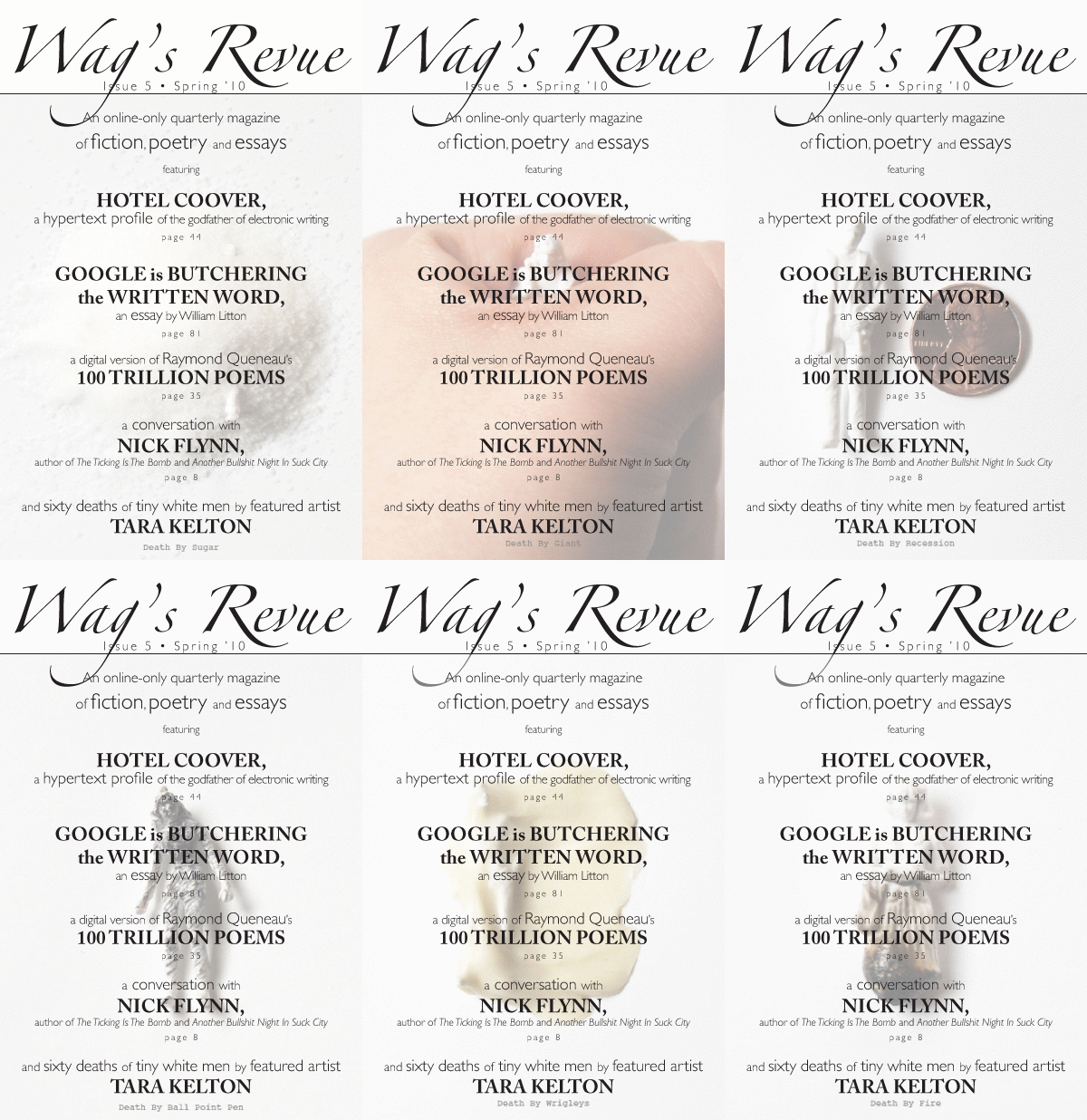
The newest issue of the stylish and savvy online literary magazine, Wag’s Revue is out new this week. In addition to art, poetry, audio clips, and short fiction, the issue features a really cool essay by Robert Moor about Robert Coover’s groundbreaking hypertext exercise, The Hypertext Hotel. Fittingly, the essay is itself an exercise in ludic hyperlinked indeterminancy. Good stuff.

Hiding Man — Tracy Daugherty

Hiding Man, Tracy Daugherty’s excellent and insightful biography of Donald Barthelme begins with a fascinating anecdote. Daugherty, a student of Bartheleme’s, is told to “Find a copy of John Ashbery’s Three Poems, read it, buy a bottle of wine, go home, sit in front of the typewriter, drink the wine, don’t sleep, and produce, by dawn, twelve pages of Ashbery imitation.” We’re not sure if that sounds like fun homework or not, but it does signal both Barthelme’s imaginative trajectory as well as Daugherty’s intimacy with his subject. Elsewhere in his introduction, he notes that “it’s wrong to think of Don as a victim of neglect. He was, rather, a connoisseur of it.” In short, Daugherty argues that Barthelme was a “Hiding Man,” an artist of structured subtlety who remains under-appreciated and misunderstood.

Daugherty’s book is at once a well-researched biography, a work of cultural and literary criticism, and a writerly affair–that is, its written with a novelist’s fine ear. He weaves Barthelme’s personal life with the man’s stories against the backdrop of a rapidly changing society, weighing Barthelme’s themes and methods along with a shift in literature, art, film, and culture. The book is most interesting when Daugherty situates Barthelme’s writing along/against other writers, particularly the other authors at the forefront of the so-called post-modernist movement. In one late episode, Barthelme organized what has come to be known as “The Postmodern Dinner,” inviting literary giants like William Gaddis, William Gass, John Barth, Kurt Vonnegut, Robert Coover, and Susan Sontag to a fancy SoHo restaurant (Thomas Pynchon politely declined the invite). By 1983, postmodernism had fallen out of favor in lieu of minimalism; Barthelme wasn’t the only writer at the dinner who we might–even now–see as a “victim of neglect.” Many of these writers were attacked (and continue to be attacked) as verbal tricksters, hacks playing at a literary shell game. But, as Daugherty makes very clear in Hiding Man, Barthelme was deeply concerned with matters of meaning and art and philosophy and life and love. He was, like most postmodernists (and Modernists, and post-postmodernists), simply willing to remove some of the strictures that bound distinctions of high and low culture, all as a means of getting closer to a core of truth and perception–not as a means of displacing or denying it. He was an artist.

Hiding Man both begins and ends with an assignment. Daugherty invites Barthelme to read at Oregon State University in early 1989, six months before his death. After the reading, in a moment of utter poignancy, Barthelme asks his former pupil, “Did I do okay for you?” As Barthelme gets in a taxi to leave he gives Daugherty one final assignment: “Write a story about a genius.” Daugherty gets more than a passing grade on this one. Recommended.

Hiding Man is new this month in trade paperback from Picador.

The Recognitions (Part I) — William Gaddis

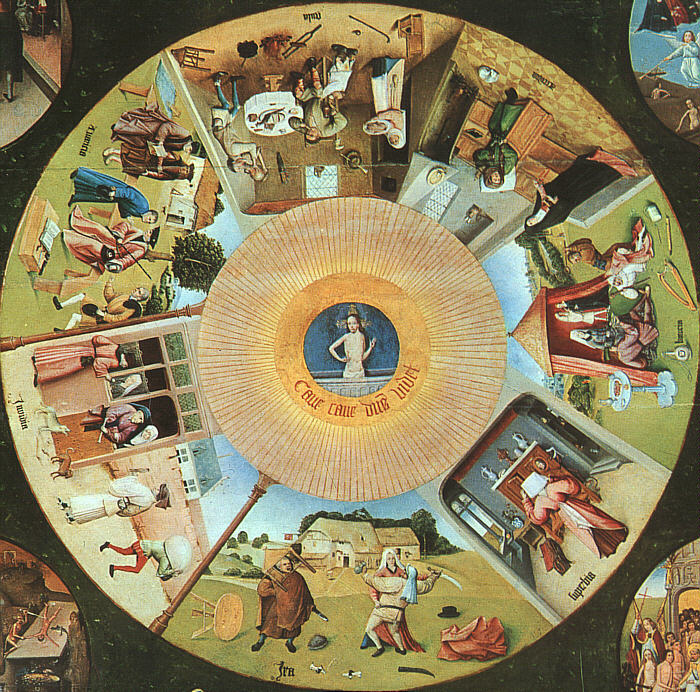
In William Gaddis‘s massive first novel, The Recognitions, Wyatt Gwyon forges paintings by master artists like Hieronymous Bosch, Hugo van der Goes, and Hans Memling. To be more accurate, Wyatt creates new paintings that perfectly replicate not just the style of the old masters, but also the spirit. After aging the pictures, he forges the artist’s signature, and at that point, the painting is no longer an original by Wyatt, but a “new” old original by a long-dead genius. The paintings of the particular artists that Wyatt counterfeits are instructive in understanding, or at least in hoping to understand how The Recognitions works. The paintings of Bosch, Memling, or Dierick Bouts function as highly-allusive tableaux, semiotic constructions that wed religion and mythology to art, genius, and a certain spectacular horror, and, as such, resist any hope of a complete and thorough analysis. Can you imagine, for example, trying to catalog and explain all of the discrete images in Bosch’s triptych, The Garden of Earthly Delights? And then, after creating such a catalog, explaining the intricate relationships between the different parts? You couldn’t, and Gaddis’s novel is the same way. I’ve finished the first of the novel’s three parts, 277 of 956 pages, and I’m going to go out on a limb and guess that the Gaddis has structured the novel as a triptych. The first part, like Bosch’s painting, The Seven Deadly Sins, is comprised of seven sections.

bosch16
The Seven Deadly Sins – Hieronymous Bosch

Early in The Recognitions, teenage Wyatt copies The Seven Deadly Sins–his father owns the original, a painted table top he purchased in Europe. Wyatt replaces the original with his own and gets away with this strange crime–no small feat considering the genius of his father, the Rev. Gwyon, a New England priest who, after the death of his wife at sea, comes to reject the austere puritanism of his order and embrace (much to the consternation of his dwindling congregation) a pluralistic religious world view. In one of many stunning passages centering on Gwyon and religion, the congregation is “stirred with indignant discomfort after listening to the familiar story of virgin birth on December twenty-fifth, mutilation and resurrection, to find they had been attending, not Christ, but Bacchus, Osiris, Krishna, Buddha, Adonis, Marduk, Balder, Attis, Amphion, or Quetzalcoatl.” This series of substitutions enacts a chain of recognitions, and, in a sense, compartmentalizes much of the thematic material of the novel: What is it to be a hero, a redeemer, a savior? What is originality, and how does one recognize it? Who originates whom? What does it mean to create? How is art separate from religion? Clearly, these are not simple questions, and The Recognitions is not a simple book.

Triptych with the Martyrdom of St. Hippolytus -- Dierck Bouts and Hugo van der Goes
Triptych with the Martyrdom of St. Hippolytus — Dierck Bouts and Hugo van der Goes

In order to pose (and perhaps offer varying answers to) these questions, Gaddis employs daring, richly detailed prose, larded with esoteric (and not so esoteric) references to mythology, religion, art, music, and literature. Like the discrete sections of Bosch’s Sins, each of the chapters of the first section of The Recognitions has its own distinct idiom, comportment, and rhythm; yet, even as Gaddis’s approaches seem discontinuous from chapter to chapter, these coalesce to a larger picture.

The first chapter is the best first chapter of any book I can remember reading in recent years. It tells the story of Rev. Gwyon looking for solace in the Catholic monasteries of Spain after his wife’s death at sea under the clumsy hands of a fugitive counterfeiter posing as a doctor (already, the book posits the inherent dangers of forgery, even as it complicates those dangers by asking who isn’t in some sense a phony). There’s a beautiful line Gaddis treads in the first chapter between pain, despair, and melancholy and caustic humor, as Gwyon slowly realizes the false limits of his religion. The chapter continues to tell the story of young Wyatt, growing up under the stern care of his puritanical Aunt May, whose religious attitude is confounded by the increasingly erratic behavior of Wyatt’s often-absent father. While deathly ill, Wyatt teaches himself to paint by copying masterworks. He also attempts an original, a painting of his dead mother, but he cannot bear to finish it because, as he tells his father, “There’s something about . . . an unfinished piece of work . . . Where perfection is still possible. Because it’s there, it’s there all the time, all the time you work trying to uncover it.” This problem of originality, of Platonic perfection guides much of the novel’s critique on Modernism.

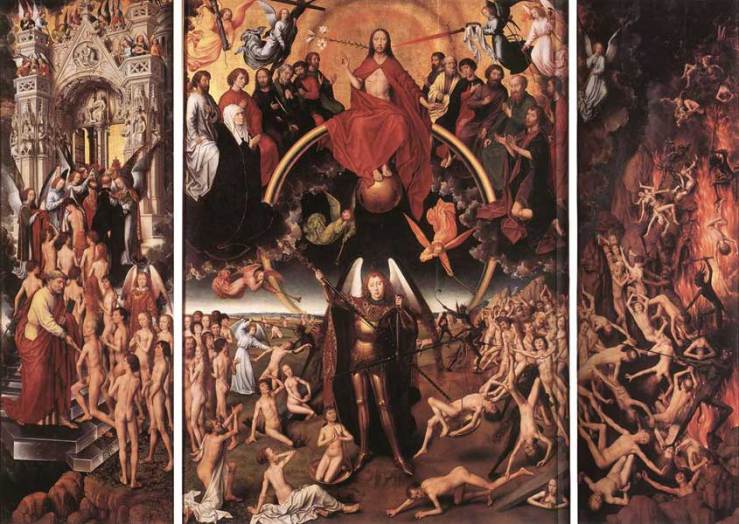
memling_oordeel
The Last Judgment – Hans Memling

Wyatt studies but ultimately rejects the ministry, opting instead to become an artist. The second chapter finds him in Paris, attempting to sell his original work. The chapter is a bravura shift into the sounds, sights, and consciousness of another world, another distinct mythology–ex-patriot Paris, Hemingway’s Paris, Woolf’s Paris. Gaddis shows a heavy debt to James Joyce‘s innovations in Ulysses here (and throughout the book, of course), although it would be a mistake to reduce the novel to a mere aping of that great work. Rather, The Recognitions seems to continue that High Modernist project, and, arguably, connect it to the (post)modern work of Pynchon, DeLillo, and David Foster Wallace. (In it’s heavy erudition, numerous allusions, and complex voices, the novel readily recalls both W.G. Sebald and Roberto Bolaño as far as I’m concerned). By the third chapter we find Wyatt married, quite unhappily, producing hack work, copies he lets his boss put his name on. The chapter is painful and often ugly, as we see his marriage disintegrate. In this chapter he meets Recktall Brown, the Mephistophelean business man who will arrange Wyatt’s future career as a counterfeiter of original paintings. As the chapter ends, Wyatt is no longer referred to by his name, a device that continues throughout the rest of part one (and perhaps the whole book). It’s as if he’s lost something intrinsic, some core originality in exchange for the ability to “become” the artist he is emulating. Wyatt now disintegrates into the background of the narrative, and is exchanged for a young Harvard grad named Otto. Otto follows Wyatt around like a puppy, writing down whatever he says, absorbing whatever he can from him, and eventually sleeping with his wife. Otto is the worst kind of poseur; he travels to Central America to finish his play only to lend the mediocre (at best) work some authenticity, or at least buzz. He fakes an injury and cultivates a wild appearance he hopes will give him artistic mystique among the Bohemian Greenwich Villagers he hopes to impress. In the fifth chapter, at an art-party, Otto, and the reader, learn quickly that no one cares about his play–everyone’s busy making their own original art. Gaddis’s evocation of a Village party in the late forties/early fifties here is wonderful, fly-on-the-wall stuff. His rhetoric captures the buzzing musicality of a raucous house party, and even if his mockery of the assembled artists, critics, and wannabes is savage, it’s also loving. Gaddis has an astute ear for the mid-twentieth century, where gossip infiltrates debate on aesthetics, and commercials punctuate classical scores on the radio.

Wyatt (unnamed) returns for the seventh (and longest) chapter of part one. He’s been very successful at his work, although he seems not to care at all for the money he’s making. Instead, he seems obsessed with channeling these ancient masters, for only in this pre-modern world is originality possible. Of course, the levels of irony are confounding here: Wyatt’s only access to originality is to pretend to be another person. The originality of the paintings he creates is subject to the condition that they be not original to him (their creator) but to another. While this attack on Modernity–namely, that originality is impossible–is severe, it’s also worth noting that Gaddis’s writing enacts originality, even as it cobbles together disparate sources. This is what makes the novel such an addictive pleasure to read. While I cannot make any final claims about a novel before finishing it, I will go out on another limb and suggest that those who already own this novel and have not yet made a crack at it for fear of its massive size and allusive structure should go ahead and take it up: it’s dark, erudite, sad, and very, very funny. It’s also not that hard to read, and if the allusions get too dense, there’s always Steven Moore‘s fantastic resource, A Reader’s Guide to William Gaddis’s The Recognitions, now available in its entirety online. Have at it. More when I finish Part II.

Inherent Vice — Thomas Pynchon

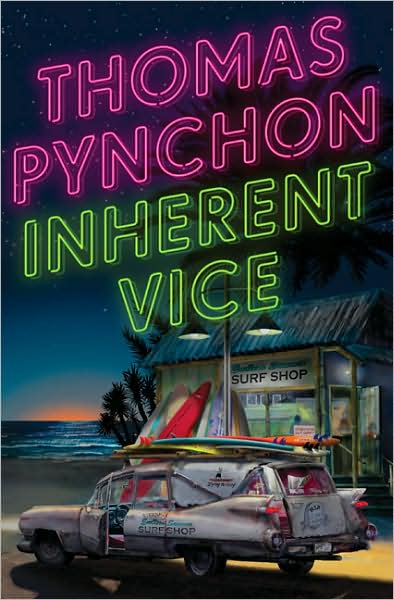
inherent_vice

Thomas Pynchon’s latest novel, Inherent Vice is a detective-fiction genre exercise/parody set in a cartoonish, madcap circa-1970 L.A. redolent with marijuana smoke, patchouli, and paranoia. Navigating this druggy haze is private detective Doc Sportello, who, at the behest of his ex-girlfriend, searches for a missing billionaire in a plot tangled up with surfers, junkies, rock bands, New Age cults, the FBI, and a mysterious syndicate known as the Golden Fang–and that’s not even half of it. At a mere 369 pages, Inherent Vice is considerably shorter than Pynchon’s last novel Against the Day, not to mention his masterpieces Gravity’s Rainbow and Mason & Dixon, and while it might not weigh in with those novels, it does bear plenty of the same Pynchonian trademarks: a strong picaresque bent, a mix of high and low culture, plenty of pop culture references, random sex, scat jokes, characters with silly names (too many to keep track of, of course), original songs, paranoia, paranoia, paranoia, and a central irreverence that borders on disregard for the reader. And like Pynchon’s other works, Inherent Vice is a parody, a take on detective noir, but also a lovely little rip on the sort of novels that populate beaches and airport bookstores all over the world. It’s also a send-up of L.A. stories and drug novels, and really a hate/love letter to the “psychedelic 60s” (to use Sportello’s term), with much in common with Pynchon’s own Vineland (although comparisons to Elmore Leonard, Raymond Chandler, The Big Lebowski and even Chinatown wouldn’t be out of place either).

While most of Inherent Vice reverberates with zany goofiness and cheap thrills, Pynchon also uses the novel as a kind of cultural critique, proposing that modern America begins at the end of the sixties (the specter of the Manson family, the ultimate outsiders, haunts the book). The irony, of course–and undoubtedly it is purposeful irony–is that Pynchon has made similar arguments before: Gravity’s Rainbow locates the end of WWII as the beginning of modern America; the misadventures of the eponymous heroes of Mason & Dixon foreground an emerging American mythology; V. situates American place against the rise of a globally interdependent world. If Inherent Vice works in an idiom of nostalgia, it also works to undermine and puncture that nostalgia. Feeling a little melancholy, Doc remarks on the paradox underlying the sixties that “you lived in a climate of unquestioning hippie belief, pretending to trust everybody while always expecting be sold out.” In one of the novel’s most salient passages–one that has nothing to do with the plot, of course–Doc watches a music store where “in every window . . . appeared a hippie freak or a small party of hippie freaks, each listening on headphones to a different rock ‘n’ roll album and moving around at a different rhythm.” Doc’s reaction to this scene is remarkably prescient:

. . . Doc was used to outdoor concerts where thousands of people congregated to listen to music for free, and where it all got sort of blended together into a single public self, because everybody was having the same experience. But here, each person was listening in solitude, confinement and mutual silence, and some of them later at the register would actually be spending money to hear rock ‘n’ roll. It seemed to Doc like some strange kind of dues or payback. More and more lately he’d been brooding about this great collective dream that everybody was being encouraged to stay tripping around in. Only now and then would you get an unplanned glimpse at the other side.

If Doc’s tone is elegiac, the novel’s discourse works to undercut it, highlighting not so much the “great collective dream” of “a single public self,” but rather pointing out that not only was such a dream inherently false, an inherent vice, but also that this illusion came at a great price–one that people are perhaps paying even today. Doc’s take on the emerging postmodern culture is ironized elsewhere in one of the book’s more interesting subplots involving the earliest version of the internet. When Doc’s tech-savvy former mentor hips him to some info from ARPANET – “I swear it’s like acid,” he claims – Doc responds dubiously that “they outlawed acid as soon as they found out it was a channel to somethin they didn’t want us to see? Why should information be any different?” Doc’s paranoia (and if you smoked a hundred joints a day, you’d be paranoid too) might be a survival trait, but it also sometimes leads to this kind of shortsightedness.

Intrinsic ironies aside, Inherent Vice can be read straightforward as a (not-so-straightforward) detective novel, living up to the promise of its cheesy cover. Honoring the genre, Pynchon writes more economically than ever, and injects plenty of action to keep up the pace in his narrative. It’s a page-turner, whatever that means, and while it’s not exactly Pynchon-lite, it’s hardly a heavy-hitter, nor does it aspire to be. At the same time, Pynchon fans are going to find plenty to dissect in this parody, and should not be disappointed with IV‘s more limited scope (don’t worry, there’s no restraint here folks–and who are we kidding, Pynchon is more or less critic-proof at this point in his career, isn’t he?). Inherent Vice is good dirty fun, a book that can be appreciated on any of several different levels, depending on “where you’re at,” as the hippies in the book like to say. Recommended.

Inherent Vice is available from Penguin August 4th, 2009.

The Penelopiad – Margaret Atwood

thepenelopiad

The Odyssey has long been my go-to example for phallocentric literature in the high school classes I teach. The story of wily Odysseus and his crew wandering the high seas for a decade after the Trojan War prototypifies a literature of masculine fantasy full of adventure, intrigue, and romance. While Odysseus explores the world, bedding nymphs and witches and having every kind of adventure with his boys, his wife Penelope is at home, faithful and chaste, raising kid Telemachus and keeping the would-be usurpers at bay. In short, the story of Odysseus licenses an entire tradition of phallocentric literature wherein the clever protagonist is able to duck familial and social duty and have a great adventure in the process. Think of Huck lighting out for the territory. Same deal. Not that there’s anything wrong with that. But as Margaret Atwood saliently demonstrates in The Penelopiad, her reworking of The Odyssey, there’s always another side to that story of masculine escape–and a price to that adventure, as well.

As its title suggests, The Penelopiad tells the story from the perspective of Penelope, a plain but clever girl, who–like Odysseus–must learn to live by her wits. Atwood, working from several myths, details Penelope’s divine parentage (she’s half-naiad), and her upbringing as a young maid in her father’s home. In an early key scene, Penelope’s father supposedly (the details are fuzzy, she admits) tries to murder her by drowning her, after learning that she will weave his shroud. This infanticide echoes the story of Oedipus, and also serves as a dominant motif throughout the story (it’s also twinned with a motif of eating meat–Penelope remarks at one point that she is just “meat” to be eaten). As the story progresses, young, shy Penelope slowly transforms from a naive gal with a chip on her shoulder about her preternaturally beautiful cousin, Helen, into a woman as wily as Odysseus himself. Atwood treats us to Penelope’s inner thoughts on all sorts of subjects, and even though Penelope claims to love Odysseus, it’s repeatedly clear how angry she is at not only him, but also her son.

While Penelope’s story is dominant, Atwood is very concerned with Penelope’s twelve maids, orphaned servants slain by Odysseus and Telemachus after Odysseus’ return. The maids serve as a chorus, interjecting their voice in short chapters written in a variety of styles, ranging from epic poetry to sea shanties to short skits. One of the most fascinating choral sections plays as an anthropological seminar, in which Atwood’s maids suggest that the real story of Odysseus and Penelope is in fact the displacement of a matriarchy by a wandering warrior. There’s also an inspired court scene where Odysseus is tried for killing the suitors, and the maids sue for justice.

Ultimately, Atwood paints the maids, poor orphans and slaves, as the real victims in this ancient tale. While Penelope complains that she is treated as “meat,” Atwood makes it clear that it’s really the maids who are treated as mere flesh to be consumed–slaves forced to clean, bodies subjected to repeated rapes. And while Penelope repeatedly expresses sorrow and dismay for the murder of the maids, complaining that their deaths were a result of tragic miscommunication, the maids have a different story to tell–one that ironizes much of what Penelope has to say. As the story progresses, we are frequently reminded by Penelope herself that she is a liar and storyteller on par with Odysseus and because of this insight we begin to realize that there might be something to some of the slanderous rumors she’s been protesting in her narrative. It would’ve been simple for Atwood to give Penelope a straightforward and strong voice, a voice that communicated the virtue classically identified with Penelope along with a feminist slant of insight. Instead, Atwood’s Penelope is far more complex and human, gossipy and spiteful, sympathetic and ripe for contempt. The Penelopiad ironizes not only The Odyssey (and the phallocentric literary tradition after it), but also itself; its a book that complicates our notions of history, memory, and identity, and it does so in ways both playful and profound. Highly recommended.

Death of the Author

“[O]nce I’m done with the thing, I’m basically dead, and probably the text’s dead: it becomes simply language, and language lives not just in but through the reader” — David Foster Wallace, quoted in Marshall Boswell’s Understanding David Foster Wallace

In the quote above, DFW illustrates why, when writing at his best, he was able to transcend the cold irony and post-modern goofiness of forbears (and, to some extent, contemporaries) like DeLillo and Pynchon. Wallace understood language as a game, and understood that the game was cooperative. He knew that it wasn’t enough to be clever–readers need to care about that cleverness. If the author is dead, and the text is dead, then the language has to live on through voices, through perspectives, through a series of interior identifications: this is where DFW excelled and dazzled. The myriad voices that lard Infinite Jest testify the power of walking in another’s shoes and seeing through another pair of eyes–in caring for the other. This is the power of literature, and this is why Wallace was such a powerful writer. And this is why we’ll miss him so much.

Wallace’s work went past the post-modern (counter)tradition of meta-textuality and self-referentiality, and commented–sometimes with a painful awareness and acuity–on the emotional deadening produced by contemporary irony and consumerist culture. His characters weren’t just placeholders to be pushed around in the hopes of proving a point, but real, achieved voices who lived through the reader. DFW’s project was not to simply repeat the postmodern realization of the indecidability of textuality, but to work through that realization into a new realm of connection and meaning and identification with his readers despite a cold, ironic, and sometimes meaningless world. In both his groundbreaking fiction and his brilliant essays, DFW delivered what matters the most in any piece of writing–subjects and characters you care about (often despite yourself). Postmodernist thought declares there’s nothing outside the text, a supposition many contemporary authors explore and expound upon in chilly irony or silly wordplay. Even when he was negotiating problems of meaning, signification, and communication in the face of alienation, fragmentation, and despair, David Foster Wallace gave us fully-realized worlds populated with characters we could care about.

There are any number of reports out there right now that mischaracterize DFW as an author who hid behind wordplay and irony. Consider Guy Adams ridiculous lead in The Independent: “For a writer who elevated irony to an art form, and whose infinite jesting co-existed with an all-too-apparent dark side, it felt grimly appropriate that David Foster Wallace should have chosen suicide as the means by which to end his own life story.” Did it feel “grimly appropriate”? Why? What was “grimly appropriate,” about David Foster Wallace’s suicide, Guy? Adams reinforces both his ignorance of his subject as well as his lack of literary understanding with this tidbit: “For all his natural ability, and occasional brilliance, Wallace never lived-up to the fullness of his talent, or the haunting reach of his possibilities.” Adams’s dismissive-yet-inflated rhetoric is exactly the kind of verbal posturing that needs to be shouted down right now by those who’ve actually read Wallace and can testify that his brilliance was anything but “occasional.” And that, I guess, is my only real goal here. Adams is wrong. It’s not true that “Wallace never lived-up to the fullness of his talent”–that phrase doesn’t even mean anything. Who measured the fullness of Wallace’s talent? When did that measurement take place, and in what units was said-talent measured? The measure of DFW’s talent can only be assessed by actually reading his work, and that’s what you should do–especially if you’ve been putting it off. Our author may be dead, but he lives on in a language game played with his readers via the act of reading, and this is a game where everyone stands to win.