Gordon Lish: “Don’t Believe Me”

gl

From “A Conversation with Gordon Lish,” an outstanding interview between the writer/editor and Rob Trucks. The interview is really amazing—Lish talks at length about his writing process, his sense of competition, his friendships with Don DeLillo and Cynthia Ozick, his interest in Julia Kristeva, his feelings for Harold Brodkey and Barry Hannah—and Blood Meridian. Lots and lots of Blood Meridian.

I chose this little nugget because I think it reads almost like a perfect little Lish story—or at least, it seems to perfectly express Lish’s voice, which if you haven’t heard it, my god, get thee to his own reading of his Collected Fictions. Again, the whole interview is well worth your time if you have any interest in Lish. It includes this insight into the man’s fiction:

dickbook

Read “55 Miles to the Gas Pump,” a Lovely Horrific Short Story by Annie Proulx

“55 Miles to the Gas Pump” is a very short story by Annie Proulx.

Rancher Croom in handmade boots and filthy hat, that walleyed cattleman, stray hairs like the curling fiddle string ends, that warm-handed, quick-foot dancer on splintery boards or down the cellar stairs to a rack of bottles of his own strange beer, yeasty, cloudy, bursting out in garlands of foam, Rancher Croom at night galloping drunk over the dark plain, turning off at a place he knows to arrive at a canyon brink where he dismounts and looks down on tumbled rock, waits, then steps out, parting the air with his last roar, sleeves surging up, windmill arms, jeans riding over boot tops, but before he hits he rises again to the top of the cliff like a cork in a bucket of milk.

Mrs. Croom on the roof with a saw cutting a hole into the attic where she has not been for twelve years thanks to old Croom’s padlocks and warnings, whets to her desire, and the sweat flies as she exchanges the saw for a chisel and hammer until a ragged slab peak is free and she can see inside: just as she thought: the corpses of Mr. Croom’s paramours – she recognizes them from their photographs in the paper: MISSING WOMAN – some desiccated as jerky and much the same color, some moldy from lying beneath roof leaks, and, all of them used hard, covered with tarry handprints, the marks of boot heels, some bright blue with remnants of paint used on the shutters years ago, one wrapped in newspaper nipple to knee.

When you live a long way out you make your own fun.

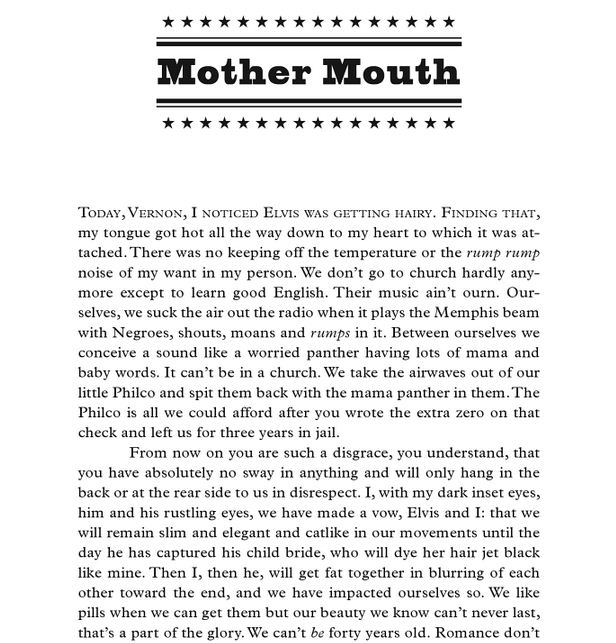
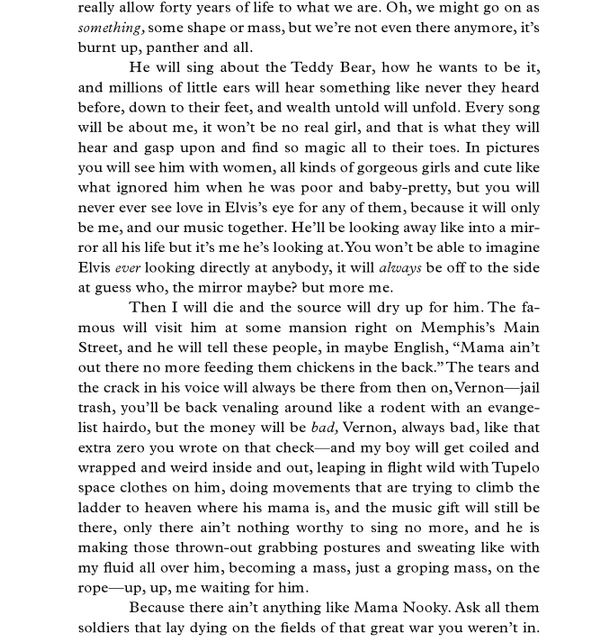
“Mother Mouth” — Barry Hannah

“Examples of Remember” — Lydia Davis

“New Continent” — Georges Perec

“Absent-minded Window-gazing” — Franz Kafka


Absent-minded Window-gazing

What are we to do with these spring days that are now fast coming on? Early this morning the sky was gray, but if you go to the window now you are surprised and lean your cheek against the latch of the casement.

The sun is already setting, but down below you see it lighting up the face of the little girl who strolls along looking about her, and at the same time you see her eclipsed by the shadow of the man behind overtaking her.

And then the man has passed by and the little girl’s face is quite bright

“Absent-minded Window-gazing” by Franz Kafka.


“John Mortonson’s Funeral” — Ambrose Bierce

“John Mortonson’s Funeral,” a very short story by Ambrose Bierce

John Mortonson was dead: his lines in ‘the tragedy “Man”‘ had all been spoken and he had left the stage.

The body rested in a fine mahogany coffin fitted with a plate of glass. All arrangements for the funeral had been so well attended to that had the deceased known he would doubtless have approved. The face, as it showed under the glass, was not disagreeable to look upon: it bore a faint smile, and as the death had been painless, had not been distorted beyond the repairing power of the undertaker. At two o’clock of the afternoon the friends were to assemble to pay their last tribute of respect to one who had no further need of friends and respect. The surviving members of the family came severally every few minutes to the casket and wept above the placid features beneath the glass. This did them no good; it did no good to John Mortonson; but in the presence of death reason and philosophy are silent.

As the hour of two approached the friends began to arrive and after offering such consolation to the stricken relatives as the proprieties of the occasion required, solemnly seated themselves about the room with an augmented consciousness of their importance in the scheme funereal. Then the minister came, and in that overshadowing presence the lesser lights went into eclipse. His entrance was followed by that of the widow, whose lamentations filled the room. She approached the casket and after leaning her face against the cold glass for a moment was gently led to a seat near her daughter. Mournfully and low the man of God began his eulogy of the dead, and his doleful voice, mingled with the sobbing which it was its purpose to stimulate and sustain, rose and fell, seemed to come and go, like the sound of a sullen sea. The gloomy day grew darker as he spoke; a curtain of cloud underspread the sky and a few drops of rain fell audibly. It seemed as if all nature were weeping for John Mortonson.

When the minister had finished his eulogy with prayer a hymn was sung and the pall-bearers took their places beside the bier. As the last notes of the hymn died away the widow ran to the coffin, cast herself upon it and sobbed hysterically. Gradually, however, she yielded to dissuasion, becoming more composed; and as the minister was in the act of leading her away her eyes sought the face of the dead beneath the glass. She threw up her arms and with a shriek fell backward insensible.

     The mourners sprang forward to the coffin, the friends followed, and as the clock on the mantel solemnly struck three all were staring down upon the face of John Mortonson, deceased.

They turned away, sick and faint. One man, trying in his terror to escape the awful sight, stumbled against the coffin so heavily as to knock away one of its frail supports. The coffin fell to the floor, the glass was shattered to bits by the concussion.

From the opening crawled John Mortonson’s cat, which lazily leapt to the floor, sat up, tranquilly wiped its crimson muzzle with a forepaw, then walked with dignity from the room.


“The Maid” — Robert Walser

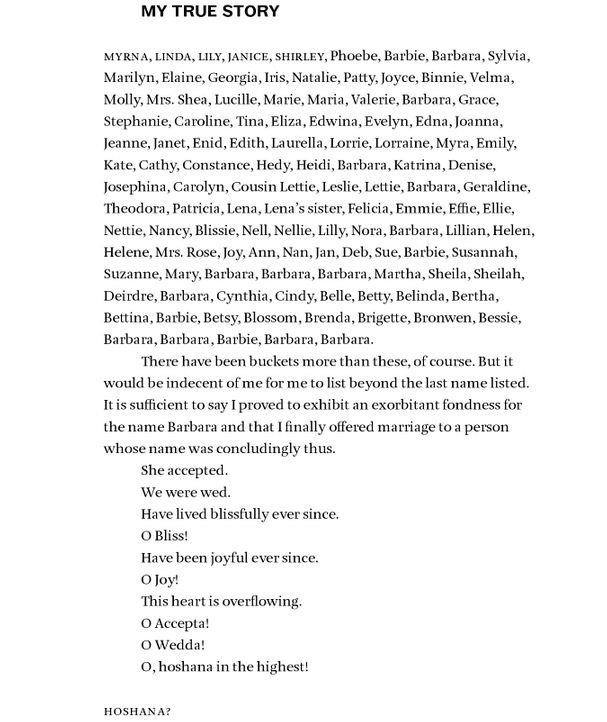
“My True Story” — Gordon Lish

“Stockings” — Tim O’Brien

Henry Dobbins was a good man, and a superb soldier, but sophistication was not his strong suit. The ironies went beyond him. In many ways he was like America itself, big and strong, full of good intentions, a roll of fat jiggling at his belly,slow of foot but always plodding along, always there when you needed him, a believer in the virtues of simplicity and directness and hard labor. Like his country, too, Dobbins was drawn toward sentimentality.

Even now, twenty years later, I can see him wrapping his girlfriend’s pantyhose around his neck before heading out on ambush.

It was his one eccentricity. The pantyhose, he said, had the properties of a good-luck charm. He liked putting his nose into the nylon and breathing in the scent of his girlfriend’s body, he liked the memories this inspired, he sometimes slept with the stockings up against his face, the way an infant sleeps with a magic blanket, secure and peaceful. More than anything,though, the stockings were a talisman for him. They kept him safe. They gave access to a spiritual world, where things were soft and intimate, a place where he might someday take his girlfriend to live. Like many of us in Vietnam, Dobbins felt the pull of superstition, and he believed firmly and resolutely in the protective power of the stockings. They were like body armor, he thought. Whenever we saddled up for a late-night ambush, putting on our helmets and flak jackets, Henry Dobbins would make a ritual out of arranging the nylons around his neck, carefully tying a knot, draping the two leg sections over his left shoulder. There were some jokes, of course, but we came to appreciate the mystery of it all. Dobbins was invulnerable. Never wounded, never a scratch. In August, he tripped a Bouncing Betty, which failed to detonate. And a week later he got caught in the open during a fierce little firefight, no cover at all, but he just slipped the pantyhose over his nose and breathed deep and let the magic do its work.

It turned us into a platoon of believers. You don’t dispute facts.

But then, near the end of October, his girlfriend dumped him. It was a hard blow. Dobbins went quiet for a while,staring down at her letter, then after a time he took out the stockings and tied them around his neck as a comforter.

“No sweat,” he said. “I still love her. The magic doesn’t go away.” [It was a relief for all of us.]

“Stockings,” a short short story by Tim O’Brien. From The Things They Carried.

“In a House Besieged” — Lydia Davis

In a house besieged lived a man and a woman. From where they cowered in the kitchen the man and woman heard small explosions. “The wind,” said the woman. “Hunters,” said the man. “The rain,” said the woman. “The army,” said the man. The woman wanted to go home, but she was already home, there in the middle of the country in a house besieged.

“In a House Besieged,” from Lydia Davis’s first collection Break It Down (1986); available in The Collected Stories.

Amy Hempel Reads “The Orphan Lamb”

“55 Miles to the Gas Pump” — Annie Proulx

“55 Miles to the Gas Pump” is a very short story by Annie Proulx.

Rancher Croom in handmade boots and filthy hat, that walleyed cattleman, stray hairs like the curling fiddle string ends, that warm-handed, quick-foot dancer on splintery boards or down the cellar stairs to a rack of bottles of his own strange beer, yeasty, cloudy, bursting out in garlands of foam, Rancher Coom at night galloping drunk over the dark plain, turning off at a place he knows to arrive at a canyon brink where he dismounts and looks down on tumbled rock, waits, then steps out, parting the air with his last roar, sleeves surging up, windmill arms, jeans riding over boot tops, but before he hits he rises again to the top of the cliff like a cork in a bucket of milk.

Mrs. Croom on the roof with a saw cutting a hole into the attic where she has not been for twelve years thanks to old Croom’s padlocks and warnings, whets to her desire, and the sweat flies as she exchanges the saw for a chisel and hammer until a ragged slab peak is free and she can see inside: just as she thought: the corpses of Mr. Croom’s paramours – she recognizes them from their photographs in the paper: MISSING WOMAN – some desiccated as jerky and much the same color, some moldy from lying beneath roof leaks, and, all of them used hard, covered with tarry handprints, the marks of boot heels, some bright blue with remnants of paint used on the shutters years ago, one wrapped in newspaper nipple to knee.

When you live a long way out you make your own fun.

“A Gentleman’s C” — Padgett Powell

“A Gentleman’s C,” a very short story by Padgett Powell

My father, trying to finally graduate from college at sixty-two, came, by curious circumstance, to be enrolled in an English class I taught, and I was, perhaps, a bit tougher on him than I was on the others. Hadn’t he been tougher on me than on other people’s kids growing up? I gave him a hard, honest, low C. About what I felt he’d always given me.

We had a death in the family, and my mother and I traveled to the funeral. My father stayed put to complete his exams–it was his final term. On the way home we learned that he had received his grades, which were low enough in the aggregate to prevent him from graduating, and reading this news on the dowdy sofa inside the front door, he leaned over as if to rest and had a heart attack and died.

For years I had thought that the old man’s passing away would not affect me, but it did.

(From Micro Fiction, edited by Jerome Stern).

“Midnight in Dostoevsky” — New Short Fiction from Don DeLillo

Want to read to read the latest from Don DeLillo? Of course you do. Check out “Midnight in Dostoevsky,” via The New Yorker. Still not intrigued? Here’s the first paragraph:

We were two sombre boys hunched in our coats, grim winter settling in. The college was at the edge of a small town way upstate, barely a town, maybe a hamlet, we said, or just a whistle stop, and we took walks all the time, getting out, going nowhere, low skies and bare trees, hardly a soul to be seen. This was how we spoke of the local people: they were souls, they were transient spirits, a face in the window of a passing car, runny with reflected light, or a long street with a shovel jutting from a snowbank, no one in sight.