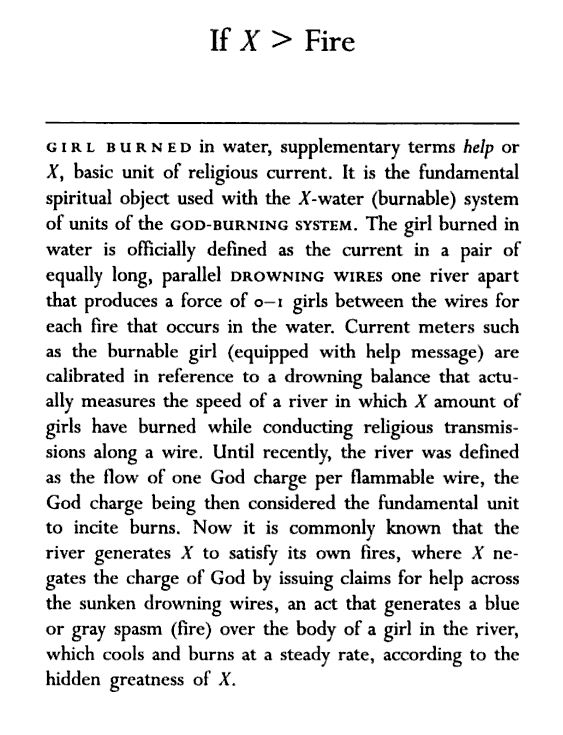
“If X > Fire” — Ben Marcus

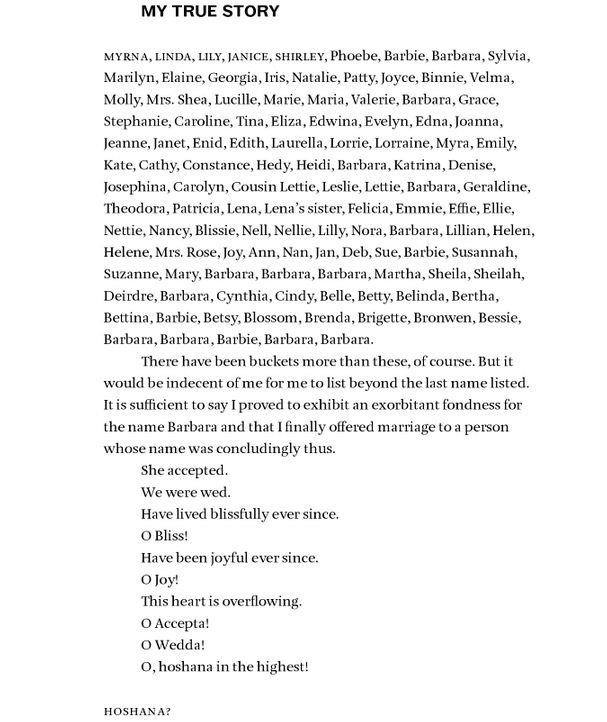
“My True Story” — Gordon Lish

“Stockings” — Tim O’Brien

Henry Dobbins was a good man, and a superb soldier, but sophistication was not his strong suit. The ironies went beyond him. In many ways he was like America itself, big and strong, full of good intentions, a roll of fat jiggling at his belly,slow of foot but always plodding along, always there when you needed him, a believer in the virtues of simplicity and directness and hard labor. Like his country, too, Dobbins was drawn toward sentimentality.

Even now, twenty years later, I can see him wrapping his girlfriend’s pantyhose around his neck before heading out on ambush.

It was his one eccentricity. The pantyhose, he said, had the properties of a good-luck charm. He liked putting his nose into the nylon and breathing in the scent of his girlfriend’s body, he liked the memories this inspired, he sometimes slept with the stockings up against his face, the way an infant sleeps with a magic blanket, secure and peaceful. More than anything,though, the stockings were a talisman for him. They kept him safe. They gave access to a spiritual world, where things were soft and intimate, a place where he might someday take his girlfriend to live. Like many of us in Vietnam, Dobbins felt the pull of superstition, and he believed firmly and resolutely in the protective power of the stockings. They were like body armor, he thought. Whenever we saddled up for a late-night ambush, putting on our helmets and flak jackets, Henry Dobbins would make a ritual out of arranging the nylons around his neck, carefully tying a knot, draping the two leg sections over his left shoulder. There were some jokes, of course, but we came to appreciate the mystery of it all. Dobbins was invulnerable. Never wounded, never a scratch. In August, he tripped a Bouncing Betty, which failed to detonate. And a week later he got caught in the open during a fierce little firefight, no cover at all, but he just slipped the pantyhose over his nose and breathed deep and let the magic do its work.

It turned us into a platoon of believers. You don’t dispute facts.

But then, near the end of October, his girlfriend dumped him. It was a hard blow. Dobbins went quiet for a while,staring down at her letter, then after a time he took out the stockings and tied them around his neck as a comforter.

“No sweat,” he said. “I still love her. The magic doesn’t go away.” [It was a relief for all of us.]

“Stockings,” a short short story by Tim O’Brien. From The Things They Carried.
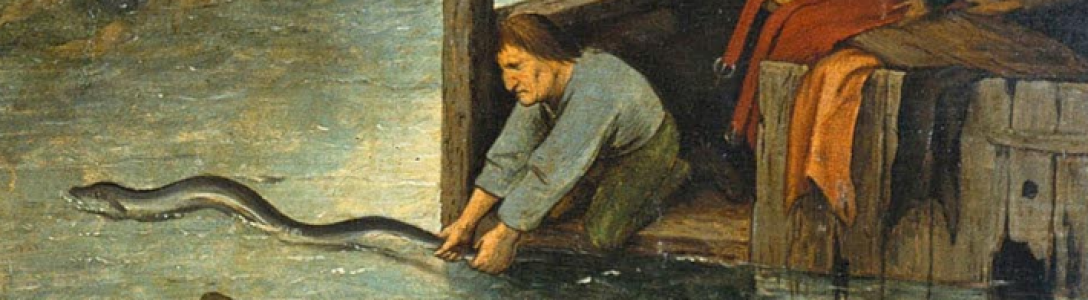
Chapter V, In Our Time — Ernest Hemingway

They shot the six cabinet ministers at half-past six in the morning against the wall of a hospital. There were pools of water in the courtyard. There were wet dead leaves on the paving of the courtyard. It rained hard. All the shutters of the hospital were nailed shut. One of the ministers was sick with typhoid. Two soldiers carried him downstairs and out into the rain. They tried to hold him up against the wall but he sat down in a puddle of water. The other five stood very quietly against the wall. Finally the officer told the soldiers it was no good trying to make him stand up. When they fired the first volley he was sitting down in the water with his head on his knees.

—Chapter V of In Our Time by Ernest Hemingway

“The Man with the Pumpkin Head” — Robert Walser

“Clothes” — Franz Kafka


Clothes

Often when I see clothes with manifold pleats, frills, and appendages which fit so smoothly onto lovely bodies I think they won’t keep that smoothness long, but will get creases that can’t be ironed out, dust lying so thick in the embroidery that it can’t be brushed away, and that no one would want to be so unhappy and so foolish as to wear the same valuable gown every day from early morning till night.

And yet I see girls who are lovely enough and display attractive muscles and small bones and smooth skin and masses of delicate hair, and nonetheless appear day in, day out, in this same natural fancy dress, always propping the same face on the same palms and letting it be reflected from the looking glass.

Only sometimes at night, on coming home late from a party, it seems in the looking glass to be worn out, puffy, dusty, already seen by too many people, and hardly wearable any longer.

“Clothes” by Franz Kafka.


“In a House Besieged” — Lydia Davis

In a house besieged lived a man and a woman. From where they cowered in the kitchen the man and woman heard small explosions. “The wind,” said the woman. “Hunters,” said the man. “The rain,” said the woman. “The army,” said the man. The woman wanted to go home, but she was already home, there in the middle of the country in a house besieged.

“In a House Besieged,” from Lydia Davis’s first collection Break It Down (1986); available in The Collected Stories.

“A Very Short Story” — Ernest Hemingway

“A Very Short Story” by Ernest Hemingway:

One hot evening in Padua they carried him up onto the roof and he could look out over the top of the town. There were chimney swifts in the sky. After a while it got dark and the searchlights came out. The others went down and took the bottles with them. He and Luz could hear them below on the balcony. Luz sat on the bed. She was cool and fresh in the hot night.

Luz stayed on night duty for three months. They were glad to let her. When they operated on him she prepared him for the operating table; and they had a joke about friend or enema. He went under the anaesthetic holding tight on to himself so he would not blab about anything during the silly, talky time. After he got on crutches he used to take the temperatures so Luz would not have to get up from the bed. There were only a few patients, and they all knew about it. They all liked Luz. As he walked back along the halls he thought of Luz in his bed.

Before he went back to the front they went into the Duomo and prayed. It was dim and quiet, and there were other people praying. They wanted to get married, but there was not enough time for the banns, and neither of them had birth certificates. They felt as though they were married, but they wanted everyone to know about it, and to make it so they could not lose it.

Luz wrote him many letters that he never got until after the armistice. Fifteen came in a bunch to the front and he sorted them by the dates and read them all straight through. They were all about the hospital, and how much she loved him and how it was impossible to get along without him and how terrible it was missing him at night.

After the armistice they agreed he should go home to get a job so they might be married. Luz would not come home until he had a good job and could come to New York to meet her. It was understood he would not drink, and he did not want to see his friends or anyone in the States. Only to get a job and be married. On the train from Padua to Milan they quarreled about her not being willing to come home at once. When they had to say good-bye, in the station at Milan, they kissed good-bye, but were not finished with the quarrel. He felt sick about saying good-bye like that.

He went to America on a boat from Genoa. Luz went back to Pordonone to open a hospital. It was lonely and rainy there, and there was a battalion of arditi quartered in the town. Living in the muddy, rainy town in the winter, the major of the battalion made love to Luz, and she had never known Italians before, and finally wrote to the States that theirs had only been a boy and girl affair. She was sorry, and she knew he would probably not be able to understand, but might some day forgive her, and be grateful to her, and she expected, absolutely unexpectedly, to be married in the spring. She loved him as always, but she realized now it was only a boy and girl love. She hoped he would have a great career, and believed in him absolutely. She knew it was for the best.

The major did not marry her in the spring, or any other time. Luz never got an answer to the letter to Chicago about it. A short time after he contracted gonorrhea from a sales girl in a loop department store while riding in a taxicab through Lincoln Park.

New Order Plays “Temptation” Live in the Studio; Bernard Sumner Wears Short Shorts