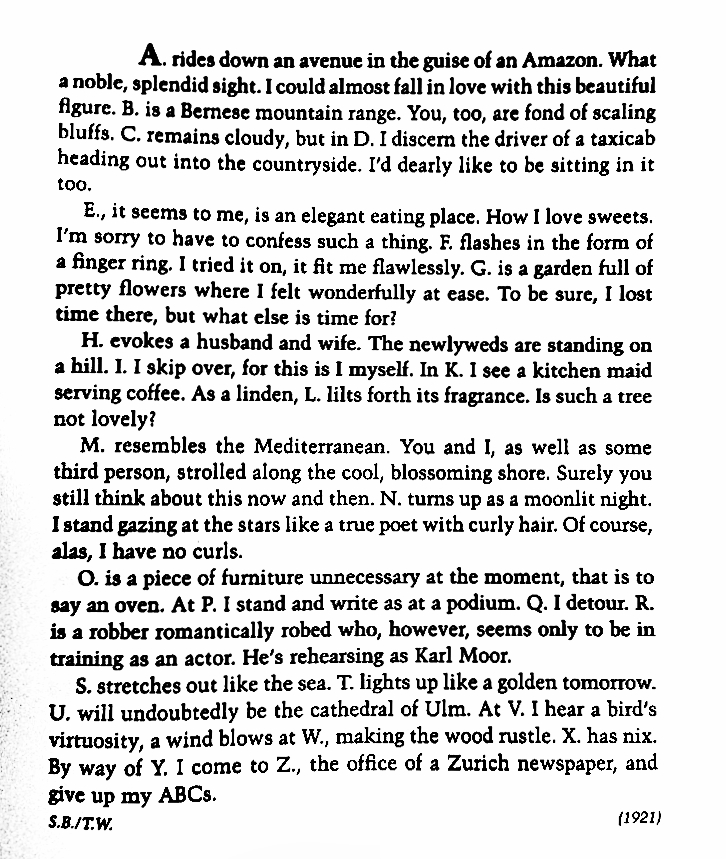
“The Alphabet” — Robert Walser

rw

“The Cloak” — Nikolai Gogol

“The Cloak” by Nikolai Gogol

In the department of—but it is better not to mention the department. There is nothing more irritable than departments, regiments, courts of justice, and, in a word, every branch of public service. Each individual attached to them nowadays thinks all society insulted in his person. Quite recently a complaint was received from a justice of the peace, in which he plainly demonstrated that all the imperial institutions were going to the dogs, and that the Czar’s sacred name was being taken in vain; and in proof he appended to the complaint a romance in which the justice of the peace is made to appear about once every ten lines, and sometimes in a drunken condition. Therefore, in order to avoid all unpleasantness, it will be better to describe the department in question only as a certain department.

So, in a certain department there was a certain official—not a very high one, it must be allowed—short of stature, somewhat pock-marked, red-haired, and short-sighted, with a bald forehead, wrinkled cheeks, and a complexion of the kind known as sanguine. The St. Petersburg climate was responsible for this. As for his official status, he was what is called a perpetual titular councillor, over which, as is well known, some writers make merry, and crack their jokes, obeying the praiseworthy custom of attacking those who cannot bite back.

His family name was Bashmatchkin. This name is evidently derived from “bashmak” (shoe); but when, at what time, and in what manner, is not known. His father and grandfather, and all the Bashmatchkins, always wore boots, which only had new heels two or three times a year. His name was Akakiy Akakievitch. It may strike the reader as rather singular and far-fetched, but he may rest assured that it was by no means far-fetched, and that the circumstances were such that it would have been impossible to give him any other.

This is how it came about.

Akakiy Akakievitch was born, if my memory fails me not, in the evening of the 23rd of March. His mother, the wife of a Government official and a very fine woman, made all due arrangements for having the child baptised. She was lying on the bed opposite the door; on her right stood the godfather, Ivan Ivanovitch Eroshkin, a most estimable man, who served as presiding officer of the senate, while the godmother, Anna Semenovna Byelobrushkova, the wife of an officer of the quarter, and a woman of rare virtues. They offered the mother her choice of three names, Mokiya, Sossiya, or that the child should be called after the martyr Khozdazat. “No,” said the good woman, “all those names are poor.” In order to please her they opened the calendar to another place; three more names appeared, Triphiliy, Dula, and Varakhasiy. “This is a judgment,” said the old woman. “What names! I truly never heard the like. Varada or Varukh might have been borne, but not Triphiliy and Varakhasiy!” They turned to another page and found Pavsikakhiy and Vakhtisiy. “Now I see,” said the old woman, “that it is plainly fate. And since such is the case, it will be better to name him after his father. His father’s name was Akakiy, so let his son’s be Akakiy too.” In this manner he became Akakiy Akakievitch. They christened the child, whereat he wept and made a grimace, as though he foresaw that he was to be a titular councillor. Continue reading ““The Cloak” — Nikolai Gogol” →

“The Prophetic Pictures” — Nathaniel Hawthorne

“The Prophetic Pictures” by Nathaniel Hawthorne

“But this painter!” cried Walter Ludlow, with animation. “He not only excels in his peculiar art, but possesses vast acquirements in all other learning and science. He talks Hebrew with Dr. Mather and gives lectures in anatomy to Dr. Boylston. In a word, he will meet the best-instructed man among us on his own ground. Moreover, he is a polished gentleman, a citizen of the world—yes, a true cosmopolite; for he will speak like a native of each clime and country on the globe, except our own forests, whither he is now going. Nor is all this what I most admire in him.”

“Indeed!” said Elinor, who had listened with a women’s interest to the description of such a man. “Yet this is admirable enough.”

“Surely it is,” replied her lover, “but far less so than his natural gift of adapting himself to every variety of character, insomuch that all men—and all women too, Elinor—shall find a mirror of themselves in this wonderful painter. But the greatest wonder is yet to be told.”

“Nay, if he have more wonderful attributes than these,” said Elinor, laughing, “Boston is a perilous abode for the poor gentleman. Are you telling me of a painter, or a wizard?” Continue reading ““The Prophetic Pictures” — Nathaniel Hawthorne” →

“Beyond the Bayou” — Kate Chopin

“Beyond the Bayou” by Kate Chopin

The bayou curved like a crescent around the point of land on which La Folle’s cabin stood. Between the stream and the hut lay a big abandoned field, where cattle were pastured when the bayou supplied them with water enough. Through the woods that spread back into unknown regions the woman had drawn an imaginary line, and past this circle she never stepped. This was the form of her only mania.

She was now a large, gaunt black woman, past thirty-five. Her real name was Jacqueline, but every one on the plantation called her La Folle, because in childhood she had been frightened literally “out of her senses,” and had never wholly regained them.

It was when there had been skirmishing and sharpshooting all day in the woods. Evening was near when P’tit Maitre, black with powder and crimson with blood, had staggered into the cabin of Jacqueline’s mother, his pursuers close at his heels. The sight had stunned her childish reason.

She dwelt alone in her solitary cabin, for the rest of the quarters had long since been removed beyond her sight and knowledge. She had more physical strength than most men, and made her patch of cotton and corn and tobacco like the best of them. But of the world beyond the bayou she had long known nothing, save what her morbid fancy conceived.

People at Bellissime had grown used to her and her way, and they thought nothing of it. Even when “Old Mis'” died, they did not wonder that La Folle had not crossed the bayou, but had stood upon her side of it, wailing and lamenting.

P’tit Maitre was now the owner of Bellissime. He was a middle-aged man, with a family of beautiful daughters about him, and a little son whom La Folle loved as if he had been her own. She called him Cheri, and so did every one else because she did.

None of the girls had ever been to her what Cheri was. They had each and all loved to be with her, and to listen to her wondrous stories of things that always happened “yonda, beyon’ de bayou.”

But none of them had stroked her black hand quite as Cheri did, nor rested their heads against her knee so confidingly, nor fallen asleep in her arms as he used to do. For Cheri hardly did such things now, since he had become the proud possessor of a gun, and had had his black curls cut off.

That summer—the summer Cheri gave La Folle two black curls tied with a knot of red ribbon—the water ran so low in the bayou that even the little children at Bellissime were able to cross it on foot, and the cattle were sent to pasture down by the river. La Folle was sorry when they were gone, for she loved these dumb companions well, and liked to feel that they were there, and to hear them browsing by night up to her own enclosure. Continue reading ““Beyond the Bayou” — Kate Chopin” →

“On the Tram” — Franz Kafka

“On the Tram” by Franz Kafka

I stand on the end platform of the tram and am completely unsure of my footing in this world, in this town, in my family. Not even casually could I indicate any claims that I might rightly advance in any direction. I have not even any defense to offer for standing on this platform, holding on to this strap, letting myself be carried along by this tram, nor for the people who give way to the tram or walk quietly along or stand gazing into shopwindows. Nobody asks me to put up a defense, indeed, but that is irrelevant.

The tram approaches a stopping place and a girl takes up her position near the step, ready to alight. She is as distinct to me as if I had run my hands over her. She is dressed in black, the pleats of her skirt hang almost still, her blouse is tight and has a collar of white fine-meshed lace, her left hand is braced flat against the side of the tram, the umbrella in her right hand rests on the second top step. Her face is brown, her nose, slightly pinched at the sides, has a broad round tip. She has a lot of brown hair and stray little tendrils on the right temple. Her small ear is close-set, but since I am near her I can see the whole ridge of the whorl of her right ear and the shadow at the root of it.

At that point I asked myself: How is it that she is not amazed at herself, that she keeps her lips closed and makes no such remark?

“Easter Eve” — Anton Chekhov

I was standing on the bank of the River Goltva, waiting for the ferry-boat from the other side. At ordinary times the Goltva is a humble stream of moderate size, silent and pensive, gently glimmering from behind thick reeds; but now a regular lake lay stretched out before me. The waters of spring, running riot, had overflowed both banks and flooded both sides of the river for a long distance, submerging vegetable gardens, hayfields and marshes, so that it was no unusual thing to meet poplars and bushes sticking out above the surface of the water and looking in the darkness like grim solitary crags.

The weather seemed to me magnificent. It was dark, yet I could see the trees, the water and the people. . . . The world was lighted by the stars, which were scattered thickly all over the sky. I don’t remember ever seeing so many stars. Literally one could not have put a finger in between them. There were some as big as a goose’s egg, others tiny as hempseed. . . . They had come out for the festival procession, every one of them, little and big, washed, renewed and joyful, and everyone of them was softly twinkling its beams. The sky was reflected in the water; the stars were bathing in its dark depths and trembling with the quivering eddies. The air was warm and still. . . . Here and there, far away on the further bank in the impenetrable darkness, several bright red lights were gleaming. . . .

A couple of paces from me I saw the dark silhouette of a peasant in a high hat, with a thick knotted stick in his hand.

“How long the ferry-boat is in coming!” I said.

“It is time it was here,” the silhouette answered.

“You are waiting for the ferry-boat, too?”

“No I am not,” yawned the peasant—”I am waiting for the illumination. I should have gone, but to tell you the truth, I haven’t the five kopecks for the ferry.”

“I’ll give you the five kopecks.”

“No; I humbly thank you. . . . With that five kopecks put up a candle for me over there in the monastery. . . . That will be more interesting, and I will stand here. What can it mean, no ferry-boat, as though it had sunk in the water!”

The peasant went up to the water’s edge, took the rope in his hands, and shouted; “Ieronim! Ieron—im!” Continue reading ““Easter Eve” — Anton Chekhov” →

“The Easter Egg” — Saki

“The Easter Egg” by Saki

It was distinctly hard lines for Lady Barbara, who came of good fighting stock, and was one of the bravest women of her generation, that her son should be so undisguisedly a coward. Whatever good qualities Lester Slaggby may have possessed, and he was in some respects charming, courage could certainly never be imputed to him. As a child he had suffered from childish timidity, as a boy from unboyish funk, and as a youth he had exchanged unreasoning fears for others which were more formidable from the fact of having a carefully thought-out basis. He was frankly afraid of animals, nervous with firearms, and never crossed the Channel without mentally comparing the numerical proportion of lifebelts to passengers. On horseback he seemed to require as many hands as a Hindu god, at least four for clutching the reins, and two more for patting the horse soothingly on the neck. Lady Barbara no longer pretended not to see her son’s prevailing weakness, with her usual courage she faced the knowledge of it squarely, and, mother-like, loved him none the less.

Continental travel, anywhere away from the great tourist tracks, was a favoured hobby with Lady Barbara, and Lester joined her as often as possible. Eastertide usually found her at Knobaltheim, an upland township in one of those small princedoms that make inconspicuous freckles on the map of Central Europe.

A long-standing acquaintanceship with the reigning family made her a personage of due importance in the eyes of her old friend the Burgomaster, and she was anxiously consulted by that worthy on the momentous occasion when the Prince made known his intention of coming in person to open a sanatorium outside the town. All the usual items in a programme of welcome, some of them fatuous and commonplace, others quaint and charming, had been arranged for, but the Burgomaster hoped that the resourceful English lady might have something new and tasteful to suggest in the way of loyal greeting. The Prince was known to the outside world, if at all, as an old-fashioned reactionary, combating modern progress, as it were, with a wooden sword; to his own people he was known as a kindly old gentleman with a certain endearing stateliness which had nothing of standoffishness about it. Knobaltheim was anxious to do its best. Lady Barbara discussed the matter with Lester and one or two acquaintances in her little hotel, but ideas were difficult to come by.

“Might I suggest something to the Gnädige Frau?” asked a sallow high-cheek-boned lady to whom the Englishwoman had spoken once or twice, and whom she had set down in her mind as probably a Southern Slav. Continue reading ““The Easter Egg” — Saki” →

“The Cupboard of the Yesterdays” — Saki

“The Cupboard of the Yesterdays” — Saki

“War is a cruelly destructive thing,” said the Wanderer, dropping his newspaper to the floor and staring reflectively into space.

“Ah, yes, indeed,” said the Merchant, responding readily to what seemed like a safe platitude; “when one thinks of the loss of life and limb, the desolated homesteads, the ruined—”

“I wasn’t thinking of anything of the sort,” said the Wanderer; “I was thinking of the tendency that modern war has to destroy and banish the very elements of picturesqueness and excitement that are its chief excuse and charm.  It is like a fire that flares up brilliantly for a while and then leaves everything blacker and bleaker than before.  After every important war in South-East Europe in recent times there has been a shrinking of the area of chronically disturbed territory, a stiffening of frontier lines, an intrusion of civilised monotony.  And imagine what may happen at the conclusion of this war if the Turk should really be driven out of Europe.”

“Well, it would be a gain to the cause of good government, I suppose,” said the Merchant.

“But have you counted the loss?” said the other.  “The Balkans have long been the last surviving shred of happy hunting-ground for the adventurous, a playground for passions that are fast becoming atrophied for want of exercise.  In old bygone days we had the wars in the Low Countries always at our doors, as it were; there was no need to go far afield into malaria-stricken wilds if one wanted a life of boot and saddle and licence to kill and be killed.  Those who wished to see life had a decent opportunity for seeing death at the same time.”

“It is scarcely right to talk of killing and bloodshed in that way,” said the Merchant reprovingly; “one must remember that all men are brothers.”

“One must also remember that a large percentage of them are younger brothers; instead of going into bankruptcy, which is the usual tendency of the younger brother nowadays, they gave their families a fair chance of going into mourning.  Every bullet finds a billet, according to a rather optimistic proverb, and you must admit that nowadays it is becoming increasingly difficult to find billets for a lot of young gentlemen who would have adorned, and probably thoroughly enjoyed, one of the old-time happy-go-lucky wars.  But that is not exactly the burden of my complaint.  The Balkan lands are especially interesting to us in these rapidly-moving days because they afford us the last remaining glimpse of a vanishing period of European history.  When I was a child one of the earliest events of the outside world that forced itself coherently under my notice was a war in the Balkans; I remember a sunburnt, soldierly man putting little pin-flags in a war-map, red flags for the Turkish forces and yellow flags for the Russians.  It seemed a magical region, with its mountain passes and frozen rivers and grim battlefields, its drifting snows, and prowling wolves; there was a great stretch of water that bore the sinister but engaging name of the Black Sea—nothing that I ever learned before or after in a geography lesson made the same impression on me as that strange-named inland sea, and I don’t think its magic has ever faded out of my imagination.  And there was a battle called Plevna that went on and on with varying fortunes for what seemed like a great part of a lifetime; I remember the day of wrath and mourning when the little red flag had to be taken away from Plevna—like other maturer judges, I was backing the wrong horse, at any rate the losing horse.  And now to-day we are putting little pin-flags again into maps of the Balkan region, and the passions are being turned loose once more in their playground.”

“The war will be localised,” said the Merchant vaguely; “at least every one hopes so.”

“It couldn’t wish for a better locality,” said the Wanderer; “there is a charm about those countries that you find nowhere else in Europe, the charm of uncertainty and landslide, and the little dramatic happenings that make all the difference between the ordinary and the desirable.”

“Life is held very cheap in those parts,” said the Merchant.

“To a certain extent, yes,” said the Wanderer.  “I remember a man at Sofia who used to teach me Bulgarian in a rather inefficient manner, interspersed with a lot of quite wearisome gossip.  I never knew what his personal history was, but that was only because I didn’t listen; he told it to me many times.  After I left Bulgaria he used to send me Sofia newspapers from time to time.  I felt that he would be rather tiresome if I ever went there again.  And then I heard afterwards that some men came in one day from Heaven knows where, just as things do happen in the Balkans, and murdered him in the open street, and went away as quietly as they had come.  You will not understand it, but to me there was something rather piquant in the idea of such a thing happening to such a man; after his dullness and his long-winded small-talk it seemed a sort of brilliant esprit d’esalier on his part to meet with an end of such ruthlessly planned and executed violence.”

The Merchant shook his head; the piquancy of the incident was not within striking distance of his comprehension.

“I should have been shocked at hearing such a thing about any one I had known,” he said.

“The present war,” continued his companion, without stopping to discuss two hopelessly divergent points of view, “may be the beginning of the end of much that has hitherto survived the resistless creeping-in of civilisation.  If the Balkan lands are to be finally parcelled out between the competing Christian Kingdoms and the haphazard rule of the Turk banished to beyond the Sea of Marmora, the old order, or disorder if you like, will have received its death-blow.  Something of its spirit will linger perhaps for a while in the old charmed regions where it bore sway; the Greek villagers will doubtless be restless and turbulent and unhappy where the Bulgars rule, and the Bulgars will certainly be restless and turbulent and unhappy under Greek administration, and the rival flocks of the Exarchate and Patriarchate will make themselves intensely disagreeable to one another wherever the opportunity offers; the habits of a lifetime, of several lifetimes, are not laid aside all at once.  And the Albanians, of course, we shall have with us still, a troubled Moslem pool left by the receding wave of Islam in Europe.  But the old atmosphere will have changed, the glamour will have gone; the dust of formality and bureaucratic neatness will slowly settle down over the time-honoured landmarks; the Sanjak of Novi Bazar, the Muersteg Agreement, the Komitadje bands, the Vilayet of Adrianople, all those familiar outlandish names and things and places, that we have known so long as part and parcel of the Balkan Question, will have passed away into the cupboard of yesterdays, as completely as the Hansa League and the wars of the Guises.

“They were the heritage that history handed down to us, spoiled and diminished no doubt, in comparison with yet earlier days that we never knew, but still something to thrill and enliven one little corner of our Continent, something to help us to conjure up in our imagination the days when the Turk was thundering at the gates of Vienna.  And what shall we have to hand down to our children?  Think of what their news from the Balkans will be in the course of another ten or fifteen years.  Socialist Congress at Uskub, election riot at Monastir, great dock strike at Salonika, visit of the Y.M.C.A. to Varna.  Varna—on the coast of that enchanted sea!  They will drive out to some suburb to tea, and write home about it as the Bexhill of the East.

“War is a wickedly destructive thing.”

“Still, you must admit—” began the Merchant.  But the Wanderer was not in the mood to admit anything.  He rose impatiently and walked to where the tape-machine was busy with the news from Adrianople.
 

“Excellent People” — Anton Chekhov

“Excellent People” by Anton Chekhov

ONCE upon a time there lived in Moscow a man called Vladimir Semyonitch Liadovsky. He took his degree at the university in the faculty of law and had a post on the board of management of some railway; but if you had asked him what his work was, he would look candidly and openly at you with his large bright eyes through his gold pincenez, and would answer in a soft, velvety, lisping baritone:

“My work is literature.”

After completing his course at the university, Vladimir Semyonitch had had a paragraph of theatrical criticism accepted by a newspaper. From this paragraph he passed on to reviewing, and a year later he had advanced to writing a weekly article on literary matters for the same paper. But it does not follow from these facts that he was an amateur, that his literary work was of an ephemeral, haphazard character. Whenever I saw his neat spare figure, his high forehead and long mane of hair, when I listened to his speeches, it always seemed to me that his writing, quite apart from what and how he wrote, was something organically part of him, like the beating of his heart, and that his whole literary programme must have been an integral part of his brain while he was a baby in his mother’s womb. Even in his walk, his gestures, his manner of shaking off the ash from his cigarette, I could read this whole programme from A to Z, with all its claptrap, dulness, and honourable sentiments. He was a literary man all over when with an inspired face he laid a wreath on the coffin of some celebrity, or with a grave and solemn face collected signatures for some address; his passion for making the acquaintance of distinguished literary men, his faculty for finding talent even where it was absent, his perpetual enthusiasm, his pulse that went at one hundred and twenty a minute, his ignorance of life, the genuinely feminine flutter with which he threw himself into concerts and literary evenings for the benefit of destitute students, the way in which he gravitated towards the young—all this would have created for him the reputation of a writer even if he had not written his articles.

He was one of those writers to whom phrases like, “We are but few,” or “What would life be without strife? Forward!” were pre-eminently becoming, though he never strove with any one and never did go forward. It did not even sound mawkish when he fell to discoursing of ideals. Every anniversary of the university, on St. Tatiana’s Day, he got drunk, chanted Gaudeamus out of tune, and his beaming and perspiring countenance seemed to say: “See, I’m drunk; I’m keeping it up!” But even that suited him. Continue reading ““Excellent People” — Anton Chekhov” →

“The Lightning-Rod Man” — Herman Melville

What grand irregular thunder, thought I, standing on my hearth-stone among the Acroceraunian hills, as the scattered bolts boomed overhead, and crashed down among the valleys, every bolt followed by zigzag irradiations, and swift slants of sharp rain, which audibly rang, like a charge of spear-points, on my low shingled roof. I suppose, though, that the mountains hereabouts break and churn up the thunder, so that it is far more glorious here than on the plain. Hark!–someone at the door. Who is this that chooses a time of thunder for making calls? And why don’t he, man-fashion, use the knocker, instead of making that doleful undertaker’s clatter with his fist against the hollow panel? But let him in. Ah, here he comes. “Good day, sir:” an entire stranger. “Pray be seated.” What is that strange-looking walking-stick he carries: “A fine thunder-storm, sir.”

“Fine?–Awful!”

“You are wet. Stand here on the hearth before the fire.”

“Not for worlds!”

The stranger still stood in the exact middle of the cottage, where he had first planted himself. His singularity impelled a closer scrutiny. A lean, gloomy figure. Hair dark and lank, mattedly streaked over his brow. His sunken pitfalls of eyes were ringed by indigo halos, and played with an innocuous sort of lightning: the gleam without the bolt. The whole man was dripping. He stood in a puddle on the bare oak floor: his strange walking-stick vertically resting at his side. Continue reading ““The Lightning-Rod Man” — Herman Melville” →

“The Bet” — Anton Chekhov

“The Bet” by Anton Chekhov

I

It was a dark autumn night. The old banker was pacing from corner to corner of his study, recalling to his mind the party he gave in the autumn fifteen years before. There were many clever people at the party and much interesting conversation. They talked among other things of capital punishment. The guests, among them not a few scholars and journalists, for the most part disapproved of capital punishment. They found it obsolete as a means of punishment, unfitted to a Christian State and immoral. Some of them thought that capital punishment should be replaced universally by life-imprisonment.

“I don’t agree with you,” said the host. “I myself have experienced neither capital punishment nor life-imprisonment, but if one may judge a priori, then in my opinion capital punishment is more moral and more humane than imprisonment. Execution kills instantly, life-imprisonment kills by degrees. Who is the more humane executioner, one who kills you in a few seconds or one who draws the life out of you incessantly, for years?”

“They’re both equally immoral,” remarked one of the guests, “because their purpose is the same, to take away life. The State is not God. It has no right to take away that which it cannot give back, if it should so desire.”

Among the company was a lawyer, a young man of about twenty-five. On being asked his opinion, he said:

“Capital punishment and life-imprisonment are equally immoral; but if I were offered the choice between them, I would certainly choose the second. It’s better to live somehow than not to live at all.”

There ensued a lively discussion. The banker who was then younger and more nervous suddenly lost his temper, banged his fist on the table, and turning to the young lawyer, cried out:

“It’s a lie. I bet you two millions you wouldn’t stick in a cell even for five years.”

“If you mean it seriously,” replied the lawyer, “then I bet I’ll stay not five but fifteen.”

“Fifteen! Done!” cried the banker. “Gentlemen, I stake two millions.”

“Agreed. You stake two millions, I my freedom,” said the lawyer.

So this wild, ridiculous bet came to pass. The banker, who at that time had too many millions to count, spoiled and capricious, was beside himself with rapture. During supper he said to the lawyer jokingly:

“Come to your senses, young roan, before it’s too late. Two millions are nothing to me, but you stand to lose three or four of the best years of your life. I say three or four, because you’ll never stick it out any longer. Don’t forget either, you unhappy man, that voluntary is much heavier than enforced imprisonment. The idea that you have the right to free yourself at any moment will poison the whole of your life in the cell. I pity you.”

And now the banker, pacing from corner to corner, recalled all this and asked himself:

“Why did I make this bet? What’s the good? The lawyer loses fifteen years of his life and I throw away two millions. Will it convince people that capital punishment is worse or better than imprisonment for life? No, no! all stuff and rubbish. On my part, it was the caprice of a well-fed man; on the lawyer’s pure greed of gold.” Continue reading ““The Bet” — Anton Chekhov” →

“The Return” — Joseph Conrad

“The Return” by Joseph Conrad

The inner circle train from the City rushed impetuously out of a black hole and pulled up with a discordant, grinding racket in the smirched twilight of a West-End station. A line of doors flew open and a lot of men stepped out headlong. They had high hats, healthy pale faces, dark overcoats and shiny boots; they held in their gloved hands thin umbrellas and hastily folded evening papers that resembled stiff, dirty rags of greenish, pinkish, or whitish colour. Alvan Hervey stepped out with the rest, a smouldering cigar between his teeth. A disregarded little woman in rusty black, with both arms full of parcels, ran along in distress, bolted suddenly into a third-class compartment and the train went on. The slamming of carriage doors burst out sharp and spiteful like a fusillade; an icy draught mingled with acrid fumes swept the whole length of the platform and made a tottering old man, wrapped up to his ears in a woollen comforter, stop short in the moving throng to cough violently over his stick. No one spared him a glance.

Alvan Hervey passed through the ticket gate. Between the bare walls of a sordid staircase men clambered rapidly; their backs appeared alike—almost as if they had been wearing a uniform; their indifferent faces were varied but somehow suggested kinship, like the faces of a band of brothers who through prudence, dignity, disgust, or foresight would resolutely ignore each other; and their eyes, quick or slow; their eyes gazing up the dusty steps; their eyes brown, black, gray, blue, had all the same stare, concentrated and empty, satisfied and unthinking.

Outside the big doorway of the street they scattered in all directions, walking away fast from one another with the hurried air of men fleeing from something compromising; from familiarity or confidences; from something suspected and concealed—like truth or pestilence. Alvan Hervey hesitated, standing alone in the doorway for a moment; then decided to walk home. Continue reading ““The Return” — Joseph Conrad” →

“Chippings with a Chisel” — Nathaniel Hawthorne

“Chippings with a Chisel” by Nathaniel Hawthorne

Passing a summer several years since at Edgartown, on the island of Martha’s Vineyard, I became acquainted with a certain carver of tombstones who had travelled and voyaged thither from the interior of Massachusetts in search of professional employment. The speculation had turned out so successful that my friend expected to transmute slate and marble into silver and gold to the amount of at least a thousand dollars during the few months of his sojourn at Nantucket and the Vineyard. The secluded life and the simple and primitive spirit which still characterizes the inhabitants of those islands, especially of Martha’s Vineyard, insure their dead friends a longer and dearer remembrance than the daily novelty and revolving bustle of the world can elsewhere afford to beings of the past. Yet, while every family is anxious to erect a memorial to its departed members, the untainted breath of Ocean bestows such health and length of days upon the people of the isles as would cause a melancholy dearth of business to a resident artist in that line. His own monument, recording his decease by starvation, would probably be an early specimen of his skill. Gravestones, therefore, have generally been an article of imported merchandise.

In my walks through the burial-ground of Edgartown—where the dead have lain so long that the soil, once enriched by their decay, has returned to its original barrenness—in that ancient burial-ground I noticed much variety of monumental sculpture. The elder stones, dated a century back or more, have borders elaborately carved with flowers and are adorned with a multiplicity of death’s-heads, crossbones, scythes, hour-glasses, and other lugubrious emblems of mortality, with here and there a winged cherub to direct the mourner’s spirit upward. These productions of Gothic taste must have been quite beyond the colonial skill of the day, and were probably carved in London and brought across the ocean to commemorate the defunct worthies of this lonely isle. The more recent monuments are mere slabs of slate in the ordinary style, without any superfluous flourishes to set off the bald inscriptions. But others—and those far the most impressive both to my taste and feelings—were roughly hewn from the gray rocks of the island, evidently by the unskilled hands of surviving friends and relatives. On some there were merely the initials of a name; some were inscribed with misspelt prose or rhyme, in deep letters which the moss and wintry rain of many years had not been able to obliterate. These, these were graves where loved ones slept. It is an old theme of satire, the falsehood and vanity of monumental eulogies; but when affection and sorrow grave the letters with their own painful labor, then we may be sure that they copy from the record on their hearts. Continue reading ““Chippings with a Chisel” — Nathaniel Hawthorne” →

“Thrawn Janet” — Robert Louis Stevenson

“Thrawn Janet” by Robert Louis Stevenson

The Reverend Murdoch Soulis was long minister of the moorland parish of Balweary, in the vale of Dule. A severe, bleak-faced old man, dreadful to his hearers, he dwelt in the last years of his life, without relative or servant or any human company, in the small and lonely manse under the Hanging Shaw. In spite of the iron composure of his features, his eye was wild, scared, and uncertain; and when he dwelt, in private admonitions, on the future of the impenitent, it seemed as if his eye pierced through the storms of time to the terrors of eternity. Many young persons, coming to prepare themselves against the season of the holy communion, were dreadfully affected by his talk. He had a sermon on I Pet. V. 8, “The devil as a roaring lion,” on the Sunday after every 17th of August, and he was accustomed to surpass himself upon that text both by the appalling nature of the matter and the terror of his bearing in the pulpit. The children were frightened into fits, and the old looked more than usually oracular, and were, all that day, full of those hints that Hamlet deprecated. The manse itself, where it stood by the water of Dule among some thick trees, with the Shaw overhanging it on the one side, and on the other many cold, moorish hilltops rising toward the sky, had begun, at a very early period of Mr. Soulis’s ministry, to be avoided in the dusk hours by all who valued themselves upon their prudence; and guidmen sitting at the clachan alehouse shook their heads together at the thought of passing late by that uncanny neighbourhood. There was one spot, to be more particular, which was regarded with especial awe. The manse stood between the highroad and the water of Dule, with a gable to each; its bank was toward the kirktown of Balweary, nearly half a mile away; in front of it, a bare garden, hedged with thorn, occupied the land between the river and the road. The house was two stories high, with two large rooms on each. It opened not directly on the garden, but on a causewayed path, or passage, giving on the road on the one hand, and closed on the other by the tall willows and elders that bordered on the stream. And it was this strip of causeway that enjoyed among the young parishioners of Balweary so infamous a reputation. The minister walked there often after dark, sometimes groaning aloud in the instancy of his unspoken prayers; and when he was from home, and the manse door was locked, the more daring school-boys ventured, with beating hearts, to “follow my leader” across that legendary spot.

This atmosphere of terror, surrounding, as it did, a man of God of spotless character and orthodoxy, was a common cause of wonder and subject of inquiry among the few strangers who were led by chance or business into that unknown, outlying country. But many even of the people of the parish were ignorant of the strange events which had marked the first year of Mr. Soulis’s ministrations; and among those who were better informed, some were naturally reticent, and others shy of that particular topic. Now and again, only, one of the older folk would warm into courage over his third tumbler, and recount the cause of the minister’s strange looks and solitary life. Continue reading ““Thrawn Janet” — Robert Louis Stevenson” →

“The End of Something” — Ernest Hemingway

“The End of Something” by Ernest Hemingway

In the old days Hortons Bay was a lumbering town. No one who lived in it was out of sound of the big saws in the mill by the lake. Then one year there were no more logs to make lumber. The lumber schooners came into the bay and were loaded with the cut of the mill that stood stacked in the yard. All the piles of lumber were carried away. The big mill building had all its machinery that was removable taken out and hoisted on board one of the schooners by the men who had worked in the mill. The schooner moved out of the bay toward the open lake, carrying the two great saws, the travelling carriage that hurled the logs against the revolving, circular saws and all the rollers, wheels, belts and iron piled on a hull-deep load of lumber. Its open hold covered with canvas and lashed tight, the sails of the schooner filled and it moved out into the open lake, carrying with it everything that had made the mill a mill and Hortons Bay a town.

The one-story bunk houses, the eating-house, the company store, the mill offices, and the big mill itself stood deserted in the acres of sawdust that covered the swampy meadow by the shore of the bay.

Ten years later there was nothing of the mill left except the broken white limestone of its foundations showing through the swampy second growth as Nick and Marjorie rowed along the shore. They were trolling along the edge of the channel-bank where the bottom dropped off suddenly from sandy shallows to twelve feet of dark water. They were trolling on their way to set night lines for rainbow trout.

“There’s our old ruin, Nick,” Marjorie said.

Nick, rowing, looked at the white stone in the green trees.

“There it is,” he said.

“Can you remember when it was a mill?” Marjorie asked.

“I can just remember,” Nick said.

“It seems more like a castle,” Marjorie said.

Nick said nothing. They rowed on out of sight of the mill, following the shore line. Then Nick cut across the bay.

“They aren’t striking,” he said.

“No,” Marjorie said. She was intent on the rod all the time they trolled, even when she talked. She loved to fish. She loved to fish with Nick. Continue reading ““The End of Something” — Ernest Hemingway” →

“The Offshore Pirate” — F. Scott Fitzgerald

“The Offshore Pirate” by F. Scott Fitzgerald

I

This unlikely story begins on a sea that was a blue dream, as colorful as blue-silk stockings, and beneath a sky as blue as the irises of children’s eyes. From the western half of the sky the sun was shying little golden disks at the sea—if you gazed intently enough you could see them skip from wave tip to wave tip until they joined a broad collar of golden coin that was collecting half a mile out and would eventually be a dazzling sunset. About half-way between the Florida shore and the golden collar a white steam-yacht, very young and graceful, was riding at anchor and under a blue-and-white awning aft a yellow-haired girl reclined in a wicker settee reading The Revolt of the Angels, by Anatole France.

She was about nineteen, slender and supple, with a spoiled alluring mouth and quick gray eyes full of a radiant curiosity. Her feet, stockingless, and adorned rather than clad in blue-satin slippers which swung nonchalantly from her toes, were perched on the arm of a settee adjoining the one she occupied. And as she read she intermittently regaled herself by a faint application to her tongue of a half-lemon that she held in her hand. The other half, sucked dry, lay on the deck at her feet and rocked very gently to and fro at the almost imperceptible motion of the tide.

The second half-lemon was well-nigh pulpless and the golden collar had grown astonishing in width, when suddenly the drowsy silence which enveloped the yacht was broken by the sound of heavy footsteps and an elderly man topped with orderly gray hair and clad in a white-flannel suit appeared at the head of the companionway. There he paused for a moment until his eyes became accustomed to the sun, and then seeing the girl under the awning he uttered a long even grunt of disapproval.

If he had intended thereby to obtain a rise of any sort he was doomed to disappointment. The girl calmly turned over two pages, turned back one, raised the lemon mechanically to tasting distance, and then very faintly but quite unmistakably yawned.

“Ardita!” said the gray-haired man sternly.

Ardita uttered a small sound indicating nothing.

“Ardita!” he repeated. “Ardita!”

Ardita raised the lemon languidly, allowing three words to slip out before it reached her tongue.

“Oh, shut up.”

“Ardita!”

“What?”

“Will you listen to me—or will I have to get a servant to hold you while I talk to you?”

The lemon descended very slowly and scornfully.

“Put it in writing.”

“Will you have the decency to close that abominable book and discard that damn lemon for two minutes?”

“Oh, can’t you lemme alone for a second?”

“Ardita, I have just received a telephone message from the shore——”

“Telephone?” She showed for the first time a faint interest.

“Yes, it was——”

“Do you mean to say,” she interrupted wonderingly, “‘at they let you run a wire out here?”

“Yes, and just now——”

“Won’t other boats bump into it?”

“No. It’s run along the bottom. Five min——”

“Well, I’ll be darned! Gosh! Science is golden or something—isn’t it?”

“Will you let me say what I started to?”

“Shoot!”

“Well it seems—well, I am up here—” He paused and swallowed several times distractedly. “Oh, yes. Young woman, Colonel Moreland has called up again to ask me to be sure to bring you in to dinner. His son Toby has come all the way from New York to meet you and he’s invited several other young people. For the last time, will you——”

“No,” said Ardita shortly, “I won’t. I came along on this darn cruise with the one idea of going to Palm Beach, and you knew it, and I absolutely refuse to meet any darn old colonel or any darn young Toby or any darn old young people or to set foot in any other darn old town in this crazy state. So you either take me to Palm Beach or else shut up and go away.”

“Very well. This is the last straw. In your infatuation for this man.—a man who is notorious for his excesses—a man your father would not have allowed to so much as mention your name—you have rejected the demi-monde rather than the circles in which you have presumably grown up. From now on——”

“I know,” interrupted Ardita ironically, “from now on you go your way and I go mine. I’ve heard that story before. You know I’d like nothing better.”

“From now on,” he announced grandiloquently, “you are no niece of mine. I——”

“O-o-o-oh!” The cry was wrung from Ardita with the agony of a lost soul. “Will you stop boring me! Will you go ‘way! Will you jump overboard and drown! Do you want me to throw this book at you!”

“If you dare do any——”

Smack! The Revolt of the Angels sailed through the air, missed its target by the length of a short nose, and bumped cheerfully down the companionway.

The gray-haired man made an instinctive step backward and then two cautious steps forward. Ardita jumped to her five feet four and stared at him defiantly, her gray eyes blazing.

“Keep off!”

“How dare you!” he cried.

“Because I darn please!”

“You’ve grown unbearable! Your disposition——”

“You’ve made me that way! No child ever has a bad disposition unless it’s her fancy’s fault! Whatever I am, you did it.” Continue reading ““The Offshore Pirate” — F. Scott Fitzgerald” →

“The Valley of Spiders” — H.G. Wells

“The Valley of Spiders” by H.G. Wells

Towards mid-day the three pursuers came abruptly round a bend in the torrent bed upon the sight of a very broad and spacious valley. The difficult and winding trench of pebbles along which they had tracked the fugitives for so long, expanded to a broad slope, and with a common impulse the three men left the trail, and rode to a little eminence set with olive-dun trees, and there halted, the two others, as became them, a little behind the man with the silver-studded bridle.

For a space they scanned the great expanse below them with eager eyes. It spread remoter and remoter, with only a few clusters of sere thorn bushes here and there, and the dim suggestions of some now waterless ravine, to break its desolation of yellow grass. Its purple distances melted at last into the bluish slopes of the further hills—hills it might be of a greener kind—and above them invisibly supported, and seeming indeed to hang in the blue, were the snowclad summits of mountains that grew larger and bolder to the north-westward as the sides of the valley drew together. And westward the valley opened until a distant darkness under the sky told where the forests began. But the three men looked neither east nor west, but only steadfastly across the valley.

The gaunt man with the scarred lip was the first to speak. “Nowhere,” he said, with a sigh of disappointment in his voice. “But after all, they had a full day’s start.”

“They don’t know we are after them,” said the little man on the white horse.

“SHE would know,” said the leader bitterly, as if speaking to himself.

“Even then they can’t go fast. They’ve got no beast but the mule, and all to-day the girl’s foot has been bleeding—-”

The man with the silver bridle flashed a quick intensity of rage on him. “Do you think I haven’t seen that?” he snarled.

“It helps, anyhow,” whispered the little man to himself.

The gaunt man with the scarred lip stared impassively. “They can’t be over the valley,” he said. “If we ride hard—”

He glanced at the white horse and paused.

“Curse all white horses!” said the man with the silver bridle, and turned to scan the beast his curse included.

The little man looked down between the melancholy ears of his steed.

“I did my best,” he said.

The two others stared again across the valley for a space. The gaunt man passed the back of his hand across the scarred lip. Continue reading ““The Valley of Spiders” — H.G. Wells” →