
RIP Robert Coover, 1932-2024
Robert Coover passed away a few days ago at ninety-two years old. In his decades-spanning career, Coover published twenty-one novels, four plays, and four short story collections. He also published dozens of (as-yet) uncollected stories, essays, and a host of so-called “electronic fiction.” A fifth short story collection, 2018’s Going for a Beer, collected some of Coover’s greatest hits, and is generally an excellent starting place for those interested in Coover’s metatextual fabulism.

Coover didn’t start out as a metatextual fabulist. His first novel, 1966’s The Origin of the Brunists, is vivid, humanist realism with the slightest tinges of magic brightening its edges. 1968’s follow-up, The Universal Baseball Association, Inc., J. Henry Waugh, Prop., strays much deeper into the pop-myth fantasies that Coover would perfect in his mature career.
Coover’s 1969 collection Pricksongs & Descants shows a remarkable shift into postmodern metafiction. Pricksongs features some of his better stories, like “The Brother” (told from the point of view of the biblical Noah’s brother), “The Elevator,” and “The Magic Poker,” which begins with the sentence “I wander the island, inventing it” — a tidy encapsulation of Coover’s growing motif of the self-creating story. At times, this metatextual motif can exhaust the reader, as in Pricksongs’ capper “The Hat Act.” However, the collection features one of Coover’s best stories, “The Babysitter,” in which the titular character serves as a locus for a mundane suburban community’s collective repressed anxieties of sex and violence.
Coover would continue to explore such themes throughout his career, refining and sharpening his metatextual hat act in standout novels like Spanking the Maid (1982), Gerald’s Party (1986), and 1977’s The Public Burning—arguably Coover’s most important novel. It’s easy to think of The Public Burning as the last part of a loose postmodern American trilogy of large daring novels, the first two parts comprised of Pynchon’s Gravity’s Rainbow (1973) and William Gaddis’s J R (1975).
Indeed, Coover was regularly grouped with a (very white, very male) clique of postmodern American writers. In his 1980 essay “The Literature of Replenishment,” John Barth halfheartedly counted up the members: “By my count, the American fictionists most commonly included in the canon, besides the three of us at Tubingen [William H. Gass, John Hawkes and Barth himself], are Donald Barthelme, Robert Coover, Stanley Elkin, Thomas Pynchon, and Kurt Vonnegut, Jr.”
There was some chatter on social media that Coover’s passing left just Pynchon–and maybe Don DeLillo and Joseph McElroy–as the last living luminaries of twentieth-century US American postmodernist fiction. Of course, Pynchon really wasn’t a member of this or any other clique (he declined an invitation to Donald Barthelme’s so-called “postmodernists dinner“), and, as is too often the case with such groupings, Ishmael Reed’s contribution to American postmodernist fiction continues to be marginalized.
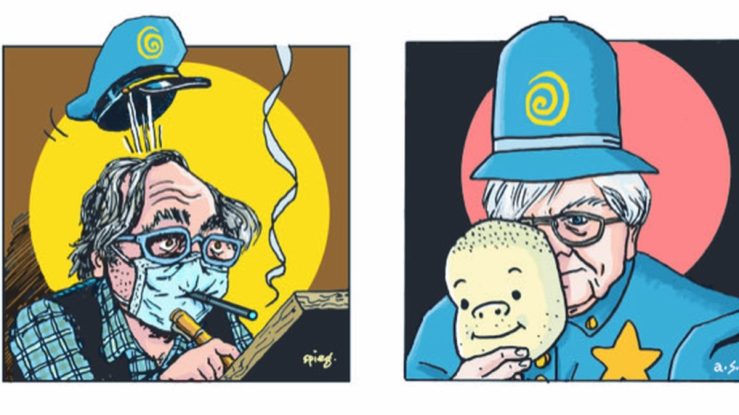
Let it stand then that Robert Coover, despite whatever connections and friendships he held with other writers and artists, was his own special self-made creation. He was prolific, especially later in life, publishing nine novels in the twenty-first century. One of these was The Brunist Day of Wrath (2014), a sequel to his debut; he also collaborated with comix artist Art Spiegelman on the graphic novelette Street Cop (2021) and even found a sliver of mainstream readers with Huck Out West, his wonderful 2017 “sequel” to Adventures of Huckleberry Finn. Coover’s latest novel Open House was published just over a year ago.
Clearly, Coover leaves behind a large body of work, and we’ll likely see more of his work collected and published over the next decade. I won’t pretend to have read most of what he’s written, but I’ve loved a lot of it—particularly Pricksongs & Descants, Huck Out West, Spanking the Maid, and Briar Rose, which, as far as I can recall, is likely the first thing I read of his (my girlfriend at the time’s sister had to read it in college; she professed that she hated it but thought I’d like it). The aforementioned 2018 collection Going for a Beer is a nice starting place for Coover; those more interested in novels might like Spanking the Maid. Or jump into one of his later short novels, like 2004’s Stepmother or 2018’s The Enchanted Prince, both of which exemplify his metamagicianist mode. Or hell, just go for the big boy, The Public Burning. Ultimately, Coover leaves behind a trove of trembling, writhing, vividly-living words, an oeuvre that will continue to engage readers fascinated by a certain stamp of so-called experimental literature–and for that I thank him.
 Biblioklept