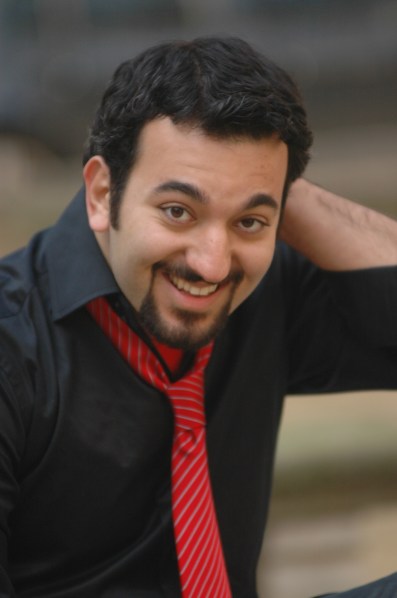
 Daniel Nayeri was born in Iran and spent a couple of years as a refugee before immigrating to Oklahoma at age eight with his family. He is the author of Straw House, Wood House, Brick House, Blow, a collection of four novellas; Kirkus called it, “Provocative and deeply satisfying,” Bookpage named it “a delightful amalgam of the high and the low, the silly and the sublime,”and the BCCB mentioned the “breathtakingly vivid word smithery” in its starred review.
In addition to his writing, Daniel is an editor of picture books, novels, and graphic novels at Houghton Mifflin Harcourt, an accomplished filmmaker, and a professional pastry chef.
Daniel was kind enough to talk to us about his work via email.
Biblioklept: Your book was composed entirely on an iPhone. Can you tell us a bit about that process? How did you start? How intentional was the process in the beginning? Did you use a specific program? Did you edit on the iPhone at all?
Daniel Nayeri: Several years ago, I was reading an article about the “cell phone novel” phenomenon in Japan. The tone of the article was basically, “check out this super popular thing in Japan that all the literary folks hate.” It described the authors as these quiet teen girls, and early-twenty-something women, who would dash off a few chapters on the subway and email them to a website service. The authors didn’t do themselves any favors by saying they disliked reading “real” books, and the critics didn’t do themselves any favors by flipping out and wondering out loud if this trend meant the “death of the author.”
For me, the fascinating tidbit came from a few comments that noted the possible effects of writing on a cell phone. Every undergrad discusses the interplay of form and content (Dickens’s serialized form, the oral iterations of the Iliad, etc). I got really excited about forcing my imagination to live in an incredibly small space. The Japanese authors discussed that when they moved to computers, their vocabulary became “richer” and their “sentences have also grown longer.” I wanted to see if I could push those boundaries out a little (maybe I’m the crazy person who tries to paint the Mona Lisa on an Etch-a-Sketch).
As for the program I used. I bought the first-gen iPhone, so I was using the notepad app that comes with the phone (without cut and paste). To edit, I got very tired of deleting sentences and retyping them three pages down, so I created a code system. For example, if I wanted to move a paragraph up by two pages, I would bracket off the section I wanted and place a symbol next to it. Then I would go up two pages and just place the same symbol. By the end of my editing, there would be pages of work that were nothing but symbols, connected with various prepositions.
Biblioklept: Did you always have the idea to write a quartet of novellas over different genres? How did the idea come about?
DN: I think in general, novels have gotten fatter. As an editor, my first pass on nearly every manuscript is to ask for major cuts. I’m actually kind of petulant about it. My position is that if a book isn’t going to be as good as Anna Karenina, then it probably shouldn’t be as long.
It’s a reactionary position to take, so I thought I would challenge myself with telling stories and building worlds as large and as complex as I could possibly make them, with the limitation of 35-45 thousand words. Obviously, I sort of cheated by connecting some of my thoughts and themes in a collection of four. Hypocrisy and petulance—that’s the sort of delightful company you’ll get if you find yourself working with me.
(Another reason was that I’m still young, and I’d like to learn a lot more before I start demanding the attention of readers for five hundred pages at a time).
Biblioklept: What challenges did you face when working in the variety of genres you worked in?
DN: Presenting four very different voices (to whatever extent one might think it succeeded) is the aspect of this project I am most proud of, actually. The nicest thing anyone has said about the book so far has been to say it is, “the literary equivalent of a singer with a four-octave range.”
To me, it represents the ability to assimilate—a quality any first-generation immigrant valorizes at one point or another. When I first came to the states, I quickly took up the Texas/Oklahoma speech patterns. I was a voracious cataloguer of idioms. When I moved to New York, I did the same. I picked up “kitchen Spanish” in my years as a pastry chef. I love local parlance. As a kid struggling with English, having a proficient knowledge of colloquial expressions represented mastery over the language.
So to me, genres and forms with heavy use of lingo (sports writing, noir, poetry) were the height literary achievement. It sounds backwards, but if you learned the queen’s English first, then you value Huckleberry Finn’s jargon highest of all.
Biblioklept: Straw House, Wood House, Brick House, Blow is being marketed as a YA book. There’s been some debate in the past few years about a perceived sense of darkness or violence in YA. What place do dark or violent themes have in YA fiction?
DN: I almost never think about this as a writer. I almost never stop thinking about it in my capacity as an editor at Houghton Mifflin Harcourt. My personal interests keep me PG-13, generally. But geez, people send me some crazy-inappropriate material—even for general consumption. Lots of incest. Lots of racial hang-ups. Lots of creepy.
I believe strongly in an editor’s responsibility to put out well-written work (whether or not it’s politically or ethically aligned with one’s self). The old Voltaire quote -– “I disapprove of what you say, but will defend to the death your right to say it” –- has difficult implications for “gatekeepers” in any media.
But just because there is an ethical challenge to acquire broadly, doesn’t mean the public can’t resist-—meaning that the marketplace often creates pressure to move material toward the unobjectionable. When minors are involved, however, I would hope there are adults who will curate the material. I think the majority of adults agree that there is such a thing as “age appropriateness.” I think both sides of the argument are often concern-trolling-—one side saying kids shouldn’t hear the f-word, and the other side screaming censorship to the culling of anything short of snuff-porn.
The conversation seems to dance around a rating system (as with the MPAA for films, or the ESA for video games), but that has a ton of complications. I’m not sure what I think of a rating system, personally. I just think the discussion would be more interesting than making fun of people over Twitter.
Biblioklept: What are you working on next?
DN: Straw House has four very western genres, so I’m working on another set of four stories, but this time in eastern genres. I’m from Iran and immigrated to Oklahoma, so collections about the East West interaction have always fascinated me (Rushdie wrote a great essay collection call East West).
There’s an Ibn Battuta travelogue, a 1001 Nights tale, a parable, etc. I’m about halfway finished.
Biblioklept: Have you ever stolen a book?
DN: I’ve never stolen from a retailer, but when I was in middle school, I volunteered at the local library. When I forgot to return books after a long time, the head librarian would let me go into the database and erase my fine, as well as the book itself. That’s how I got my first copy of The Fellowship of the Ring, a CD of Boston’s greatest hits, and a book on juggling. So basically what I’m saying is that I was pretty hardcore.

 Biblioklept