“Well, the evening began at the Gentleman’s club, where we were discussing Wittgenstein over a game of backgammon”

Book Shelves #16, 4.15.2012

20120415-113741.jpg

Book shelves series #16, sixteenth Sunday of 2012.

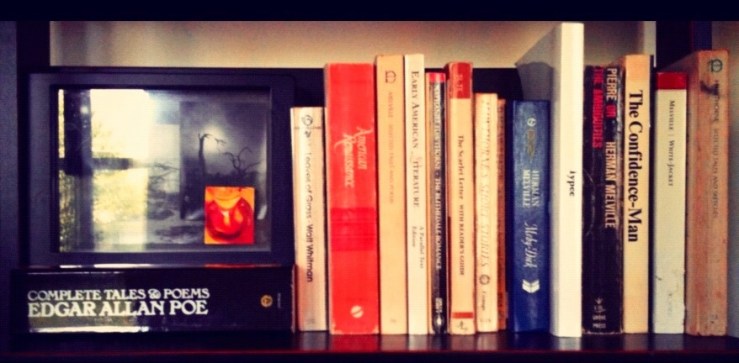
It’s hard to photograph books, and using an iPhone 3gs probably doesn’t help. Lots of glare. Anyway: This shelf houses mostly Melville, with some Hawthorne, Poe, and Whitman, as well as some critical works on the American Renaissance movement. (Henry James and F.O. Matthiessen). I have other versions of a lot of these books, including a fraternal twin in my office, a bit bulkier (Emerson, Dickinson, Thoreau, etc.), although these days I’m apt to go to the Kindle for American Renaissance stuff. Here’s a better angle, perhaps:

20120415-113756.jpg

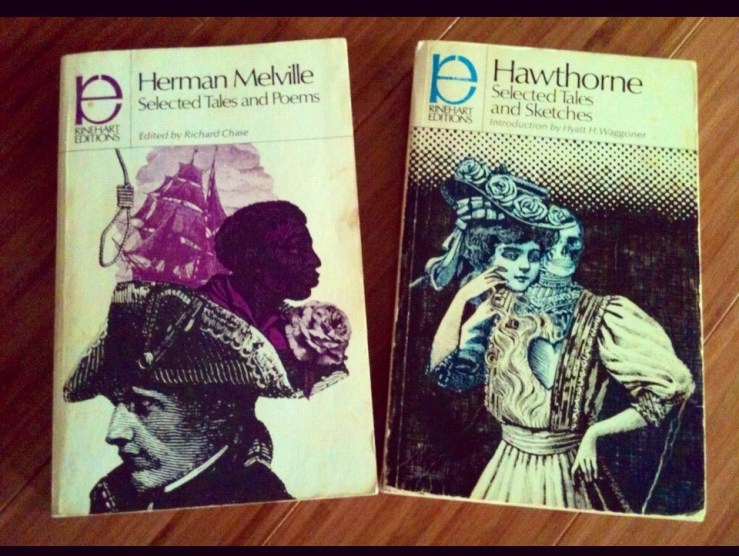
The version of Typee is bizarre: no colophon, no publisher info, just text. I love these midcentury Rinehart Editions of Hathorne and Melville stuff:

20120415-113807.jpg

“Rhetoric” — A Page from James Joyce’s Notebooks

This page is from a notebook that contains some of Joyce’s preparatory notes for Ulysses—there are notes for characters (“Stephen,” “Simon,” “Leopold,” etc.) as well as lists (“Books,” “Recipes”) and general ideas (“Theosophy”). This particular page, “Rhetoric,” seems to be part of the material that went into the “Aeolus” chapter of Ulysses, which plays with the windiness of rhetorical figures. From the National Library of Ireland, via UbuWeb.

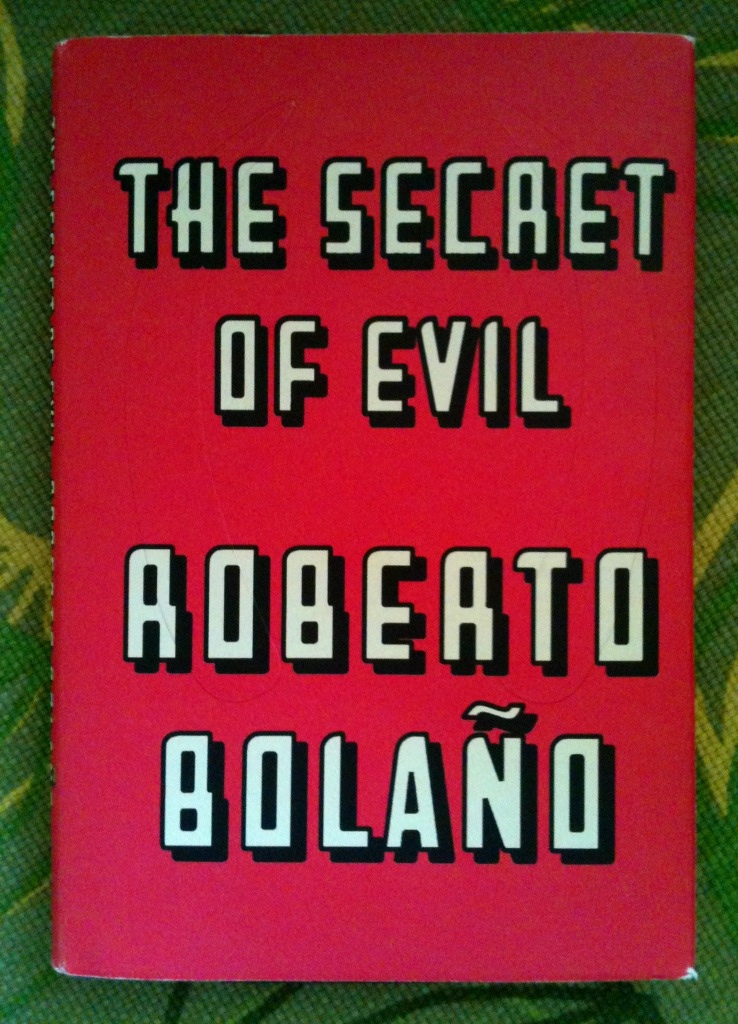
Roberto Bolaño’s The Secret of Evil (Book Acquired, 4.09.2012)

20120414-140951.jpg

How you react to a “new” book by Roberto Bolaño at this point is probably dependent on how much you love or loathe his work—although I imagine those indifferent to or unfamiliar with his writing might be unduly put off by this point at the volume of material that this writer drops posthumously [insert Tupac joke here].

I’m a fan though, so I’m excited about The Secret of Evil, even if the material collected here is in part unfinished . . . although, as Ignacio Echevarria points out in his introduction, all of Bolaño’s “narratives, not just The Secret of Evil, seem to be governed by a poetics of inconclusiveness.” A few of the pieces in Evil have already been excerpted, and I read a few this weekend (who can resist a Bolaño text called “Crimes”?), and while some pieces here are sketchier than others, there’s that preponderance of life force that we expect from late period Bolaño, from a man who seemed to pour what was left of himself into his words and sentences.

From publisher New Directions’ website:

Opening this book is like being granted access to the Chilean master’s personal files. Included in this one-of-a-kind collection is everything Roberto Bolaño was working on just before his death in 2003, and everything that he wanted to share with his readers. Fans of his writing will find familiar characters in new settings, and entirely new stories and styles, too.

A North American journalist in Paris is woken at 4 a.m. by a mysterious caller with urgent information. Daniela de Montecristo (familiar to readers of Nazi Literature in the Americas and 2666) recounts the loss of her virginity. Arturo Belano returns to Mexico City and meets the last disciples of Ulises Lima, who play in a band called The Asshole of Morelos. Belano’s son Gerónimo disappears in Berlin during the Days of Chaos in 2005. Memories of a return to the native land; Argentine writers as gangsters; zombie schlock as allegory…and much more.

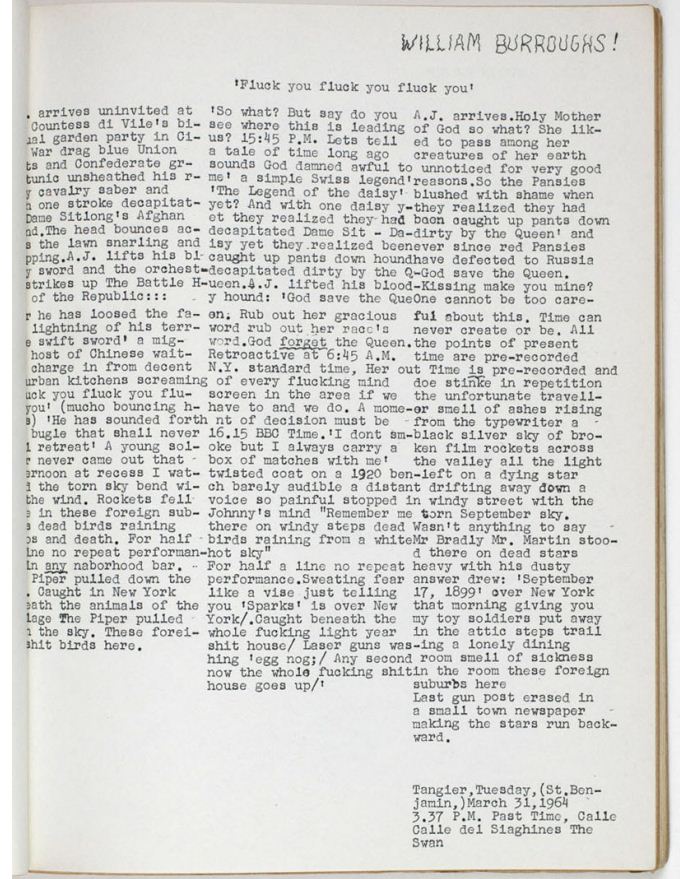
“Fluck you fluck you fluck you” — Tangier Transmission from William Burroughs, 1964

From Number 5, Vol. 7 of Fuck You, (1964) a mimeograph magazine from editor Ed Sanders. The magazine featured Allen Ginsberg, Tuli Kupferberg, Frank O’Hara and more. There’s a fantastic visual archive of Fuck You at Reality Studio, which is where I got this Burroughs layout.

“Mediæval mythology, rich and gorgeous, is a compound like Corinthian brass”

Mediæval mythology, rich and gorgeous, is a compound like Corinthian brass, into which many pure ores have been fused, or it is a full turbid river drawn from numerous feeders, which had their sources in remote climes. It is a blending of primæval Keltic, Teutonic, Scandinavian, Italic, and Arab traditions, each adding a beauty, each yielding a charm, bat each accretion rendering the analysis more difficult. Pacciuchelli says:–“The Anio flows into the Tiber; pure as crystal it meets the tawny stream, and is lost in it, so that there is no more Anio, but the united stream is all Tiber.” So is it with each tributary to the tide of mediæval mythology. The moment it has blended its waters with the great and onward rolling flood, it is impossible to detect it with certainty; it has swollen the stream, but has lost its own identity. If we would analyse a particular myth, we must not go at once to the body of mediæval superstition, but strike at one of the tributaries before its absorption.

From Sabine Baring-Gould’s marvelous volume The Book of Were-Wolves (1865).