Book Shelves #23, 6.03.2012

20120603-185137.jpg

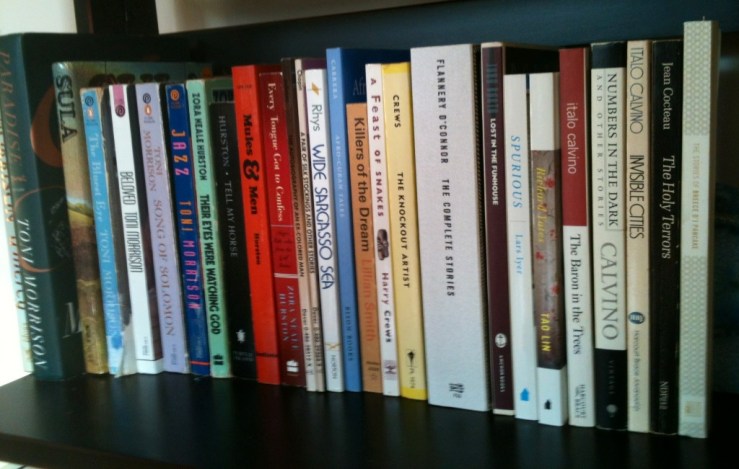
Book shelves series #23, twenty-third Sunday of 2012

Okay. So, a bit later than usual getting this in. It’s the daughter’s birthday and I’m recovering from a Saturday party and I’ve been out in the garden other day and some other excuses.

Toni Morrison, Zora Neale Hurston, James Weldon Johnson, Harry Crews, Flannery O’Connor—and then some books that seem misshelved. Calvino used to hang out with Umberto Eco but that shelf got too crowded. The John Barth should be with the other John Barth books, but they’re all mass market paperbacks in shabby condition.

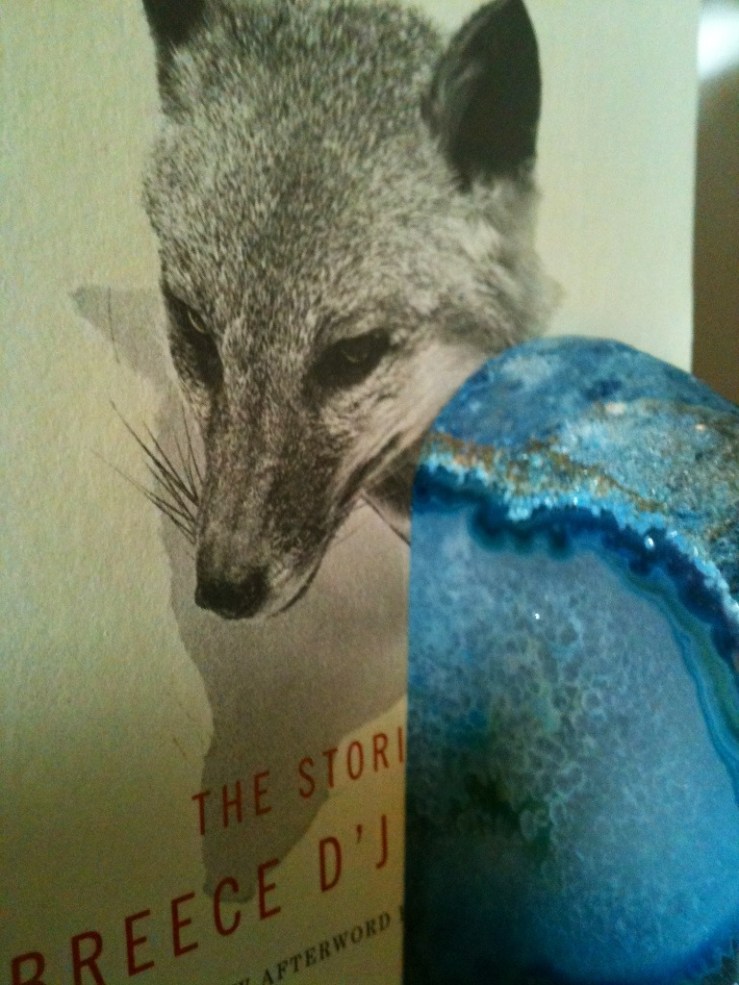
I like the cover of the Breece D’J Pancake collection:
20120603-185149.jpg

Lydia Cabrera’s Afro-Cuban Tales is this secret awesome book that almost no one has read. It was one of the first books I reviewed on this blog and the review is so woefully short that I’ll just cut and paste it below:

20120603-185156.jpg

In a sublime synthesis of traditional folklore and imagistic surrealism, Lydia Cabrera’s Afro-Cuban Tales questions the normative spaces occupied by bodies. Deriving from animist tradition, her characters exist in an impossible multiplicity of spaces, being at once animals and plants, humans and gods. Cabrera’s characters endure trials of biological identity and social co-existence, and through these problems they internalize authority, evince taboos, and create a social code. Cabrera’s trickster characters provoke, challenge, or otherwise disrupt the symbolic order of this code. In “Bregantino Bregantín,” a story that recalls Freud’s primal horde theory, as well as the work of more contemporary theorists such as Julia Kristeva and Judith Butler,  narcissist Bull kills all the males of his kingdom and takes all the women for himself.  The sadistic titular turtle of “Papa Turtle and Papa Tiger” uses the power of his dead friend’s antlers to shame, torment, and torture the other animals of his community. And in the magical realism of “Los Compadres,” Capinche seeks to put the horns on his best friend Evaristo by sleeping with his wife–a transgression that ends in necrophilia. This union of sex and death, creation and destruction is the norm in Cabrera’s green and fecund world; the trickster’s displacements of order invariably result in reanimation, transformation, and regeneration—the drawing, stepping-over, and re-drawing of boundaries.

Read “The Werewolf,” A Short Fable by Angela Carter

“The Werewolf,” a short story by Angela Carter (collected in The Bloody Chamber and Burning Your Boats):

It is a northern country; they have cold weather, they have cold hearts.Cold; tempest; wild beasts in the forest. It is a hard life. Their houses are built of logs, dark and smoky within. There will be a crude icon of the virgin behind a guttering candle, the leg of a pig hung up to cure, a string of drying mushrooms. A bed, a stool, a table. Harsh, brief, poor lives.To these upland woodsmen, the Devil is as reals as you or I. More so; they have not seen us nor even know that we exist, but the Devil they glimpse often in the graveyards, those bleak and touching townships of the dead where the graves are marked with portraits of the deceased in the naif style and there are no flowers to put in front of them, no flowers grow there, so they put out small votive offerings, little loaves, sometimes a cake that the bears come lumbering from the margins of the forests to snatch away. At midnight, especially on Walpurgisnacht, the Devil holds picnics in the graveyards and invites the witches; then they dig up fresh corpses, and eat them. Anyone will tell you that.Wreaths of garlic on the doors keep out the vampires. A blue-eyed child born feet first on the night of St. John’s Eve will have second sight. When they discover a witch – some old woman whose cheeses ripen when her neighbours’ do not, another old woman whose black cat, oh, sinister! follows her about all the time, they strip the crone, search for her marks, for the supernumerary nipple her familiar sucks. They soon find it. Then they stone her to death.

Winter and cold weather.

Go and visit grandmother, who has been sick. Take her the oatcakes I’ve baked for her on the hearthstone and a little pot of butter.

The good child does as her mother bids – five miles’ trudge through the forest; do not leave the path because of the bears, the wild boar, the starving wolves. Here, take your father’s hunting knife; you know how to use it.

The child had a scabbby coat of sheepskin to keep out the cold, she knew the forest too well to fear it but she must always be on her guard. When she heard that freezing howl of a wolf, she dropped her gifts, seized her knife, and turned on the beast.

It was a huge one, with red eyes and running, grizzled chops; any but a mountaineer’s child would have died of fright at the sight of it. It went for her throat, as wolves do, but she made a great swipe at it with her father’s knife and slashed off its right forepaw.

The wolf let out a gulp, almost a sob, when it saw what had happened to it; wolves are less brave than they seem. It went lolloping off disconsolately between the trees as well as it could on three legs, leaving a trail of blood behind it. The child wiped the blade of her knife clean on her apron, wrapped up the wolf’s paw in the cloth in which her mother had packed the oatcakes and went on towards her grandmother’s house. Soon it came on to snow so thickly that the path and any footsteps, track or spoor that might have been upon it were obscured.

She found her grandmother was so sick she had taken to her bed and fallen into a fretful sleep, moaning and shaking so that the child guessed she had a fever. She felt the forehead, it burned. She shook out the cloth from her basket, to use it to make the old woman a cold compress, and the wolf’s paw fell to the floor.

But it was no longer a wolf’s paw. It was a hand, chopped off at the wrist, a hand toughened with work and freckled with old age. There was a wedding ring on the third finger and a wart in the index finger. By the wart, she knew it for her grandmother’s hand.

She pulled back the sheet but the old woman woke up, at that, and began to struggle, squawking and shrieking like a thing possessed. But the child was strong, and armed with her father’s hunting knife; she managed to hold her grandmother down long enough to see the cause of her fever. There was a bloody stump where her right hand should have been, festering already.

The child crossed herself and cried out so loud the neighbours heard her and come rushing in. They know the wart on the hand at once for a witch’s nipple; they drove the old woman, in her shift as she was, out into the snow with sticks, beating her old carcass as far as the edge of the forest, and pelted her with stones until she fell dead.

Now the child lived in her grandmother’s house; she prospered.

Rats! (Herzog’s Nosferatu)

Girl Reading — Lucian Freud