The Follow — Wong Kar Wai (Short Film)

“Moral Effects of Tea-Tasting” (From Flann O’Brien’s At Swim-Two-Birds)

Moral Effects of Tea-Tasting.

The long-continued use of tea has a distinct effect upon the character. This has been too often noticed and remarked to be questioned. There are tea-sots in every great charitable institution – particularly those for the maintenance of the aged. Their symptoms are generally mental irritability, muscular tremors, and sleeplessness. The following is an account of one of the cases observed. The immediate effects upon him are as follows: In about ten minutes the face becomes flushed, the whole body feels warm and heated and a sort of intellectual intoxication comes on, much the same in character, it would seem, as that which occurs in the rarefied air of a mountain. He feels elated, exhilarated, troubles and cares vanish, everything seems bright and cheerful, his body feels light and elastic, his mind clear, his ideas abundant, vivid, and flowing fluently into words. At the end of an hour’s tasting a slight reaction begins to set in; some headache comes on, the face feels wrinkled and shrivelled, particularly about the eyes, which also get dark under the lids. At the end of two hours this reaction becomes firmly established, the flushed warm feeling has passed off, the hands and feet are cold, a nervous tremor comes on, accompanied with great mental depression. And he is now so excitable that every noise startles him; he is in a state of complete unrest; he can neither walk nor sit down, owing to his mental condition, and he settles into complete gloom. Copious and frequent urinations are always present, as also certain dyspeptic symptoms, such as eructations of wind, sour taste, and others. His mental condition is peculiar. He lives in a state of dread that some accident may happen to him; in the omnibus fears a collision; crossing the street, fears that he will be crushed by passing teams; walking on the sidewalks, fears that a sign may fall, or watches the eaves of houses, thinking that a brick may fall down and kill him; under the apprehension that every dog he meets is going to bite the calves of his legs, he carries an umbrella in all weathers as a defence against such an attack.

Conclusion of the foregoing.

From Flann O’Brien’s novel At Swim-Two-Birds.


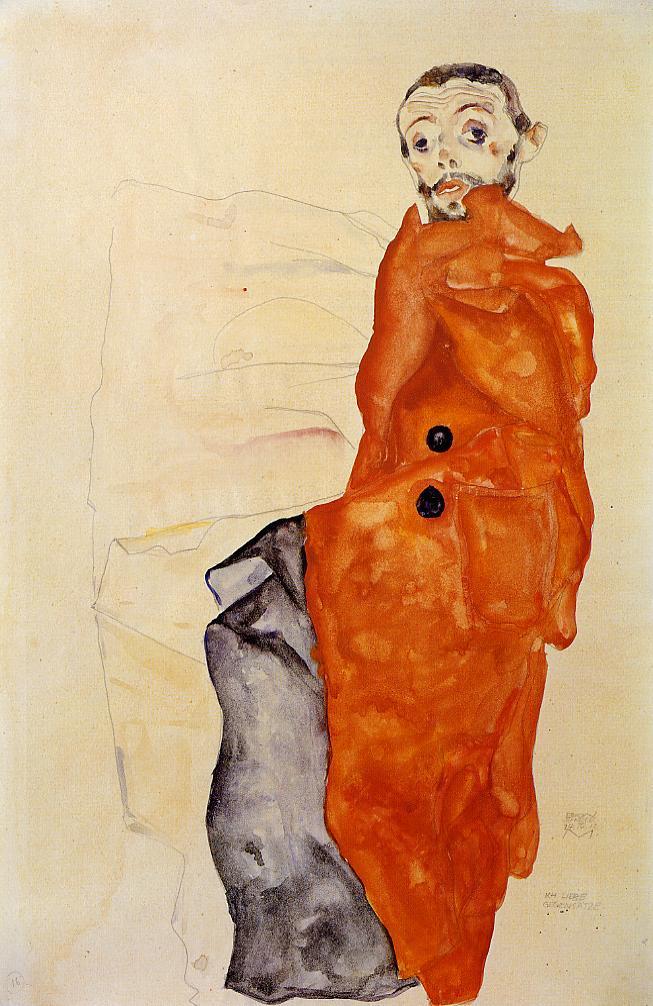
I Love Antitheses — Egon Schiele

i-love-antitheses-1912

“Man Carrying Thing” — Wallace Stevens

“Man Carrying Thing” by Wallace Stevens:

The poem must resist the intelligence
Almost successfully. Illustration:

A brune figure in winter evening resists
Identity. The thing he carries resists

The most necessitous sense. Accept them, then,
As secondary (parts not quite perceived

Of the obvious whole, uncertain particles
Of the certain solid, the primary free from doubt,

Things floating like the first hundred flakes of snow
Out of a storm we must endure all night,

Out of a storm of secondary things),
A horror of thoughts that suddenly are real.

We must endure our thoughts all night, until
The bright obvious stands motionless in cold.


Taxi Driver Sweded by Michel Gondry

Sunday — Edward Hopper

sunday

“The Oblong Box” — Edgar Allan Poe

“The Oblong Box” by Edgar Allan Poe

SOME years ago, I engaged passage from Charleston, S. C, to the city of New York, in the fine packet-ship “Independence,” Captain Hardy. We were to sail on the fifteenth of the month (June), weather permitting; and on the fourteenth, I went on board to arrange some matters in my state-room.

I found that we were to have a great many passengers, including a more than usual number of ladies. On the list were several of my acquaintances, and among other names, I was rejoiced to see that of Mr. Cornelius Wyatt, a young artist, for whom I entertained feelings of warm friendship. He had been with me a fellow-student at C— University, where we were very much together. He had the ordinary temperament of genius, and was a compound of misanthropy, sensibility, and enthusiasm. To these qualities he united the warmest and truest heart which ever beat in a human bosom.

I observed that his name was carded upon three state-rooms; and, upon again referring to the list of passengers, I found that he had engaged passage for himself, wife, and two sisters—his own. The state-rooms were sufficiently roomy, and each had two berths, one above the other. These berths, to be sure, were so exceedingly narrow as to be insufficient for more than one person; still, I could not comprehend why there were three state-rooms for these four persons. I was, just at that epoch, in one of those moody frames of mind which make a man abnormally inquisitive about trifles: and I confess, with shame, that I busied myself in a variety of ill-bred and preposterous conjectures about this matter of the supernumerary state-room. It was no business of mine, to be sure, but with none the less pertinacity did I occupy myself in attempts to resolve the enigma. At last I reached a conclusion which wrought in me great wonder why I had not arrived at it before. “It is a servant of course,” I said; “what a fool I am, not sooner to have thought of so obvious a solution!” And then I again repaired to the list—but here I saw distinctly that no servant was to come with the party, although, in fact, it had been the original design to bring one—for the words “and servant” had been first written and then overscored. “Oh, extra baggage, to be sure,” I now said to myself—”something he wishes not to be put in the hold—something to be kept under his own eye—ah, I have it—a painting or so—and this is what he has been bargaining about with Nicolino, the Italian Jew.” This idea satisfied me, and I dismissed my curiosity for the nonce. Continue reading ““The Oblong Box” — Edgar Allan Poe”

Still Life with Plaster Statuette, a Rose and Two Novels — Vincent van Gogh

still-life-with-plaster-statuette-a-rose-and-two-novels-1887