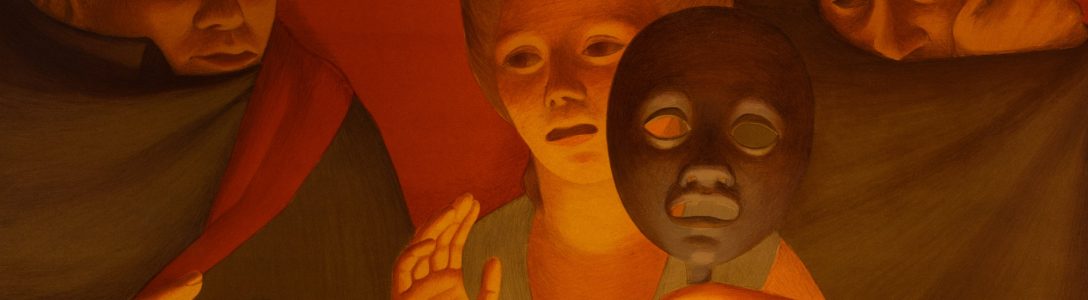
- Joseph Cornell’s boxes.
- Much of J.G. Ballard, especially the stuff in the ’70s and ’80s.
- The Residents.
- The films of the Brothers Quay.
- Charles Burns’s stuff.
- Wm. Burroughs, or the idea of Wm. Burroughs.
- Joseph Beuys and his goddamn fat and felt.
Day: February 12, 2013
Watch Peter Greenaway’s Meredith Monk Documentary
Charles Darwin — James Tissot

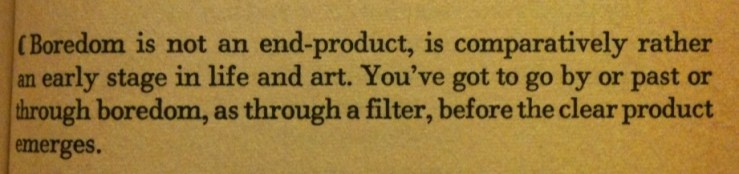
Boredom // F. Scott Fitzgerald
Marvin Digs — Ralph Bakshi (Short Film)
T.S. Eliot Writes to F.Scott Fitzgerald
FABER AND GWYER LTD. Publishers 24 Russell Square, London, W.C.1. 31st December, 1925
F. Scott Fitzgerald, Esqre., % Charles Scribners & Sons, New York City.Dear Mr. Scott Fitzgerald,
The Great Gatsby with your charming and overpowering inscription arrived the very morning that I was leaving in some haste for a sea voyage advised by my doctor. I therefore left it behind and only read it on my return a few days ago. I have, however, now read it three times. I am not in the least influenced by your remark about myself when I say that it has interested and excited me more than any new novel I have seen, either English or American, for a number of years.When I have time I should like to write to you more fully and tell you exactly why it seems to me such a remarkable book. In fact it seems to me to be the first step that American fiction has taken since Henry James….
By the way, if you ever have any short stories which you think would be suitable for the Criterion I wish you would let me see them.
With many thanks, I am,
Yours very truly, T. S. EliotP.S. By a coincidence Gilbert Seldes in his New York Chronicle in the Criterion for January 14th has chosen your book for particular mention.
Portrait of James Joyce — Djuna Barnes

“Mrs. Bullfrog” — Nathaniel Hawthorne
“Mrs. Bullfrog” by Nathaniel Hawthorne
It makes me melancholy to see how like fools some very sensible people act in the matter of choosing wives. They perplex their judgments by a most undue attention to little niceties of personal appearance, habits, disposition, and other trifles which concern nobody but the lady herself. An unhappy gentleman, resolving to wed nothing short of perfection, keeps his heart and hand till both get so old and withered that no tolerable woman will accept them. Now this is the very height of absurdity. A kind Providence has so skilfully adapted sex to sex and the mass of individuals to each other, that, with certain obvious exceptions, any male and female may be moderately happy in the married state. The true rule is to ascertain that the match is fundamentally a good one, and then to take it for granted that all minor objections, should there be such, will vanish, if you let them alone. Only put yourself beyond hazard as to the real basis of matrimonial bliss, and it is scarcely to be imagined what miracles, in the way of recognizing smaller incongruities, connubial love will effect.
For my own part I freely confess that, in my bachelorship, I was precisely such an over-curious simpleton as I now advise the reader not to be. My early habits had gifted me with a feminine sensibility and too exquisite refinement. I was the accomplished graduate of a dry goods store, where, by dint of ministering to the whims of fine ladies, and suiting silken hose to delicate limbs, and handling satins, ribbons, chintzes calicoes, tapes, gauze, and cambric needles, I grew up a very ladylike sort of a gentleman. It is not assuming too much to affirm that the ladies themselves were hardly so ladylike as Thomas Bullfrog. So painfully acute was my sense of female imperfection, and such varied excellence did I require in the woman whom I could love, that there was an awful risk of my getting no wife at all, or of being driven to perpetrate matrimony with my own image in the looking-glass. Besides the fundamental principle already hinted at, I demanded the fresh bloom of youth, pearly teeth, glossy ringlets, and the whole list of lovely items, with the utmost delicacy of habits and sentiments, a silken texture of mind, and, above all, a virgin heart. In a word, if a young angel just from paradise, yet dressed in earthly fashion, had come and offered me her hand, it is by no means certain that I should have taken it. There was every chance of my becoming a most miserable old bachelor, when, by the best luck in the world, I made a journey into another state, and was smitten by, and smote again, and wooed, won, and married, the present Mrs. Bullfrog, all in the space of a fortnight. Owing to these extempore measures, I not only gave my bride credit for certain perfections which have not as yet come to light, but also overlooked a few trifling defects, which, however, glimmered on my perception long before the close of the honeymoon. Yet, as there was no mistake about the fundamental principle aforesaid, I soon learned, as will be seen, to estimate Mrs. Bullfrog’s deficiencies and superfluities at exactly their proper value.
The same morning that Mrs. Bullfrog and I came together as a unit, we took two seats in the stage-coach and began our journey towards my place of business. There being no other passengers, we were as much alone and as free to give vent to our raptures as if I had hired a hack for the matrimonial jaunt. My bride looked charmingly in a green silk calash and riding habit of pelisse cloth; and whenever her red lips parted with a smile, each tooth appeared like an inestimable pearl. Such was my passionate warmth that—we had rattled out of the village, gentle reader, and were lonely as Adam and Eve in paradise—I plead guilty to no less freedom than a kiss. The gentle eye of Mrs. Bullfrog scarcely rebuked me for the profanation. Emboldened by her indulgence, I threw back the calash from her polished brow, and suffered my fingers, white and delicate as her own, to stray among those dark and glossy curls which realized my daydreams of rich hair. Continue reading ““Mrs. Bullfrog” — Nathaniel Hawthorne”
The Love Letter — Eugene de Blaas

 Biblioklept