August in the City — Edward Hopper

hopper

List with No Name #35

  1. Achebe
  2. Bolaño
  3. Carter
  4. DeLillo
  5. Ellison
  6. Fitzgerald
  7. Gaddis
  8. Houellebecq
  9. Ishiguro
  10. James
  11. Kertész
  12. Lispector
  13. McCarthy
  14. Nabokov
  15. O’Connor
  16. Pullman
  17. Quincey, de
  18. Rousseau
  19. Shakespeare
  20. Tolkien
  21. Uris
  22. Vollmann
  23. Wallace
  24. X, Malcolm
  25. Yates
  26. Zweig

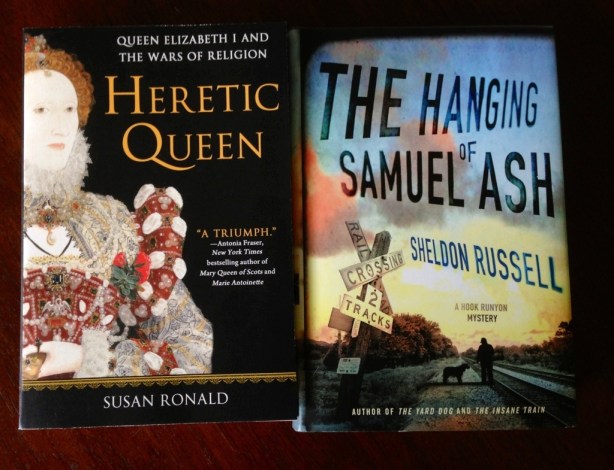
Heretic/Hanging (Books Acquired, Sometime Last Week)

20130806-162835.jpg

I was out of town when these showed up last week.

First, Susan Ronald’s Heretic Queen: Publisher St. Martin’s Griffin’s blurb:

Acclaimed biographer Susan Ronald delivers a stunning account of Elizabeth I that focuses on her role in the Wars on Religion—the battle between Protestantism and Catholicisim that tore apart Europe in the 16th Century

Elizabeth’s 1558 coronation procession was met with an extravagant outpouring of love. Only twenty-five years old, the young queen saw herself as their Protestant savior, aiming to provide the nation with new hope, prosperity, and independence from the foreign influence that had plagued her sister Mary’s reign. Given the scars of the Reformation, Elizabeth would need all of the powers of diplomacy and tact she could summon.

Extravagant, witty, and hot-tempered, Elizabeth was the ultimate tyrant. Yet at the outset, in religious matters, she was unfathomably tolerant for her day. “There is only one Christ, Jesus, one faith,” Elizabeth once proclaimed. “All else is a dispute over trifles.” Heretic Queen is the highly personal, untold story of how Queen Elizabeth I secured the future of England as a world power. Susan Ronald paints the queen as a complex character whose apparent indecision was really a political tool that she wielded with great aplomb.

And: The Hanging of Samuel Ash by Sheldon Russell, from Minotaur. Publishers Weekly blurb:

A compelling lead compensates only in part for the relatively weak plot of Russell’s fourth mystery featuring one-armed Santa Fe railroad bull Hook Runyon (after 2012’s Dead Man’s Tunnel), set during WWII against a backdrop of labor unrest. When Runyon checks out a nonworking signal on a remote stretch of track, he discovers a man’s corpse hanging from the signal’s cantilever. The only clue to the dead man’s identity is a Bronze Star inscribed with the name Samuel Ash. Not wanting the war hero to be buried in a pauper’s grave, Runyon takes custody of the body and embarks on a quest to find Ash’s relatives and the truth about his death. A dose of humor lightens the gloom—pickpockets steal Runyon’s wallet and badge while he’s hunting pickpockets—but the mystery itself never picks up much steam. Fans will hope for a return to form next time.


“Waitin’ Around to Die” — Townes van Zandt

“Translations are always disgusting / But they brought me a lot of money” (Thomas Bernhard)

tb

From Thomas Bernhard’s play Der Weltverbesserer (The World-Fixer). The translation here is by Gitta Honegger and appears as an illustrating example in her fantastic essay “Language Speaks. Anglo-Bernhard: Thomas Bernhard in Translation,” collected in A Companion to the Works of Thomas Bernhard (ed. Matthias Konzett). At the time of Companion’s first publication, Der Weltverbesserer had yet to be released in an English edition; Ariadne released one in 2005.


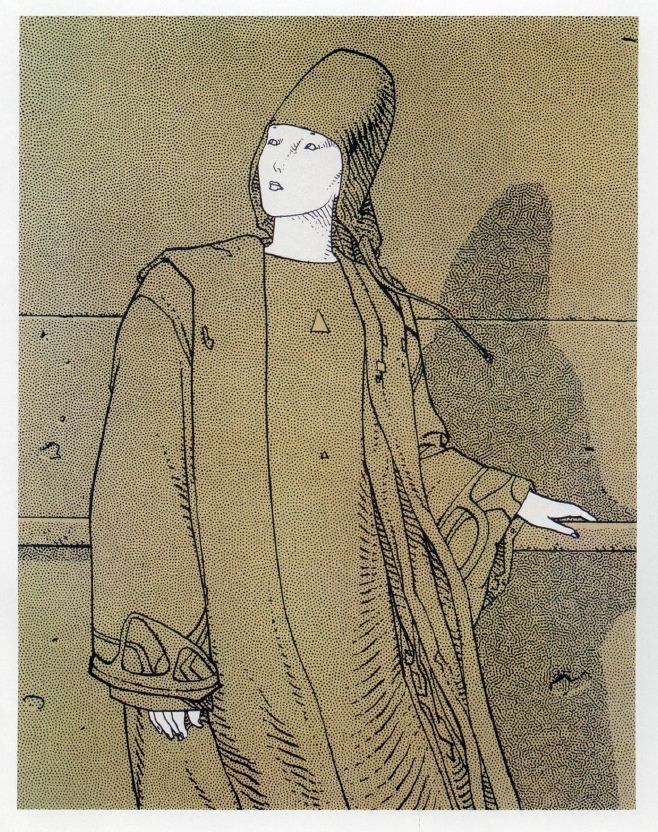
Helen — Moebius

helen

“Von Kempelen and His Discovery ” — Edgar Allan Poe

“Von Kempelen and His Discovery ” by Edgar Allan Poe

AFTER THE very minute and elaborate paper by Arago, to say nothing of the summary in ‘Silliman’s Journal,’ with the detailed statement just published by Lieutenant Maury, it will not be supposed, of course, that in offering a few hurried remarks in reference to Von Kempelen’s discovery, I have any design to look at the subject in a scientific point of view. My object is simply, in the first place, to say a few words of Von Kempelen himself (with whom, some years ago, I had the honor of a slight personal acquaintance), since every thing which concerns him must necessarily, at this moment, be of interest; and, in the second place, to look in a general way, and speculatively, at the results of the discovery.

It may be as well, however, to premise the cursory observations which I have to offer, by denying, very decidedly, what seems to be a general impression (gleaned, as usual in a case of this kind, from the newspapers), viz.: that this discovery, astounding as it unquestionably is, is unanticipated.

By reference to the ‘Diary of Sir Humphrey Davy’ (Cottle and Munroe, London, pp. 150), it will be seen at pp. 53 and 82, that this illustrious chemist had not only conceived the idea now in question, but had actually made no inconsiderable progress, experimentally, in the very identical analysis now so triumphantly brought to an issue by Von Kempelen, who although he makes not the slightest allusion to it, is, without doubt (I say it unhesitatingly, and can prove it, if required), indebted to the ‘Diary’ for at least the first hint of his own undertaking.

The paragraph from the ‘Courier and Enquirer,’ which is now going the rounds of the press, and which purports to claim the invention for a Mr. Kissam, of Brunswick, Maine, appears to me, I confess, a little apocryphal, for several reasons; although there is nothing either impossible or very improbable in the statement made. I need not go into details. My opinion of the paragraph is founded principally upon its manner. It does not look true. Persons who are narrating facts, are seldom so particular as Mr. Kissam seems to be, about day and date and precise location. Besides, if Mr. Kissam actually did come upon the discovery he says he did, at the period designated—nearly eight years ago—how happens it that he took no steps, on the instant, to reap the immense benefits which the merest bumpkin must have known would have resulted to him individually, if not to the world at large, from the discovery? It seems to me quite incredible that any man of common understanding could have discovered what Mr. Kissam says he did, and yet have subsequently acted so like a baby—so like an owl—as Mr. Kissam admits that he did. By-the-way, who is Mr. Kissam? and is not the whole paragraph in the ‘Courier and Enquirer’ a fabrication got up to ‘make a talk’? It must be confessed that it has an amazingly moon-hoaxy-air. Very little dependence is to be placed upon it, in my humble opinion; and if I were not well aware, from experience, how very easily men of science are mystified, on points out of their usual range of inquiry, I should be profoundly astonished at finding so eminent a chemist as Professor Draper, discussing Mr. Kissam’s (or is it Mr. Quizzem’s?) pretensions to the discovery, in so serious a tone. Continue reading ““Von Kempelen and His Discovery ” — Edgar Allan Poe”

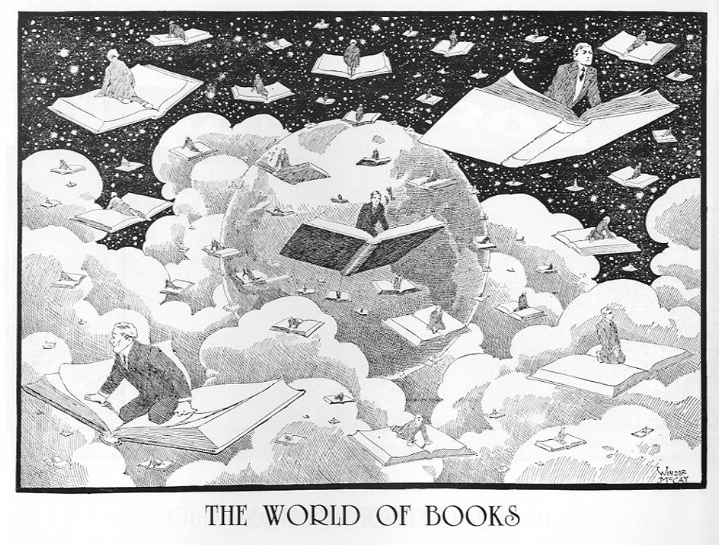
World of Books — Winsor McCay

McCayWorldOfBooksBaja