Zabriskie Point — Michelangelo Antonioni (Full Film)

Film Poster for Andrei Tarkovsky’s Stalker (Jean-Michel Folon)

9.-Locandina-francese-di-STALKER-di-Tarkovski-autore-Folon

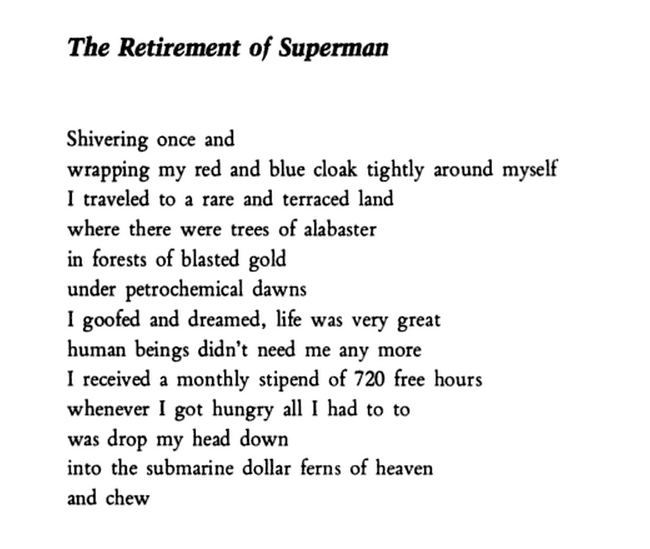
“The Retirement of Superman” — Tom Clark

Capture

Cartwheel (Book Acquired, 9.10.2013)

20130914-084658.jpg

Cartwheel is Jennifer DuBois’ follow up to last year’s hit A Partial History of Lost Causes. It’s out later this month from Random House. Their blurb:

When Lily Hayes arrives in Buenos Aires for her semester abroad, she is enchanted by everything she encounters: the colorful buildings, the street food, the handsome, elusive man next door. Her studious roommate Katy is a bit of a bore, but Lily didn’t come to Argentina to hang out with other Americans.

Five weeks later, Katy is found brutally murdered in their shared home, and Lily is the prime suspect. But who is Lily Hayes? It depends on who’s asking. As the case takes shape—revealing deceptions, secrets, and suspicious DNA—Lily appears alternately sinister and guileless through the eyes of those around her: the media, her family, the man who loves her and the man who seeks her conviction. With mordant wit and keen emotional insight, Cartwheel offers a prismatic investigation of the ways we decide what to see—and to believe—in one another and ourselves.

In Cartwheel, duBois delivers a novel of propulsive psychological suspense and rare moral nuance. No two readers will agree who Lily is and what happened to her roommate. Cartwheel will keep you guessing until the final page, and its questions about how well we really know ourselves will linger well beyond.


Manutara — George Boorujy

Four Story Ideas from Nathaniel Hawthorne’s Note-Books

  1. A girl’s lover to be slain and buried in her flower-garden, and the earth levelled over him. That particular spot, which she happens to plant with some peculiar variety of flowers, produces them of admirable splendor, beauty, and perfume; and she delights, with an indescribable impulse, to wear them in her bosom, and scent her chamber with them. Thus the classic fantasy would be realized, of dead people transformed to flowers.
  2. Objects seen by a magic-lantern reversed. A street, or other location, might be presented, where there would be opportunity to bring forward all objects of worldly interest, and thus much pleasant satire might be the result.
  3. A missionary to the heathen in a great city, to describe his labors in the manner of a foreign mission.
  4. To show the effect of gratified revenge. As an instance, merely, suppose a woman sues her lover for breach of promise, and gets the money by instalments, through a long series of years. At last, when the miserable victim were utterly trodden down, the triumpher would have become a very devil of evil passions,–they having overgrown his whole nature; so that a far greater evil would have come upon himself than on his victim.

Two on the Aisle — Edward Hopper