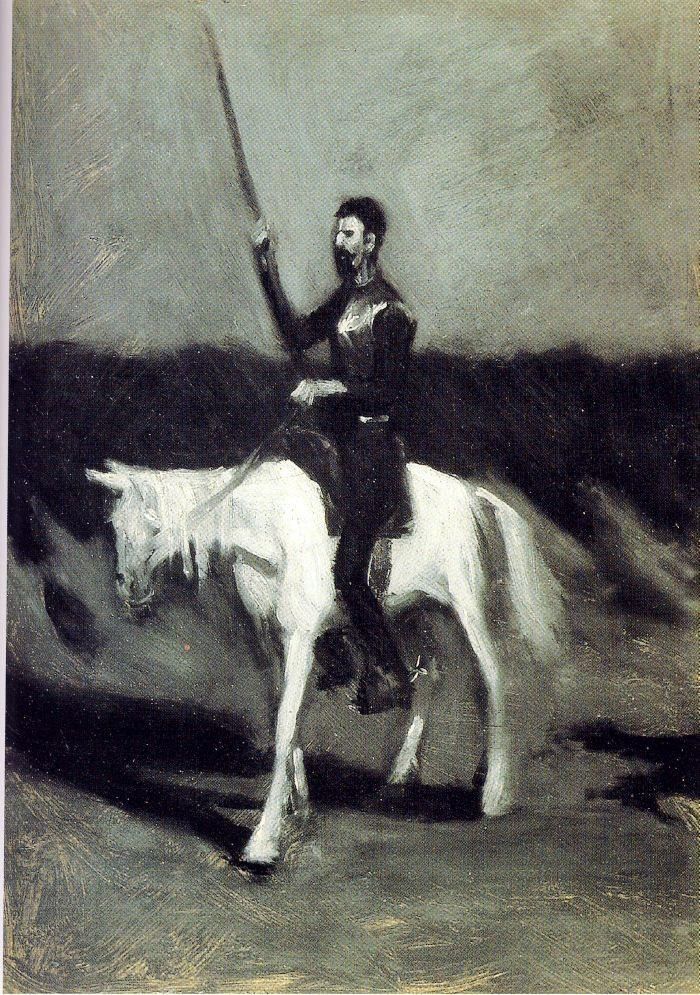
Don Quixote on Horseback — Edward Hopper

Don Quixote on Horseback

The O. Henry Prize Stories 2013 (Book Acquired, Sometime Last Week)

20130914-084712.jpg

Here are the table of contents for the 2013 O. Henry Prize Stories:

Your Duck Is My Duck, by DEBORAH EISENBERG
Sugarcane, by DEREK PALACIO
The Summer People, by KELLY LINK
Leaving Maverley, by ALICE MUNRO
White Carnations, by POLLY ROSENWAIKE
Sail, by TASH AW
Anecdotes, by ANN BEATTIE
Lay My Head, by L. ANNETTE BINDER
He Knew, by DONALD ANTRIM
The Visitor, by ASAKO SERIZAWA
Where Do You Go? by SAMAR FARAH FITZGERALD
Aphrodisiac, by RUTH PRAWER JHABVALA
Two Opinions, by JOAN SILBER
They Find the Drowned, by MELINDA MOUSTAKIS
The Mexican, by GEORGE MCCORMICK
Tiger, by NALINI JONES
Pérou, by LILY TUCK
Sinkhole, by JAMIE QUATRO
The History of Girls, by AYŞE PAPATYA BUCAK
The Particles, by ANDREA BARRETT

My favorite thing about the list is that I’ve only heard of a handful of the writers here. Read the introduction here.

Biblioklept’s Dictionary of Literary Terms

AFFECTIVE FALLACY

Avoid reading with emotions. Ignore any feelings you feel during reading—that’s not the point of literature.

BYRONIC HERO

Super-cool cool guy.

CANON

All the literature that’s fit to print. Declare it dead or meaningless or obsolete every few years. Revise as necessary.

DIARY

The private thoughts of an author, never intended for publication. Publish and disseminate widely after death.

ENLIGHTENMENT

A brief, optimistic mistake.

FRANKENSTEIN

Always point out that Frankenstein is the doctor’s name, not the monster’s. Argue that Percy Shelley’s edits were intrusive.

GOTHIC NOVEL

Wears black; smokes cloves.

HAIKU

A form of poetry grade school children are forced to write. Count the syllables.

INKHORN TERM

Linguistic aureation proliferated to adnichilate reader apperception.

JOUISSANCE

A nebulous, sticky French pun.

KITSCH

The sad process by which the consumerist trash capitalism necessitates colonizes an aesthetic perspective via defensive irony.

LIMERICK

The acme of excellence in poetry. Nantucket is a popular setting.

MEMOIR

A genre of literature often mistaken for truth by its audience.

NOVELLA

A novelist’s chance at perfection.

ORWELLIAN

A useful adjective. Misuse freely—especially if you only dimly recall the two or three things you ever read by George Orwell.

PHALLOGOCENTRISM

In the beginning there was the Word, and the Word was Phallus.

QUARTO

Bring up in any discussion of Shakespeare; watch the students’ eyes glaze over.

ROMAN A CLEF

A genre of literature often mistaken for fiction by its audience.

SOCRATIC IRONY

The tedious, drawn out process of questioning that Plato submits his characters to in order to get to his thesis.

THEME

A misunderstanding of the text in which all its words are distilled into a single cliché, guaranteeing that the text will not have to be reread.

UNCANNY

Pair with valley or X-Men.

VARIORUM

An annotated edition of a text with scholarly commentary intended to ruin any possible enjoyment on the reader’s part.

WELTANSCHAUUNG

A German word that students should use in term papers instead of “viewpoint” or “perspective.”

XANADU

Poorly received 1980 musical film about roller skating. Also the setting of a Coleridge poem.

YA

Abbreviation for “Young Adult,” a genre of books that people of all ages read and which serve as the basis for Hollywood film franchises.

ZARATHUSTRA

Dude who spake.
The Sunday Walk — Carl Spitzweg

Read Kazuo Ishiguro’s Subtle and Unsettling Story “A Village After Dark”

There was a time when I could travel England for weeks on end and remain at my sharpest—when, if anything, the travelling gave me an edge. But now that I am older I become disoriented more easily. So it was that on arriving at the village just after dark I failed to find my bearings at all. I could hardly believe I was in the same village in which not so long ago I had lived and come to exercise such influence.

There was nothing I recognized, and I found myself walking forever around twisting, badly lit streets hemmed in on both sides by the little stone cottages characteristic of the area. The streets often became so narrow I could make no progress without my bag or my elbow scraping one rough wall or another. I persevered nevertheless, stumbling around in the darkness in the hope of coming upon the village square—where I could at least orient myself—or else of encountering one of the villagers. When after a while I had done neither, a weariness came over me, and I decided my best course was just to choose a cottage at random, knock on the door, and hope it would be opened by someone who remembered me.

I stopped by a particularly rickety-looking door, whose upper beam was so low that I could see I would have to crouch right down to enter. A dim light was leaking out around the door’s edges, and I could hear voices and laughter. I knocked loudly to insure that the occupants would hear me over their talk. But just then someone behind me said, “Hello.”

Read the rest of Kazuo Ishiguro’s story “A Village After Dark” at The New Yorker; you can also hear Ben Marcus read and discuss the story on The New Yorker’s fiction podcast.


Woman with a Newspaper — Richard Diebenkorn