My God, My God, Why Hast Thou Forsaken Me? — Shinji Aoyama (Full Film)

Trompe l’oeil: A Cabinet in the Artist’s Studio — Cornelis Norbertus Gysbrechts

Obscenity as a technical device (Henry Miller)

20140721-162338-59018771.jpg

From “Obscenity and the Law of Reflection,” collected in Henry Miller on Writing.

World Destroyed by Water — Gustave Doré

Four Notes from Nathaniel Hawthorne’s Note-Books

  1. Punishment of a miser,–to pay the drafts of his heir in his tomb.
  2. A series of strange, mysterious, dreadful events to occur, wholly destructive of a person’s happiness. He to impute them to various persons and causes, but ultimately finds that he is himself the sole agent. Moral, that our welfare depends on ourselves.
  3. The strange incident in the court of Charles IX. of France: he and five other maskers being attired in coats of linen covered with pitch and bestuck with flax to represent hairy savages. They entered the hall dancing, the five being fastened together, and the king in front. By accident the five were set on fire with a torch. Two were burned to death on the spot, two afterwards died; one fled to the buttery, and jumped into a vessel of water. It might be represented as the fate of a squad of dissolute men.
  4. A perception, for a moment, of one’s eventual and moral self, as if it were another person,–the observant faculty being separated, and looking intently at the qualities of the character. There is a surprise when this happens,–this getting out of one’s self,–and then the observer sees how queer a fellow he is.

From Nathaniel Hawthorne’s American Note-Books.

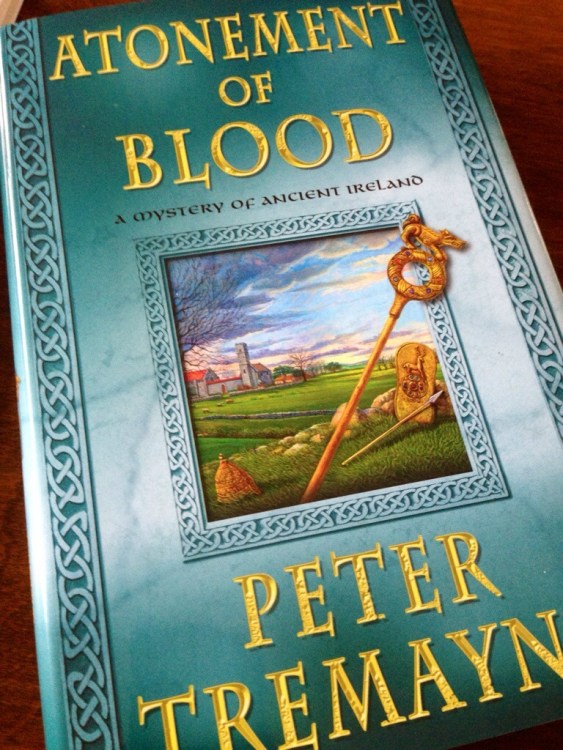
Atonement of Blood (Book Acquired, Sometime in Early July, 2014)

20140707-150321-54201189.jpg

Atonement of Blood is historical mystery fiction by Peter Tremayne. Publisher’s blurb:

Winter, 670 AD. King Colgú has invited the leading nobles and chieftains of his kingdom to a feast day. Fidelma and her companion Eadulf are finally home for an extended stay, and have promised their son, Alchú, that they’ll be able to spend some time together after months of being on the road, investigating crimes. Fidelma and Eadulf are enjoying the feast when it is interrupted by the entrance of a religieux, who claims he has an important message for the King. He approaches the throne and shouts ‘Remember Liamuin!’ and then stabs King Colgú. The assassin is slain, but does enough damage to take out Colgú’s bodyguard, and to put the king himself on the verge of death.

As King Colgú lies in recovery, Fidelma, Eadulf, and bodyguard Gormán are tasked with discovering who is behind the assassination attempt, and who Liamuin is. They must journey into the territory of their arch-enemies, the Uí Fidgente, to uncover the secrets in the Abbey of Mungairit, and then venture into the threatening mountain territory ruled by a godless tyrant. Danger and violence are their constant companions until the final devastating revelation.

Night Stories — Sally Storch

storch