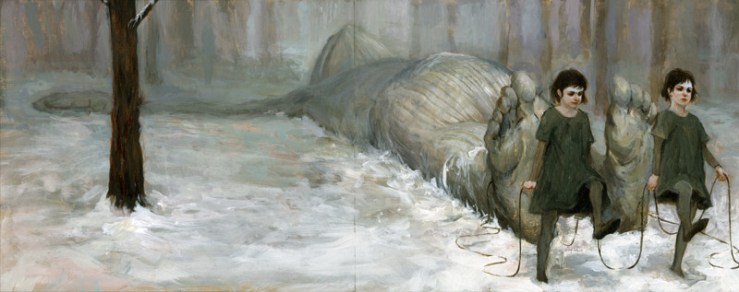
The Whalers — Vincent Hui

whaler1

A last desperate attempt to convince us of the innocence of violence, the good clean fun of horror

The enemy of society on the run toward “freedom” is also the pariah in flight from his guilt, the guilt of that very flight; and new phantoms arise to haunt him at every step. American literature likes to pretend, of course, that its bugaboos are all finally jokes: the headless horseman a hoax, every manifestation of the supernatural capable of rational explanation on the last page—but we are never quite convinced. Huckleberry Finn, that euphoric boys’ book, begins with its protagonist holding off at gun point his father driven half mad by the D.T.’s and ends (after a lynching, a disinterment, and a series of violent deaths relieved by such humorous incidents as soaking a dog in kerosene and setting him on fire) with the revelation of that father’s sordid death. Nothing is spared; Pap, horrible enough in life, is found murdered brutally, abandoned to float down the river in a decaying house scrawled with obscenities. But it is all “humor,” of course, a last desperate attempt to convince us of the innocence of violence, the good clean fun of horror. Our literature as a whole at times seems a chamber of horrors disguised as an amusement park “fun house,” where we pay to play at terror, and are confronted in the innermost chamber with a series of inter-reflecting mirrors which present us with a thousand versions of our own face.

From the introduction to Leslie Fiedler’s Love and Death in the American Novel (1960).

Virgin and Child with a Monkey — Albrecht Dürer

RISDM 49-001

Leisure Hours – John Everett Millais

He saw (Cormac McCarthy’s Suttree)

The fire had died in the room, the candles burned to pools of grease in their dishes. Suttree saw with perfect clarity a parade he’d watched through the legs of the crowd like a thing that passed in a forest, the floats of colored crepe and the band with its drum and horns and the polished wine broadcloth and gold braid and the majordomo in a stained shako wielding a baton and prancing and farting like a brewery horse. He saw what had been so how a caravan of pennanted cars wound through the rain on a dark day and how Clayton in corduroy knickers and aviator’s cap marched with his sisters in a high ceilinged room where the paneled doors were drawn and a nurse in a white uniform called closeorder drill and tapped out the time with a cane and he could remember the stamped brass grapes of an umbrella stand cool and metallic under his tongue and he knew that in that house some soul lay dying.

He saw a pool of oil on a steel drumhead that lay shirred with the pounding of machinery. He saw the blood in his eyelids where he lay in a field in a summer noon and he saw young boys in a pond, pale nates and small bald cods shriveled with the cold and he saw an idiot in a yard in a leather harness chained to a clothesline and it leaned and swayed drooling and looked out upon the alley with eyes that fed the most rudimentary brain and yet seemed possessed of news in the universe denied right forms, like perhaps the eyes of squid whose simian depths seem to harbor with his elbows cocked high as his ears to rest on the dark oak chairarms. He saw a small boy in a schoolyard with a broken arm screaming and how the children watched like animals.

He saw shellfish crusted on the spiles of a wooden bridge and a salt river that ran two ways. Buoybells on a reef where the bones of a schooner broke the shallow surf on the out tide and the sound of the parlous and marbled sea and the seethe of spume and the long clatter of pebbles in the foam. He saw ajar in a garden with mousebones and lint and old sash weights stacked like ingots under a woodshed and the mortised shape of a wagonhub, spokestripped, weatherbleached, oaken, arcane. He saw a dead poodle in a street like a toy dog with its red collar and flannel tongue.

He saw what was so how his sisters came down the steps in their black patentleather shoes and he rode in the car with his mouth on the molding of the rear window and how the cold metal tasted of salt and hummed against his lips and he remembered the attar of rose and candlewax and the facets of a glass doorknob cold and smooth on his tongue.

And he saw old bottles and jars in a row on a board propped up with bricks in a field of sedge and the mixtures of mud and diced weeds within and round white pebbles wherein lay basilisks incubating and secret paths through the sedge and a little clearing with broken bricks, an old limecrusted mortarbox, dry white dogturds. He saw a mooncalf dead in a wet road you could see through it, you could see its bones where it lay pale and blue and naked with eyes as barren as lightbulbs.

And he saw what had been how that old lady who had sat in the stained and cracked photograph like a fierce bird lay cold in state, white satin tucked or quilted and the parched claws that came out of the black stuff of her burial dress looked like the bony hands of some grimmer being crossed at her throat. Black lacquer bier trestled up in a drafty hall and how the rain swung from the rims of the pallbearers’ hats.

A late trip sequence in Cormac McCarthy’s Suttree.

There’s a soul, or


Still from Hard to Be a God (2013). Directed by Aleksey German. Cinematography by Vladimir Ilin and Yuriy Klimenk.

Three Books

image

Love and Death in the American Novel by Leslie A. Fiedler. First edition hardback published by Criterion in 1960. Cover design by Sidney Feinberg. I was dismayed when I first found Fiedler—he’d arrived at his thesis—and supported it with a big fat book—decades before me. I was hipped to this by a kindly professor in graduate school, who suggested I read and then credit Fiedler. I pulled this book out to help me in an American lit course I’m teaching this fall.

IMG_8254

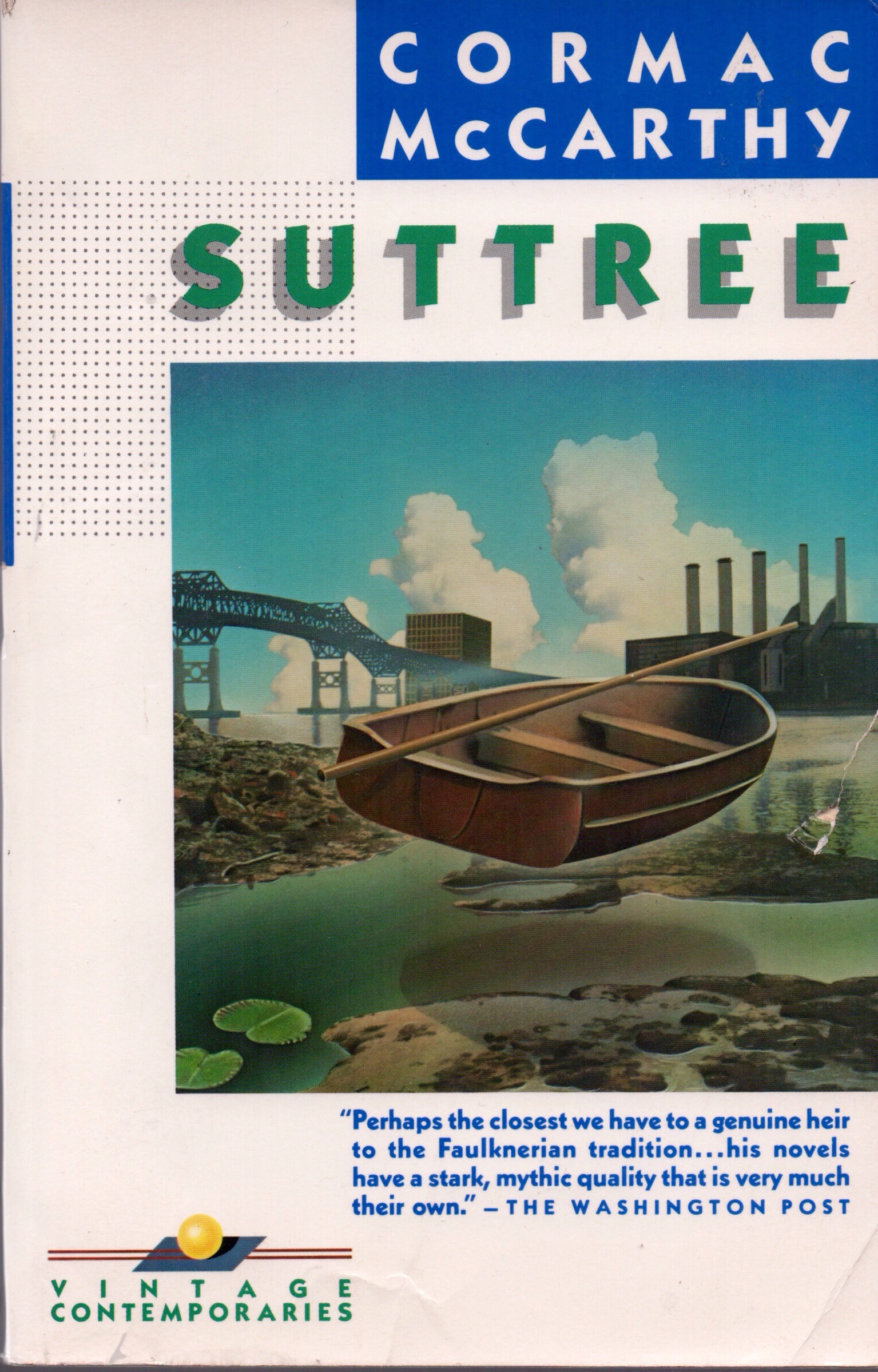
Suttree by Cormac McCarthy. First edition trade paperback published by Vintage Contemporaries. Cover design by Lorraine Louie; cover photo illustration by Marc Tauss. I’ve already written about my love of Vintage Contemporaries covers, and finding this copy of Suttree a few years ago was glorious. I’ve been rereading the novel—auditing it, really, through a superb reading by Michael Kramer. I’ve had this edition out as I go. Suttree, by the way, fits nicely neatly perfectly into Fielder’s thesis about American lit.
IMG_8300

Grooks by Piet Hein. Cute little pocket-sized paperback. Second-edition published by the M.I.T. Press. Cover illustration is by Hein; I can’t find a credit for the designer. I found this in the bookstore the other day when I was looking for something else in the poetry section. Hein’s grooks can be clever, but also occasionally a bit too pithy, if that makes sense. Still.

Summer Fires — Natalia Smirnova

7859230678_e0fdcfb99f_o

Micro Aggression — Beeple

tumblr_nujqp3i5la1r20fq5o1_1280

Woman with Moth — Michael Sowa

Typical male protagonist

The figure of Rip Van Winkle presides over the birth of the American imagination; and it is fitting that our first successful homegrown legend should memorialize, however playfully, the flight of the dreamer from the shrew—into the mountains and out of time, away from the drab duties of home and town toward the good companions and the magic keg of beer. Ever since, the typical male protagonist of our fiction has been a man on the run, harried into the forest and out to sea, down the river or into combat—anywhere to avoid “civilization,” which is to say, the confrontation of a man and a woman which leads to the fall to sex, marriage, and responsibility. One of the factors that determine theme and form in our great books is the strategy of evasion, this retreat to nature and childhood which makes our literature (and life!) so charmingly and infuriatingly “boyish.”

From the introduction of Leslie Fiedler’s Love and Death in the American Novel.

Leshy 1 & 2 — Zachari Logan

zachari8zlogan_leshy2

Sleeping Boy — Odd Nerdrum

tumblr_m4hbgli4AN1qzw5wjo1_540

Crab — Vincent van Gogh

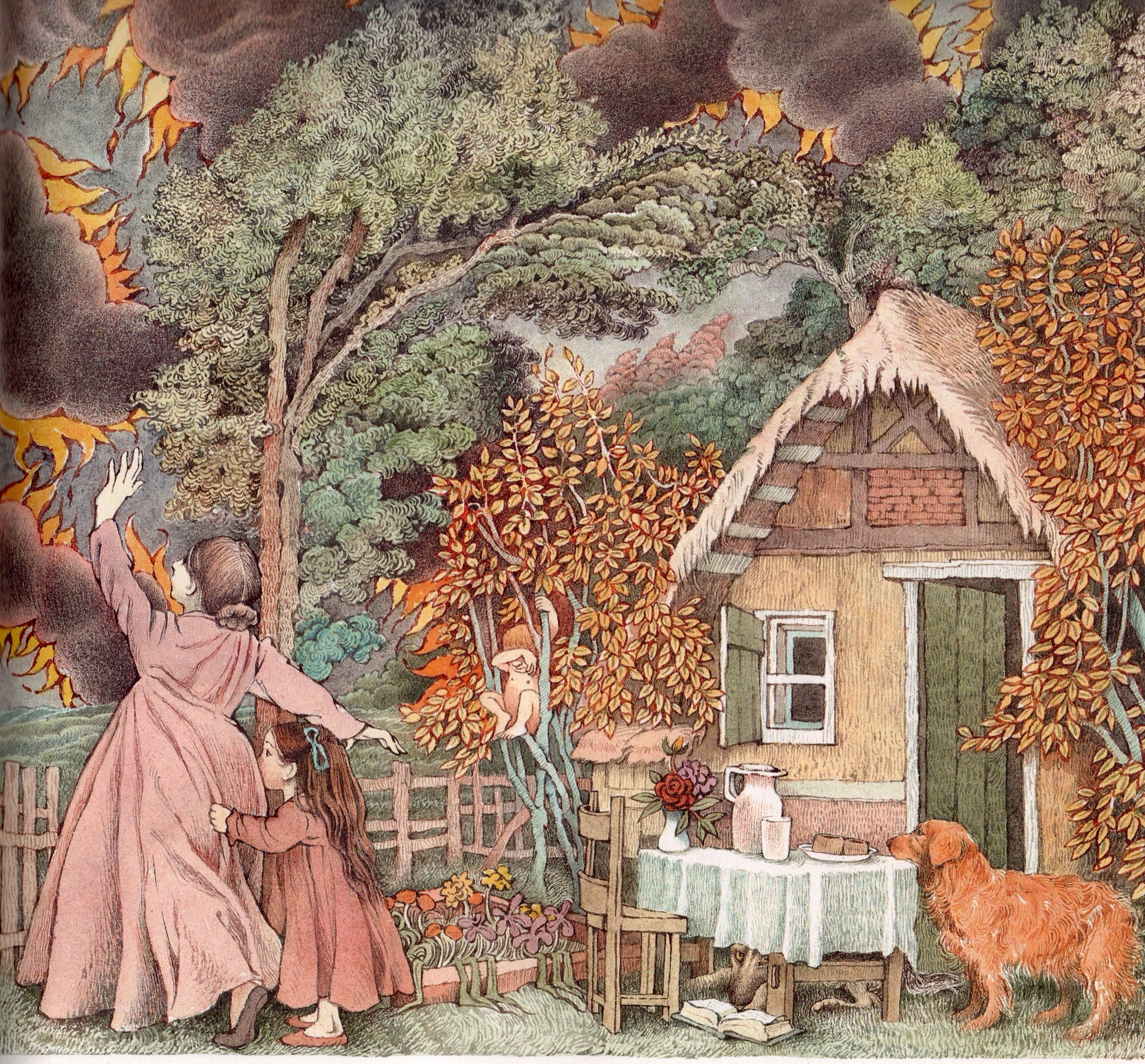
What a Fearful Storm Is Coming — Maurice Sendak

image

From Maurice Sendak’s retelling of Wilhelm Grimm’s Dear Mili.

Nathaniel Hawthorne’s September 11th, 1852 journal entry

September 11th.–The wind shifted and veered about, towards the close of yesterday, and later it was almost calm, after blowing gently from the northwest,–notwithstanding which it rained. There being a mistiness in the air, we could see the gleam of the light-house upon the mist above it, although thelight-house itself was hidden by the highest point of this island, or by our being in a valley. As we sat under the piazza in the evening, we saw the light from on board some vessel move slowly through the distant obscurity,–so slowly that we were only sensible of its progress by forgetting it and looking again. The plash and murmur of the waves around the island were soothingly audible. It was not unpleasantly cold, and Mr. Laighton, Mr. Thaxter, and myself sat under the piazza till long after dark; the former at a little distance, occasionally smoking his pipe, and Mr. Thaxter and I talking about poets and the stage. The latter is an odd subject to be discussed in this stern and wild scene, which has precisely the same characteristics now as two hundred years ago. The mosquitoes were very abundant last night, and they are certainly hardier race than their inland brethren.

This morning there is a sullen sky, with scarcely any breeze. The clouds throw shadows of varied darkness upon the sea. I know not which way the wind is; but the aspect of things seems to portend a calm drizzle as much as anything else.

About eleven o’clock, Mr. Thaxter took me over to Smutty Nose in his dory. A sloop from the eastward, laden with laths, bark, and other lumber, and a few barrels of mackerel, filled yesterday, and was left by her skipper and crew. All the morning we have seen boats picking up her deck-load, which was scattered over the sea, and along the shores of the islands. The skipper and his three men got into Smutty Nose in the boat; and the sloop was afterwards boarded by the Smutty Noses and brought into that island. We saw her lying at the pier,–a black, ugly, rotten old thing, with the water half-way over her decks. The wonderwas, how she swam so long. The skipper, a man of about thirty-five or forty, in a blue pilot-cloth overcoat, and a rusty, high-crowned hat jammed down over his brow, looked very forlorn; while the islanders were grouped about, indolently enjoying the matter.

I walked with Mr. Thaxter over the island, and saw first the graves of the Spaniards. They were wrecked on this island a hundred years ago, and lie buried in a range about thirty feet in length, to the number of sixteen, with rough, moss-grown pieces of granite on each side of this common grave. Near this spot, yet somewhat removed, so as not to be confounded with it, are other individual graves, chiefly of the Haley family, who were once possessors of the island. These have slate gravestones. There is also, within a small enclosure of rough pine boards, a white marble gravestone, in memory of a young man named Bekker, son of the person who now keeps the hotel on Smutty Nose. He was buried, Mr. Thaxter says, notwithstanding his marble monument, in a rude pine box, which he himself helped to make.

We walked to the farthest point of the island, and I have never seen a more dismal place than it was on this sunless and east-windy day, being the farthest point out into the melancholy sea which was in no very agreeable mood, and roared sullenly against the wilderness of rocks. One mass of rock, more than twelve feet square, was thrown up out of the sea in a storm, not many years since, and now lies athwart-wise, never to be moved unless another omnipotent wave shall give it another toss. On shore, such a rock would be a landmark for centuries. It is inconceivable how a sufficient mass of water could bebrought to bear on this ponderous mass; but, not improbably, all the fragments piled upon one another round these islands have thus been flung to and fro at one time or another.

There is considerable land that would serve tolerably for pasture on Smutty Nose, and here and there a little enclosure of richer grass, built round with a strong stone-wall. The same kind of enclosure is prevalent on Star Island,–each small proprietor fencing off his little bit of tillage or grass. Wild-flowers are abundant and various on these islands; the bayberry-bush is plentiful on Smutty Nose, and makes the hand that crushes it fragrant.

The hotel is kept by a Prussian, an old soldier, who fought at the Battle of Waterloo. We saw him in the barn,–a gray, heavy, round-skulled old fellow, troubled with deafness. The skipper of the wrecked sloop had, apparently, just been taking a drop of comfort, but still seemed downcast. He took passage in a fishing-vessel, the Wave, of Kittery, for Portsmouth; and I know not why, but there was something that made me smile in his grim and gloomy look, his rusty, jammed hat, his rough and grisly beard, and in his mode of chewing tobacco, with much action of the jaws, getting out the juice as largely as possible, as men always do when disturbed in mind. I looked at him earnestly, and was conscious of something that marked him out from among the careless islanders around him. Being as much discomposed as it was possible for him to be, his feelings individualized the man and magnetized the observer. When he got aboard the fishing-vessel, he seemed not entirely at his ease, being accustomed to command and work amongst his own little crew, and now having nothingto do. Nevertheless, unconsciously perhaps, he lent a hand to whatever was going on, and yet had a kind of strangeness about him. As the Wave set sail, we were just starting in our dory, and a young fellow, an acquaintance of Mr. Thaxter, proposed to take us in tow; so we were dragged along at her stern very rapidly, and with a whitening wake, until we came off Hog Island. Then the dory was cast loose, and Mr. Thaxter rowed ashore against a head sea.

The day is still overcast, and the wind is from the eastward; but it does not increase, and the sun appears occasionally on the point of shining out. A boat–the Fanny, I suppose, from Portsmouth–has just come to her moorings in front of the hotel. A sail-boat has put off from her, with a passenger in the stern. Pray God she bring me a letter with good news from home; for I begin to feel as if I had been long enough away.

There is a bowling-alley on Smutty Nose, at which some of the Star-Islanders were playing, when we were there. I saw only two dwelling-houses besides the hotel. Connected with Smutty Nose, by a stone-wall there is another little bit of island, called Malaga. Both are the property of Mr. Laighton.

Mr. Laighton says that the Spanish wreck occurred forty-seven years ago, instead of a hundred. Some of the dead bodies were found on Malaga, others on various parts of the next island. One or two had crept to a stone-wall that traverses Smutty Nose, but were unable to get over it. One was found among the bushes the next summer. Mr. Haley had been buried at his own expense.

The skipper of the wrecked sloop, yesterday, was unwilling to go to Portsmouth until he was shaved,–his beard being of several days’ growth. It seems to be the impulse of people under misfortune to put on their best clothes, and attend to the decencies of life.

The Fanny brought a passenger,–a thin, stiff, black-haired young man, who enters his name as Mr. Tufts, from Charlestown. He, and a country trader, his wife, sister, and two children (all of whom have been here several days), are now the only guests besides myself.

Nathaniel Hawthorne’s September 11th, 1852 journal entry. From Passages from the American Note-Books.

Posted in Art

Grey Line With Black, Blue And Yellow — Georgia O’Keeffe